Asymco

Asymmetric Intelligence

smartphone

  1. Smartphone impressions triple in a year

    Research

    link: Smartphone traffic is up 193% in a year - Apple 2.0 - Fortune Brainstorm Tech

    What is important to observe is not the share numbers in the link above but the absolute growth and trend.

    Doing a bit of algebra from the data Admob provided we can calculate that:

    1. The overall traffic admob handled was 14.1b up from 6.6b a year ago. (114% growth)
    2. Smartphones generated 6.78b impressions in February, up from 2.3b a year ago. (193% growth). The iPhone OS generated 3.4b impressions.
    3. Feature phones generated 4.9b, up from 3.5b (43% growth)

    Although it's dangerous to equate "usage" to these impression numbers, the overall trend is that most of the growth is happening on smartphones. Of those, the iPhone OS and Android are taking 75% share of eyeballs, at least on Admob's network.

    The iPhone platform generated as many impressions in February as all feature phones generated a year ago. It does not seem a stretch to predict that iPhone will overtake all feature phones in overall impressions in the near future.

  2. Could the iPad become Apple's most popular product?

    Research

    There were an estimated 228 million U.S. Web users in 2009, so if Apple was able to sell iPads to only one-third of those it would mean domestic sales of 76 million units.

    Link: San Jose Business Journal

    More interesting stats from Business Pulse survey by the Silicon Valley/San Jose Business Journal that was conducted between March 16 and March 23:

    • 9% plan to buy right away
    • 23% said they expect to buy but can wait (total of 32% plan on purchase)

    Additional survey data from comScore:

    • 65% awareness
    • 1% of those aware already ordered the iPad
    • 15% of those aware plan to buy within 3 months

    Another from Sybase and conducted by Zogby International surveyed 2,443 adults with a mobile phone, 770 of which own smartphones. Among the smartphone-owning respondents, more than half -- 52.3 percent -- said they are most likely to use a tablet device like the iPad to do work

    AppleInsider | No. 1 planned use for Apple iPad: working on the go.

  3. Analyst: App Market to Reach $15.xx Billion by 2013

    Research

    An upswing in the market share of “smart” devices, along with an increase in application focus from OEMs, OS developers and mobile network operators will drive yearly app revenues from US$1.94 billion (2009) to US$15.65 billion in only four years, according to our most recent research findings. The application market’s growth is driven by the widespread push of advanced handset capabilities by the mobile industry and the increasingly-connected global consumer base. This trend will continue, seeing global smartphone users numbering 970 million by the end of 2013.

    link: SMARTPHONE APPLICATION MARKET TO REACH US$15.65 BILLION IN 2013 | research2guidance

    Nice numbers. Too bad they blew their credibility by showing too many significant digits in their estimate. How can they state with a straight face that the market could reach $15.65 billion without some hint of a potential margin of error?

  4. Palm's Forecast

    Research

    full-year revenue would be "well below" its previous target of $1.6 billion to $1.8 billion. Wall Street was expecting $1.6 billion

    If we assume $1 billion/yr. revenues, that works out to about 3 million smartphones a year out of a market that Gartner just forecast to be 215 million this year. That gives Palm just 1.4% share of smartphones.

    The WebOS is a fine piece of code, but one has to understand that success in this business is not just doing something right. You have to do everything right:

    • Nokia has great distribution and logistics, not so good software or platform story
    • Palm has great software, not so good distribution or platform
    • RIM has great distribution and service, not so great software
    • Android has good software but not great integration of solution
    • Apple's software and platform are great, but distribution is still weak
    • Microsoft has nothing good at all

    The question of acquisition invariably comes up. The obvious answer would be to pair Palm with somebody who needs what they have and who has what they don't. Unfortunately no perfect fit arises.

    UPDATE 3-Palm cuts revenue view on weak phone sales | Reuters

  5. HP continues to say that it is serious about smartphones

    Research

    The consequences of licensing a mobile OS:

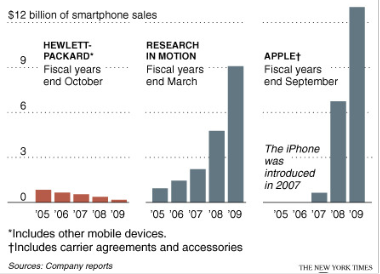
    Sales of H.P.’s hand-held products, including its iPaq smartphone, dropped to $25 million in the quarter, down from $57 million in the same period last year. Apple, by contrast, had sales of $5.6 billion for iPhones and related products during its most recent quarter.

    To put it in more perspective, $25 million at an ASP of $350 a phone means HP sold about 70k phones last quarter, or what Apple sold every 17 hours.

    link: Hewlett-Packard, a Technology Powerhouse, Stumbles in Smartphones - NYTimes.com

  6. Microsoft's standardised handsets will win the day, says Gartner

    Research

    Symbian will lose smartphone battle By Rob Jones at Gartner Symposium ITxpo, Cannes [07-11-2003] Microsoft's standardised handsets will win the day, says Gartner

    Analyst Gartner has warned that, without a concerted effort by Symbian and its backers, Microsoft will sweep them aside in the smartphone business.

    Redmond's ability to offer standardised handsets which are easier for businesses to support and use will help the software giant win corporate approval, the market watcher predicted.

    The analyst predicted that Microsoft will ship a phone boasting strong integration of a range of packages, such as Exchange and Outlook.

    Symbian, he added, needed to resolve a number of issues to be a credible, corporate alternative. Its platform and menus differ slightly on various handsets, which means that they often do not have the same user interface.

    So spoke Nick Jones, vice president and research fellow at Gartner in 2003.

  7. Windows Mobile renamed Windows Phone Classic

    Research · 1 comment

    The mobile operating system formerly known as “Pocket PC 2000/2002, Pocket PC 2000/2002 Phone Edition, Smartphone 2002, Windows Mobile (2003/5.0) for Pocket PC, Windows Mobile (2003/SE/5.0) for Pocket PC Phone Edition, Windows Mobile (2003/SE/5.0) for Smartphone, Windows Mobile 6[.1/.5] Professional/Classic/Standard” will now be known as Windows Phone Classic.

    The last “Classic” nomenclature lasted from Windows Mobile 6 Classic to Windows Mobile 6.1 Classic and denoted the OS for Microsoft’s PDAs. It disappeared after version 6.5.

    Windows Phone Classic will co-exist with Windows Phone 7 Series.

    Simple.

  8. Blackberry Users Consume One Fifth the Data of iPhone Users

    Research · 1 comment

    As mentioned before, Blackberries should not be thought of as smartphones.

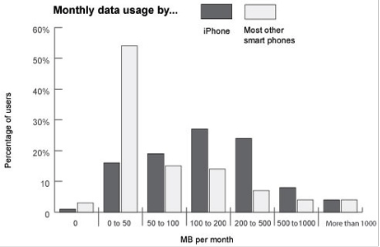
    Consumer Reports announced this week the results of a study it commissioned assessing the monthly data usage for customers of Apple's iPhone and other smartphones. The data reveals:

    On average, iPhone users consume 273 MBs of data per month. That compares with 54 MBs for consumer users of Blackberrys and 150 MBs for consumers who use other brands of smart phones, the Validas study found.

    The disparity in data usage is particularly evident at low levels, where 80% of BlackBerry and 54% of "other" smartphone users consume less than 50 MB of data per month while only less than 20% of iPhone users maintain such low usage.

    As I argued in the past, Blackberries should be considered feature phones. Doing so helps to understand both their limitations and their potential.

    This categorization helps put into perspective the phenomenal growth RIM is able to maintain while not being at all competitive with other platforms by any measure of performance that defines the basis of competition in smartphones.

    Being a feature phone means the Blackberry just needs to be better than a dumb phone, something it’s more than able to demonstrate to a prospective buyer.

  9. One Million Americans Switching to Smartphones Every Month

    Research · 2 comments

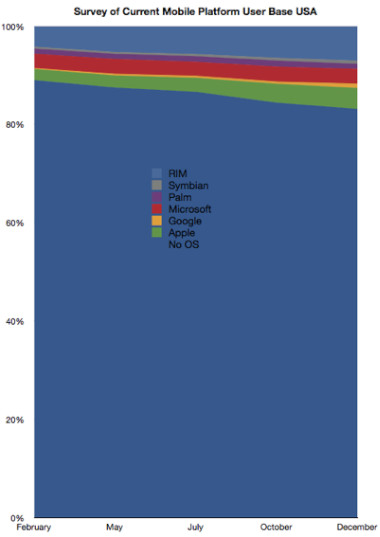
    Comscore revealed their latest survey resultsfor the US mobile subscriber market. From the latest data and the data previously released in October we can put together a few insights.

    The number of smartphone users increased by 3.2 million, growing at over 1 million new users per month.

    Apple and Android added about 1 million users each. RIM added 1.4 million with Symbian adding about 200k users. Palm lost 441k users and Microsoft lost about 44k users.

    Non-smartphones lost 2.1 million users and 1 million subscribers were added to the top line.

    The non-smartphones lost 1% share in the quarter and 6% since February. Smartphones make up 17% of all users.

    Google has overtaken Symbian to rise from last place in the platform installed base and is closing on Palm.

    At 5% share erosion per year, the non-smartphone market will completely disappear in about 14 years, though I feel 10 years is a more likely target with 5 years until the market is 50% penetrated.

  10. HTC: Hard to Compete

    Research

    HTC is the world’s fourth largest smartphone company. It ships 80% of all Windows Mobile and probably a similar proportion of Android devices. Like Microsoft in 2003, Google turned to HTC for its first smartphone, the G1 and its latest, the co-branded Nexus One. The company shipped a total of 11.7 million mobile phones in 2009.

    It would appear that HTC is very well positioned in what amounts to be the best industry in technology.

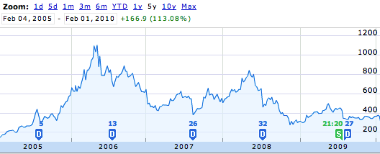
    However, not all is well. A few days ago HTC issued revenue guidance below analyst estimates and its stock price is at 2005 levels, 70% off its peak (see graph--source: Google finance).

    Part of this could be explained by its continuing reliance on Windows Mobile which is fading fast, but also it’s because, as management acknowledged, there is significant price pressure.

    HTC prides itself with having a “premier” product with typically high-end feature sets and positioning. HTC invested in its own UI to differentiate its products and has mounted a branding campaign to move away from being a white-label ODM.

    It seems all for nought. The rules of the smartphone market do not favor modular component players. As HTC does not front its own OS, it still struggles to stand out in the eyes of the consumer.

    Looking at the list of top 3 vendors: Nokia, RIM and Apple, we see hardware companies that field an integrated OS/service bundle.

    It’s hard to compete against this.