Asymco

Asymmetric Intelligence

Windows

  1. The Composition of Active Devices
    Research · 8 comments

    Measuring the future

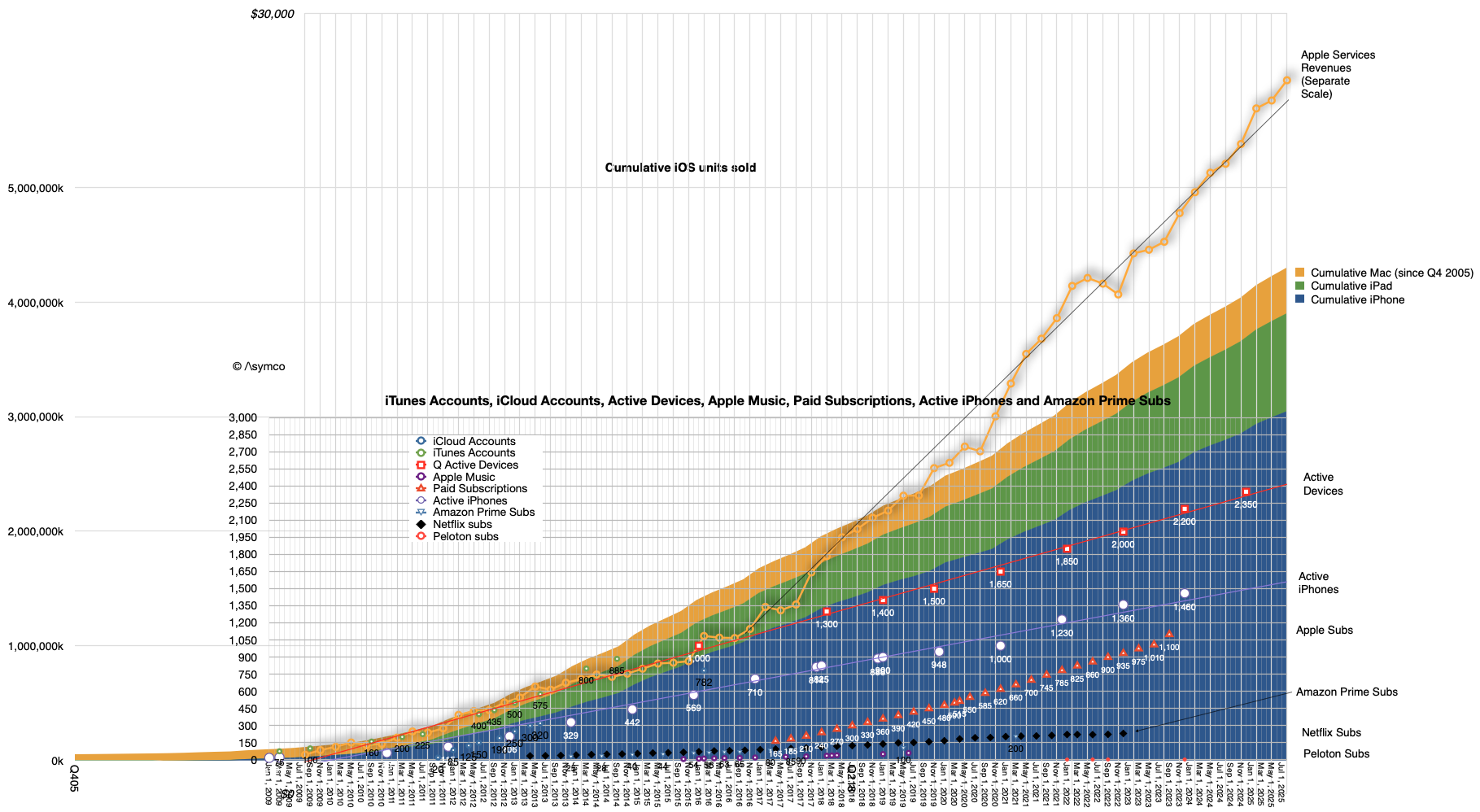
    In January this year Apple reported that there were 2.5 billion active Apple devices in use. This figure has been getting updated for years and I've been reporting its trajectory and other measures that are correlated to it. For instance the number of Apple subscriptions, Apple Services revenues and other historical indicators such as iCloud accounts and Apple Music.

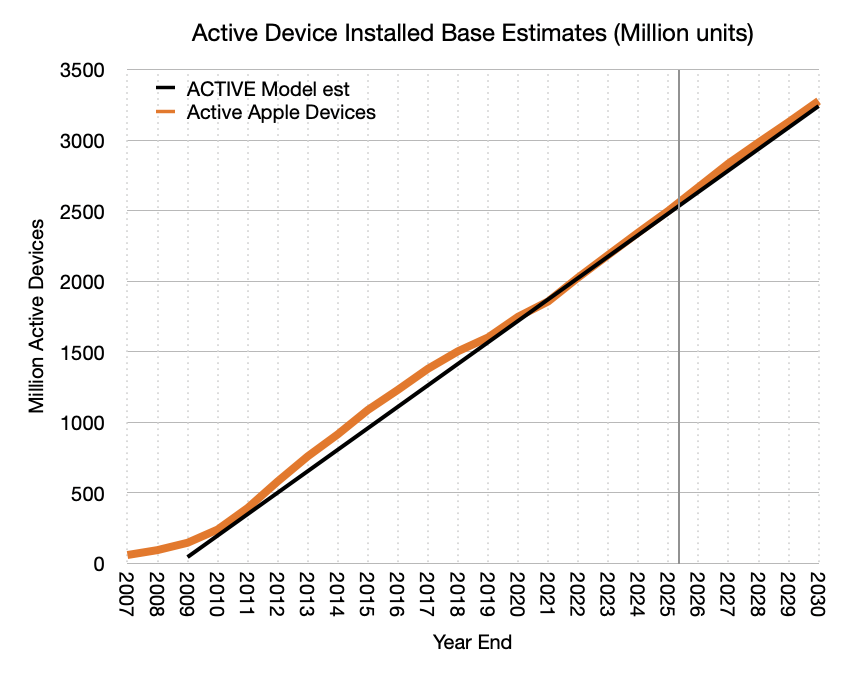
    Simplifying, I published the "ACTIVE" model which makes some basic projections of this total device count and it's shown below"
    One element of the analysis that has eluded me was the more precise composition of this total "devices". In other words, which devices and what is their mix. We have seen numbers for iPhones but not for other types of devices. I should note that this is not easily derived because we have neither the units sold (only revenues) and we don't know how long they stay in use. The measure of active population implies that the products are bought, used and eventually retired.

    The only clue we have, beside quarterly revenues--and even there wearables and home are not separated by product--is that management occasionally mentions that "more than half" of buyers of a specific product are "new to the product". It's not much to go on.

    But there are other data sets we can tap. StatCounter provides a share of platforms in use by aggregating browser identifying data for a moderately large set of web sites. That may help with share of base but not with how much the total base is. Various other analysts do try to summarize some of the installed base for particular dates.

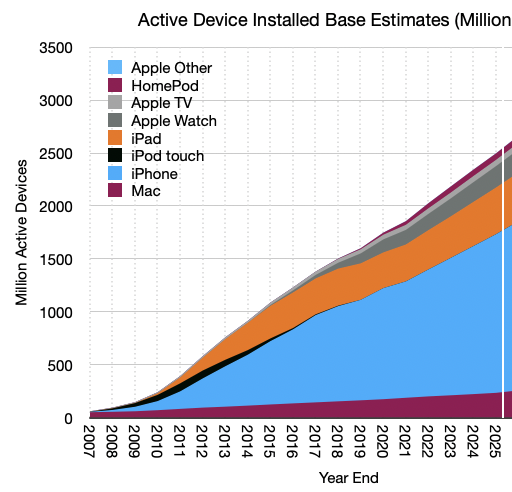
    Combining all the available data and some interpolation, I set out to do is to provide a yearly count of the population of Apple devices for each year since 2007. Then to try to forecast this population to 2030. The result is shown below:

    The following is a summary for the components for the end of 2025 in millions:

    Year-endMaciPhoneiPadWatchApple TVHomePodOther
    2025233150044220358.561.750.5

    This history looks like this:

    What about the future? Let's dig in.


    This is a future five years away. Is this growth rate and consistency in mix a reasonable assumption?

    To answer, we should zoom out and look at not just Apple's device base. The following graph shows also Android phones and tablets, Windows, Linux (PC) and Game Consoles.[1] It contrasts mobile and "non-mobile" computing and shows the total global population (blue line).
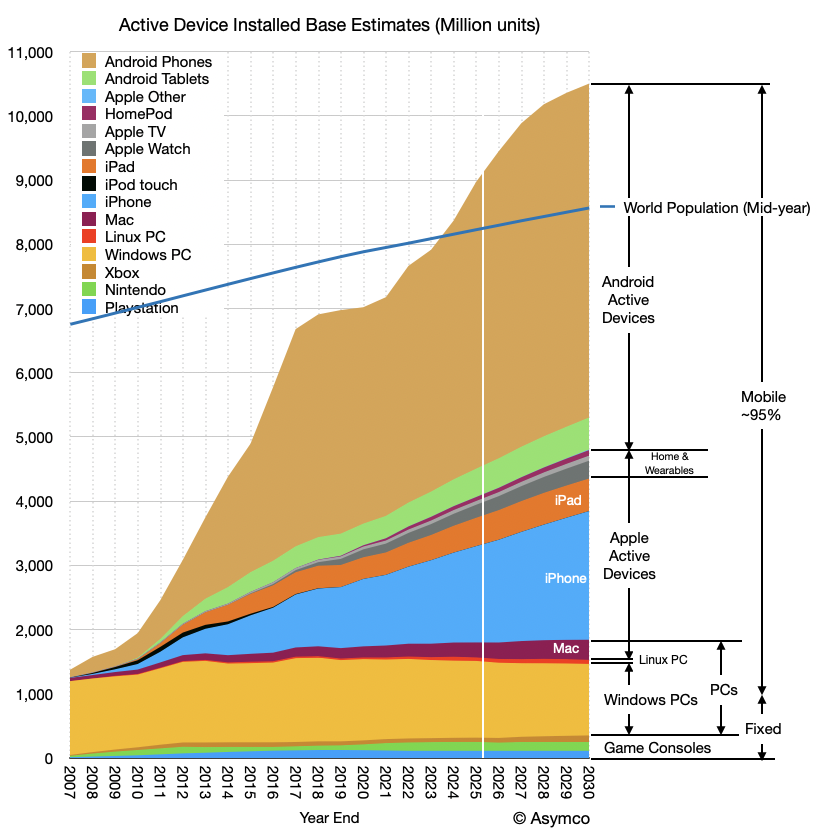
    I have several observations:

    • The total device population now exceeds the total human population. The total number of phone lines was already higher for some time[2] but what are shown here are "computers" insofar as they have CPUs and operating systems that can run third-party apps.
    • Given the device count exceeds human count, how much higher can this total go? The forecast shows a slowing of growth within the next five years but this is not a certainty. The attach rate of devices/person could well exceed 1.2 to 1.3 and go to levels seen in wealthy countries (above 2.) If that is the case then the device total may exceed 16 billion at saturation. This has implications for how far current strategies and business models can run.
    • The composition of device types is fairly constant and form factor substitution is rare. New categories beyond phones and current wearables are hard to anticipate but even if they emerge, the evidence suggests they are additive. Evidently the phone did not so much displace the PC but build on top of it. The potential for wearables and home devices to explode is there but it's hard to image these stealing "share of pocket" any more than phones stole "share of desk or share of backpack". If they do explode, they will add to the total via higher attach rates. 3x human population (24 billion) is possible with new wearables and home[3].
    • AI holds many promises but how AI is accessed is not necessarily requiring of or benefiting from new device types. The smartphone is still the best AI device imaginable[4]. Ambient or passive computing can be provided by existing wearables but, as the graph shows, these are augmentative to phones. If AI introduces a completely new form factor, the impact will take decades to diffuse. As the graph shows, the mobile era is now approaching 20 years with the next five years foreseeable with some confidence. The next 15 years will be discussed in a future post.
    • Android typically captures non-consumers who eventually churn into Apple devices. This means that as long as non-consumption exists, Android grows and as long as Android exists Apple grows. If and when Android growth stops then the dynamics will change and Apple might change strategy to accelerate churn.[5]
    • Google and Apple will be the primary distributors for all software and services into the foreseeable future. Try as they might, challengers face over 9 billion in installed base. Note well how entrenched Windows has been on the desktop even as (free) Linux and (better) macOS alternatives have harvested usage. This rigidity has held over the 1.5 billion addressable market for 30 years now. For additional evidence consider the dynamics, or lack thereof, of the game console business.
    1. It excludes servers and early phone platforms such as Symbian, Blackberry and Linux phones.
    2. According to ITU Facts and Figures 2024, there were 112 mobile-cellular subscriptions per 100 inhabitants globally in 2024
    3. Households are 1/3 human population and vehicles are only about 1/7 so Home and Automotive don't move the needle much.
    4. AI is, if anything, putting the "smart" back in "smartphone".
    5. This might be what is happening with the Mac Neo, decades after the PC market saturated. Perhaps pieces have finally fallen into place but apart from Chromebooks, it's been very difficult to challenge the Windows PC head-on. (Though the iPad was possibly designed to displace some of the PC usage, it hit mainly with non-consuming very young or very old and PC use was unaffected.)

    —

    Join me for a live discussion of this research and more at Asymco Office Hours Live Q&A on Friday, May 1, 2026.
  2. Asymco One Office Hours Live Q&A with Horace Dediu & Gene Munster: April 8, 2026

    Office Hours

    A lively discsussion of Apple topics such as:

    • Geopolitics: China concentration; Taiwan tail risk
    • Financials: Solid near-term growth
    • AI: Critical narrative shift; to be proven
    • Growth Strategy: User expansion
    • Business Model: Evolution: hardware → services → Personal AI platform
    • Moat: Privacy + integration; trust

    Non-Subscribers:

    Join Asymco One as a Subscriber to participate OR

    Just Register to Watch live.

    Contact us at events@asysmco.com if you have any questions.

    For most up-to-date information, see

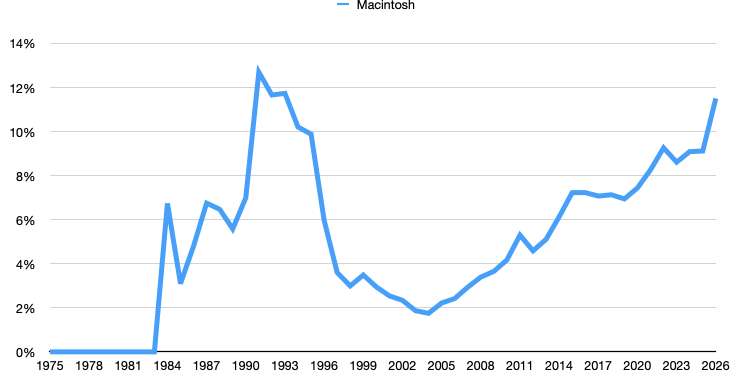
  3. Mac market share to grow from 9% to 12% in 2026

    Nota Bene · 1 comment

    Bucking the Trend

    Global notebook shipments are showing clear signs of further weakening, according to TrendForce’s latest findings on the notebook industry. Subsequently, TrendForce has revised its 2026 full-year shipment forecast downward from -9.2% to -14.8% YoY amid expectations of deteriorating end-market demand and rising supply chain costs, reflecting a deeper industry correction.

    TrendForce estimates that Apple’s notebook shipments will grow 7.7% YoY in 2026, outperforming the broader market trend. This is based on Apple’s ability to expand into lower price segments, adopt a proactive pricing strategy, and maintain stronger chain control than its peers.

    Source: TrendForce

    NB: 8% rise for Apple coupled with a 15% market contraction…

    Gartner adds their Mac Q1 estimate to the pile
    Yearly market share of Macintosh, 1975 to 2026.
  4. Apple at 50 - Ben Thompson interviews Horace Dediu

    Podcast · 4 comments

    Ben Thompson of the Stratechery interviews Horace on the Stratechery Plus Podcast to discuss Horace's journey to become an influential tech analyst: early career in research, business school under Clayton Christensen, and his time at Nokia during the rise of the iPhone. 

    The conversation further explores Disruption Theory in the context of both smartphones and AI, why Christensen misjudged Apple, and whether AI could challenge today’s tech giants. It also marks the launch of Dediu’s new paid service Asymco One and reflects his continued conviction in Apple Inc. at its 50-year milestone.

  5. We know that Macs last longer in use. How much longer?

    Nota Bene · 1 comment

    What did I just say?

    A new analysis of computers used in the enterprise finds that Macs and iPhones last much longer and have far fewer problems.

    Macs in enterprise settings typically last for five years, besting the three-year lifespan for Windows PCs, according to a company that makes software to help businesses manage their computers.

    But the really shocking revelation from the report is that more than half of Windows PCs used in big business get replaced within a year.

    While factors like software compatibility, IT familiarity and customization options also play a role, upfront hardware cost remains the biggest driver for most organizations.

    By comparison, Macs are often seen as premium products, which can make them harder to justify at scale (although the recently released $599 MacBook Neo is changing that equation).

    Companies making these sorts of computer buying decisions should pay attention to a new report from Omnissa.

    “Compared to Windows, 6.5x more Macs are seen in service into year 6, and 3.3x more Macs are seen in service into year 3+,” noted Omnissa’s report.

    “Only 17% of macOS devices were replaced within one year, compared to 54% of Windows devices, reducing disruption tied to frequent hardware replacement,” said the analysis.

    Macs are far less likely to crash. The benefits of using Apple computers don’t stop at longevity, though. Employees using Macs also run into far fewer bugs.

    “The telemetry reveals that Windows devices exhibit 3.1x more total forced shutdowns (including system crashes and unexpected restarts) than macOS devices,” said Omnissa. “Windows devices experience 2.2x more app crashes and a staggering 7.5x more app hangs (unresponsive software states) than Macs.”

    “A forced shutdown is much more than an IT support ticket — it’s a disruption to an employee’s work that translates directly into lost work hours,” said Omnissa.

    Apple’s lifespan advantage extends to iPhones as well. When compared to Android handsets, “the data suggests that iOS devices display longer service life, with twice as many devices in service into year 6,” said Omnissa.

    “iOS is updated 8.1 times faster than Android,” said Omnissa. “macOS is updated 1.5 times faster than Windows.”

    The long-term cost benefits of using macOS or iOS in the enterprise are starting to overcome companies’ habit of making buying decisions based on short-term savings.

    Source: Cult of Mac

    NB: “Penny wise but pound foolish…

  6. MacBook Neo Market Impact: Analysts weigh in

    Nota Bene · 2 comments

    Market analysts analyze market

    Francisco Jeronimo, Vice President of Client Devices at IDC, told Benzinga, "The MacBook Neo will have a significant impact on the low-end PC segment, particularly in education, which accounts for 6.7% of global PC shipments, or 13.4 million units in 2025."

    He said that the market is currently dominated by Windows notebooks, with an average selling price of $682 and Chromebooks, which average at $362.

    "Apple's ASP in Education was $1,425 in 2025 and accounted for only 5% of the segment," he said.

    He echoed the statements by the above analysts while adding that MacBook Neo will allow Apple to acquire users early in their digital lives.

    "Omdia’s February 2026 forecast shows Windows OEMs facing component cost increases of $90 to $165 per unit, pushing average notebook selling prices from approximately $850 toward $915," the research firm stated.

    It went on to say that to maintain margins after these cost increases, many Windows laptops would need to be priced above $1,000 to "stay profitable."

    On the other hand, Apple benefits from higher margins, making it easier for the iPhone-maker to sell the product at low-cost while still maintaining profitability.

    In the education segment, the $499 price for students removes the cost barrier. However, the firm noted that the price isn't the only hurdle.

    "Displacing Chrome in K-12 would require Apple to match Google’s admin tooling and institutional relationships, not just its price point," Canalys stated.

    David Naranjo, associate director at Counterpoint, told Benzinga that Apple's real opportunity lies in higher education.

    It is because the launch comes when Google continues to dominate the K-12 sector through Chromebooks, Google Workspace and school-managed devices.

    "The MacBook Neo is unlikely to displace Chromebooks at scale in the K-12 market in the near term. Schools remain highly price-sensitive and deeply integrated into the Google ecosystem," Naranjo stated.

    Source: Benzinga

    NB: Competing products are flimsy and don't hold up making cost of ownership higher.…

  7. The biggest surprise of the MacBook Neo

    Research · 2 comments

    Remembering the PC market

    Almost 10 years ago I said "Managing the Mac product line must be one of the most challenging problems at Apple. That may not be obvious given the product’s success." I pointed out that although the company grew the Mac into a redeemed and prosperous platform, "The big change in computing has not been a growing Mac vs. declining PC. It has been a huge surge in mobile device use vs. a decline in PC use overall."

    It's time to revisit this observation.

    First, a status update:

    • The Mac is in its 32 42nd year of market presence. A longevity that is (still) unmatched by any other PC maker.
    • Apple reached a top five four position in the ranking of PC vendors. This was achieved far along in the evolution of the market.
    • With about $23 $33 billion in revenues per year, Apple places among the top four three PC vendors in terms of revenue.
    • With an estimated $5.5 $13.8 billion in operating margin Apple is the most profitable PC vendor, capturing over 60% of the available PC hardware profits.
    • The product has retained an average selling price of over $1200 ($1400 last year) for at least a decade. At the same time the average pricing of Personal Computers has more than halved.
    • Volumes increased by about 20% over a decade.

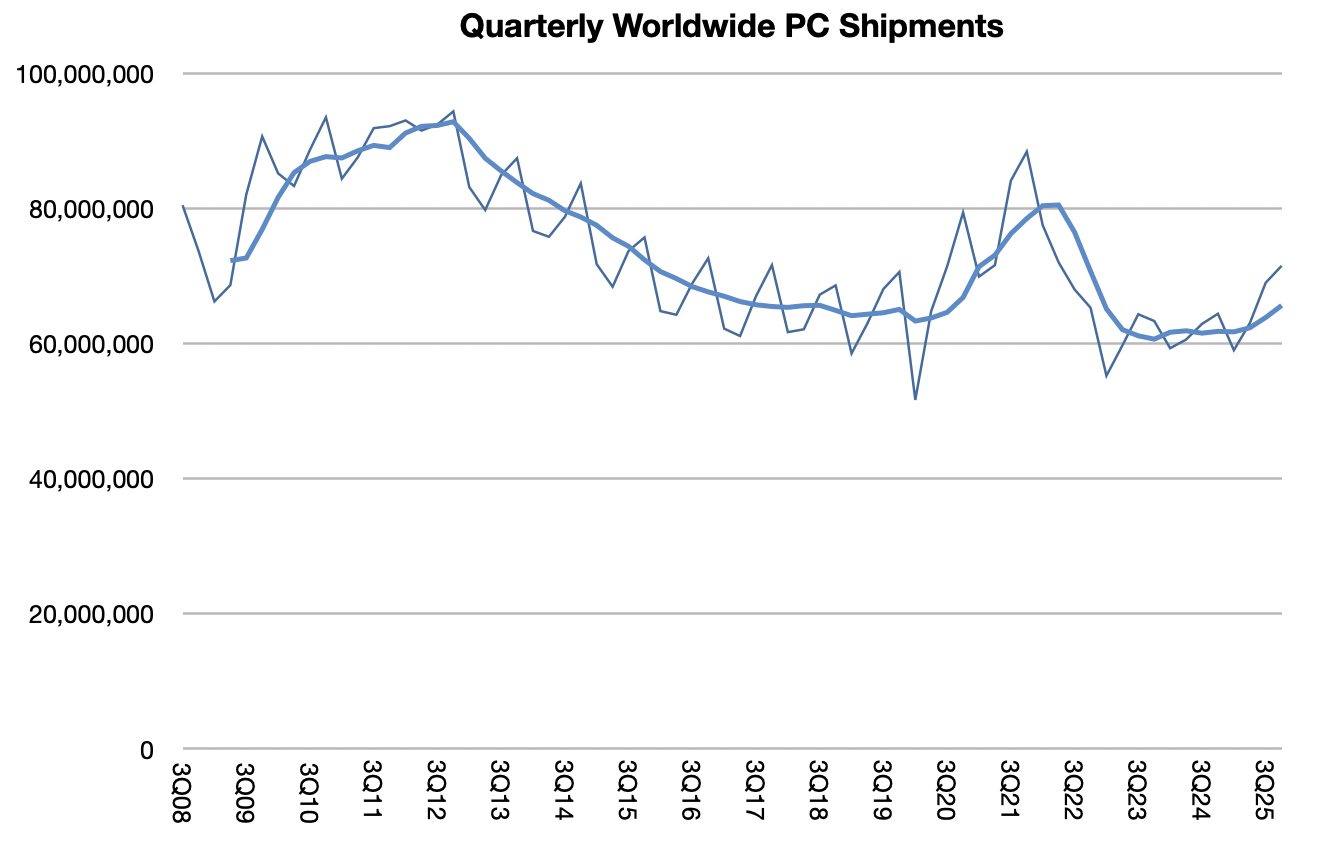
    The overall picture of the market is shown the following graphs. First, the overall quarterly shipments.

    Note the Covid-era surge during 2020 and 2021 but overall decline from peak in 2012. Yearly shipments were 262 million in 2025 vs. 371 million in 2012. The install base of users is largely unchanged. Microsoft has cited "over 1 billion" to 1.4 billion monthly active devices, with figures varying between official statements. My estimate has been 1.2 billion PC users with an additional 250 million Mac users, more about this later.

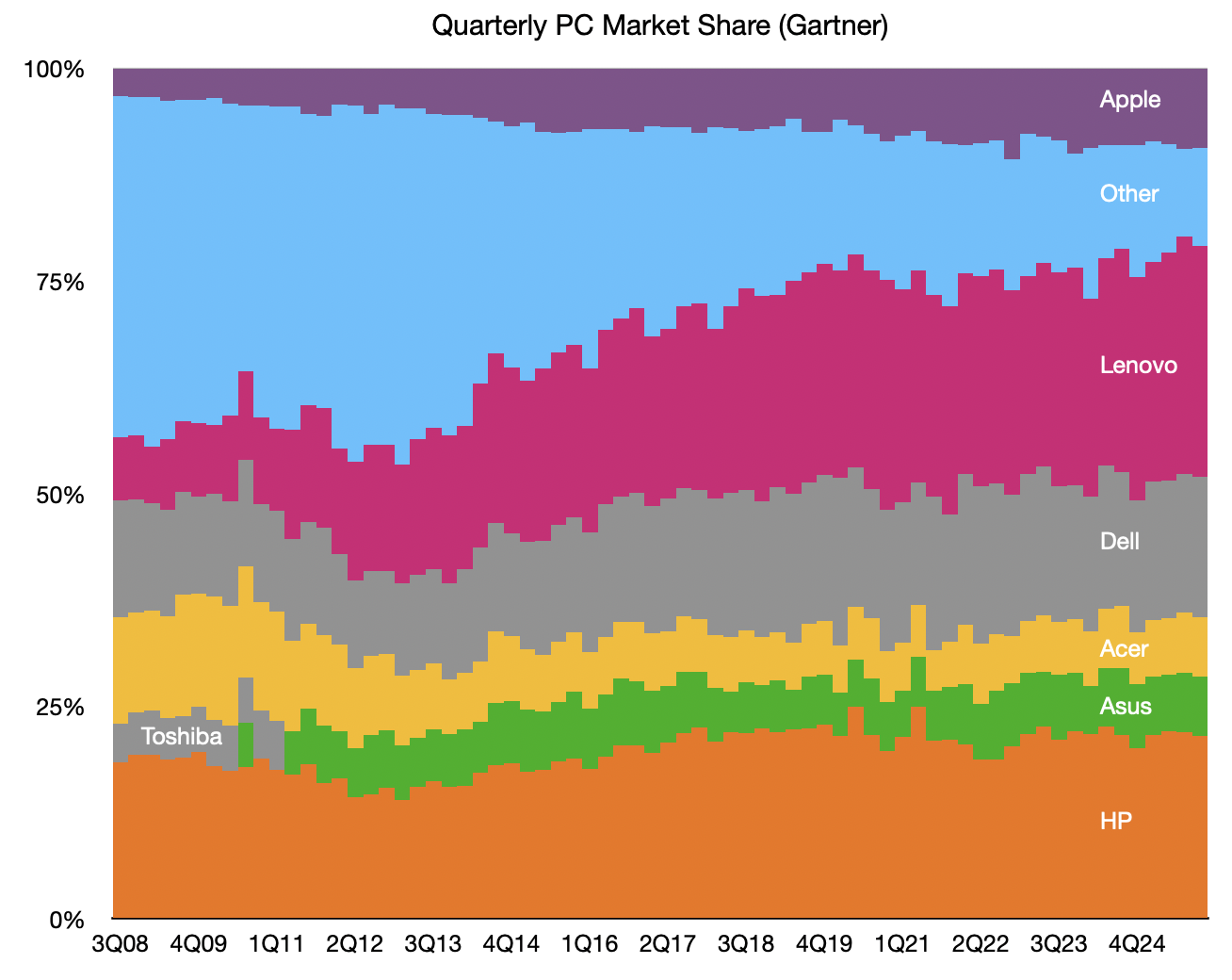
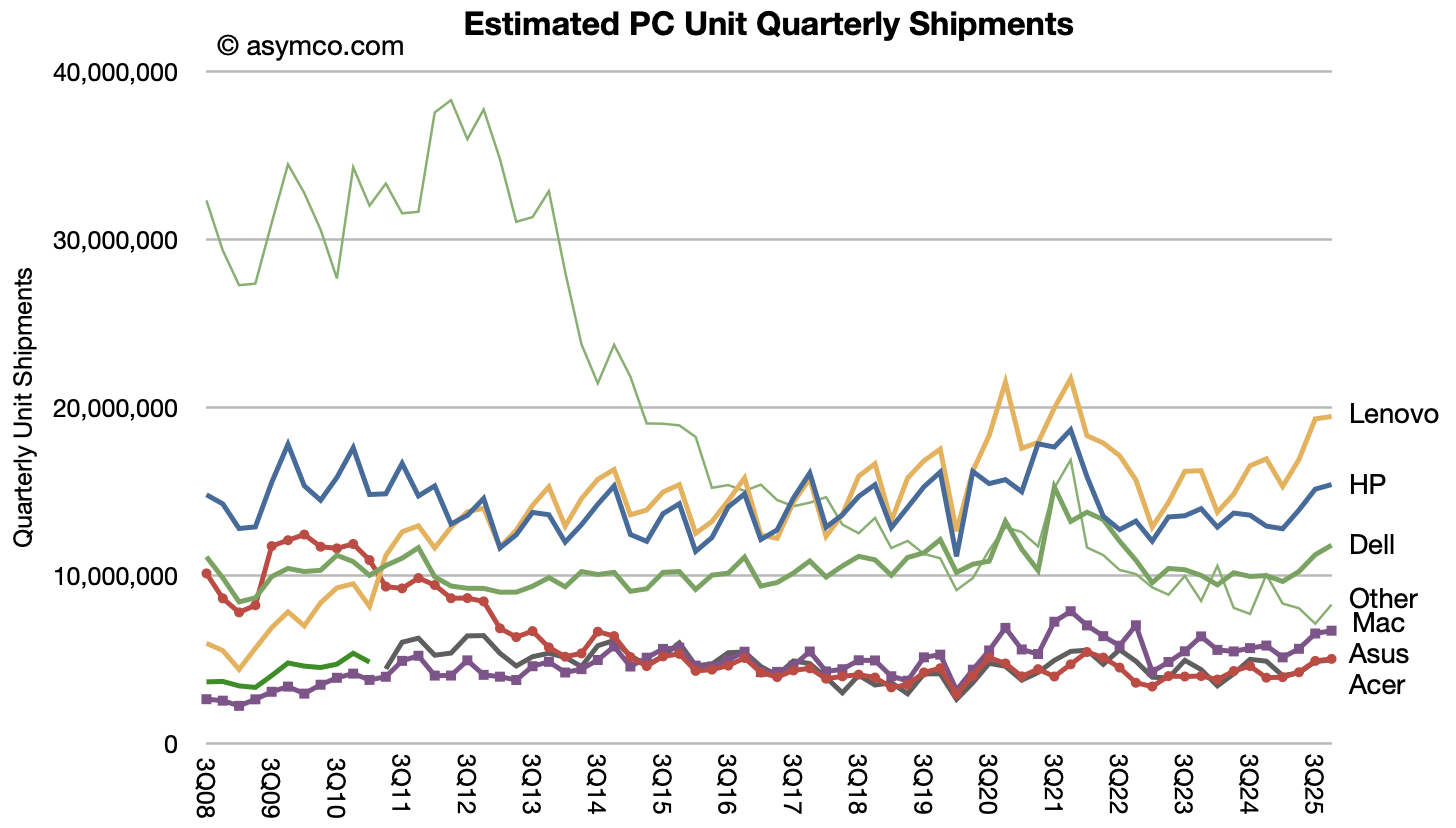
    The shipments data provided by Gartner over the last 17 years is shown below:

    Notable are the declines in "other" vendors and the gains from Lenovo and Apple. Broadly speaking, "other" are assumed to be mostly consumer markets and that has either declined or been captured by Mac with consolidation around Lenovo. Lenovo, HP, Dell are likely to maintain enterprise accounts serving large customers and that has been a steady but low margin business for decades.

    Mac has grown to fourth place but still a way to go to third place Dell. Apple may overtake "other" combined in a year or two.

    Quarterly PC Market Shares by Vendor

    The market share data shows how "other" has been squeezed between Lenovo and Apple while the other players have largely held steady. Acer and Asus somehow managed to survive.

    So what does this mean for the future? What is Apple's strategy with the MacBook Neo. Or for that matter, for Studio and iMac and Mac Mini and MacBook Air and MacBook Pro?

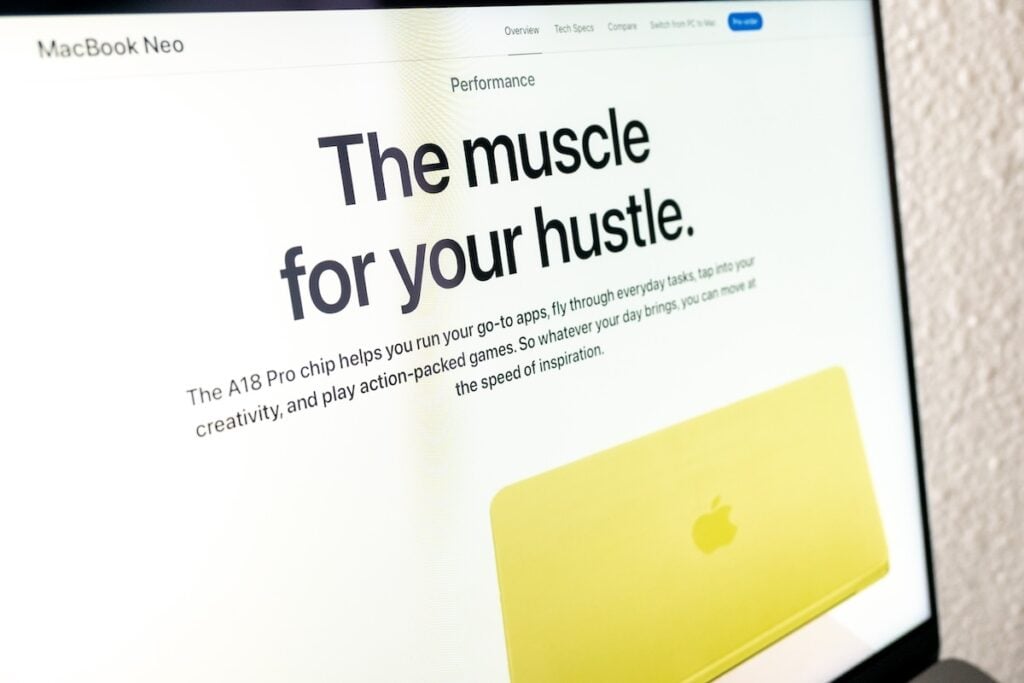
    The Neo was such a surprise for many given its incredible price/performance ratio and the overall quality and affordability (and distribution potential). I've read many reviews suggesting it will "disrupt" the market and that Windows PCs are just no longer competitive.

    Will the MacBook Neo move the needle? Will it take share from the Windows world (or for that matter from the Chromebook and even iPad?)

    One more thing: Apple's sales of about 24 million Macs for a base of 260 million users implies a life span for Macs of nearly 11 years. However, all the other PCs sold add up to 238 million for a user base of 1.2 billion. That means the life span for the non-Mac PC is only 5 years.

    This is, of course, reflected in the price difference but with the MacBook Neo, the potential for a 10 year old life for a $500 laptop puts the Neo price at $50/yr or 14c/day. Based on data for 2025, the average selling price of a new Windows PC is estimated to be $600 to $900 for consumer models. At $700 for a life span of 5 years makes the PC cost $140/yr or 38c/day.

    This means that the average PC is more than twice the cost of the MacBook Neo. Now that is a surprise.

  8. Google and Apple, The Beginning

    Research

    Are Apple and Google competitors or are they partners?

    Prior to the launch of the Android operating system, Apple and Google collaborated on many projects. Google Search was predominant on Apple products including the (at the time) new iPhone. The iPhone also launched with support for Gmail and had native Google Maps and even YouTube. Google was a cornerstone supplier for the new smartphone.

    After the launch of Android only a year later, the relationship changed. The two companies came to be viewed as mortal enemies. The perception that Android was disruptive to Apple—insofar as it undercut the pricing power of the new touch-based user experience—was universal. The "zero price" of Android and its licensing by all other phone makers suggested a competitive collapse was imminent for the fledgling iPhone. Android phones were far cheaper and "good enough." If not immediately, then with the resources of all phone makers and Google itself, Android would surely soon overtake the iPhone in performance along all dimensions. It took a great deal of courage to argue otherwise.

    But, over time, the notion that the iPhone would continue to exist became more widely held. Holding on to a "premium" positioning, iPhone seemed to be have pulled a rabbit out of a hat, perhaps because of Steve Jobs' reality distortion field or because of magical marketing. Nonetheless, doubts over long-term growth persisted.

    Having survived Android, Apple was still seen as vulnerable to a multitude of Google initiatives including Chrome and Chromebooks, a range of Google Pixel phones (enabled by the acquisition of Motorola and HTC.) The entry of Google wearables (enabled by the acquisition of Fitbit), Glasses, the Play Store, YouTube content, Google productivity apps, Google cloud, Google TV, Nest, Google Assistant and numerous other services were all cited as nails in the iPhone coffin. This is all before the age of Crypto a new generation of AIs came into fashion.

    Throughout this period the iPhone continued to increase its audience, growing its base of users not only from smartphone non-users but also from so-called "switchers", that is, those who moved from Android to iOS. Apple has benefitted from this net positive switching for at least five years now as most of its addressable market has already adopted the smartphone. There are about 1.2 billion iPhone users and it's far more likely that a new iPhone user today arrives from the 3.5 billion Android users than from the 3.2 billion people who don't yet have any smartphone. That is because those who don't yet have a smartphone today are also likely to not yet have access to electricity, cellular networks or money.

    Indeed, it is Android that seems to be in a precarious position. The ecosystem is bleeding not just high-end users but also from fragmentation. Chinese OEMs in particular deliver their own experiences and code bases, eschewing Google services altogether. Large OEMs such as Samsung are seeking to differentiate with their own experiences and ecosystems and accessories and chafe against Google's hardware offerings. Upgrade rates to new Android versions are poor. Support of hardware beyond a few years is lacking. But, most fundamentally, Google has not developed a business model that directly fuels development of Android.

    Put simply, Android is not a profitable product. It's not designed to create revenues. It's designed to reduce costs.

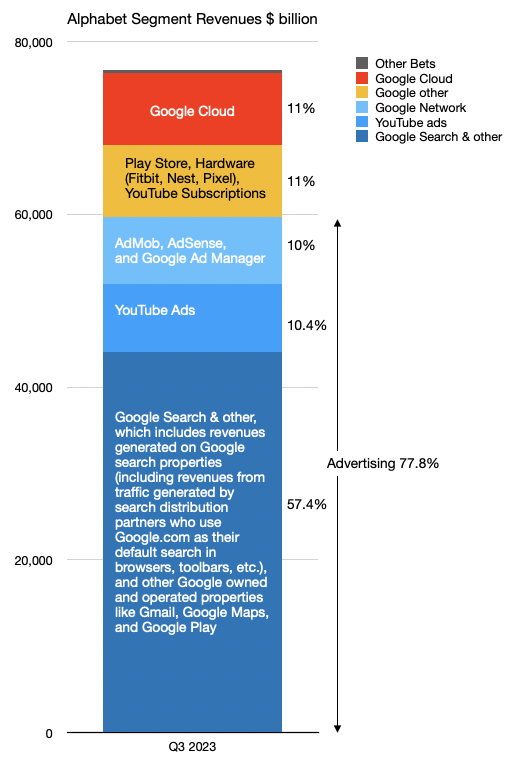
    To understand this, we have to understand Google's business. It's not very complicated. Google's revenues in the last quarter are segmented as follows:

    The colors above indicate the major categories. Blues are Advertising, yellow is "Other" and red is Google Cloud. Other Bets, consisting of research projects, is a 0.4% rounding error. Apart from Search which is about 60%, each major category is about 10%. Advertising as a business model is about 78%.

    To Alphabet's credit, Advertising as a business model has been reduced from 94% a few years ago. Much of that credit goes to Cloud which is a B2B business and has completely different resources, processes and priorities than Search. The "one trick pony" label is less applicable to Google today.

    Search however, and the ancillary properties, are still, by far, the largest sources of revenues and profit. Note that Android itself is missing from this mix apart from Play Store which is a direct Android extension. Play does contribute somewhat as part of "Other" but the OS itself is an enabler across all these categories.

    While not directly producing revenues, what Android does is perhaps even more important. It helps reduce the amount Google has to pay to access its customers. Think of Search as a system which takes queries in and puts results out. These results are what advertisers pay for and the queries are what Google pays for. The output depends on the input. That input is harvested from many users. Access to those users is not free. The cost can be paid by building access directly (Android) or by paying for access to someone else's property (Apple, Windows, or Firefox). In old-school business terminology this is called distribution.

    Distribution is often ignored or considered a superfluous "middleman" to be bypassed. But distribution is foundational to any business. It is, effectively, other people, outside your company, helping you sell your product because they have access to the customers. They get paid for that access, often with a percent of sales. Stores are distribution. Wholesalers are distribution. Resellers are distribution. Without distribution scale cannot happen. Distributors help both producers and consumers by creating access.

    Access is also provided by what we call infrastructure. Just like you can't travel by car from your house to your destination without roads, all access to products and services is effectively infrastructure. If you own the infrastructure then you have to pay to build it and maintain it. If you don't own it you have to pay to use it. All infrastructure has value and all infrastructure has costs.

    This all makes more sense when recalling the historic birth of Android. At the time (2006 to 2008) the worry for Google was that Microsoft's mobile operating system (Windows Mobile née Windows CE) would be licensed as was Windows. That is to say that all phone OEMs would take a license for a nominal fee and build Windows Mobile phones. Microsoft would thus dominate the mobile computing market the way it dominated the PC market (with market share above 95%). Microsoft would then ensure that Bing search was the default on all devices running Windows and Windows Mobile, thus blocking access to what was expected to be the next 3 billion users while capturing all search ad dollars ad infinitum.

    If Windows Mobile were to dominate, Google would be denied distribution, at any price. It would thus be relegated to, at best, 10% market share of mobile search. This would be an existential crisis.

    In this setting, Apple was an ally for Google. Apple was not a search engine provider and was very welcoming of Google search on a nascent Safari browser. Whereas Explorer would block Google search, Safari would offer default placement. Not for free, but for a reasonable cost. Google was a "go-to-market" partner for Apple and it was a symbiotic relationship.

    However, the expectation of Google at the time was that Apple would be no more successful with iPhone than it was with the Mac: A fringe of "creative" or "fanboy" quirky oddballs. This was not just Google's expectation. It was everyone's expectation.

    Android was built to counter a Microsoft mobile OS monopoly with a "zero cost" option vs. Microsoft's end-user-license model. Microsoft made money selling software. Both system software (Windows) and application software (Office.) Google would give away system software (Android) and services (Gmail and Docs) but make money on advertising.

    A genius move. Phone OEMs would much rather pay zero of the OS on their phones than for the non-zero Windows Mobile license. [On a $200 retail cost phone (and thus $90 bill of materials) a $8 OS license is a huge cost.] Google's Android did indeed block Windows Mobile from getting a foothold in the post-PC era.

    But it did so by taking some short cuts. Android itself was an acquisition in 2005 (for $50 million, with a keyboard interface) and, in response to the iPhone, a new touch user interface was developed. It so happened that this interface copied as closely iOS as Windows had copied the original Mac. This perceived theft was such an affront to Steve Jobs that he declared war on Google.

    It was important to ask (as few did) why did Google need to develop an OS, only to give it away. Was its business that robust if it needed to expend enormous energy and capital to build an enabler? The answer is, of course, distribution.

    Google was initially not paying for distribution as most people just typed "google.com" into their browsers. As the URL field became a search field, Google could still expect PC users to make Google.com their search bookmark, one click away.

    But on mobile devices, the friction of the constrained interface meant that defaults mattered. Mobile was going to require new distribution economics. Devices were going to be in the hands of many more people, who, since they did not have full-size keyboards, would type less and who would interact in new (and very succinct) ways. One click away was one click too far.

    With Android (and Chrome) Google set defaults for its services across the platform. If Android was the OS then Chrome would be the default. If Chrome was the default, then Google Search would be the default. For these Android-sourced queries, Google would not pay for distribution. Or, more precisely, would only pay to build and keep Android. Thus the more Android there was, the cheaper it was to obtain search queries for Google. Google had built its own highways: it owned the infrastructure that connected users to its services. These roads were for Android users. And what about iOS users?

    Over a 15 year period the smartphone went from essentially zero to 5 billion users. It became so important to those 5 billion people that they keep it with them every waking moment, use it 100 times for a total of 5 hours each day. That adds up to 182,500,000,000,000 interactions a year and, as a result, it has changed behavior, politics and humanity itself.

    Throughout this period, the relationship between Google and Apple changed. From being allies, to mortal enemies to, as we shall see, partners. We have to understand this new relationship that has emerged and its consequences.

    The next post will explore the relationship in detail using the lens of the deal structure that exists. A deal which is not public and largely unexamined.

  9. The iPad at 10

    Research

    The iPad was launched in April 2010, about three years after the iPhone. Followers of the company will know however that the iPad was designed first, starting sometime in the early 2000s.

    The iPad was the prototype touch device because it's less constrained but also because Apple was, at its heart, a computer company and the iPad was a computer first, device second.

    Concepts of tablets predated Apple's entry and go back to the 1990s. The idea of a "Tablet Computer" was envisioned by Alan Kay as the Dynabook as early as 1968. He famously remarked that if Apple were to build a tablet-sized iPhone it would "rule the world".

    But has the iPad come to rule the world?

    Ten years is not a long time—the Mac is now 36 and it's still kicking, Windows is only 25 years old—but already 500 million iPads have been sold.

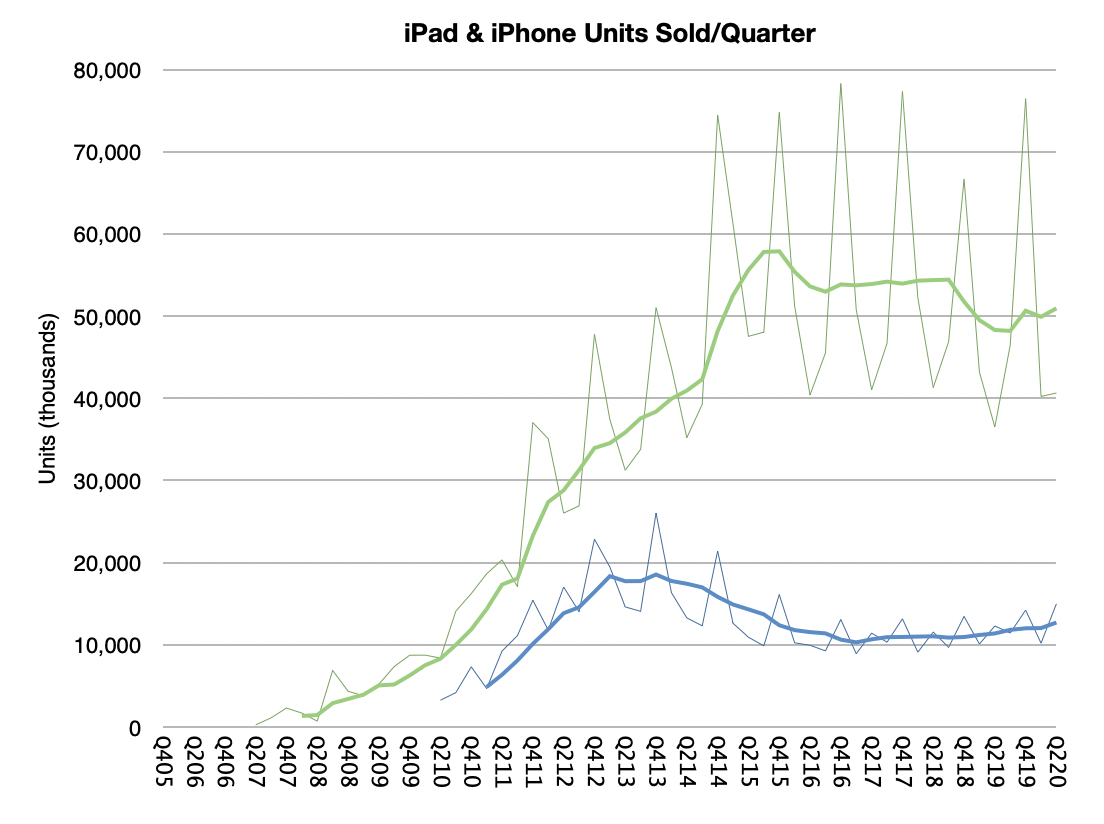
    The sales history of the iPad in units is shown below in blue vs. the iPhone in green. (Note, values in last 8 quarters are estimated).

    The story that did not pan out for the iPad is that the unit growth did not match that of the iPhone, which, in its first decade sold 1.2 billion units.

    But that is because the iPhone and iPad differ in significant ways. Ways which were difficult to anticipate early on.

    Difficult because internally the two are basically the same. Both share the same processors and architecture and (until recently) the operating system and user interaction model. They have a similar "bill of materials" (though prices are quite different, with iPhones typically more expensive.)

    The main difference has been in the display size. As I noted early on, a few inches of display may not look like a big difference but it is qualitatively very different—as much as a bathtub and a swimming pool both contain water, the quantity of water changes dramatically what you can do with either.

    As a result of its size, the iPad is more likely to remain at home; not stationary in one spot, but not "in-hand" at all times. That affects how long it lasts and the tasks it's assigned to do.

    As a result, iPads stay in use longer, get passed on to new users and serve for many years. Their average life span is likely well over 4 years and 9 year old iPads are not uncommon. It's therefore very likely that the vast majority of all iPads sold are still in use.

    So the true measure of success is not units sold but number of active (and satisfied) users. The iPad user base is probably around 400 million (about 27% of total active Apple devices.) The degree of activity is also telling and is reflected in the million apps built specifically for the platform.

    400 million users makes for a healthy ecosystem, especially as the users tend to be willing to spend on apps and services, which in turn, attracts more investment from developers, which leads to more usage, and so on, in a virtuous cycle.

    As with all aspects of Apple analysis, the qualitative is just as important as the quantitative, even more so. The quality of the users, the usage and the product is the pre-eminent assessment.

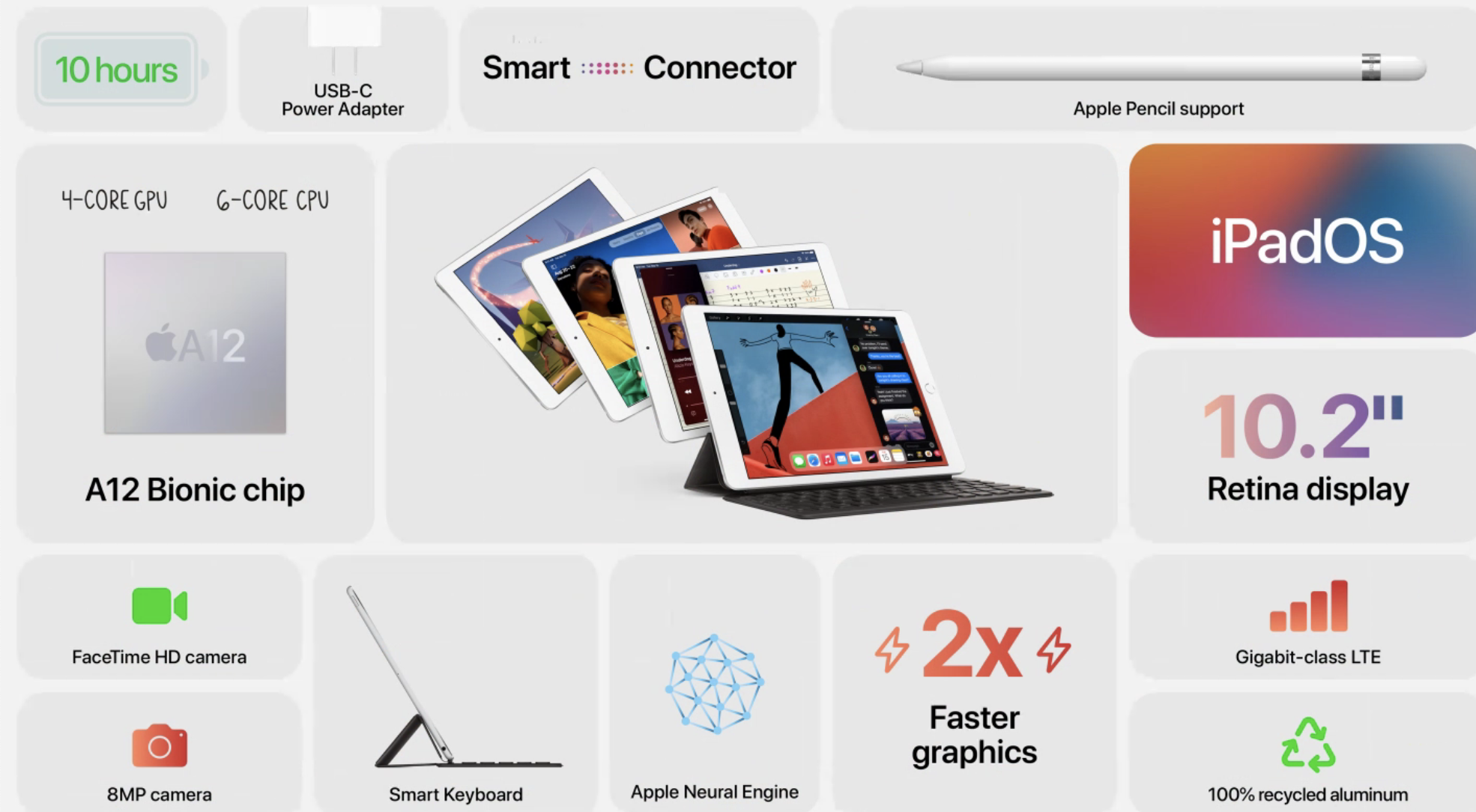
    iPad users, usage and product make for a remarkable combination. On the product side, the Fall 2020 line-up is another leap forward. In particular, the price points, breadth of offering, accessories (mini, Air, Pro, pencil, Smart Keyboard, etc.) and the power across the board.

    This year sees a performance jump in the middle of the line-up with the usual mind-boggling measurements (some beginning with "nano," and others with "tera".)

    So where to for iPad now? What worlds remain for it to conquer? So far has found users in the three "E"s: Enterprise, Education and Entertainment. Pro usage is a niche that is growing in production, especially media. What many might say is that it needs to aim at replacing the laptop, or the PC in general.

    It has not done that so far, much to the delight of naysayers. But this is not as big a failure as it might seem.

    First note that the Mac user base itself is not nearly as big (110 million +/-10%). iPad could be 4x bigger in user base. The Windows base is larger at 1.2 to 1.4 billion but that resists frontal assault as it is deeply entrenched around enterprise workflows. It's also bereft of profit.

    What iPad did do is create its own demand. It sits comfortably aside other platforms not in place of them. Most iPad users also have an iPhone and a PC or a Mac. I happen to have all those and more than one iPad. The iPad did something grander than kick the PC off its perch. It sat next to it and found life quite comfortable.

  10. Just in Time

    Research · 73 comments

    The iMac launched May 6 1998, exactly 20 years ago. It is not the most significant computer to ever exist. It was a clear descendant of the original Mac which established the "all-in-one" desktop computer category. That category, to which it still belongs, is a modest segment. The last time Apple reported portable sales separately was in late 2012 when the desktops/servers and pro systems combined made up only 20% of all Mac sales by units. If iMac were 10% of Mac sales, it would represent about 2 million units in 2017.

    Desktops evolved into laptops and personal computing evolved into pocket  computing. Becoming more personal means more intimacy and this is leading to wearable computing. There is more beyond that to be sure.

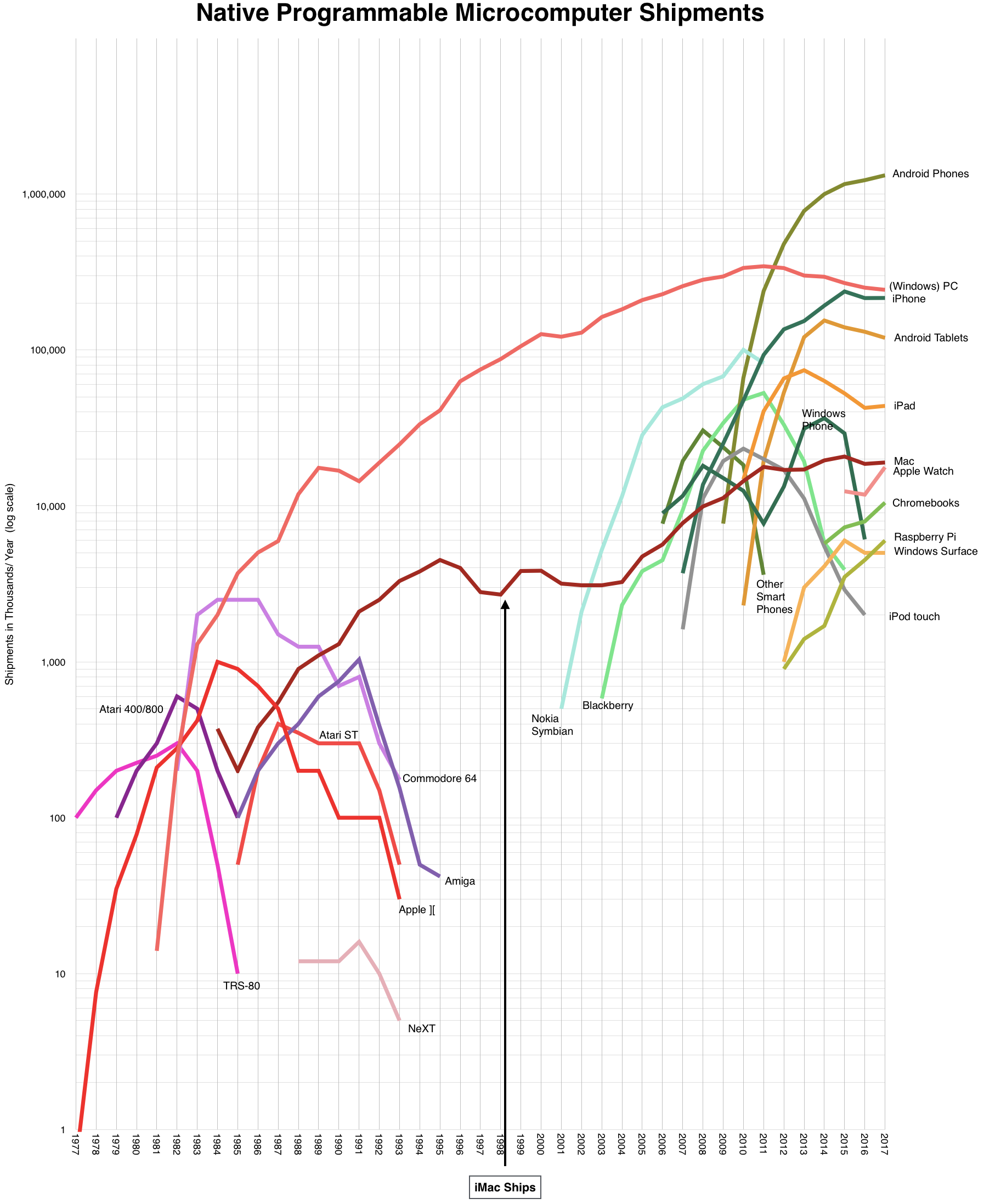
    But the iMac is a historically significant machine. It allowed Apple to start on a new trajectory. It did this by first offering a financial lifeline. Sales of Macs, which were at the time the only source of revenues for Apple, increased from 2.7 million to 3.8 million a year. This at a time when Windows PCs were shipping about 100 million units. That was enough to ensure survival. Today Mac units are five times higher while Windows PCs are about 2.5 times higher. The following graph shows the impact of iMac on the Mac's trajectory. 

    Second, the iMac was the first host of OS X, an operating system built on Unix which made it extremely flexible. iMac gave Apple the space for OS X to be developed and to be optimized for various hardware. The experience with OS X and its inherent scaleability (down as well as up) meant that it could be considered for the post-PC devices of the future.

    Lastly, iMac's design screamed "consumer product" which went from signaling inferiority to superiority. It set a standard for novelty, creativity and dynamism in the category that was considered second-rate. In the early 2000s consumers began to lead in the adoption of new technologies. DVD drives, internet connectivity, wifi, instant messaging, media consumption exploded. All the while institutions, hung up on legacy, began to block technologies. At this pivotal moment, the iMac spoke with its looks. It didn't just imply a new order, it stated it.

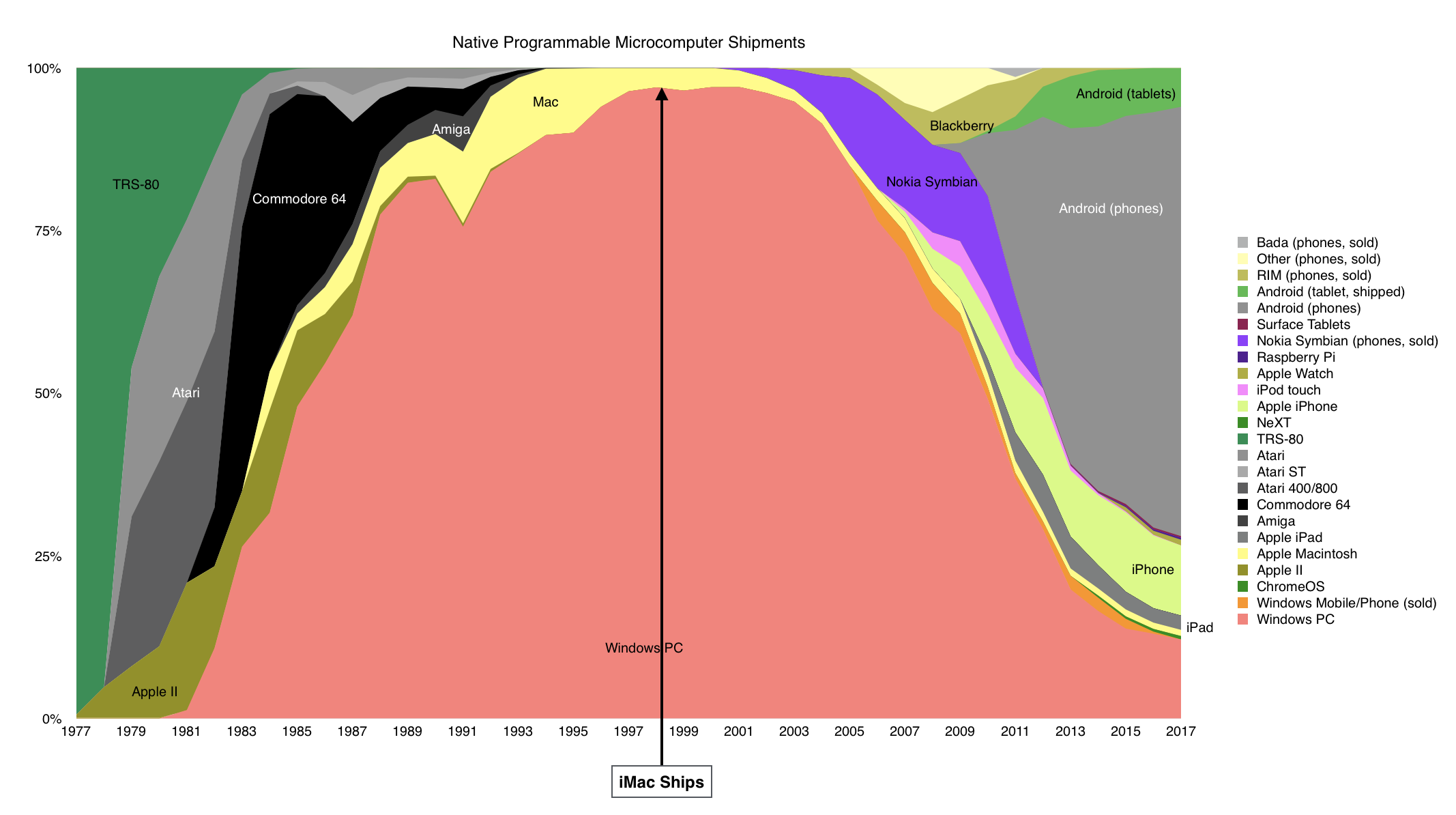
    To me the incredible aspect of the iMac's entry is its uncanny timing. It came not only just in time to save Apple but exactly half-way between the first two ages of computing. In the following graph showing "share of computing" you can see it as launching precisely at "peak Windows".

    In retrospect you have to wonder if Apple, with the iMac, was lucky to survive into this next era or if that era would have ever happened without the iMac. It's a question of causality which quickly devolves into an un-winnable argument about stochastic vs. deterministic existence.

    Regardless, the result was felt more than seen. The computing industry was pivoting. The results are seen also in the graphs above. The iMac came right in the middle of the "desert" of platform choice of the late 1990s. By the 2000s mobile platforms detonated on the scene. The iPod was Apple's first entry, in 2001, but it was not a computer. It was an appliance. A stepping stone at a time when the early platform contenders Nokia, Palm, Microsoft and BlackBerry surged before realizing that they did not have sound foundations upon which to build ecosystems. Their advances could not be consolidated.

    The spoils went to the later entries of iOS and Android. The resulting disruption was shocking and disorienting. Not only did the old order get up-ended but the magnitude of the new was 100x the old. The iMac enabled at least a trillion dollars of value to be created and made Apple the biggest company in the world.

    As you would expect, at the time, 20 years ago, none of this change was anticipated. iMac was a 'cute' computer. Toy-like and obviously unprofessional. It attracted and relished contempt.

    So now we are at a point where the second era of computing is at its apex. With markets near saturation, the device business is inflecting from growth to possible stagnation if not decline. There are two platforms--though unlike Windows, Android is fragmented and iOS is not just on one form factor. Nevertheless there is stasis. The touch UI which begat nine billion devices is normative. The next interaction metaphor has not emerged as an obvious successor.

    The question for today is what is the new iMac? What is the enabler for change? It's not easy to spot. It is not the thing of the future but it points to the future.

  11. Orthogonal Pivots

    Research · 16 comments

    Microsoft has announced that by the end of the year the Groove music service will be phased out. Users are being offered the option to move their music libraries into Spotify.

    This brings to an end a long story of Microsoft in the music distribution business. It started nearly 15 years ago with technologies in Windows that allowed for purchase and playback of various media formats. Microsoft sought to enable a large number of music retailers to market music through its formats and DRM and transaction clearing.

    Services such as AOL MusicNow, Yahoo! Music Unlimited, Spiralfrog, MTV URGE, MSN Music, Musicmatch Jukebox, Wal-Mart Music Downloads, Ruckus, PassAlong, Rhapsody, iMesh and BearShare and dozens of hardware players licensed Windows formats. Almost all of these services have shut down and the devices disappeared.

    The next stage was to offer an integrated experience through the Microsoft Zune player and Zune Marketplace music service. This too failed and was replaced by the Xbox Music brand in 2012. On July 6, 2015, Microsoft announced the re-branding of Xbox Music as Groove to tie in with the release of Windows 10.

    There was a time when Microsoft was thought of as the certain winner in media distribution. Inserting media into the Windows hegemony was classic "control point" strategy: owning the access points was a sure way to collect a tax on what transacted through the network.

    Instead we are facing a market where media is consumed through new access points: phones, tablets and TV boxes. Netflix, Spotify, Roku, Google, Amazon and Apple are all offering distribution and some are investing in original programming.

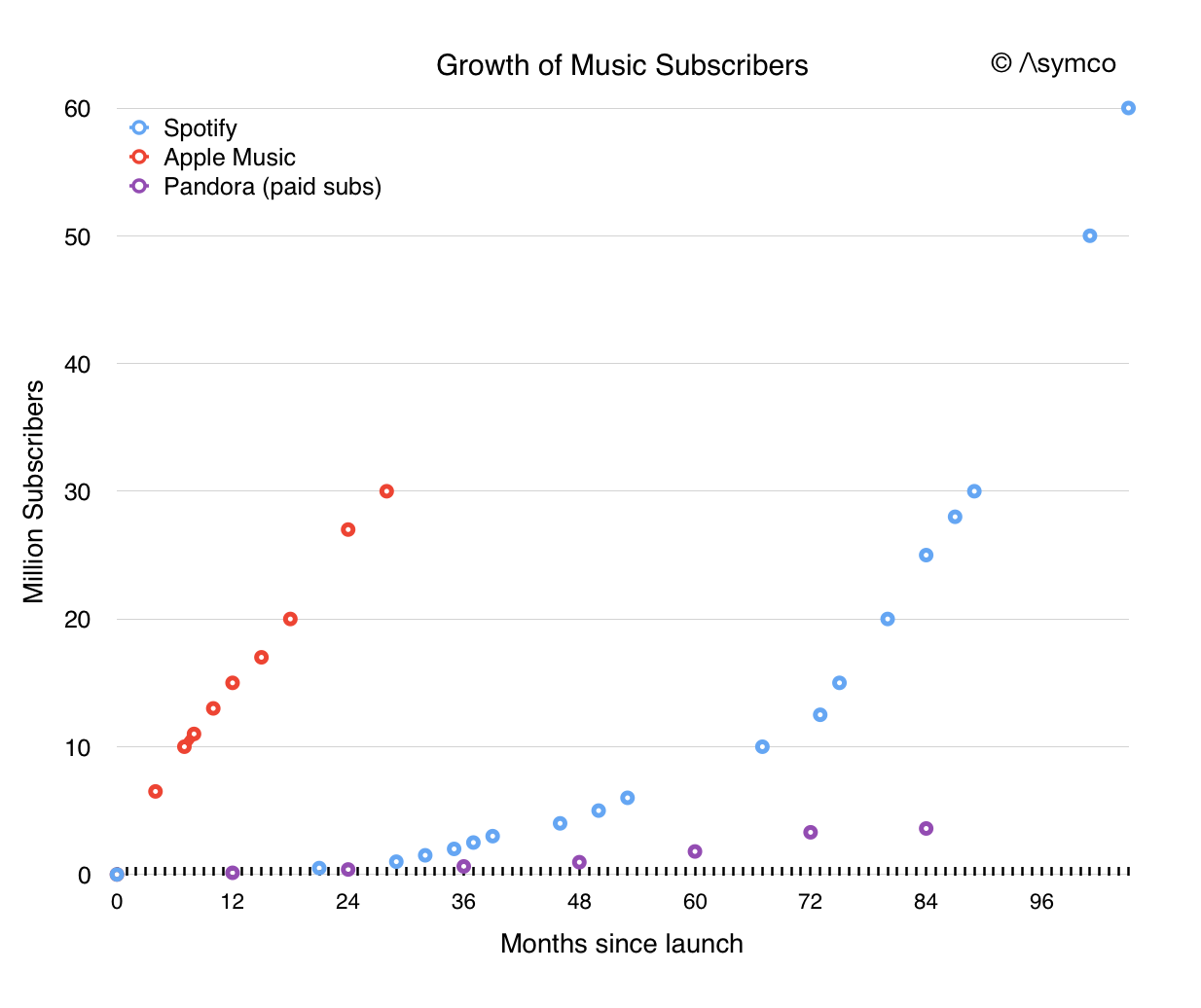
    It's perhaps worthwhile to recall that Microsoft and Apple both started their media efforts around the same time. Apple's iTunes is 16 years old and the iTunes Music Store opened in 2003, almost 15 years ago. Today Apple is transitioning to streaming with 30 million subscribers. The graph below shows the history of subscription growth to Apple Music and Spotify.

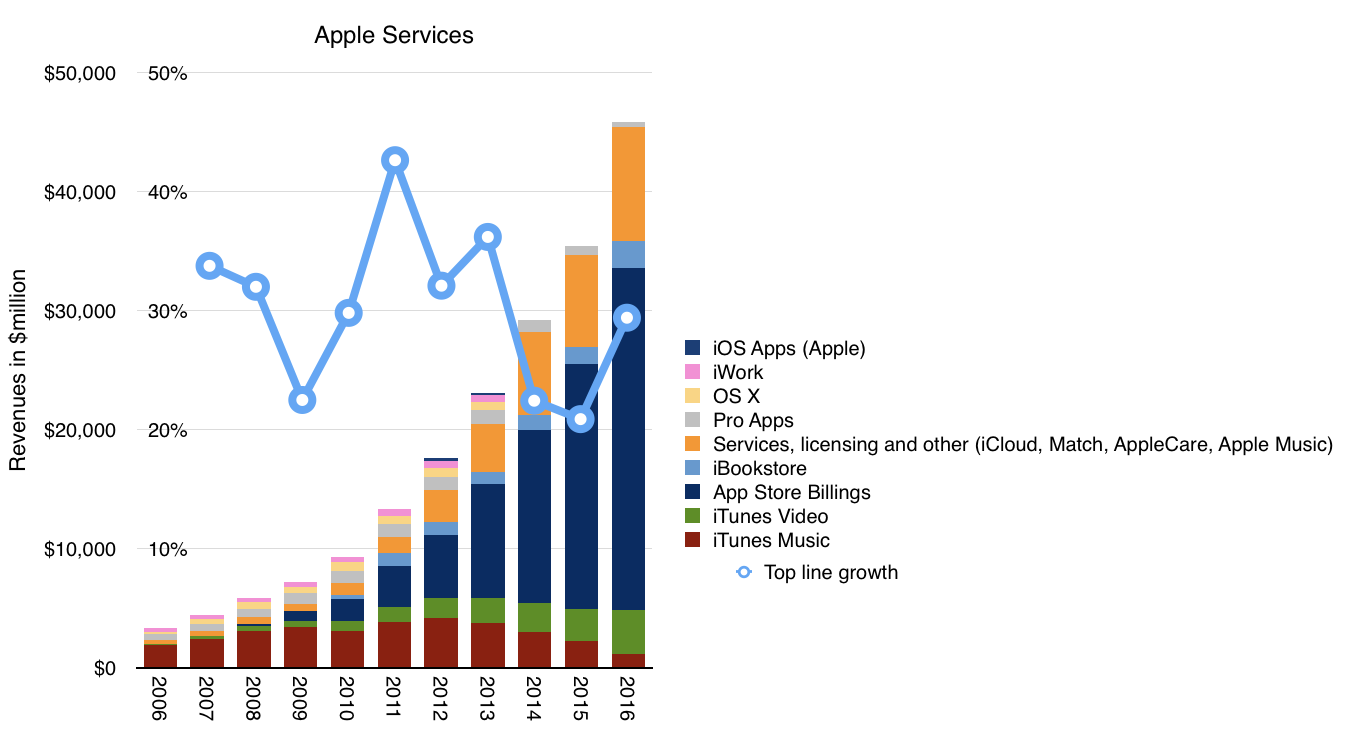
    Apple Music is a small part of Apple Services (part of the orange area below).

    On a yearly basis Apple Services are this year crossing the $50 billion gross revenue run rate. This year Apple released a new Apple TV 4K and is releasing a new smart speaker called HomePod.

    The contrast between Microsoft and Apple is most visibly between the Mac and PC. But the story of how media paralleled mobility and how Microsoft struggled with both is perhaps a cautionary tale.

    Microsoft saw the limits of modularity when new product categories emerged and when new user behaviors were created. They attempted to pivot into being more integrated but those efforts also failed. The efforts continue today with Surface devices; looking forward they will continue with AR/VR and perhaps a pivot of Xbox..

    But the long arc of history shows how hard it is to succeed in vertical integration after you build on horizontal foundations. Generations of managers graduated from the modular school of thought, specializing rather than generalizing. Now they are facing an integrated experiential world where progress depends on wrapping the mind around very broad systems problems.

    Entire industries are facing this orthogonal pivot: media, computing and transportation come to mind. Huge blind spots exist as we see only what we've been trained to see.