Smart phones sold to retail customers totaled 408,000 units, down 15% from a year earlier and 29% sequentially
By some estimates, Apple pre-sold more iPads online in one week than Palm sold smartphones through Sprint and Verizon stores in 3 months. What's more remarkable is that year-on-year decline implies Palm sold more Windows Mobile devices than WebOS which was not on the market a year ago.
The company said there are over 2,000 apps in the Palm App Catalog.
ASP was $367, down from $375.
Almost all volume was from WebOS products (Windows Mobile devices are gone)
For Q4, the company expects revenue to be less than $150 million.
Q4 gross margin likely in the mid-teens.
Guidance for $150 million in revenue, down 57% sequentially.
After hours market cap for Palm is about $833 million down 13%. Expected revenue and ASP imply about 410k units will be sold into the channel in the following quarter.
In the suit against HTC, Apple's listed infringing phones include HD2, Touch Pro2, Tilt2, Imagio, Pure and Touch Diamond. These all run Windows Mobile and not Android. HTC shipped 80% of the Windows Mobile units in the field, a far larger volume than Android so it stands to reason that the law suit is as much targeting Windows Mobile as Android.
In 2006 Microsoft announced that their partners/OEMs/Operators will get indemnification on IP suits regarding their OS. It's not a sure thing that Apple's patents cover any part of the Windows Mobile stack--vs. whatever parts HTC layered on top. However, there is a high probability that Microsoft will join Google in HTC's defense.
I should also point out that the media's emphasis on Google as the exclusive target of the suit is sensationalistic. Focusing on Google possibly misses a hidden agenda.
Namely that Apple is attacking the hub of the modular approach to mobile computing while largely leaving the integrated vendors like Palm and RIM alone (the dispute with Nokia is over license terms for GSM patents and not yet about UI patents).
Therefore it's entirely likely that HTC was singled out to disrupt the business logic of modular mobile software. HTC is the pioneer and the hub as the largest licensee for both WinMo/WinP and Android and the inspiration for hundreds of OEM/ODMs to make modular products.
HTC's defense will be complicated and difficult due to these dependencies. Legal risk weighs heavily on large corporations, especially when the payoff is marginal at best. Other vendors looking at this licensing model might think harder about participating, and that may be the whole point.
Google has taken on Microsoft with free good-enough web services for a few years. Gmail for business against Exchange, Chrome against Internet Explorer, and soon Chrome OS against Windows. But it's Android vs. Windows Mobile which is shaping up to be the first success story for Google.
Windows Mobile has to deal with Android as a classic low-end disruptor. Both are competing for OEM deals and it's plain to see how Android is a better opportunity:
lower cost means lower BOM, and higher margins
easier differentiation through customization of the UI. WP7 went so far as to eliminate this option
open source beats closed for devices any day
a fragmented ecosystem beats a dysfunctional one
WP7 appears to be something so different than what WinMo was that it may indicate Microsoft abandoning the licensing market to Google.
We’ve chosen to withdraw Skype Lite and Skype for Windows Mobile because we want to offer our new customers an improved mobile experience – much like the version that has proved so popular on the iPhone, and which is now available on Symbian phones.
As for WinMo, we have made the tough decision to defer support for that platform until WinMo7. This is due to the fact that WinMo6.5 does not support some of the critical APIs that we need.
by 2007. The goal was set 6 years and 3 months ago:
On November 3, 2003, Microsoft announced that it intends to sell 100 million Windows Mobile devices by year 2007. This goal has been set by Steve Ballmer. Majority of Windows Mobile devices that are expected to be sold will be smarpthones, not just PDAs (Pocket PC).
From the GSMA Mobile World Congress 2009 (one year ago):
Kallasvuo used Apple and its "closed" ecosystem as an example of what could limit innovation in the mobile market in the future. He said Apple's vertically integrated model, where its hardware and software are tightly controlled by the company, further fragmented the market. And he added that what is truly needed is more openness in developing applications.
Yes, prior to the iPhone innovation was zipping along rapidly, but now it's stuck because the iPhone is closed. The iPhone is hindering innovation because it's highly integrated.
Ballmer argued that device openness was important to give customers more choices. And he pointed to the number of choices that Windows Mobile customers have when choosing a device.
We'd all have more choices if we'd all choose Windows Mobile.
Fast-forward one year and Microsoft decides to offer more choice by adding a new operating system (in parallel to its existing OS) and Nokia decides to solve fragmentation by launching a new platform called MeeGo (in parallel to Symbian).
The mobile operating system formerly known as “Pocket PC 2000/2002, Pocket PC 2000/2002 Phone Edition, Smartphone 2002, Windows Mobile (2003/5.0) for Pocket PC, Windows Mobile (2003/SE/5.0) for Pocket PC Phone Edition, Windows Mobile (2003/SE/5.0) for Smartphone, Windows Mobile 6[.1/.5] Professional/Classic/Standard” will now be known as Windows Phone Classic.
The last “Classic” nomenclature lasted from Windows Mobile 6 Classic to Windows Mobile 6.1 Classic and denoted the OS for Microsoft’s PDAs. It disappeared after version 6.5.
Windows Phone Classic will co-exist with Windows Phone 7 Series.
Three new ambitious platforms starting with zero installed bases and no applications are going up against the following:
Symbian with more than 200 million users and 20k apps
WebOS with less than 3 million users and about 1k apps
Windows Mobile with 30 million users and about 2k apps
iPhone OS, about 75 million users and 150k apps
Android with 3 to 5 million users and approx. 20k apps
Blackberry OS with more than 50 million users and a few thousand apps.
It should be noted that Microsoft’s new Windows Phone “7 Series” will compete with Microsoft’s Windows Mobile 6.5 which will continue as a product line.
MeeGo will also compete with Nokia’s existing Symbian OS for developers, replacing Maemo.
Most of these new platforms will not have products shipping for at least 6 months during which time another 50 million (at least) new users will join existing ecosystems.
There are now nine smartphone platforms, but who’s counting? I’ve been hearing predictions of consolidation for years and although platforms have come and gone (PalmOS, SavaJe), the total number continues to increase.
If nothing else, this seems to indicate that the industry is not in any state of maturity or point of “over-service” where commoditization takes place.
HTC is the world’s fourth largest smartphone company. It ships 80% of all Windows Mobile and probably a similar proportion of Android devices. Like Microsoft in 2003, Google turned to HTC for its first smartphone, the G1 and its latest, the co-branded Nexus One. The company shipped a total of 11.7 million mobile phones in 2009.
It would appear that HTC is very well positioned in what amounts to be the best industry in technology.
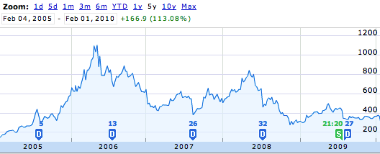
However, not all is well. A few days ago HTC issued revenue guidance below analyst estimates and its stock price is at 2005 levels, 70% off its peak (see graph--source: Google finance).
Part of this could be explained by its continuing reliance on Windows Mobile which is fading fast, but also it’s because, as management acknowledged, there is significant price pressure.
HTC prides itself with having a “premier” product with typically high-end feature sets and positioning. HTC invested in its own UI to differentiate its products and has mounted a branding campaign to move away from being a white-label ODM.
It seems all for nought. The rules of the smartphone market do not favor modular component players. As HTC does not front its own OS, it still struggles to stand out in the eyes of the consumer.
Looking at the list of top 3 vendors: Nokia, RIM and Apple, we see hardware companies that field an integrated OS/service bundle.
There is an implied message in Android advocacy that once more licensees join in, volumes will be distributed among a broad set of companies benefiting from a healthy rivalry. This broad licensing will be a boon for volumes and for user choice and the platform itself will prosper.
I'm going to argue here that there will be no healthy distribution of volumes or profits in the Android platform.
History shows that volumes for an openly licensed mobile platform concentrate in the hands of a single vendor. To illustrate, I attached a list of all the devices which shipped (to date) with a flavor of Windows Mobile. The list includes 911 different phone models (search on your own on pdadb.net under the pdamaster tab--search criteria are on the last page of the PDF).
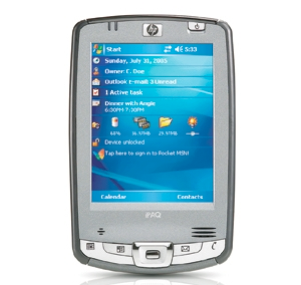
The Windows Mobile platform "took off" and had hundreds of concurrent licensees in the middle of this decade. In spite of this wide adoption, one vendor captured 80% of the volumes for all instances of the platforms: HTC. Having started with the iPaq as a PDA and followed by being the first to market with a WinMo device, HTC dominated Windows Mobile volumes even when faced with literally hundreds of competitors. These competitors included all the big names: from PC vendors like HP, Dell and Toshiba, to cellular incumbents like Motorola, Sony Ericsson, Samsung, LG and every ODM and OEM in between. The reason HTC won is mundane: they have the experience and the distribution to make an impact and they iterate rapidly and are intimate with the details of making a tough-to-integrate product work. They basically worked their way up the value chain from a contract design shop to a branded top tier vendor.
But if you exclude HTC, dividing the number of units of WinMo shipping at any given time by the number of licensed products in the market at that time, one gets about 50,000 units/licensee. Think about that: except for HTC, an average licensee could hope to ship 50k units for any phone they engineer and market. And they also need to prepay Microsoft the minimum license fee of $10/unit (approx) for a minimum order of 50k units or half a million dollars.
This is actually a paradox. Put yourself in the shoes of a business manager at one of the potential licensees. Consider the situation where there are 200 competitors in a market all shipping undifferentiated products, and one competitor has 80% share. Would you want to be the 201st? Saying yes implies hoping to split the remaining 20% 200 ways or obtaining, on average, 0.1% share? But this is not a share of all phones, it's a share of that platform, which itself is, at best 10% of all smartphones which make up maybe 20% of all phones. So you are committing a few million dollars to pursue (.2*.1*.001=) .00002 of a market. That target is 3 orders of magnitude less than what Apple obtained in 2 years (without the margins). It never adds up unless you expect your entry to blow out of the 20% ghetto and take on the incumbents.
As it turned out there were dozens upon dozens of business managers who opted to be the 201st (or 301st). Unsurprisingly, the result was that every Windows Mobile business plan failed (except that of HTC). Every decision to join this ecosystem on the device side was a value destroying decision, repeated 900 times.
Why?
I don't have an answer as to why so many are taken in by this. I have a hypothesis that it has to do with excess R&D capacity (e.g. idle engineers) that compels small companies to build product with no hope of market penetration, but I cannot prove it. They may also couple the low barrier to entry to the premise from the platform vendor that a no-name licensee could be the next Dell/Acer/HTC if the platform "takes off".
Regardless of the cause, the proliferation of WinMo SKUs did nothing for the success of the platform overall. For consumer products, it does not matter what jockeying for position happens within the value chain if the end user/developer experience is painful and uncompetitive.
Android will win or lose on the user/developer experience. It will not win or lose on the proliferation of licensees.
Nice summary: Essentially, Android isn't Google's phone platform, it's an open alternative for failing hardware makers to use in place of Symbian, Windows Mobile, and Linux to create the same type of convoluted, fractionalized, and poorly integrated products they're already making. This is also why Symbian, Windows Mobile, Motorola, and Sony Ericsson are all failing commercially.
Google's primary and most significant contribution won't be any major innovation in the core Android platform but rather in its own bundled apps, where Google plans to earn its revenues from via, to put it bluntly, adware and spyware.