The iPad outsold the Mac after two quarters in the market. It's important to understand the effect the iPad is having on PCs. Data is trickling in that potential notebook buyers are "postponing" purchases due to the iPad. The netbook market has witnessed a significant slowing which has trickled down to the performance of everybody in the value chain, from Microsoft, to PC vendors, Intel, AMD and retailers.
So naturally we need to ask how it has affected the Mac.
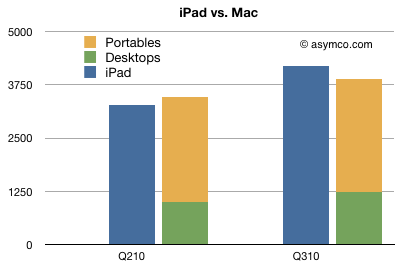
The following chart shows how the iPad has outsold the Mac the past quarter. The iPad was on the market for six months while the Mac has been for sale for 322 months--a shocking achievement.
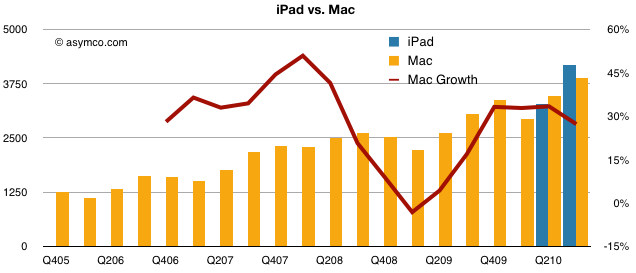
But the Mac has not slowed down. It grew faster than the overall PC market (units grew at 27.3% and revenues grew at 22%) as it has grown for most of the past 18 quarters.
The performance is also highlighted in the following chart showing the history of the Mac units by quarter over nearly five years. The Mac had a slowdown during the recession but the dip in growth in the last quarter does not seem significant.
We expect revenue to be about $23 billion compared to $15.7 billion in the December quarter last year. We expect gross margins to be about 36%. We expect OpEx to be about $2.325 billion.
We expect OI&E to be about $65 million. And we expect the tax rate to be about 25.5%. We're targeting EPS of about $4.80.
This means 63% of iPhones sold outside the US last quarter. This is down from about 70% earlier this year. As it was a launch quarter and distribution was much more constrained outside the US, the lower figure is not surprising.
It's still important to note however that sales outside the US are far larger than in the US but penetration and share is far less.
So far Apple has sold 7.458 million iPads and there is still a quarter remaining in the calendar year. The highest forecast immediately after the launch of the product was 7 million.
For the record, in January I forecast 6 million units for calendar 2010 (and 10 million in first 12 months of sales).
All analysts polled grossly underestimated the iPad. My impression is that competitors are still in denial.
By Daniel Tello's ranking I was first in Q2 but 8th (out of 38) in Q3. Overall, bloggers beat Pros but by a lower margin than in the past.
I have been ok at estimating product line performance and top line sales but not so good in guessing margins. Last quarter I went for a high iPhone number (13 million vs 14.1 actual and 11.39 Pro/12.07 Blogger consensus) and middle-of-pack on iPads (5 million vs. 4.2 actual and 4.79 Pro/5.52 Blogger consensus). The total iOS units I forecast was 18 million and Apple sold 18.3 so I was fine on units and pricing.
My guess on the cause of my estimate failure on margins was iPhone 4 rollout ramp. I had to take iPhone margin down to below 50% (about 49%) to make the reported total GM. iPhone has been, on average, running at 52% over the life of the product.
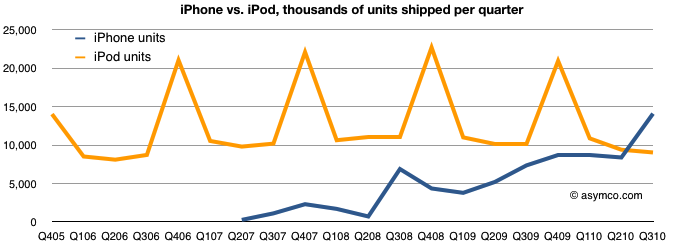
Another chart that speaks for itself. The iPod has been quite resilient as a product line but with both the iPhone and iPad embedding an iPod, cannibalization is happening.
The iPhone is now the new volume leader among Apple's devices.
In last year's third calendar quarter earnings call (October 20, 2009) Tim Cook was asked:
“So when you go from exclusive to multiple, you don’t change the charge to the carrier?”
Cook answered: “Correct.”
In this year's third calendar quarter earnings call (October 18, 2010) Tim Cook was asked again whether the future iPhone non-exclusive subsidy will affect the iPhone revenues and again Tim Cook repeated that it won't.
Chris Whitmore - Deutsche Bank
And what is your experience then when you've gone non-exclusive from a subsidy and margin standpoint on the phone, have you had to give anything up in the past?
Tim Cook
We don't give specific information out on the margins. But I think you can look at our ASPs and see that they've generally stayed above $600, and that's despite opening up several markets from an exclusive market to a non-exclusive market.
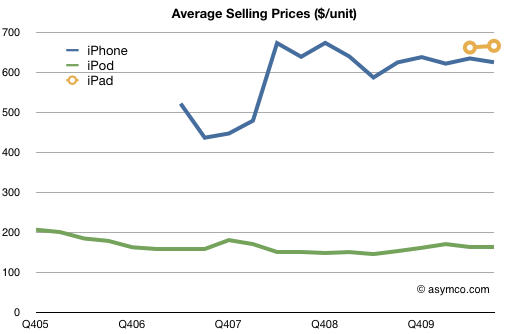
The recurring assumption that the loss of AT&T exclusivity will cause iPhone price erosion is wrong and has been evident in the sales data for over a year now. Not only did Cook state clearly that there is one price for iPhone to the channel regardless of exclusivity but the price data shows that as Apple moved to non-exclusives in many regions of the world, the ASP remained fairly constant:
Over the period when the blue line has been flat, Apple moved a number of markets from exclusive to non-exclusive. There are three main countries where iPhones have a contractual exclusive relationship. That is the United States, Germany and Spain. (China and Japan are exclusive due to network technologies). All these markets will go to non-exclusive next year. I don't expect any change in the ASP as a result.
The final data point comes from AT&T themselves when they revealed the price they paid for the iPhone was roughly the same as the ASP shown above.
Apple's "Back to the Mac" was a clever play on words. Everyone expected it to mean that the event was going to focus back on new Mac products. As we had been so steeped in iDevice news the Mac was feeling neglected. It was time to take the discussion "back to the Mac."
Instead Apple told us that the Mac and OSX were going to become more like Devices and iOS. iOS innovations were what's going "back to the Mac"
So it wasn't "back to talk about the Mac" it was "OSX went to iOS and iOS is going back to OSX." The strategic upshot of it is that "the Mac is an extension of the device portfolio." Heady stuff. We'll need to chew on this for a while.
But some implications are easy to foresee. For example, the consequences for competitors. When Apple launched the iPhone, competitors followed suit, powering their phones with a variety of "open" operating systems. When Apple launched the iPad, competitors followed suit, powering their devices with a variety of "open" operating systems. These reactions to Apple's initiatives by dozens of "open-wielding" competitors are all being touted as the inevitably winning strategies.
So, as we've observed all of Apple's strategies being copied, I can't wait to see the competitors follow its "back to the Mac" strategy:
It won't be long before Dell takes UI and hardware design elements from the Streak "back to the PC." Think of the magic that will happen when Android Froyo "hooks up" with Windows 7. Both Android and Windows being "open", if I squint hard enough I can just visualize the tweet from Andy Rubin of the command line to build a new Windows 8 with Android mojo. The Android Market selling Windows Apps. It will be beautiful.
Or perhaps we'll soon see "back to the Blackberry" as RIM takes QNX interface elements back to their core business. Not so sure about the command line make statement there.
Or maybe Nokia will announce "back to Symbian" as they take gestures from the ultra-open MeeGo to do an evolution of their majestically open Symbian.
These initiative will surely be helped by the vast community of open developers surging to support the great open merged PC/tablet/device future.
As a clue to the sarcasm challenged: The power of Apple's integrated approach across its product lines goes deeper than the user experience.
The iPad was announced to a loud chorus of disapproval and disdain. It's easy to forget the overwhelming scorn and insult poured on the product for months before and after sales start. Analyst forecasts were comical. At this time it looks like all 12 month iPad unit forecasts will have missed by more than 100% (mine included).
As data on iPad performance was published for the first quarter's sales, the mood swung from ridicule to ridiculous.
Without regard to the growth of comparable products, analysts seem to have latched on to production figures which are notoriously inaccurate. The problem with production numbers is that they are only very loosely coupled with shipment numbers to customers. There are questions of work in progress inventory, finished inventory and the actual accuracy of reports. Production also follows a ramp and is not constant over time.
Another way to analyze a new product is to think about the distribution. Although late in the quarter some large distribution deals were made public, the channel did not have much time to be filled before the end of the quarter. Not only that but there is easily obtainable evidence that the iPad did not reach most international markets. Apple announced how they were rolling out a few countries every few months.
This trickle of international sales indicated to me that the iPad sales pump was not yet fully primed. My initial estimate was for in-line sales of 3.3 million which I aggressively increased to 5 based on some of the production numbers being mentioned.
This figure turned out to be 22% too high, but not as big an error as some of the other analysts.
Another way to look at it is through comparable products. The nearest comparable product to the iPad is actually the iPhone. It was a similarly "revolutionary and magical" product launched with a similar constraint on production and distribution. It was also built and marketed by the same people. They've been down this road before and have honed the process from the iPod through the iPhone over a decade.
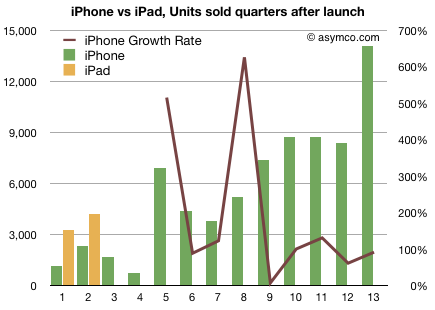
If we look at the iPhone and compare it with the iPad, we see just how popular the iPad really is. It may not follow the same seasonal pattern as the iPhone, but it will probably ramp in a similar way. In the following chart I also show the iPhone Growth rate (right scale).
The iPhone has been able to maintain over 100% y/y growth on average. I don't see a reason why the iPad can't repeat this pattern over the next three years.
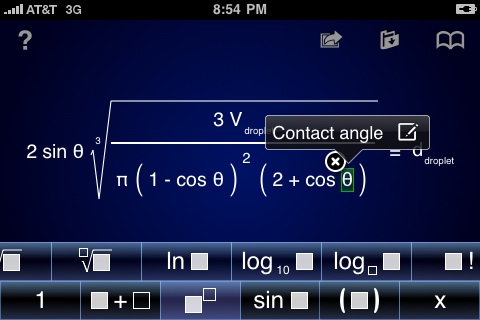
I would like to thank Sunset Lake Software for sponsoring Asymco over the past week. Unlike traditional calculators, Pi Cubed lets you construct, typeset, and instantly evaluate mathematical expressions using an interactive menu system.
The ability to compose complex equations visually and then evaluate them instantly makes the iPhone a superior scientific calculator that, with this app, takes the concept to a new level. You literally touch the equation to edit it and can enter values to evaluate it. The visual representation lets you instantly recognize errors in composition, unlike formulas encoded in textual representations. You can share it, use templates and re-use it. It even exports to PDF for use with other documents.
If you are a student of any discipline where math is used, this $9.99 app is a no brainer. If you are a professional engineer, scientist, or an analyst like myself, this is an app you can't afford not to have.
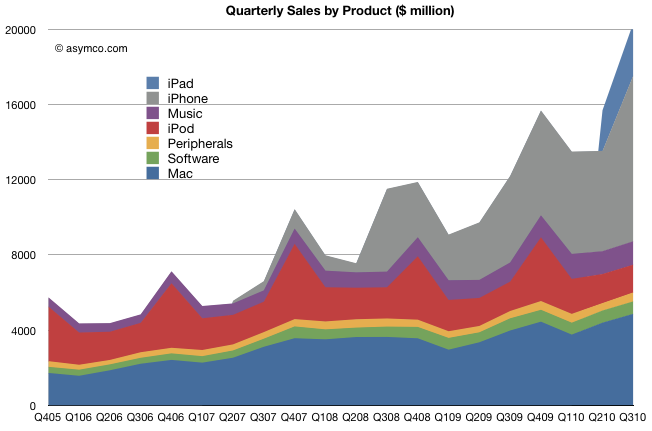
This chart speaks for itself. Note the bottom two bands and the proportion of the total that they make up.
Also note the seasonality with the holiday spikes. This last quarter is not a holiday quarter. Now imagine what next quarter will look like on this chart.
As a final note, think back to 2001 before the iPod. The the Blue, Green and Yellow bands were all that Apple had.