Broadcom, Apple extend chip supply deal through 2031
July 6, 2026 8:07 AM
July 6 (Reuters) - Broadcom said on Monday it has agreed to expand its partnership with Apple through 2031 to develop and supply a range of custom chips, sending the shares of the chipmaker up nearly 4% in premarket trading.
Broadcom has been a supplying key components to Apple for a very long time, including custom radio frequency chips used in iPhones, Wi-Fi and Bluetooth connectivity chips and other networking semiconductors.
Apple is one of Broadcom's largest customers. The iPhone maker accounts for about 20% of its annual revenue, according to analysts, making it a critical contributor to the chipmaker's business.
The extended partnership reinforces Apple's strategy of locking in long-term supply agreements with key chipmakers to bolster the resilience of its supply chain.
In 2023, the companies announced a multibillion-dollar agreement for Broadcom to develop and manufacture 5G radio frequency components.
The boom in inference - the process by which models respond to user queries - has made custom chips crucial, increasing the orders for advanced processors and intensifying competition.
While Apple has increasingly designed its own processors and, more recently, its C1 cellular modem, it continues to rely on Broadcom for key wireless connectivity and radio frequency components.
While most of the other OEMs are struggling, Apple, with its stable pricing, high margins and strong supply chain control, is in the best position to weather the memory crisis and win market share…
While most of the other OEMs are struggling, Apple, with its stable pricing, high margins and strong supply chain control, is in the best position to weather the memory crisis and win market share across key segments.
Apple’s share increases in multiple categories also reflect the increasing strength of its ecosystem, with more premium users skewing towards Apple.
“This year defines Apple’s unique resilience within the industry. The multi-segment market share gains also mean a compounding impact on the company’s ecosystem strength. Apple is still gaining new users across categories, and it will become increasingly difficult for competitors to make an Apple user switch to their operating system.”
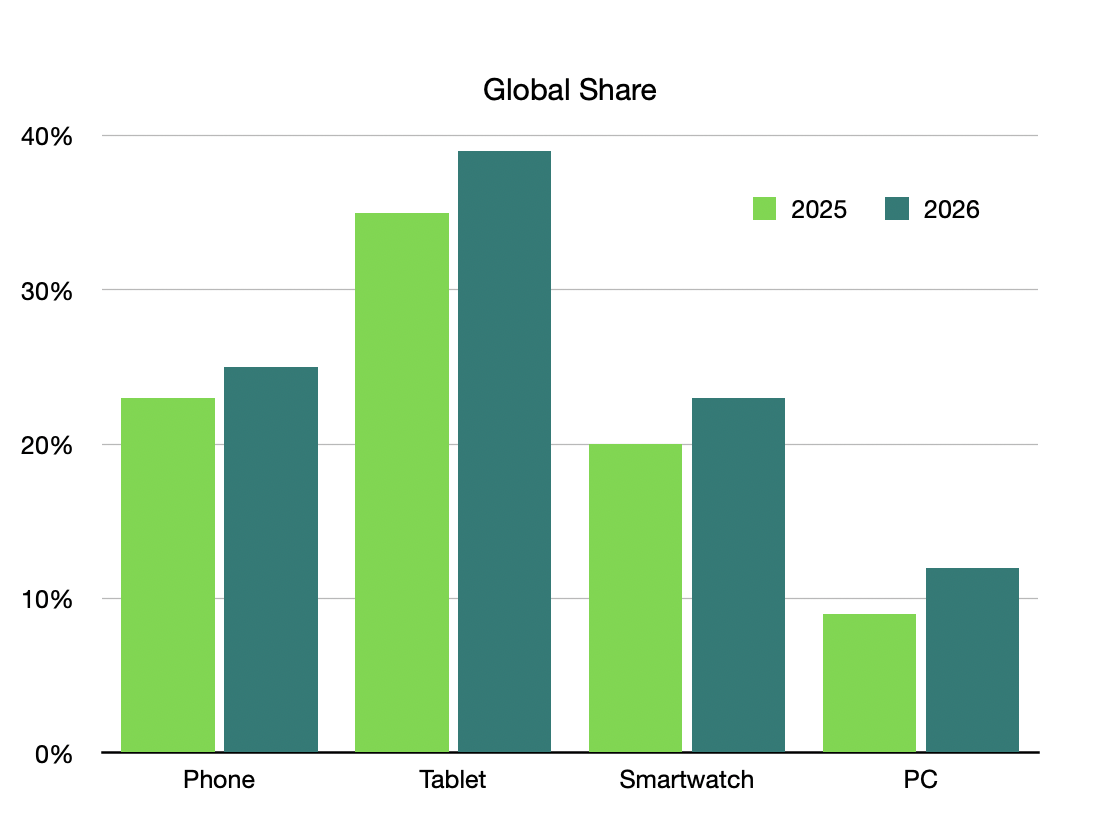
Apple’s iPhone shipments are likely to remain flat in 2026, while most of the other key OEMs will see double-digit declines. OEMs have to resort to price increases to sustain margins, but Apple has not raised iPhone prices yet. Premium segments have higher margins and can absorb more price shocks. At the same time, affluent consumers are less affected by price increases. Moreover, the iPhone 18 Pro series is expected to perform better than the iPhone 17 Pro series, and the iPhone 17 model is likely to continue its strong run in the absence of the iPhone 18 in 2026. As a result, Apple will reach its highest-ever share in the smartphone market in 2026 at around 25%.
The overall tablet market will also decline in 2026 due to inventory correction and memory shortages, but Apple is expected to grow, driven by an ongoing refresh cycle across its iPad portfolio and continued demand from emerging markets. Following the launch of the M5-powered iPad Pro in late 2025 and the iPad Air refresh earlier this year, Apple is expected to further strengthen its lineup with new base iPad and iPad mini models during the remainder of 2026. This broad refresh cycle should help Apple maintain consumer interest across multiple price tiers and better withstand the demand pressures affecting the wider tablet market, supporting further market-share gains.
Within the laptop segment, the MacBook Neo’s release will drive growth momentum in favor of Apple in 2026. Apple’s Mac shipments in 2026 will grow 23% YoY, while the overall laptop market will decline 11%. Compared to other OEMs, Apple will gain the highest percentage points of market share in the laptop segment in 2026. Within iPad and Mac as well, Apple’s share will reach its highest ever in 2026.
Smartwatches are less impacted by the memory crisis. The segment is expected to show 1% growth in 2026, with Apple growing faster than the overall segment, driven by full-year availability of the SE 3 and Watch Ultra 3 models. 2025 saw Apple’s first comprehensive portfolio refresh after 2022.
Another factor is the lowering of entry points in Apple’s ecosystem. Apple has already introduced affordable iPhone (e), watch (SE 3) and now Mac with the MacBook Neo. The company clearly wants to make its products accessible to the larger consumer base, and this is working more in its favor now as other OEMs increase prices in some segments driven by the surge in memory prices.
Apple’s share increases in multiple categories also reflect the increasing strength of its ecosystem, with more premium users skewing towards Apple. This will also mean a strong upgrade cycle for all these product categories in the future. Added to this is Apple Intelligence. At WWDC 2026, Apple showcased some strong use cases, especially for Apple Intelligence-backed Siri AI. If Apple delivers and evolves its AI landscape, it will act as a strong stickiness factor for the entire ecosystem.
Commenting on the role of Apple Intelligence, Principal Analyst Varun Mishra noted, “Apple holds the most important key, the user touchpoint across the most used devices on the planet. If delivered, a personalized Apple Intelligence will act as a strong ecosystem differentiator and unlock a new multi-device upgrade cycle for Apple.”
NB: This article was written before the price increase announced on the 25th of June. So pricing is not as "stable" as the article implies. Nevertheless, the conclusions are likely correct.
Share will grow as the effect of memory constraints will be far greater on competitors. To wit:
GoPro warned this month that it might go out of business after memory costs shot up between 80% and 115% at the end of the first quarter. And shares of speaker maker Sonos are down 23% this year as memory prices pressure margins."
Footnote: I remember when GoPro and Sonos were paraded as fantastic innovations that Apple could not hope to achieve.
More notable is that even with these high unit market shares, the share of users is significantly higher. Increasing the unit share will gradually translate in a more resilient user share in the long term. Users lead to increasing ecosystem, services and loyalty.
Overall smartphone shipments in Africa dropped 12%
According to Counterpoint Research, overall smartphone shipments in Africa dropped 12% year-over-year in Q1 2026. Factors like rising fuel prices, memory cost-driven price increases, and the region’s extreme price sensitivity contributed to the slowdown. Yet, iPhone sales bucked the trend, growing a robust 44% year-over-year.
NB: Apple does not adapt to markets. Markets evolve to become Apple markets. It's only a matter of time.
It's a myth that poor countries do not consume quality products. The cost of poor products is borne more severely by those who cannot afford quality. When the chance presents itself to escape to quality, it's taken.
This chance is helped by expanding availability through authorized resellers and carrier partnerships. Also trade-in programs and financing options making premium phones more accessible.
"Africa represents a massive long-term opportunity for smartphone makers, with a young, increasingly connected population. Apple’s ability to grow significantly faster than the market suggests its strategy of focusing on premium segments is paying dividends, even if overall volume share remains small for now."
Here is a summary of wide-ranging conversation about the 2026 memory-price shock and its consequences for Apple. Six of my answers worth separating out.
1. Why pick on memory? The politics of a commodity
My estimate is that Apple will increase by about $100 the average price of iPhones. Beyond that, I can’t analyze politics. What I do know is there are plenty of suppliers, and the memory is sourced from Asia anyway, which raises the question of why it matters so much that it not be Chinese. The memory makers are in South Korea, Taiwan supplies the processors, Japan is in there with lenses and batteries and camera modules, and there’s plenty of US content too. It’s a global train. If the decision is to pick memory out and call it "strategic", I don’t see the logic, because the penalty for not doing something is simply that there’s no supply. How does that benefit Americans? Apple is a multinational with good customers everywhere, and of all the components you could single out, memory is a peculiar one to choose.
2. How long it takes to qualify a memory supplier
When people ask how long it would take Apple to qualify a new memory supplier at meaningful volume, the answer isn’t months. Apple works on a two-year cycle for its own products. The camera lens, the battery system, the screen are all planned that far out, with targets set for suppliers to hit the quality and scale for a launch window two years away. Memory is a slightly different case, because there’s on-chip memory and there’s storage; files versus DRAM. The on-chip part has to be designed together with the system-on-a-chip, so that’s at least a year in advance. The storage memory can wait a little longer, but not much less than a year. Pricing might not freeze until six months out, which is exactly what we’re seeing now: the prices have come up because of what they’re going to be shipping late in the year.
3. Apple’s purchasing power, undermined
Apple’s strength was always that it prepaid, bought years in advance, and bought in enormous quantity, with contracts spanning hundreds of millions of devices. Nobody came close, not even Samsung [due to their far broader mix of products]. That leverage is now being undermined by new buyers willing to commit the equivalent amount, except they aren’t serving hundreds of millions of devices, they’re serving data centers measured in the single tens of millions of processing units. Orders of magnitude fewer devices, but far more memory per device. It’s been a lot of money dangling in front of a few suppliers, who decided it was better to take the cash and run. But this may pass. Two years from now, the ones who screwed Apple may find that Apple has a long memory and a grudge.
4. The hundred-year flood
Tim Cook said he’s never seen anything like this in forty years. A hundred-year flood. So when his warning came through the Wall Street Journal, it surprised me, because it suggested things may not be lining up into next year. His phrasing was careful: running out of options. Part of that could be cover for John Ternus, framing the trouble as on Tim’s watch so John can take over in the fall and look like the hero, though I won’t read it that far. What I will say is that Tim is the man who works on exactly this, the planning and predictability and negotiating in advance, and it’s his forte. It felt like he was shaken. It sounded unprecedented to him, and he wasn’t in his element.
5. Memory is the new gold
Price-insensitive buyers are purchasing everything in sight and skewing the entire market. This was supposed to be a settled issue, a commodity nobody worried about, and yet here we are. It belongs in the same family as the battery and rare-earth and quality crunches we’ve weathered before. It’s a moving target, and the memory case shocked everyone precisely because we thought it was long gone. Even Tim said he hasn’t seen anything like it in forty years. A hundred-year flood, and we’re all out of our element.
6. If Apple sneezes, everyone else catches a cold
The analysts watching the whole industry think the phone market collapses 12 to 20% this year, which would be the worst year for smartphones on record. We’ve never seen a double-digit decline, not even during COVID. Profits will evaporate. The number-three vendor globally is already down around 60% on the year, and Oppo and Vivo will almost certainly be in the red. That leaves Samsung, who happens to be a huge memory maker and whose stock has actually benefited. If Apple sneezes, everybody else has the flu. The silver lining is that Apple may gain share in a shrinking market, which has already happened in the first half, helped by the supplier inventory it carried over.
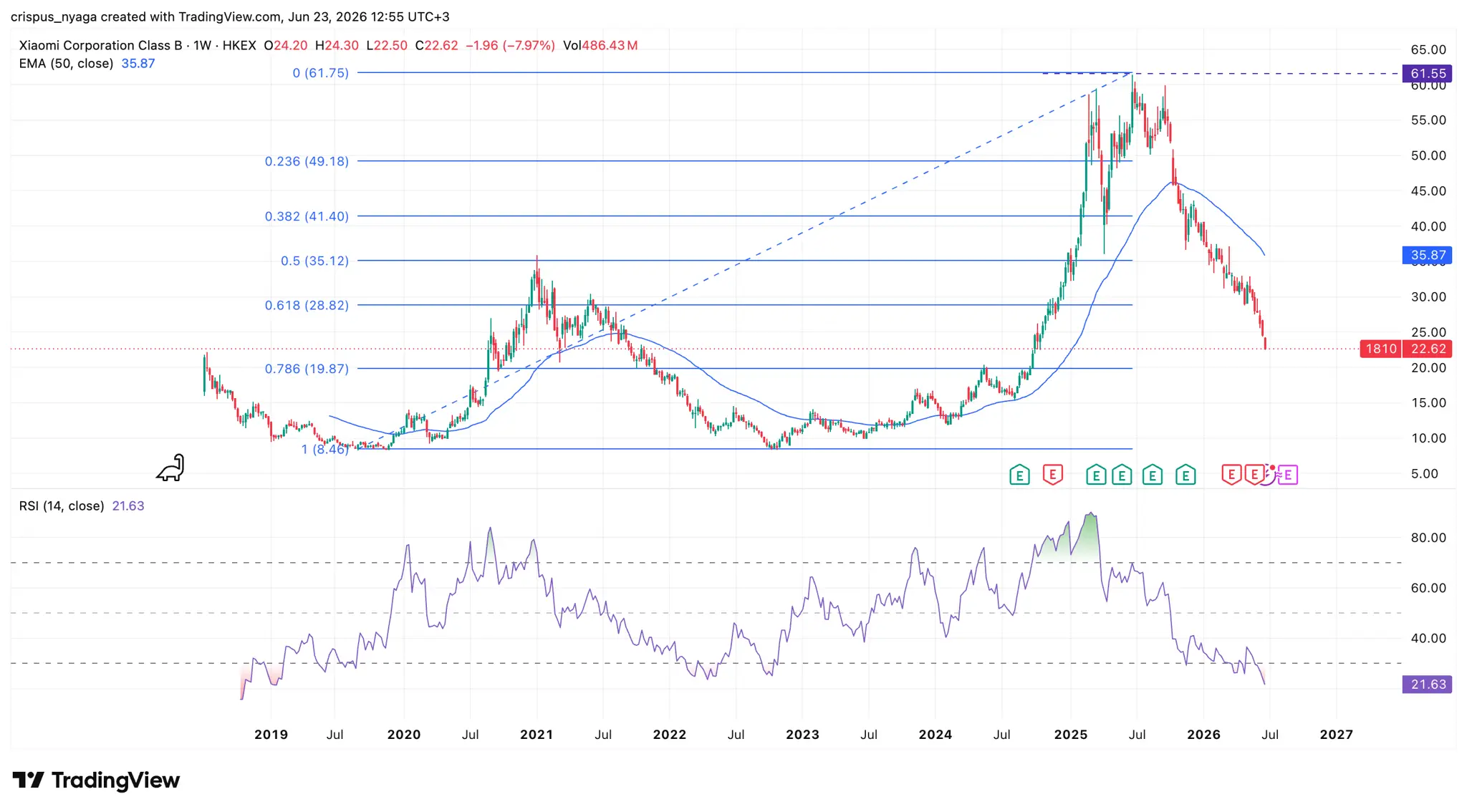
Xiaomi stock price has suffered a major reversal in the last 12 months, moving from a high of H$61.55 to H$22.62 today, its lowest level since September 2024, with its market cap falling from H$1.53 trillion ($192 billion) to $74 billion. This retreat has happened amid the soaring memory prices and the ongoing retreat in EV stocks.
Xiaomi has also struggled because of its electric vehicle business. While its EV sales are rising, there are concerns that demand will wane after Beijing ended its subsidies earlier this year. All EV stocks have plunged sharply this year.
The most recent results showed that Xiaomi’s business is going in reverse gear. Its revenue dropped by 10.9% to RMB99.14 billion in the first quarter from the previous year’s RMB111.2 billion.
Its profitability metrics were worse. Its profit for the period declined by 56.5% to RMB4.7 billion, while the operating profit fell by 60% to RMB5.3 billion. These declines were mostly driven by the smartphone segment whose shipments dropped to 33.8 million units from 41.8 million in the same period last year.
The same slowdown is happening across its other segments. Vehicle deliveries dropped to 80,856 from 145,115 in the fourth quarter.
NB: Selling cars, eh? 19% phone unit sales drop contributed to the story but cars are a disaster. A phone maker selling cars is a bad idea. Almost as bad as a car maker building robots.
Xiaomi is being dubbed "China's Apple" but unlike Apple Xiaomi is undisciplined about what segments to enter. Xiaomi initially decided to "fast follow" Apple into cars but when Apple cancelled their project, Xiaomi either could or would not do the same. So they plunged into a capital intense, slow to evolve, highly regulated and indefensible market.
Of course, the phone business is not great for them but they had a chance to differentiate with design for those who would insist on a Chinese phone.
Mixing phones and cars means mixing two completely orthogonal businesses. There is zero overlap in design, manufacturing, distribution, capital allocation, cycle time of product launch, and brand risk/reward.
Car makers have had more than a century to diversify. Every attempt failed.
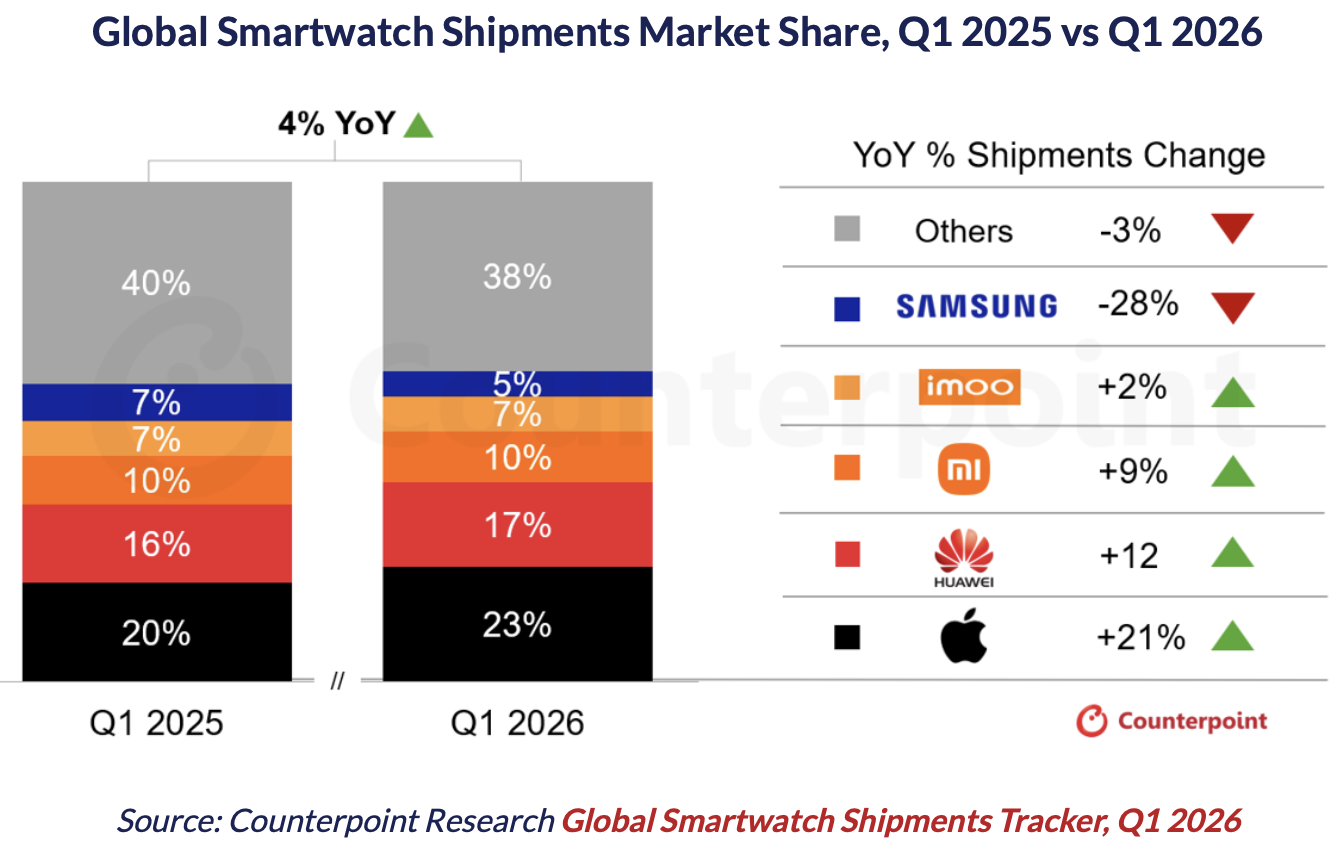
Apple grew at 21%. Global market grew 4% with forecast is 3% growth through 2030
Global smartwatch shipments grew 4% YoY in Q1 2026, driven by continued Apple adoption and the China market’s recovery.
Apple shipments rose 21% YoY, the fastest growth among the Top 10 brands.
Following the extension of the Chinese Government’s electronics subsidy and the rise of local demand, Huawei and other Chinese brands regained momentum.
Rising memory prices are expected to have a more limited impact on smartwatches given their lower BoM costs.
Commenting on Apple’s performance, Counterpoint Research’s Principal Analyst Anshika Jain said, “Apple has captured the highest shipment share of 23% and emerged as the strongest performer in Q1 2026, driven by the continued success of its refreshed lineup. While North America contributed over half of the total shipments of Apple, China and Europe recorded the fastest growth for the brand. The addition of meaningful health upgrades and the affordable SE 3 attracted new buyers.”
Emphasizing the rising ASP, Jain added, “Smartwatches’ ASP rose by 6% YoY in Q1 2026. The major drivers were the integration of improved sensors and advanced technologies to support health monitoring and AI capabilities. In addition, consumers’ transition from basic smartwatches to advanced smartwatches in emerging markets like India is also driving the overall ASP growth.”
The smartwatch market regained momentum in 2025 after a slowdown in 2024. This recovery was driven by brands introducing a variety of new features, such as satellite connectivity, 5G RedCap, AI capabilities, and more advanced health tracking for conditions like sleep apnea and hypertension. This has helped build strong growth momentum in the market. However, recent memory shortages and macro-economic factors are expected to slightly impact the overall growth rate for 2026. Even so, the effect is likely to be less severe than in other consumer electronics segments, supported by comparatively higher margins in premium smartwatches. As a result, the smartwatch market is projected to grow at a CAGR of 3% through 2030.
NB: 3% growth through 2030 is no growth at all. Non-consumption is catastrophically high and yet Counterpoint projects zero growth over four year. Apple's share at 23% roughly matches smartphone share and that may be plausible however the market for watches is still modest relative to the phone market. Something does not add up. Here are the numbers…
…There are an estimated 650 million smartwatch users worldwide. That is super low relative to phones and even estimates that the user base is projected to surpass 740 million by 2029 seem weak. There are approximately 5.78 to 5.83 billion smartphone users making watch penetration by 2030 barely 12%.
Only one in eight smartphone users uses a smart watch. How can 3% growth be acceptable?
There is enormous headroom for Apple Watch and I believe penetration is proceeding at a measured pace (20% growth is above iPhone over longer periods). The opportunity, like that for the Mac, is to address non-users with a compelling new value proposition. Is AI such a proposition? Perhaps, though it will take years.
A more likely catalyst is still a "killer app" for health and wellness. It's cheaper than GLP-1 drugs and has more of a chance to change habits.
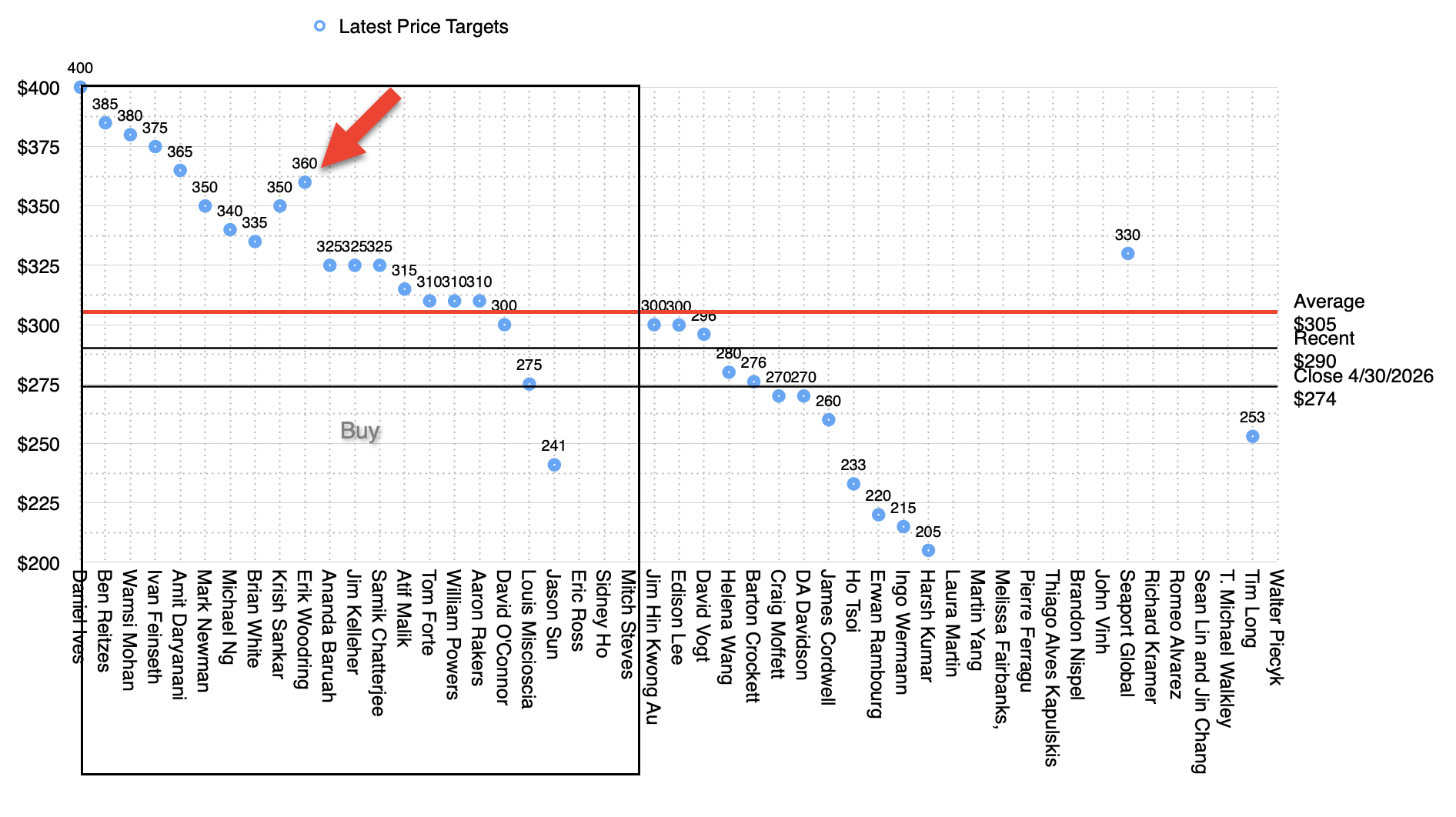
TD Cowen analyst Krish Sankar assigned a Buy rating to Apple yesterday and set a price target of $350.00. The company’s shares closed yesterday at $301.54.
Separately, Morgan Stanley analyst Eric Woodring also weighed in, maintaining an outperform (buy) rating on the stock while increasing his base price target to $360 and his bull target to $440, or 51% potential upside. He said this event "has the chance to reframe Apple as an AI winner."
NB: New average is $305. Published targets: 34. Analysts following: 41
The moves follow WWDC and might suggest relief that performance expected will be met. Note well that this AI adoption cycle will be slow. My expectation is 10 years to 50% penetration. (I measure penetration as percent of Apple uses using Siri AI at least once a week.)
In 2018, Apple became the first U.S. company to attain a $1 trillion market cap, jostling with Saudi Aramco for top spot globally. At that time many on Wall Street threw in the towel, concluding that the stock had peaked. I remember reading many analyses saying that what goes up must come down, whoever reaches the top inevitably falls, the law of large numbers, its best days were behind it. Indeed, at that time, roughly half of the analysts covering the stock rated it a hold or a sell.
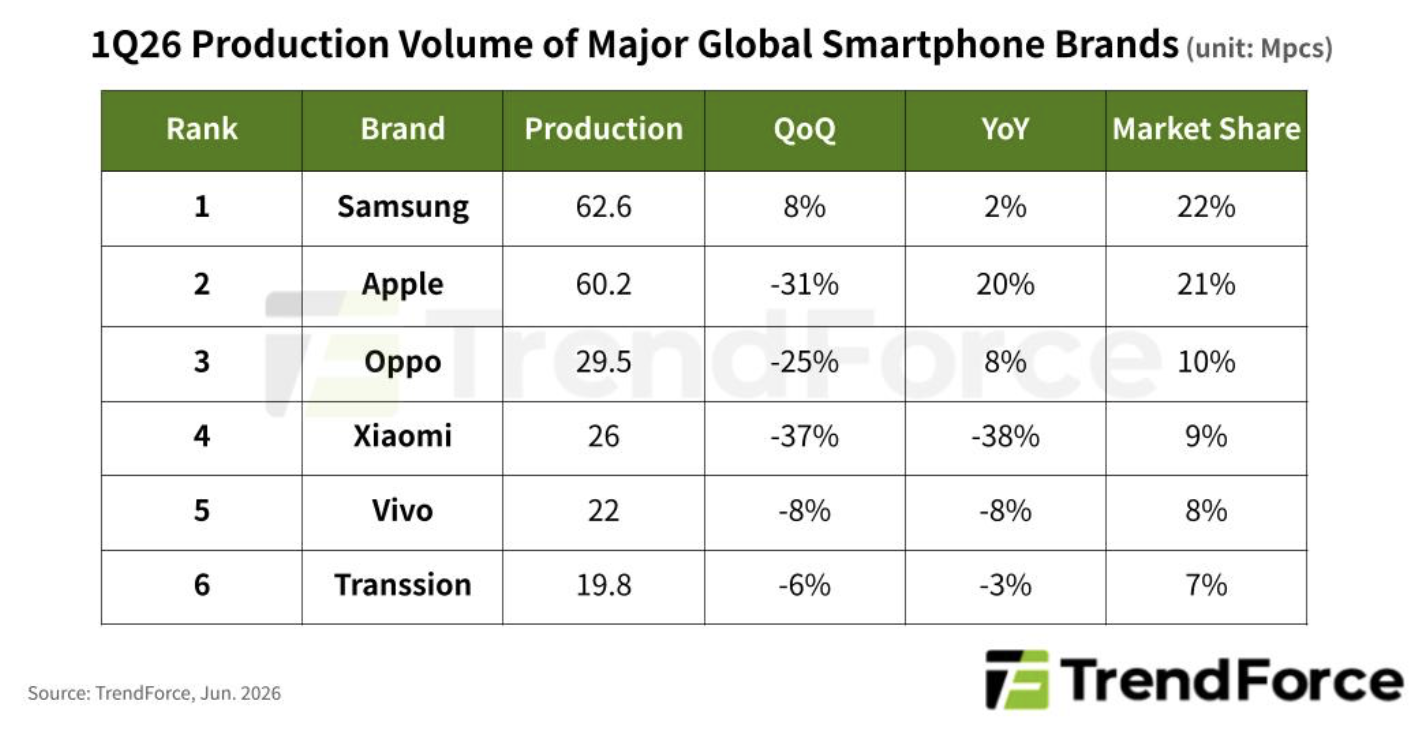
TrendForce’s latest figures reveal that global smartphone production reached around 284 million units in the first quarter of 2026, marking a 1.7% YoY decline. Despite a sharp rise in memory prices since the second half of 2025, the effect on production was minimal because brands still held inventories of cheaper memory components. Additionally, consumer expectations of higher prices in the future have helped sustain short-term demand, cushioning the impact of rising memory costs on production during the quarter.
However, as low-cost memory supplies are gradually exhausted and significant ongoing increases in memory prices reduce profits, most smartphone brands have begun adjusting production in the second quarter.
Looking ahead, TrendForce forecasts global smartphone production to decline approximately 16.2% YoY to 1.051 billion units in 2026. Under a more severe scenario, the annual decline could become even more pronounced if memory price increases remain elevated and brands are forced to raise retail prices repeatedly.
TrendForce notes that Samsung is relatively well-positioned to withstand the current cost inflation cycle thanks to strong financial backing from the broader Samsung Group and a sizable premium product portfolio. Nevertheless, its significant exposure to lower-end models remains a concern—particularly amid weakening consumer sentiment—making end-market demand a key factor to monitor.
Apple ranked second with its production of approximately 60.2 million units during the quarter. In addition to ongoing production ramp-up for new iPhone models, output was supported by the launch of the iPhone 17e, resulting in 19.7% YoY growth.
Compared with competitors that have already entered a margin-protection phase, Apple remains better positioned to absorb higher memory costs while maintaining profitability. TrendForce believes Apple is more likely to prioritize market share expansion during the current downturn as it lays the groundwork for future growth in recurring software and services revenue.
Xiaomi, Oppo, and Vivo focus on preserving profitability as production plans face greater uncertainty
First quarter production declined seasonally among the major Chinese smartphone brands, including Oppo (29.5 million units), Xiaomi (26 million units), and Vivo (22 million units). These three brands ranked third through fifth globally by production volume.
While all three delivered strong market share gains in previous years, surging memory costs are now weighing heavily on profitability, creating significant uncertainty around their 2026 production plans. As a result, production targets may be revised downward if cost pressures persist.
Transsion produced approximately 19.8 million units in 1Q26, roughly flat compared with the same period last year, placing sixth among global smartphone brands.
The brand has been particularly vulnerable during the current memory price supercycle given its smartphone portfolio is heavily concentrated in entry-level and budget segments—where profit margins are already thin. Limited access to low-cost component inventories has further amplified the impact.
NB: Counterpoint tracks sales, Trendforce tracks production. The production data may include inventory build-up not shown in sales while sales may include drawdowns not shown in production. The two analyses however agree on a market under significant supply-side stress. Profitability is a big concern and availability of components is critical. As noted previously in response to Counterpoint reports, the 2026 full year volumes will probably show the worst decline in decades.
Apple's position is highlighted in the quote above. I'm glad Trendforce believes Apple's priority is on market share expansion with the intent of driving future services revenues. Note well that none of the other vendors offer notable services.
One Foundation Model runs on Nvidia GPUs hosted in Google’s cloud and some Google proprietary model data used to refine Apple's Models.
Apple has shared new details about the technology behind its latest Apple Intelligence platform, explaining how its new Apple Foundation Models (AFM) work and clarifying the company's relationship with Google. During a post-WWDC technical discussion, Apple executives said the company does not use Google’s Gemini models, Google Search, or Google Assistant infrastructure to power Siri or Apple Intelligence
Craig Federighi, Apple’s Senior Vice President of Software Engineering:
“Of course, we don’t have the Gemini app as our app. In fact, none of that client code is part of how we run on iOS. For these models, we use none of the models that Google deploy to their customers, nor do we use the infrastructure and means by which they deploy models to their customers. And then, when it comes to the knowledge base, we of course don’t use Google Search or anything like that as the foundation of our system. So I hope that’s clear. The amount of the Google Assistant we use is none.”
AFM Core (used for expressive voices and invitation capabilities on device)
AFM Core Advanced (on device)
AFM Cloud
AFM Cloud Image image generation and editing tools, including spatial reframing
AFM Cloud Pro complex reasoning and agentic actions; Nvidia GPUs hosted in Google’s cloud
These models are custom-built for Apple Silicon, trained using proprietary data, and refined using outputs from Gemini frontier models. The company emphasized that there is no direct use of Gemini itself.
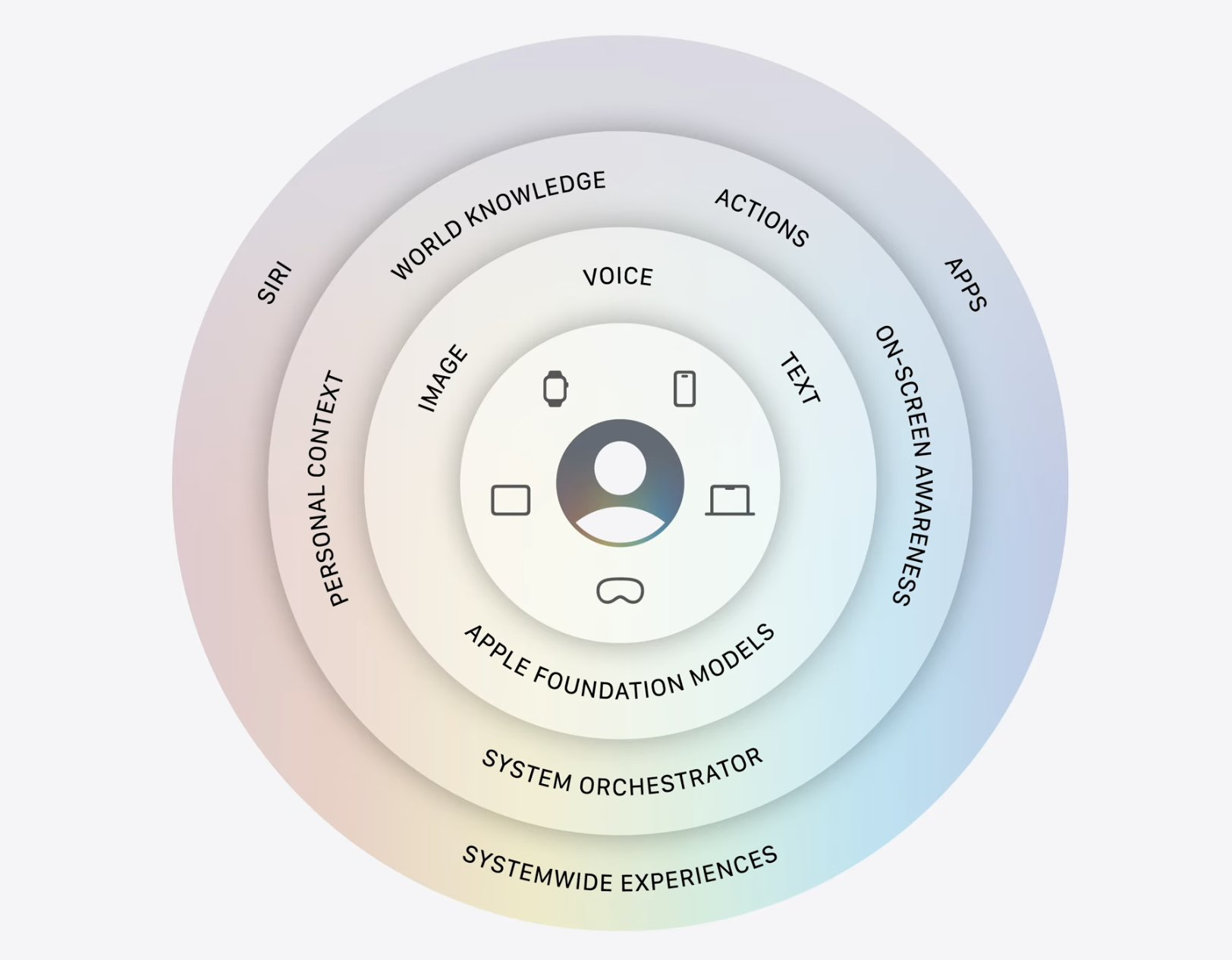
Note that at the heart of the system is a decision by System Orchestrator, which routes requests to run on-device or through Private Cloud Compute. This "Neo Operating System" funnels multiple contexts for input: app actions, personal content, a semantic index, on-screen context while maintaining privacy.
Traditionally routing inputs and outputs, managing resources and protecting user data was the domain of the Operating System. The Orchestrator sounds to me like an OS for AI. Slipping in a new OS layer to accommodate AI properly on any device is demonstrably sustaining to Apple's core value proposition. Integration, safety, abstraction. All leading to comfortable adoption and engagement with the new technologies. Always has been.
Apple has cumulatively shipped over 450 million Apple Intelligence-capable iPhones till Q1 2026.
Apple has the largest number of smartphones with consumers which are capable of GenAI as compared to any other brand.
At WWDC ‘26, Apple needs to deliver a revamped Siri showcasing practical use cases, making a strong statement.
Although iPhone sales remain strong, competition is already moving ahead in terms of AI, and Apple must be ready to follow since Agentic AI has the potential to redefine the smartphone industry.
NB: Words like "needs", "must", "follow" contrast with minimal evidence of demand.
Effectiveness is a number. Efficiency is a ratio. No bank has ever accepted a ratio as a deposit. Counterpoint continues: "Although the lack of a more fully AI-featured Siri…
…has not impacted Apple’s sales yet; iPhone 17 has been performing better than its predecessor with iPhones revenues hitting a first quarter record. This indicates that AI is not a primary buying factor for iPhones."
Not only that but what will make AI a buying factor is whatever Apple delivers. AI market creation will happen by means of AI discovery by users. Whatever they discover has to have a job that it's hired to do.
Chatbots and search are known for what they can do and are not creating new markets.
450 million devices a real number. The ratio of how many are actually used for AI remains to be measured.
If it wasn't for the MacBook Neo the fall would have been much worse.
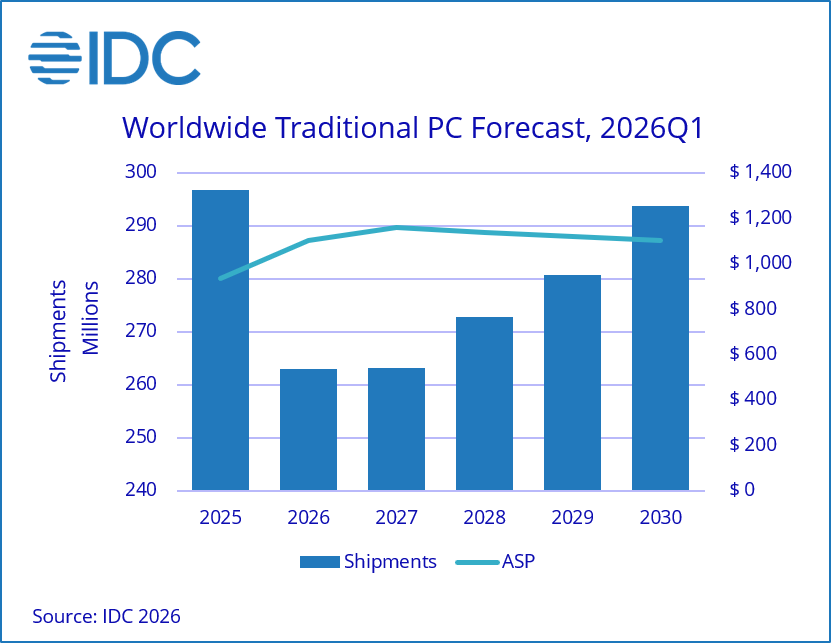
IDC now forecasts global PC shipments will decline 11.3% for the full year, with conditions worsening progressively through Q4, when shipments are expected to fall 20% year-over-year.
Pull-forward demand masked the problem, temporarily
The first quarter of 2026 offered a deceptively encouraging signal, with shipments growing 3% versus the same period last year. But that strength was largely borrowed from the future. Buyers, both consumer and commercial, accelerated purchases ahead of anticipated price hikes and product availability constraints.
Pull-forward demand masked the problem, temporarily
“The anticipation of rising prices and of limited availability of some system configurations due to memory and other component shortages has led some end-users to make purchases earlier than anticipated,” said Jean Philippe Bouchard, Vice President of Devices and Consumers at IDC. “We’re not seeing any relief to the memory shortage situation before the end of 2027, which means prices will continue to rise and PC manufacturers will struggle to maintain full product portfolios for the foreseeable future.”
One notable wildcard is Apple’s MacBook Neo, which has driven stronger-than-expected notebook demand and prompted IDC to revise its notebook forecast upward.
NB: The problem is a memory shortage: PC manufacturers are struggling to maintain product portfolios.
“The introduction of the MacBook Neo is putting real pressure on the entire PC ecosystem,” said Jitesh Ubrani, research manager for IDC’s Consumer Devices Trackers. “We expect vendors to respond with a combination of new silicon, a more efficient OS from Microsoft, and aggressive promotional pricing.”
“The competitive pressure from the Neo is providing a partial offset to broader price increases, keeping some low-cost notebook options alive. But the overall trajectory for average selling prices (ASPs) is firmly upward. IDC forecasts ASP growth of 17% in 2026, and even as memory capacity expands over the next two years, pricing is unlikely to return to 2025 levels,” Ubrani added.
As the graph shows, IDC forecasts no recovery in volumes until after 2030. This is a multi-year opportunity for Apple and may reset market share dynamics permanently.
As the graph shows, IDC forecasts no recovery in volumes until after 2030. This is a multi-year opportunity for Apple and may reset market share dynamics permanently.
Recall that just a few days ago IDC forecast that smartphone shipments are headed for a 13.9% decline in 2026. This is even worse than the 11%+ for the PC market. The production planning in Cupertino must be feverish, more so perhaps than during the Covid supply chain disruptions.
The question is whether the Windows PC market will experience permanent demand destruction. One could imagine that, apart from Apple, PC users might consider cloud-based services sufficient without hardware upgrades. In this case, the AI "disruption" will not only cause a surge in pricing and a transient shift to Macs but it might decrease appetite for PC hardware altogether.