An Office Hours question asked by Craig D., July 31, 2026.
Q: Cook's moat was built by being the biggest buyer in a market where consumer electronics set the bid; hyperscalers set it now. Is he handing Ternus a structurally diminished asset — and does an engineer CEO help or hurt when the binding constraint is procurement rather than design?
As Tim Cook says, this is the 100-year flood. The fact that there's a flood doesn't mean that you shouldn't live in cities. It so happens that floods damage cities more than they damage rural lands, because there's a low density of people there. The floods don't change our architectures. We might try to prevent them in the future, we might build dams. There are countries that live with earthquakes, like Japan; there are countries that live with all kinds of other natural disasters. And this should be seen as that.
I think Apple's not going to say: these semiconductor companies made a lot of money, let's become a semiconductor company. They made a lot of money, and it could kill them. It's possible that the decisions they make now, in this moment of abundance — it's like winning the lottery. That doesn't make you rich. A lot of people who win the lottery will actually end up broke, and worse off. It's almost guaranteed in some cases that a windfall is damaging.
The way you think about this is: is it likely to happen again? If so, we better protect ourselves. And Apple did protect itself. It was damaged by retail, damaged by distribution back in the old days, so they built stores — and everybody said that's a dumb idea. Then they said: we got damaged by Intel and Microsoft, so we built silicon. Then we built our own browser. All of these were reactions — the birth of Safari, the birth of silicon and Maps. All these were reactions to the fact that Apple was not in control of the things it needed to preserve and protect itself. I would even argue that Android was such a thing for Google. They needed to protect themselves against Microsoft controlling all access to end users. Microsoft together with Apple, but Microsoft was a far bigger threat than Apple was at the time. So they got into things they didn't necessarily want to do, that were not natural. Apple is also not naturally a content creator, but they got into TV. It had to be done.
Semis are complex, but also simple. As businesses, they're very, very tough. And they're not great, which is why we have so few people involved. And then you get into a situation where, lo and behold, things are really tough. You treat it as something you need to make sure doesn't happen to you. You have to have fire departments, because you have fires once in a while. I think they're just going to work their way through this.
Having leverage is not because they're mean and evil. Having leverage is because they are in the right part of the value network, where the customer is most important. Having that relationship with the customer determines everything, including saying: after we get scale, we're going to make sure we get a good price from suppliers. But it isn't like you started off saying, we're going to build a computer company and we'll begin by twisting the arm of everybody who makes chips. That's not how Steve thought, and it's not how anyone has thought since. It's all about: I want to focus on customers, but I don't want to be blindsided by some random natural phenomenon that's out of my control. And for that, you have to build insurance.
Editor's Note: This was one of the questions asked by participants in Asymco's July 2026 Office Hours live Q&A session, held the day after Apple's FQ3 2026 earnings and open to Asymco One subscribers.
Subscribe to Asymco One for full access to this and other content.
An Office Hours question asked by Jared P., July 31, 2026.
Q: Will Apple continue developing the Vision Pro? Hopefully there's a growing community.
Absolutely. The more time goes by, the more I think it's evident that it's a project Apple is doing because they think it's worth doing. It's not motivated by the other product histories or anything. They feel this should be done.
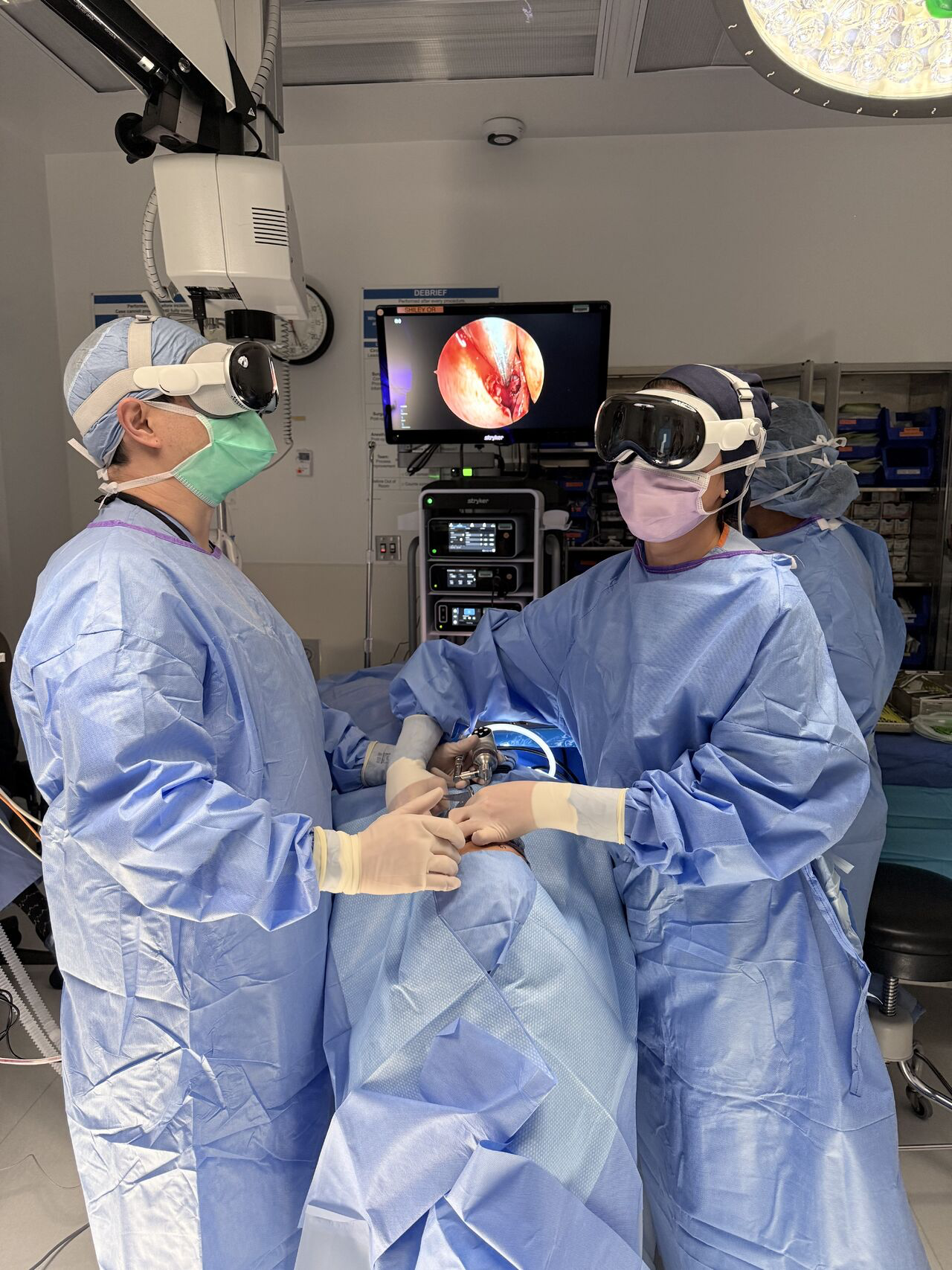
I'm not sure I can reveal, but I've been working with people in the healthcare world who use these products, and we have a paper coming out. It's amazing the way it transforms some of these professions. Some are in engineering, but some are in healthcare, particularly in surgery. When Apple is putting this out there and seeing residents with surgeons, it may learn from that, it may develop it, but I don't think it's a cynical move. I think they're just going to say: it's a good thing for surgeons to do this, and maybe that's why this product should exist.
Far more interesting — and I have written a piece about this — is plain old glasses. When you look at that market, they're probably folding a lot of the learning from the Vision Pro into a new form of wearables that are on your eyes. I'll give you a very simple example. You have a relationship with Carl Zeiss. Zeiss makes the drop-in lenses for the Vision Pro. Amazing how easy it is to put them in. Why? Because they're magnetic. Who's ever done a magnetic frame for glasses?
When the Apple Watch came, it was a tremendous innovation in the way the bands work. Bands were user-replaceable, in an instant, super easy to take on and off with the design of the loop. We forget that Apple changed the way watches are worn and put on, and the fact that you can create accessories for them. Now, for spectacles: the idea of a user changing lenses, the idea of perhaps even having those lenses be somehow magical. How much of that learning about behaviors with face-worn devices comes because of the research project that is effectively the Vision Pro?
Historically, they probably had these research projects internally. They would learn internally and launch ten years later. In this case, they decided to make the experiment global, and had their customers and developers identify killer applications. It's a very different approach. It's not something Steve would have done. The Vision Pro is following an emergent strategy, and people are not used to Apple doing emergent strategies in the wild. Not to mention the price point, not to mention it's not part of the Upgrade program. But I think they're going to keep it going and make improvements to it. Maybe the ultralight version has been put on hold while they develop the glasses — at least this is the rumor — and I don't find that alarming at all.
I think glasses are a huge opportunity. Glasses are bigger than watches — far bigger, it turns out. You should read the piece I wrote about EssilorLuxottica, one of the most incredible business stories ever, and how the industry of eyewear has evolved. It is ripe for, if not disruption, then transformation: injection of software, injection of sensing, injection of new technology. All of that is perfect for Apple. It hasn't been scratched by others yet, even though we have Meta in there. AI is going to also be sustaining it. My enthusiasm for the Vision Pro is becoming an enthusiasm for eyewear in general. Whether it includes displays or not is just a matter of time before we get to face-worn machines that are effectively ubiquitous. More people will wear a computer on their face than on the wrist — and maybe as many as will carry one in their pocket.
There's a lot of focus in glasses, with Meta and everyone else, on recording what you're seeing. But the job of putting cameras on this thing is not its purpose. Its purpose isn't to capture data. This is one of those things that also confused people when it came to smart speakers. I pointed out that a smart speaker is actually a smart microphone. Only Apple's entry bothered with the acoustics, bothered with making something that sounds great, and positioned it as a great speaker. It didn't succeed — there were other reasons for that — but everyone else approached the problem saying: we just want to listen to what everybody says when they want to ask something. They approached it as computational acoustics, which, by the way, is prevalent in all kinds of products today. The idea of spatial audio comes from it.
When it comes to wearables on the face, the job is going to be optics. When the Watch came out, they said: by the way, it's a timepiece. It took a lot of cues from timepieces, a very old category. So if you study eyewear, you have to study deeply what people are using it for. It isn't natural at all to use eyewear to take pictures. What's natural is to see better. The whole objective of eyewear is to give you clarity, not to collect information and process it in the cloud. So you pivot away from what the early versions of the products are. You listen to what the early entrants did and you get confused, because they all had the wrong jobs, or the wrong approach, or the wrong processes, or their own priorities. And you assume that what they did is what Apple's going to do. They're going to come at it a whole different way. Of course it can see — but to the extent that it can see, it helps you see. I really think they're going to position it as a great optical device, as they did with the Watch, saying it's a great chronograph.
Editor's Note: This was one of the questions asked by participants in Asymco's July 2026 Office Hours live Q&A session, held the day after Apple's FQ3 2026 earnings and open to Asymco One subscribers.
Subscribe to Asymco One for full access to this and other content.
An Office Hours question asked by Bob V., July 31, 2026.
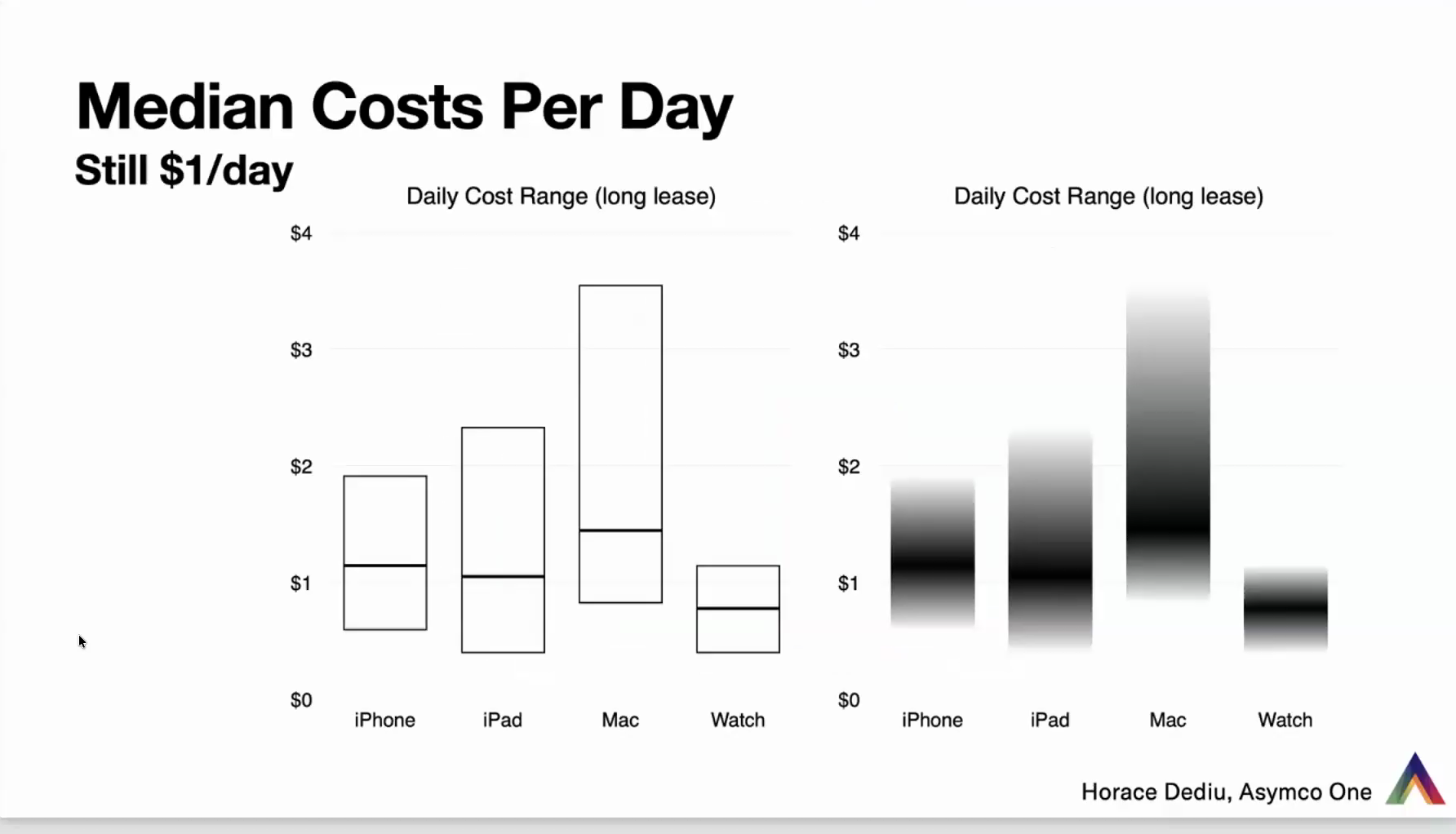
Q: Is there any “message” in the short-term versus long-term lease price difference between the iPhone and the iPad? I recall the iPhone being about 1:1.5 and the iPad being closer to 1:1.
This was a surprise to me, because I've never bothered with trying to figure out all the permutations and configurations of iPads out there. When I did it, I thought: wow, there's a lot more than I thought. (The back catalog is even more, but they took away a lot of options when you do the lease.) As it happens, the medians tend to move around.
Why is there this similarity between the short term and the long term on the iPad? It might have something to do with the depreciation rate. iPads, as opposed to phones, probably last longer, and they calculated these prices on that basis. Remember, they have to consider the residual value: what are they able to get for the product once they get it back.
I think all these prices are algorithmic. You couldn't have somebody suggest the price; you would have to calculate it every time. You see $50.01 — that's the two-terabyte 11-inch iPad Pro. You could give this as a research topic for a business school student, to try to understand what's going on here. It's fascinating, because I spent a long time trying to figure out iPhone pricing, and the feedback I got was that there's a very directed approach — they're doing it on purpose. The choice of prices is part and parcel of the product development. This is somehow different. Maybe it learns from that, it feeds into it, there's human input, but then they calculate these prices based on the economics of the product in use. That's probably what's going on here.
We'll have to see if they change this. We have to track it — build an AI to scrape all this data, because there's no easy way to do it. You have to click a lot to get even what I got. It's a full day's work. Someone has to sit and do it every day to make sure prices haven't changed. Somehow we need to automate this and track the evolution of pricing as if it were a market signal.
When I saw it, I said: something's different. This is not the way Apple's ever done things. Maybe it's reading too much into it, but think about the implications even from the accounting point of view, because this is not a sale. Do they book it as a sale if the product is in the hands of the consumer? Do they put it in Services somehow? I don't think technically you're allowed to declare a sale unless Klarna buys it from you, or something like that. The answer would be to look at how accounting for leased products is done.
Editor's Note: This was one of the questions asked by participants in Asymco's July 2026 Office Hours live Q&A session, held the day after Apple's FQ3 2026 earnings and open to Asymco One subscribers.
Subscribe to Asymco One for full access to this and other content.
An Office Hours question asked by Frederick H., July 31, 2026.
Q: What job does a foldable iPhone accomplish? Aren't iPads suitable for a decent screen experience, and iPhones for what they do, with plenty good screens?
Honestly, I don't feel I have that job to do. I have an iPad mini, in a waterproof case, and the new supposed Fold product — I don't like to talk about rumors, but it is pretty believable by now — is not going to be that much smaller than this. And I don't find myself reaching for the iPad mini if I have my iPhone in hand. Now, if it were to open up, maybe I would watch a few things there. But I'm still so used to the form factor of the iPhone that I'm not sure I would crave a new form factor. But then you never know.
One of the things that surprised me about my own job to be done: back in the day, remember when the iPhone was small. It was tiny — look at an original iPhone. Then the 4, then the 6, began to be bigger. Then there were the Max sizes, and I kept saying the problem with the Max, or any big iPhone, is that you can't reach all the points on the screen with one hand. It becomes a two-handed device, and I thought that was inconvenient. I always thought the majority of people would prefer smaller phones that were easy to put in your pocket and completely usable with one hand. But it turned out I was wrong. Big screens were desirable. I myself ended up with one, and now I only get the Max form factor. So maybe we need to try it before we learn what it can be used for.
I have other reservations — durability reservations, price reservations. Any moving parts are bound to fail sooner than those without moving parts. But some people have convinced me that there is a significant market out there for this product, if only to demonstrate that you are able to buy one. That alone may drive sales for at least the first quarter or two. So it isn't clear what the job is. I do believe, though, it'll do fairly well.
The other thing against it is that the other fold products, from Samsung and others, haven't done that great. They've been around for six years or more, and no one seems to say this is the greatest thing and everyone's switching to it. Perhaps Apple's version will be the perfect match, the perfect package, perfect in every way, that will cause adoption to take off. So I think it's a wonderful addition to the portfolio, but perhaps again a little bit more towards the highest end, and limited in how many users will take it up. Let's see how it goes.
Q (follow-up, Frederick H.): What would a foldable phone do to iPad interest? Is this an experiment? And how does this relate to the apparent convergence of Apple's software platforms?
If, when you open it, it looks like an iPad mini — people are speculating about this — the operating system will be effectively two operating systems: the small screen and the big screen. Apple has a great interface for big screens in iPadOS. Then the question is: is there value in having your iPad in your pocket with you? I think it's going to be an experiment. We'll see how people and developers take to it.
Editor's Note: This was one of the questions asked by participants in Asymco's July 2026 Office Hours live Q&A session, held the day after Apple's FQ3 2026 earnings and open to Asymco One subscribers.
Subscribe to Asymco One for full access to this and other content.
An Office Hours question asked by Joseph B., July 31, 2026.
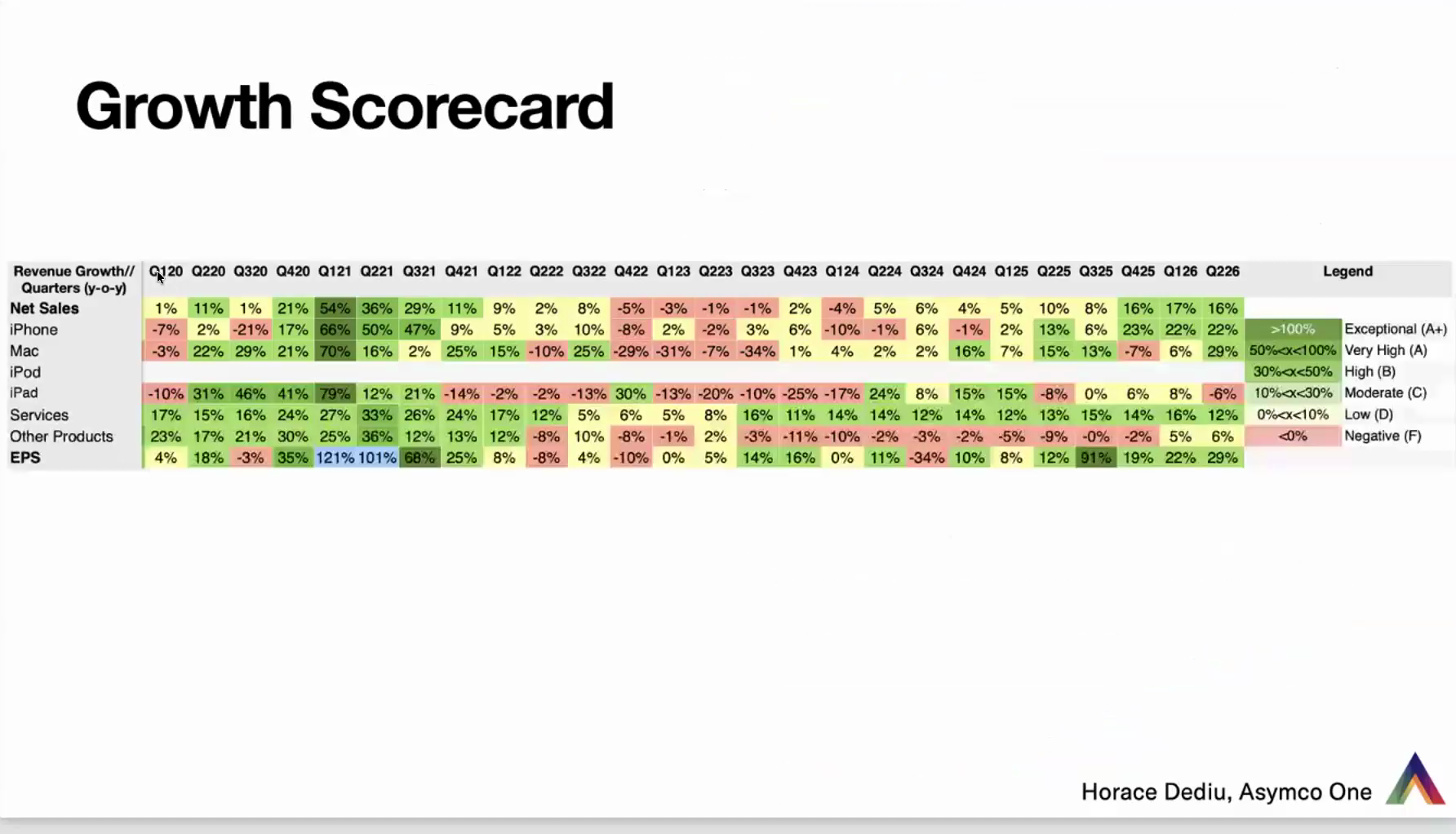
Q: What's up with the guidance? And why does this seem to be news to Mr. Market?
Start by not getting emotional about this, because I've seen so many times mispricing of Apple. But the market, as they say, is always right. It is simply the voting of a lot of people, and what it determines is the market price. It doesn't determine right or wrong, it just says that's what the market thinks.
The thing about the last few weeks, or even months, has been that Apple's been caught in a debate about whether AI is going to pay off or not. It was used by a lot of people who wanted to rotate out of AI names into something safe, and Apple seemed to be that choice. Apple never wanted to be chosen as a safe harbor. Management doesn't have that as their KPI, or in their plans, or in the product pipeline.
So strange things happen. It was unexplainable to me why the stock went up as it did in many days over the last few weeks. It was good and I felt it was fair. If it had been trading at 50 P/E, I would have been getting a little bit nervous, thinking it's maybe not justifiable. But there are many companies trading at hundreds of P/E, and who's to say that's wrong?
It seemed to have run ahead of itself a little bit. But on the other hand, the reaction is completely unwarranted if it's based on what Apple reported. Apple reported a very strong quarter. It reported some circumstances that are unusual. Foreign exchange is one. The struggle with getting supply is another. By the way, nobody seems to talk about memory anymore. Nobody seems to talk about the fact that we've seen price increases, which was just a month ago. It's all now that Apple is constrained, for other reasons. In six months we'll totally forget about this, and there'll be a new set of worries.
Fundamentally, the company is doing very well. I think it is entering a cyclical period of above-average growth. It might be because products are getting a little bit old in people's hands. It might be that demand will truly pull forward a lot of new consumption, but it's constrained by being able to deliver. Again, not the first time.
It's surprising to me how volatile, though — to see a 10% drop in one day, including after hours. I don't recall there being that much movement even in the times of Steve Jobs, when we did have huge volatility. But perhaps my memory's weak. On fundamentals alone: the next quarter, which isn't even a holiday quarter, growing 10% — as a disappointment? It'll re-accelerate.
Editor's Note: This was one of the questions asked by participants in Asymco's July 2026 Office Hours live Q&A session, held the day after Apple's FQ3 2026 earnings and open to Asymco One subscribers.
Subscribe to Asymco One for full access to this and other content.
It was an honor to collaborate with Dr. Bobby Korn of USCD, Dr. Tommy Korn of Sharp Healthcare, and Nahia Jalbout, Rolika Bansal, Marissa Shoji, Sarah Cheng, Alessia D’Urso, Hetal Hosalkar, Catherine Liu, Don O. Kikkawa, and Ryan Broderick on our new paper published in AJO International (American Journal of Ophthalmology), exploring the use of Apple Vision Pro as a wearable spatial computing display for endoscopic lacrimal surgery.
Conducted at the UC San Diego Shiley Eye Institute, the study, titled "Apple Vision Pro as a Wearable Display for Endoscopic Dacryocystorhinostomy: Surgical Experience, Efficiency, and Cost," is among the first studies evaluating Apple Vision Pro as the primary intraoperative display for endoscopic lacrimal surgery. We compared it with the traditional monitor-based approach, focusing on surgical efficiency, surgeon workload, ergonomics, and cost.
Key findings include: • 19% shorter operative times • 100% functional success with no intraoperative or postoperative complications • Significantly lower surgeon-reported workload, with every participating surgeon preferring the Apple Vision Pro experience • Improved ergonomics, allowing surgeons to maintain a natural, forward-facing posture while requiring only a fraction of the space and cost of conventional operating room visualization systems.
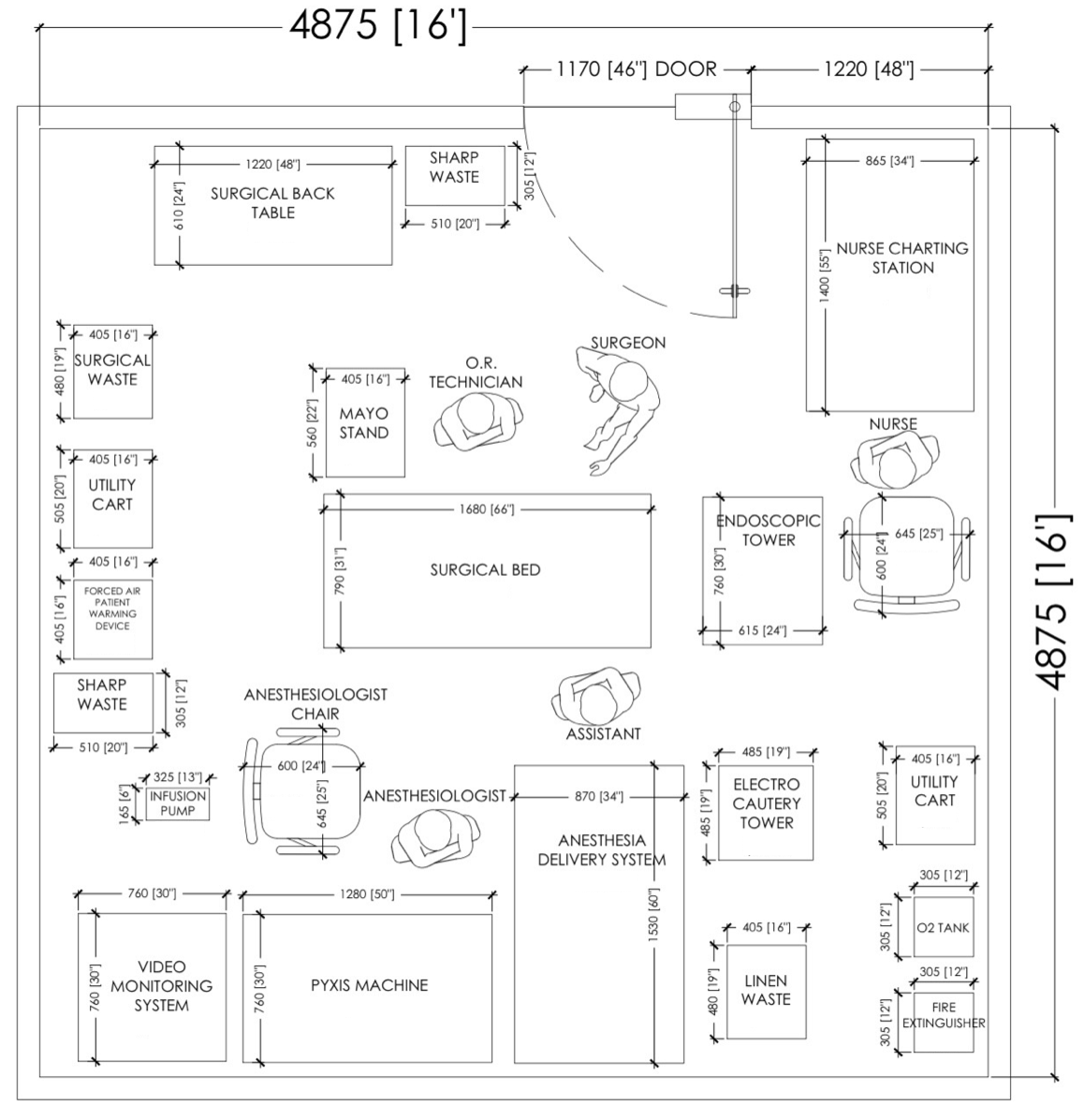
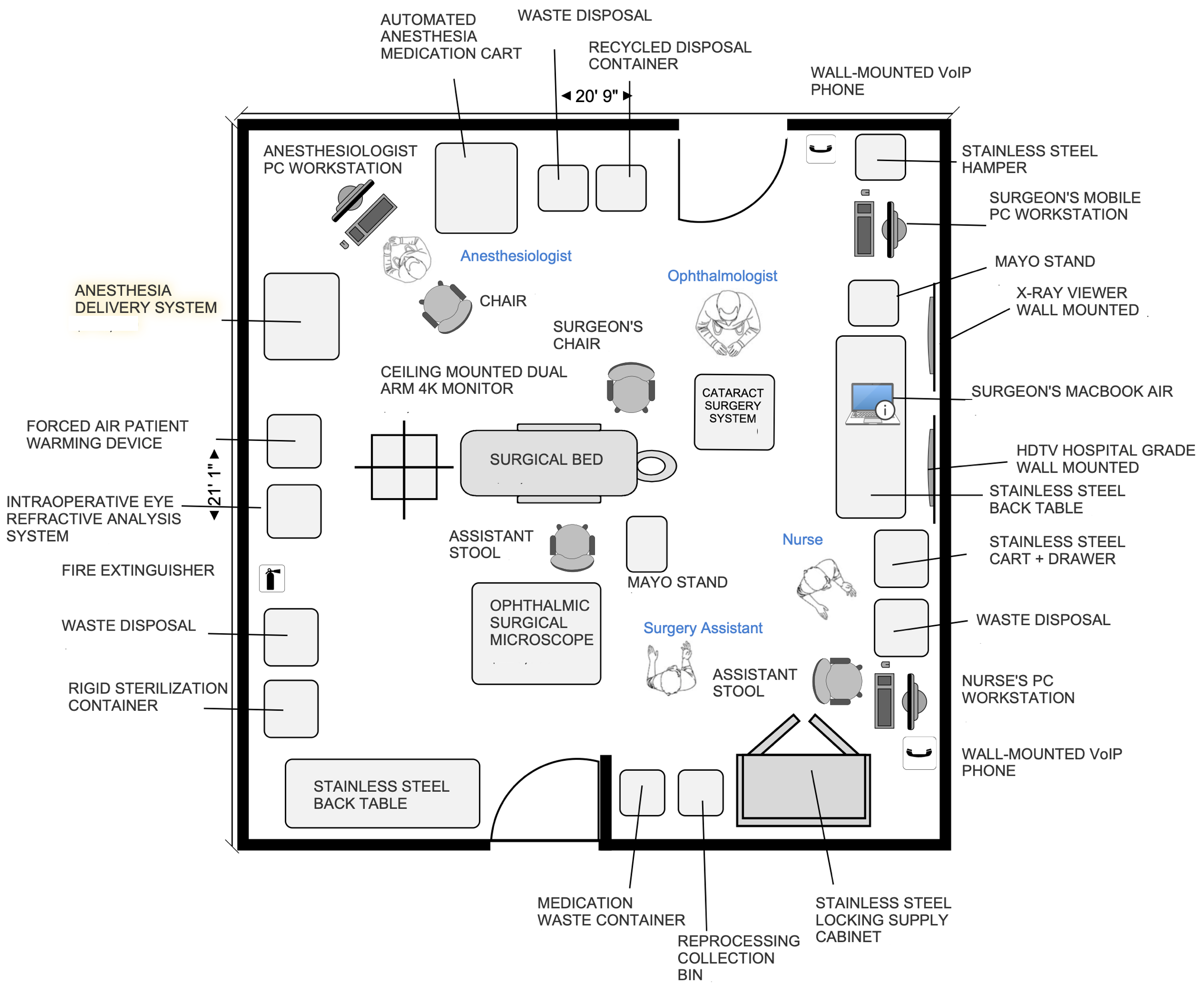
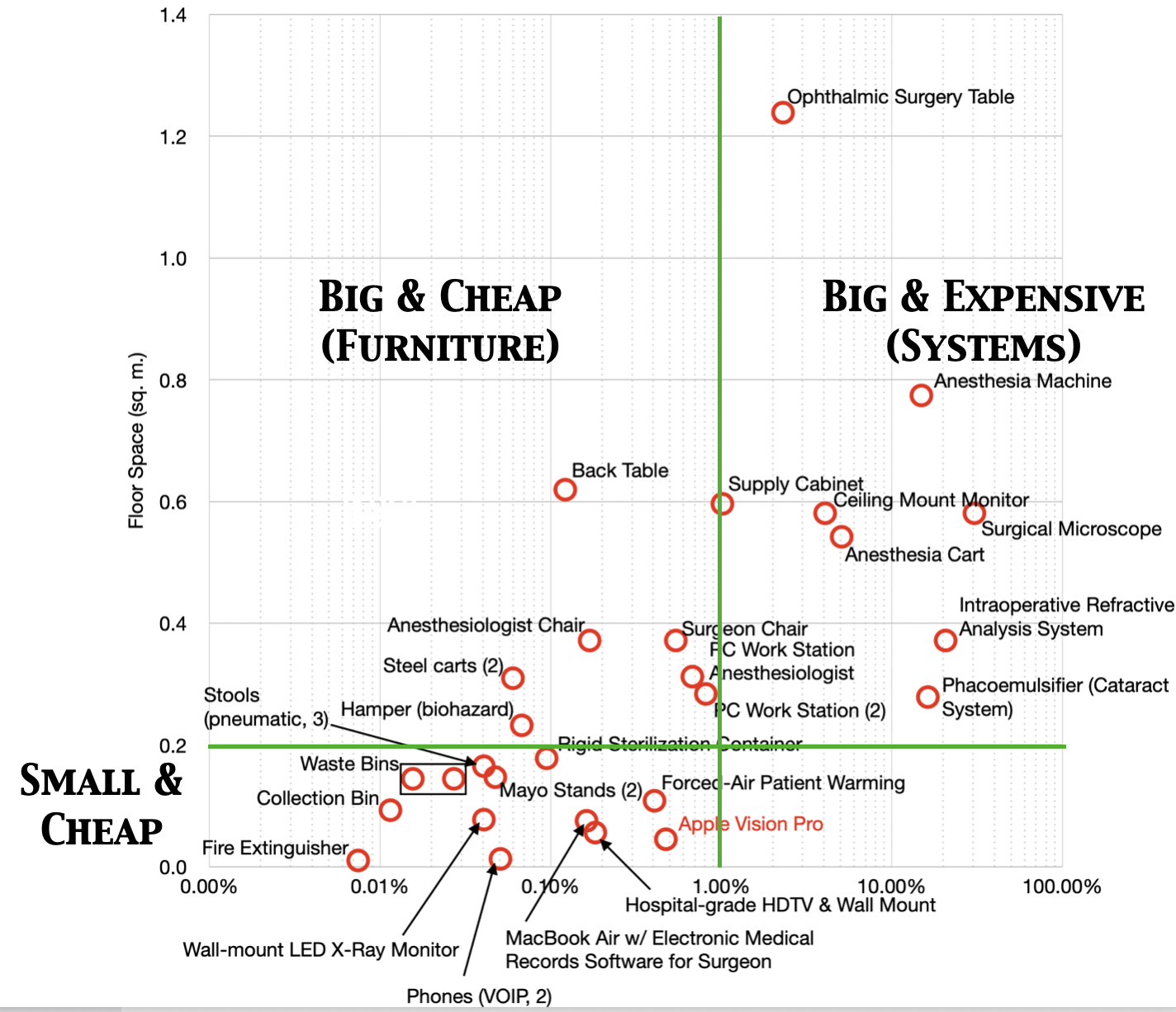
My contribution was to assess the cost and space impacts of the Apple Vision Pro in the constrained environments of ophthalmology operating rooms. The data are shown in the images below. First, the layouts of the rooms.
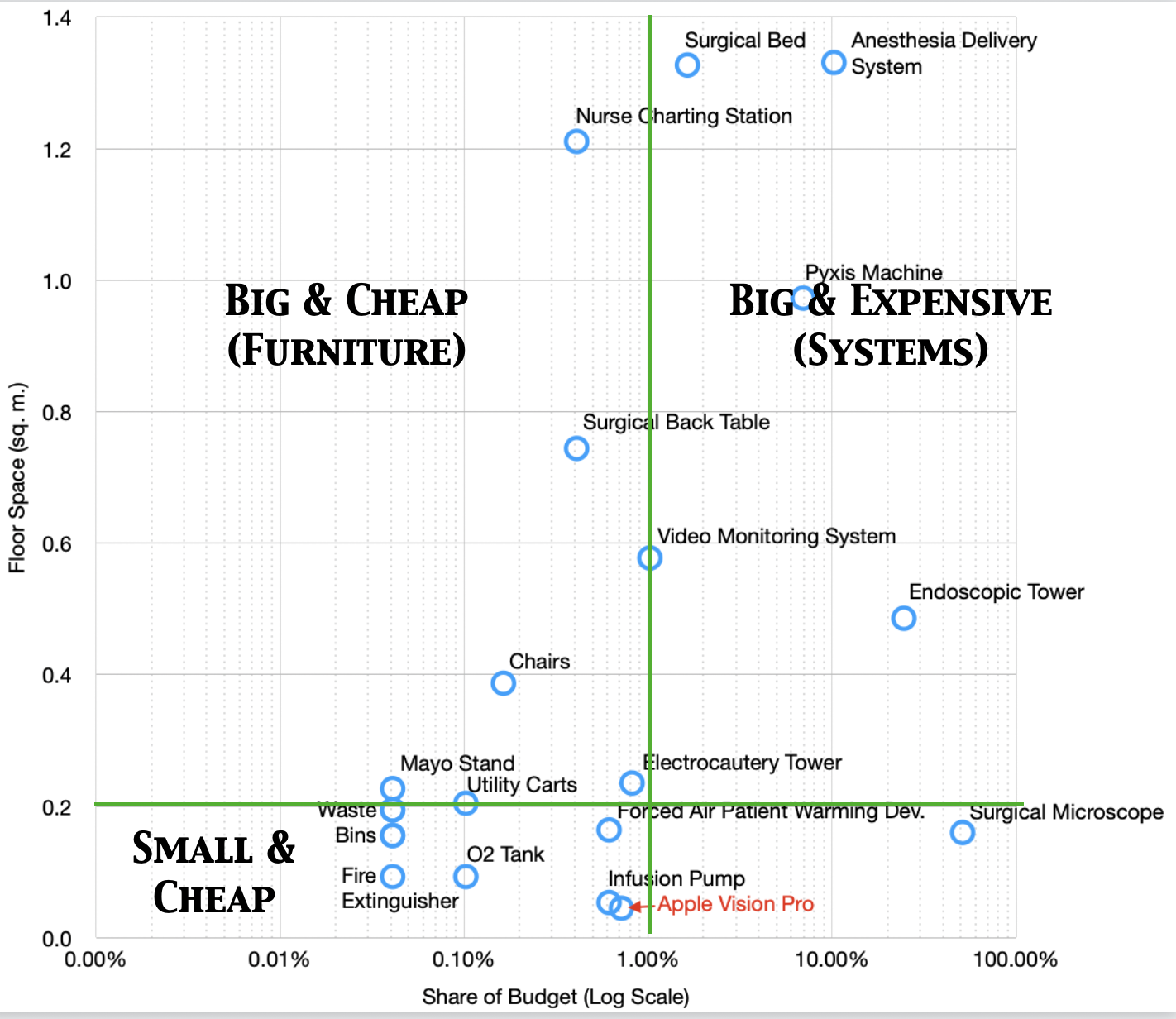
Second, the space required vs the cost of acquiring it.
In my experience, the Apple Vision is criticized for two things: being too big/heavy and being too expensive.
The data above shows that within the context of the operating room, the Apple Vision Pro is notable for being very small and very cheap. It is less than 1% of the cost and smaller than almost any piece of equipment.
When the iPhone was new it was considered a very expensive phone. At $500 most people, including, famously, Steve Ballmer, considered it too premium for the mass market. It turned out to be the most popular phone in most markets even when twice the price. It all depends on what it does and how easy it is to use.
For a hospital the cost of the Vision Pro is not insignificant. The paper considered what it can do, and, for that, it's a bargain.
Data, data everywhere but not a conclusion in sight.
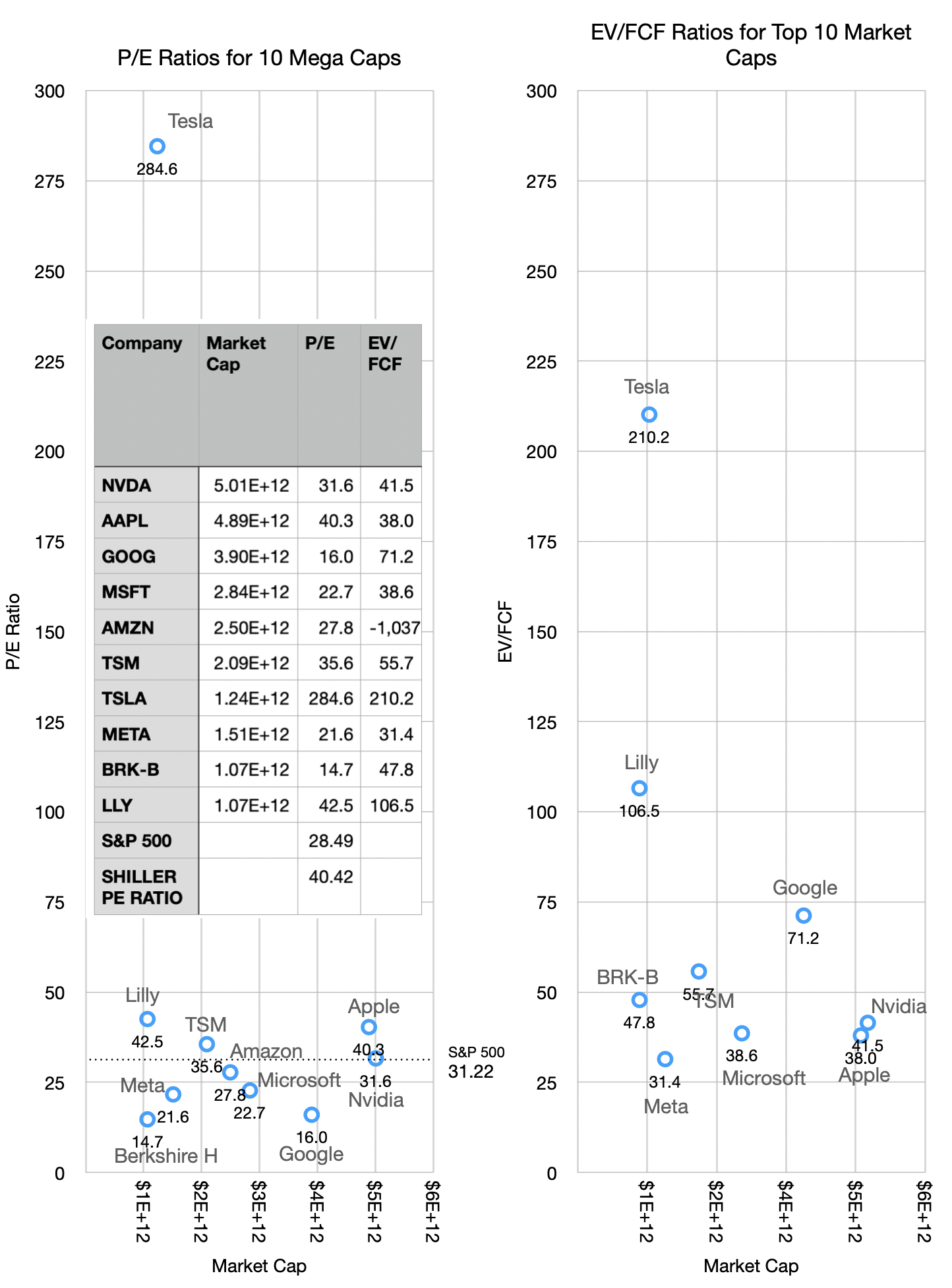
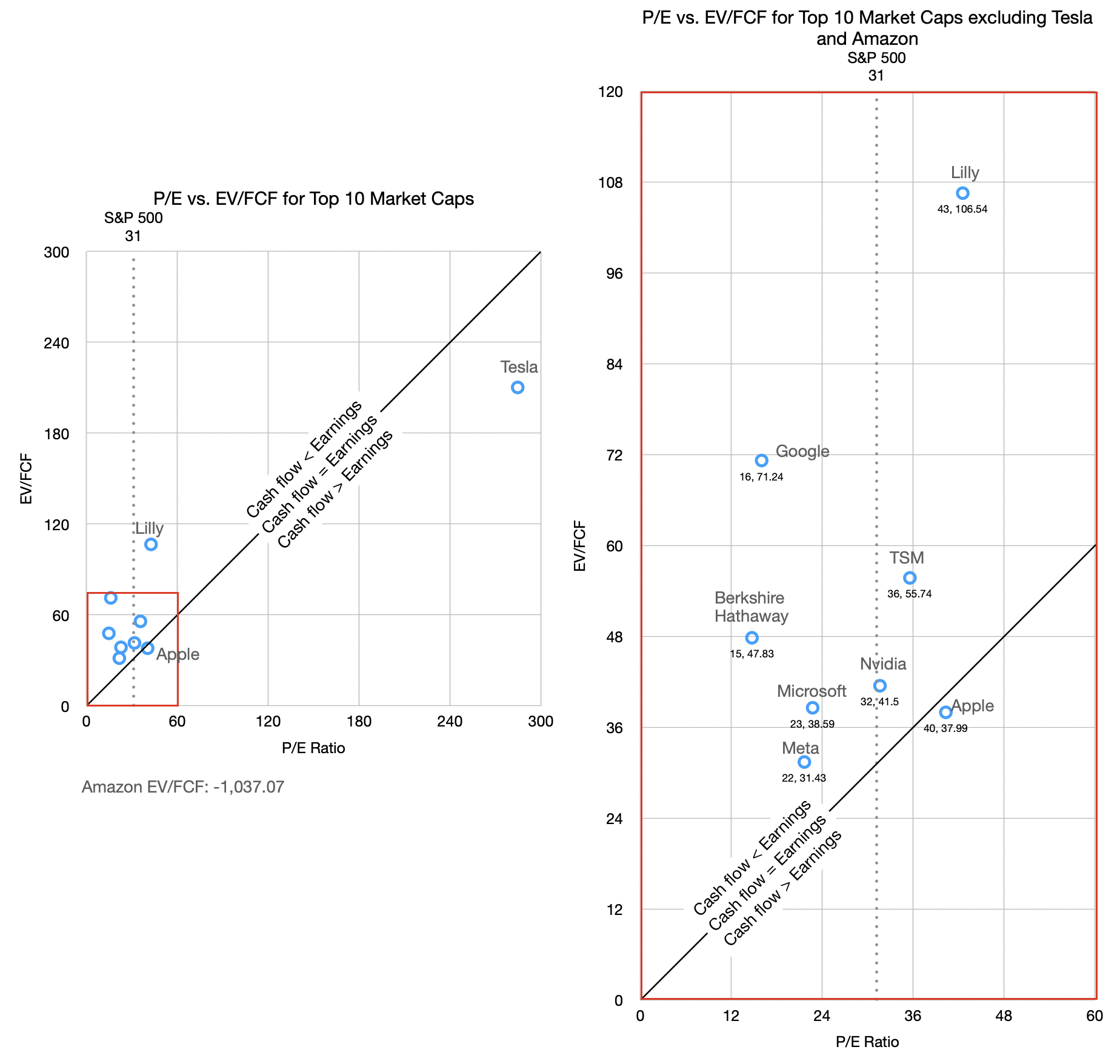
Is the market overvalued? Two measures to consider are P/E and EV/FCF. Here are those measures for 10 of the largest companies in terms of market capitalization and the overall S&P 500. Note: Amazon EV/FCF is less than negative 1,000 and is therefore excluded from the second graph. As we move forward the FCF for more of these companies will turn negative. Alphabet just recorded its first negative cash flow since going public in 2004.
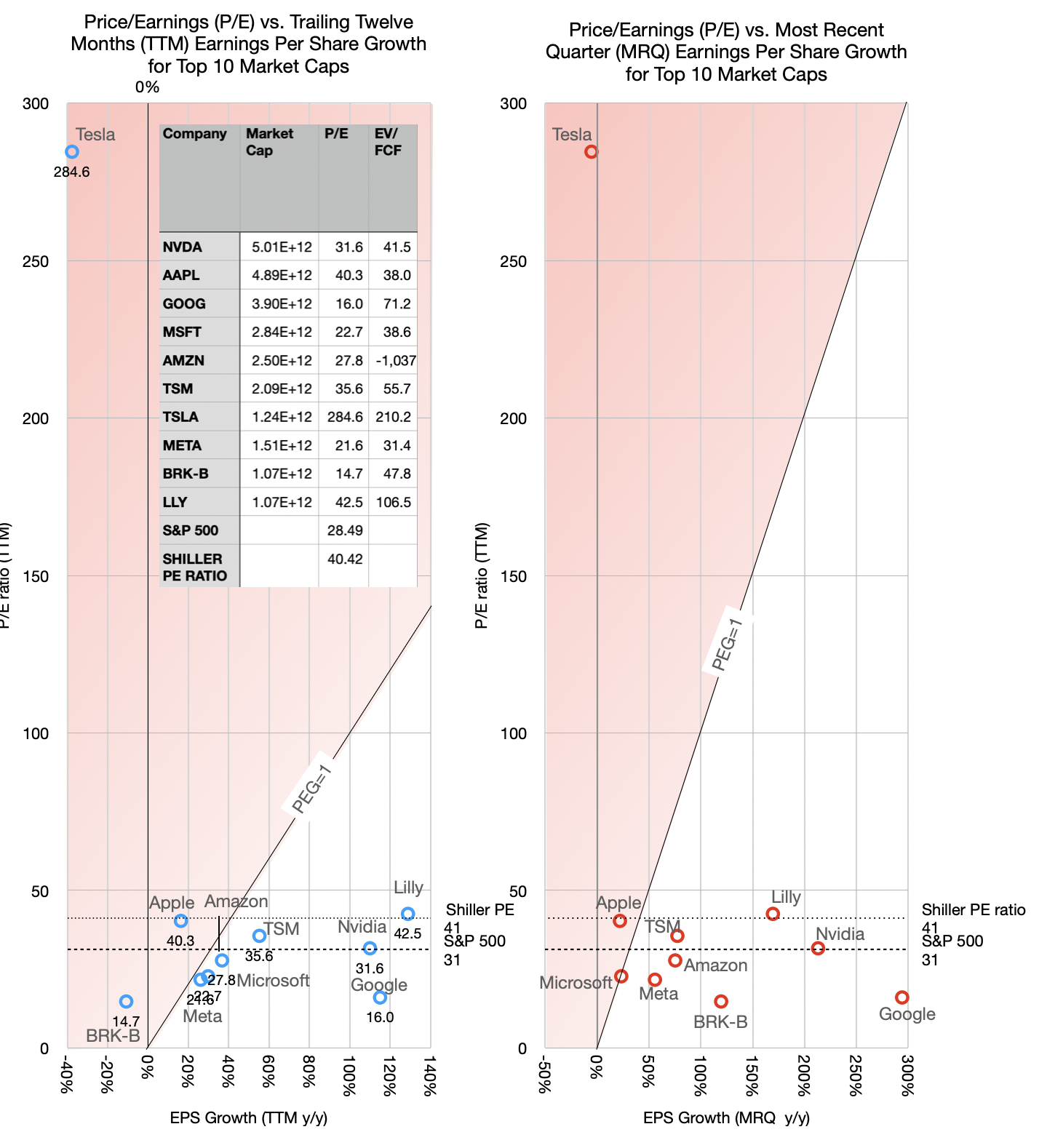
P/E should be compared to growth rates. Both growth in the most recent quarter and in the last 12 months. Here are those P/E vs. Growth measures for 10 of the largest companies in terms of market capitalization and the overall S&P 500. Rule of thumb: if PE=Growth*10 (PEG=1) then the company is "fairly valued". But, given crazy capex, we should also look at EV/FCF…
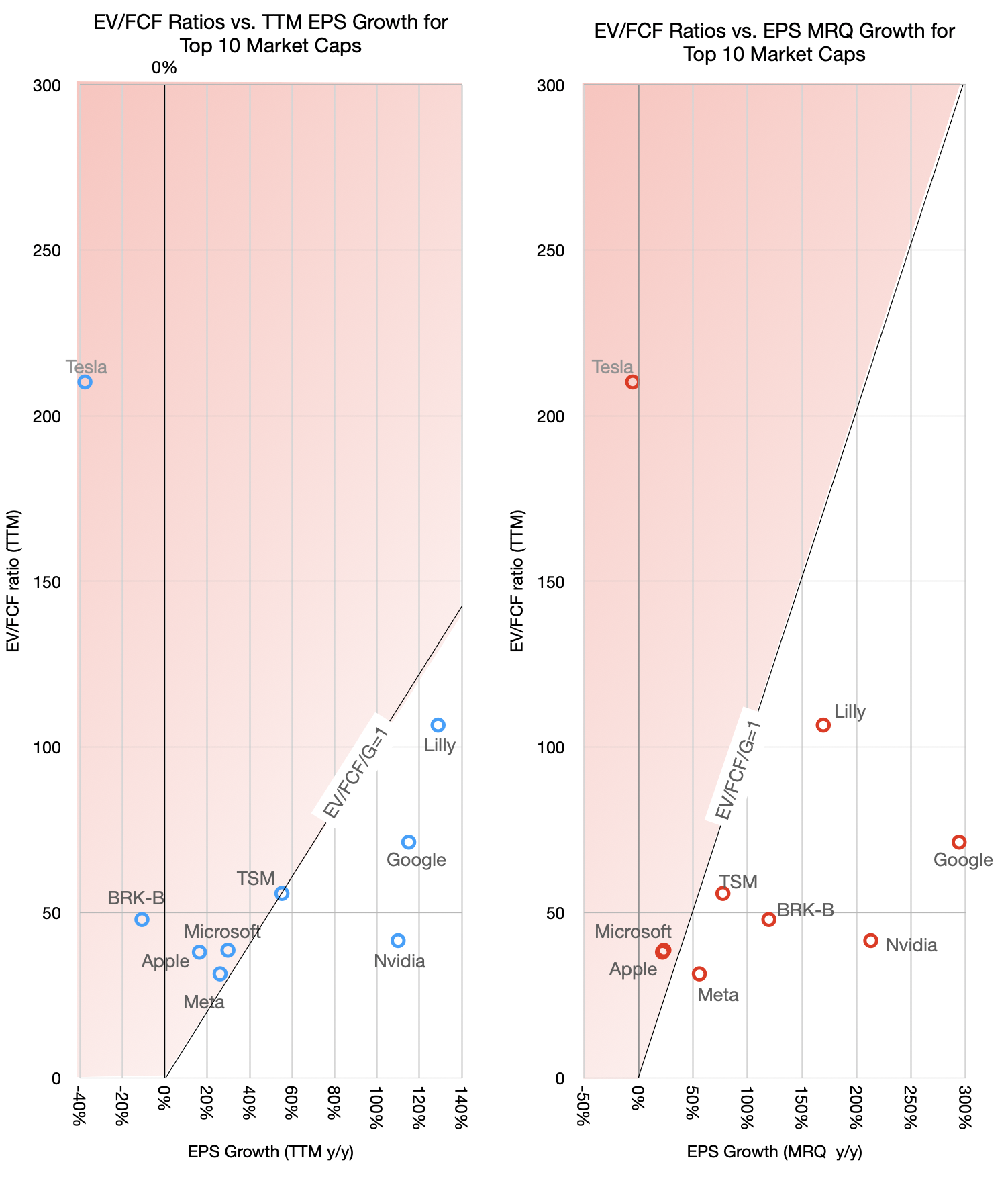
In addition to P/E, Enterprise Value/Free Cash Flow should be compared to growth rates. Both growth in the most recent quarter and in the last 12 months. Here are those EV/FCF vs. Growth measures for 10 of the largest companies in terms of market capitalization and the overall S&P 500. Rule of thumb: if EV/FCF=Growth*10 then the company is "fairly valued". Note outlier Amazon is excluded due to negative FCF. Soon, it won't be the only one. What other anomalies exist?
If the Price/Earnings (P/E) is similar to the Enterprise Value/Free Cash Flow (EV/FCF) then the company is "in balance" where neither cash is being used for investment nor earnings are overstated. Here are the two ratios relative to each other for 10 of the largest companies in terms of market capitalization and the S&P 500. We can see that the balance is uncommon. Apple is rather alone in that regard (apart from Tesla which is in its own bizarro world.) Amazon also is off the scale. Soon, it won't be the only one.
So, is the market overvalued?
Not all these companies have reported so we should update the data in the next week or so, but I've been tracking this type of data for 18 months. It continues to exhibit a reasonable P/E ratio (apart from Tesla, as always). The FCF however will turn negative and will make reasonable assessments impossible. As the cash flow turns negative, firms will raise debt to finance their desperate flight from commoditization. That's when the situation will turn challenging for not just the market but the global economy.
Recessions are built on bad debt. It's not yet at the point where there is much debt and it's not yet bad debt. But if the financing of data centers becomes debt-driven and if the cash flow does not support this financing then contagion may occur macroeconomic consequences will follow.
The market itself may not be a leading indicator if it measures only earnings. Remember: earnings are an opinion, cash flow is a fact.
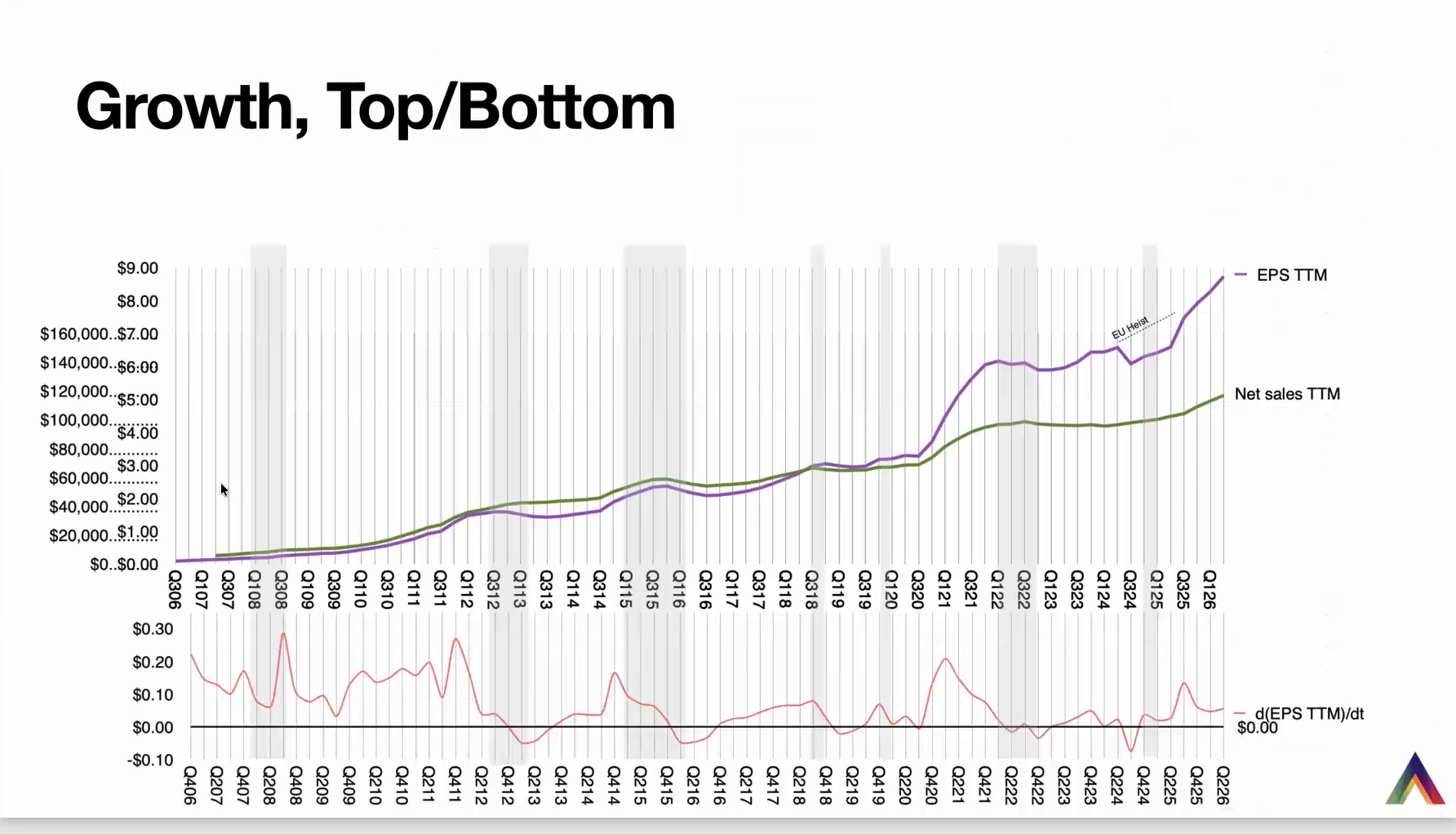
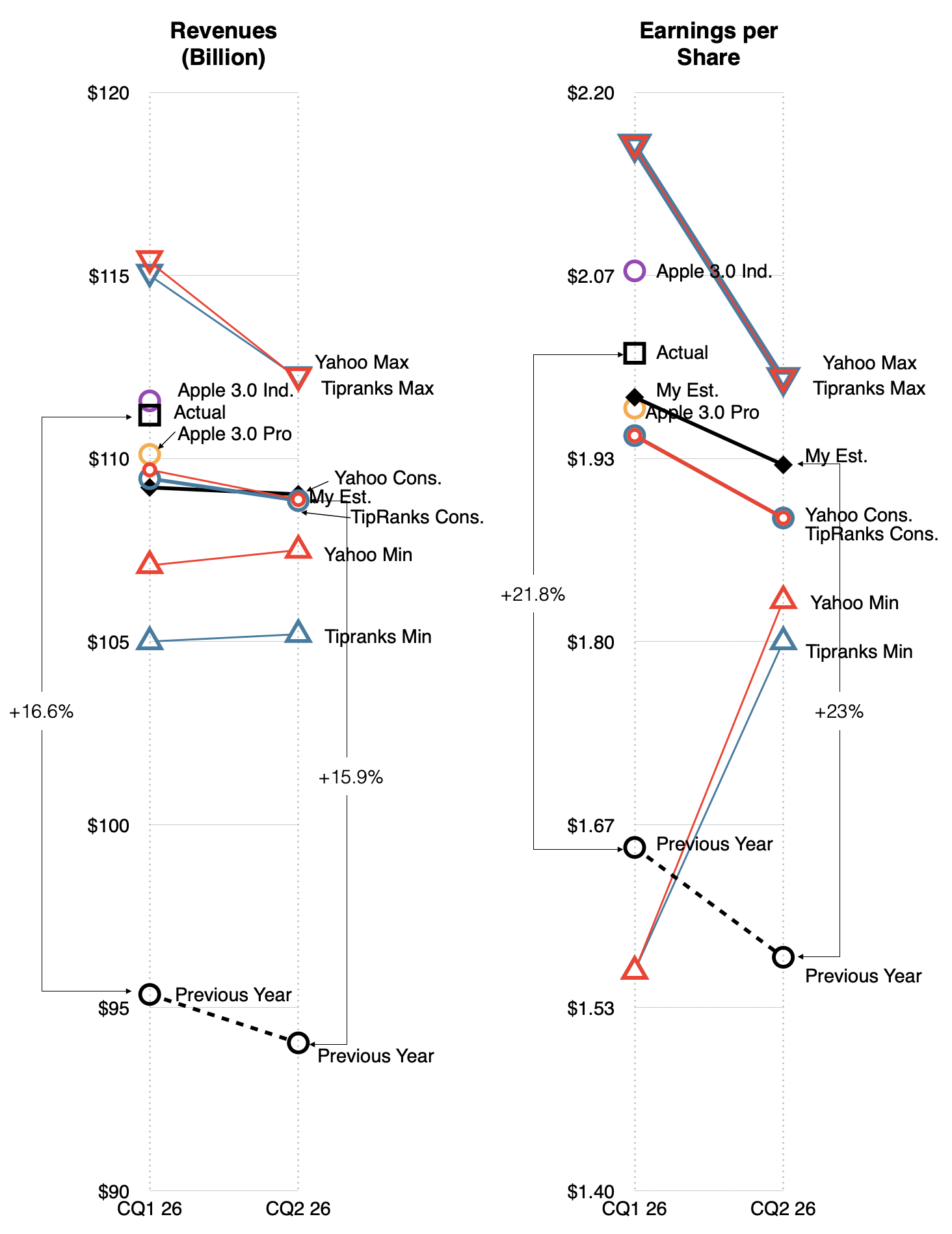
The graph below is a summary of estimates for revenues and EPS for the June quarter along with the estimates and actual results from the most recent quarter (March).
Final results will be available half an hour after markets close on July 30th. Office Hours will be held the following day.
I only note that both Yahoo and Tipranks narrowed the EPS range between min. and max significantly during the last quarter with a less prominent reduction in the Max of revenues. I don't have a hypothesis on why this might be. The data from Apple 3.0 (Pro and Independent) will be added as it becomes available.
Yesterday, Tesla reported its second quarter earnings and there were few surprises. The company's automotive business is as structurally unsound as ever. Despite automotive deliveries and revenues growing at 25% (from a very weak Y/Y comp.), Tesla only saw a 1.4% operating margin in Q2. The gross margin fell slightly but the operating income fell by 57%. Excluding regulatory credit sales of $146 million (which should disappear soon), the operating margin was only 0.7%. The days of automotive profit, never mind extraordinary profit, are gone.
Cash flow went negative at -$1.1 billion. GAAP net profit of $1.1 billion was down 6% YoY, only because of a $1 billion unrealized gain in SpaceX shares, which, if excluded, would reduce net profit to $0.35 billion, or 70% lower than Q2 2025. Shares fell 14.5% the following day and the P/E ratio fell from 350 to 335.
Tesla Bulls would argue that these metrics are not relevant because the company is in the middle of a pivot from products to services. The product business will gain its margins from subscriptions (FSD) and ride sharing (Robotaxi). Current manufacturing overcapacity (mainly due to failed Cybertruck) will be reallocated to robotic taxis and humanoid robots. Until these arrive, the metrics should be ignored. This much is already reflected in the share price as its P/E ratio is beyond reason.
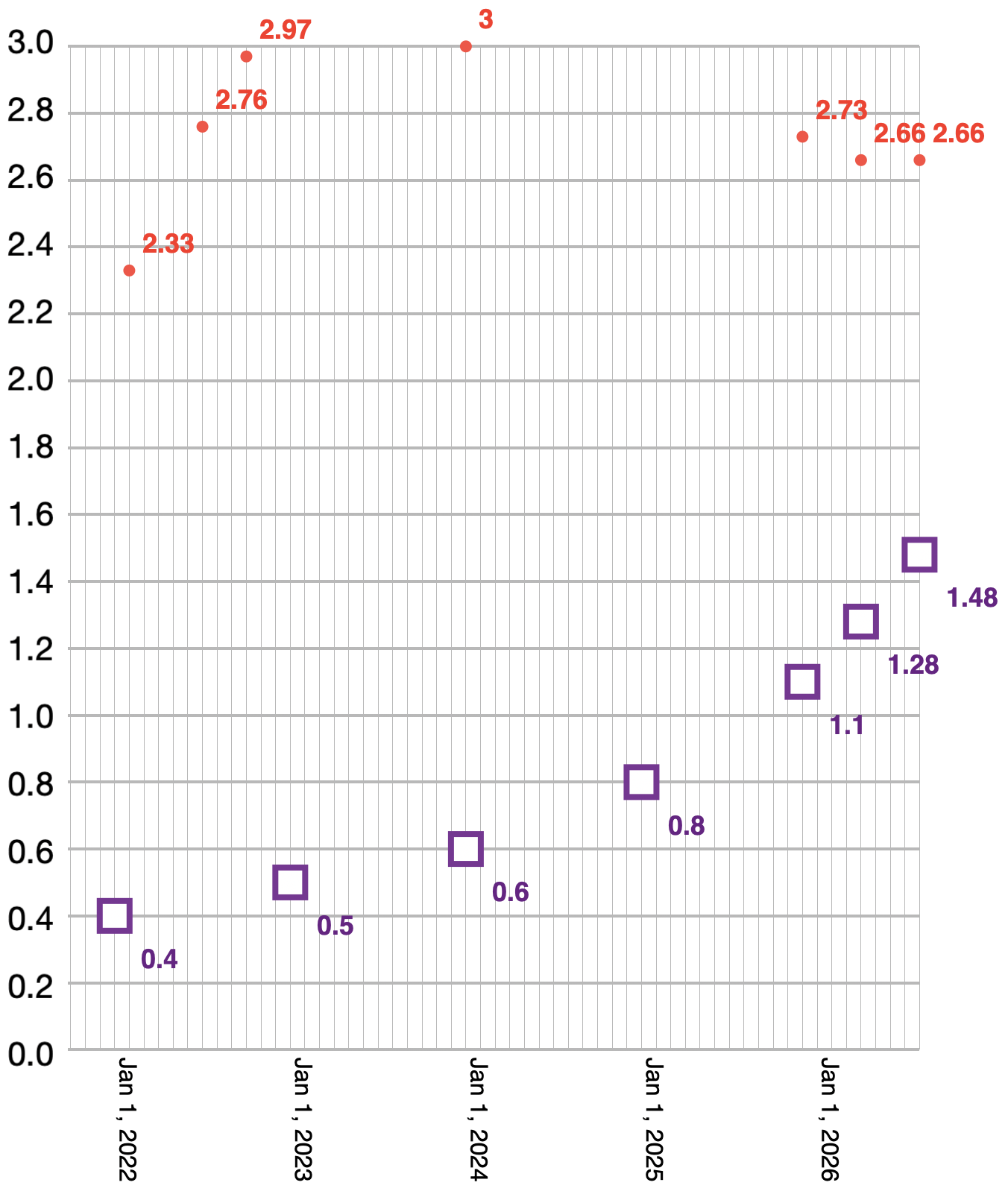
But are there other metrics we should look at besides selling cars that back this up? Robotaxi and Optimus humanoids are still not businesses contributing revenues so we can't yet measure their take-up rate. FSD subscriptions, on the other hand, are being sold and there is excitement regarding the latest numbers. At the end of last year there were 1.1 million FSD subscribers and now, six months later, the total reported was 1.48 million. The history is shown in the graph below.
It shows a nice acceleration for FSD, shown in purple squares.
But not all accelerations continue forever. As a caution, I added a second data set shown in red. It represents the number of subscribers to Peloton. Peloton was quite a darling of the tech/investor community six years ago. After going public in 2019 at around $25/share the company climbed to $150/share by end of 2020 aided, no doubt, by the pandemic. It was seen as a major "disruption" in fitness. Today the shares are $6.
The problem with Peloton was that it could not break out of a small number of relatively wealthy users and its product was disrupted by much cheaper and easier to adopt wearables which could be hired for similarly motivating exercise.
By 2024, after following the classic accelerating curve, the Peloton subscriber base peaked at 3 million. That's about twice the FSD base today. It's not impossible to imagine Tesla reaching 3 million subs by 2028, seven years after launching as a monthly software subscription. Peloton itself took a decade to peak subs. But how high can it go?
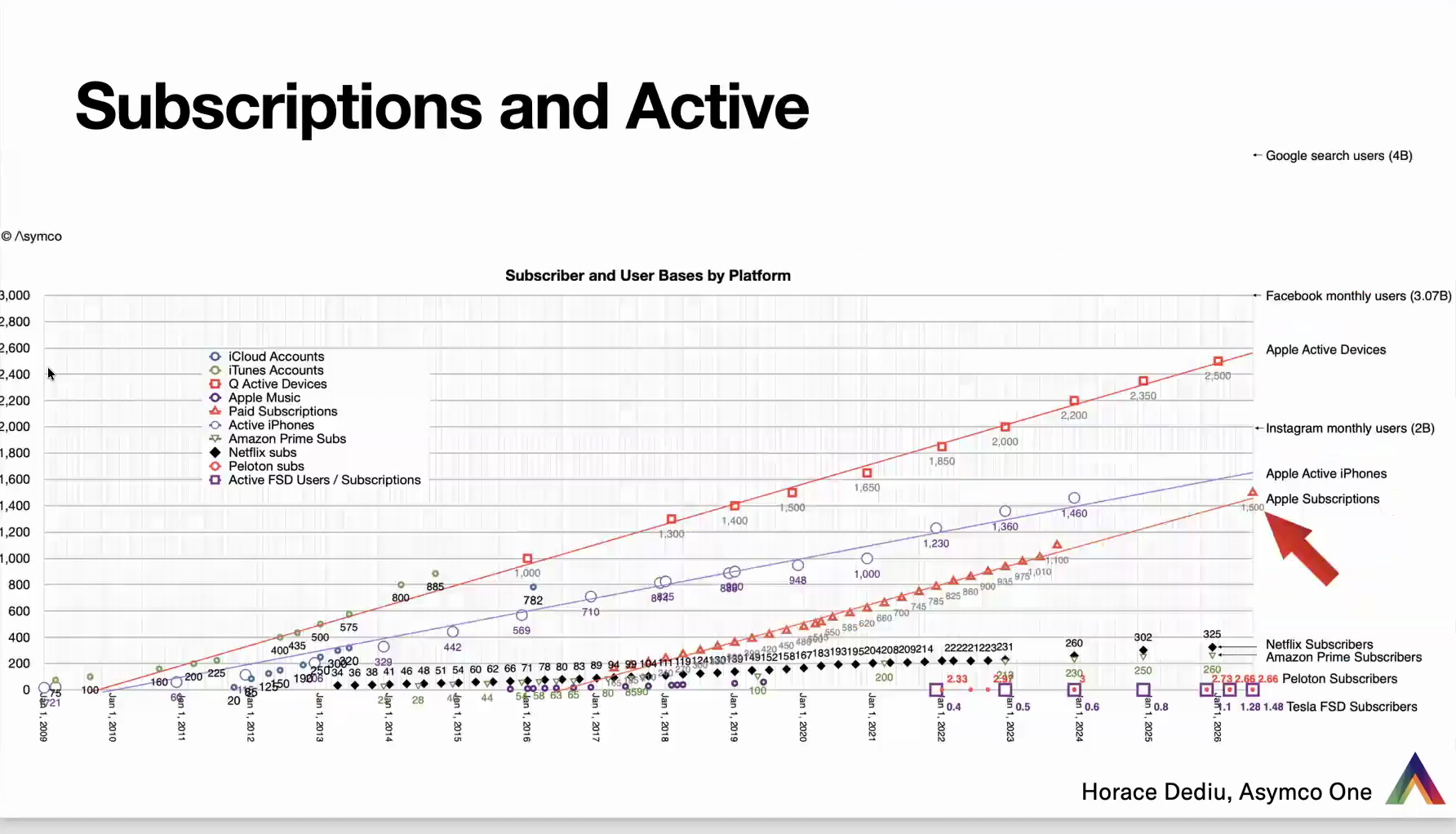
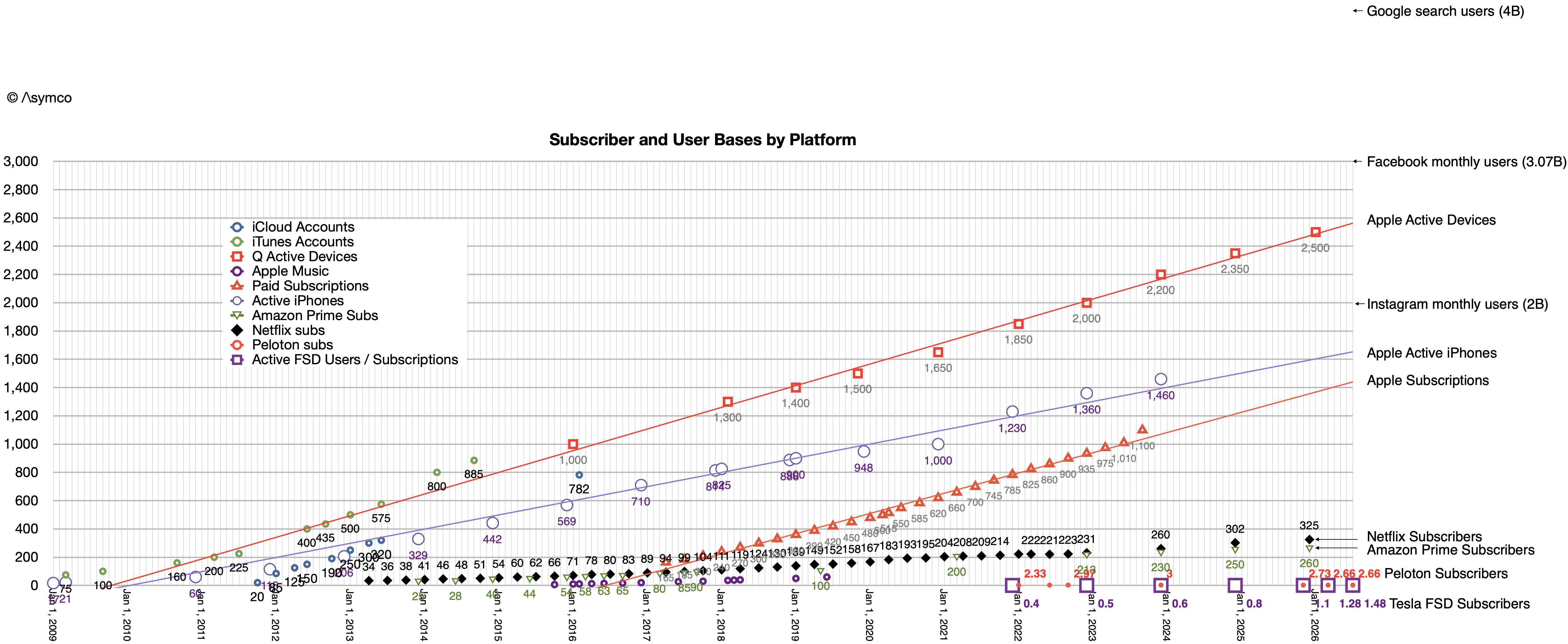
If I add a few other user bases and their histories to the graph above we can see what scale can be achieved overall. (Click image for higher resolution.)
The highest user number is arguably Google with 4 billion. Second is Facebook with 3 billion, though as part of Meta's overall 3.4 billion users of which 2 billion are Instagram users. These are not paying customers (rather, they are being sold) so the largest paying community of users are those from Apple with 2.5 billion active devices (users may be about 1.4 billion).
Active Apple subscriptions are 1.4 to 1.5 billion. PC users are about the same level.
Next would be Netflix with 325 million subscribers as of end of 2025 and Amazon with about 260 million subscribers. Note that Netflix and Amazon are growing but not accelerating suggesting they are nearing saturation.
Compared to these Peloton and Tesla are minuscule, indeed invisible on the graph. As a result the numbers are way too small to support what would be called an ecosystem--the attraction of third parties to develop on a platform. But why couldn't Tesla reach billion user numbers with FSD? The answer is structural.
The reasons are that neither exercise equipment nor automobility create consolidated, uniform, global, iterative, rapidly evolving opportunities. The products can't be obsoleted quickly enough. They are too bulky and expensive to be sacrificed for better versions. Cars are only owned by 1.2 billion people but the industry is very fragmented and becoming more so. There are hundreds of brands from dozens of auto groups with protected home markets and restrictions on distribution. Each brand has to field dozens of models which fragments the platform even more so that each product can only gain single digit million install base at best. That product has to stay in use for decades, often with to software upgrade path beyond the first few years. As a result even a prominent brand such as BMW can only create an overall customer base of 50 million users.
Tesla has barely 10 million users today1 and the total is not growing more than 2 million/yr. FSD is not even available outside the US, which is about half the install base23. Given this, the 3 million subs by 2028 might be a stretch.
Thus there isn't a critical mass in the "owned" car market that creates network effects for services and ecosystems.
What about robotic cars?
That market is yet to be measured. We can start with the taxi market and that's not very encouraging. The total professional taxi fleet globally is about 18 million, constrained by regulations. In addition, there are about 15 million active ride-hailing drivers world-wide4. They largely unconstrained by regulation but limited by economic value. If robot taxis were to replace this market5, it would not be huge enough to move toward a billion users. If it tries to replace owned cars the business has to contend with the fact that ownership is not just the utility of transport6. It's a market for smiles not miles.
And then there is the rate of change. Nothing happens quickly in transportation--the bigger the vehicle, the slower it evolves. I should also note that Tesla is 23 years old, about half the age of Apple. Ten million customers in 23 years isn't enough.
But the sclerotic automobility world is not alone .Many other industries suffer from sclerosis: housing, aviation, medical equipment, education, peacetime defense, etc. They cannot be consolidated, are not uniform, are not global, are not iterative and are not evolving rapidly enough to cope with silicon and software evolution cycles. Compare any of them with the smartphone or AI industry.
Indeed the idea of growing billion-customer bases within a decade or two is extremely rare and the exception rather than the rule. I'm guessing the challenge of adhering a service business onto the structural mess that is automobility is the primary reason Apple abandoned the idea of making a car.
Tesla cumulative global deliveries reached 9.7 million as of July 2026. Total in use must exclude scrapped cars due to accidents or end of life.
The installed base of Tesla cars in the United States is estimated to be roughly 3 to 3.5 million vehicles, derived from cumulative historical domestic sales.
Tesla maintains roughly 41% to 48% of the total active U.S. electric vehicle market share, by far its largest market by share. Europe and China are at 8% or less market share. Share in emerging markets is negligible.
Excluding buses and trains, delivery and other professional driving. The total professional driver population in the US is 5 million and world-wide, over 100 million professional drivers are employed. By overall population the US is 4% of the world.
After its first year in operations, Tesla's unsupervised robotaxi fleet has reportedly shrunk to roughly 30 vehicles, including Austin, Houston and Dallas. The Waymo fleet, having launched public commercial driverless operations in October 2020 has approximately 3,871 vehicles in active service, operating across 10 U.S. metropolitan areas. Waymo, after six years in operations, is aiming to deliver 0.0014% of an estimated 70 billion miles driven in the US each week. If it increases its operating rate by 300,000% it will reach 1% of global driven miles. Approximately 206 billion miles are driven in the world each week. This estimate comes from global calculations showing that roughly 1.3 billion vehicles log an estimated 10.7 trillion total miles every year
If it were, the service of public transit would be more popular. As an exercise, contrast that with public aviation, a utility based industry that has 99%+ market share relative to private aviation.
Rumor has it that Apple will split the launch of the latest iPhone models across two quarters. The high-end iPhones will be announced as always, in September, but the base models will be released in the following quarter. I don't know if this is to be believed but there are other factors that might affect the next quarter that are out of the normal.
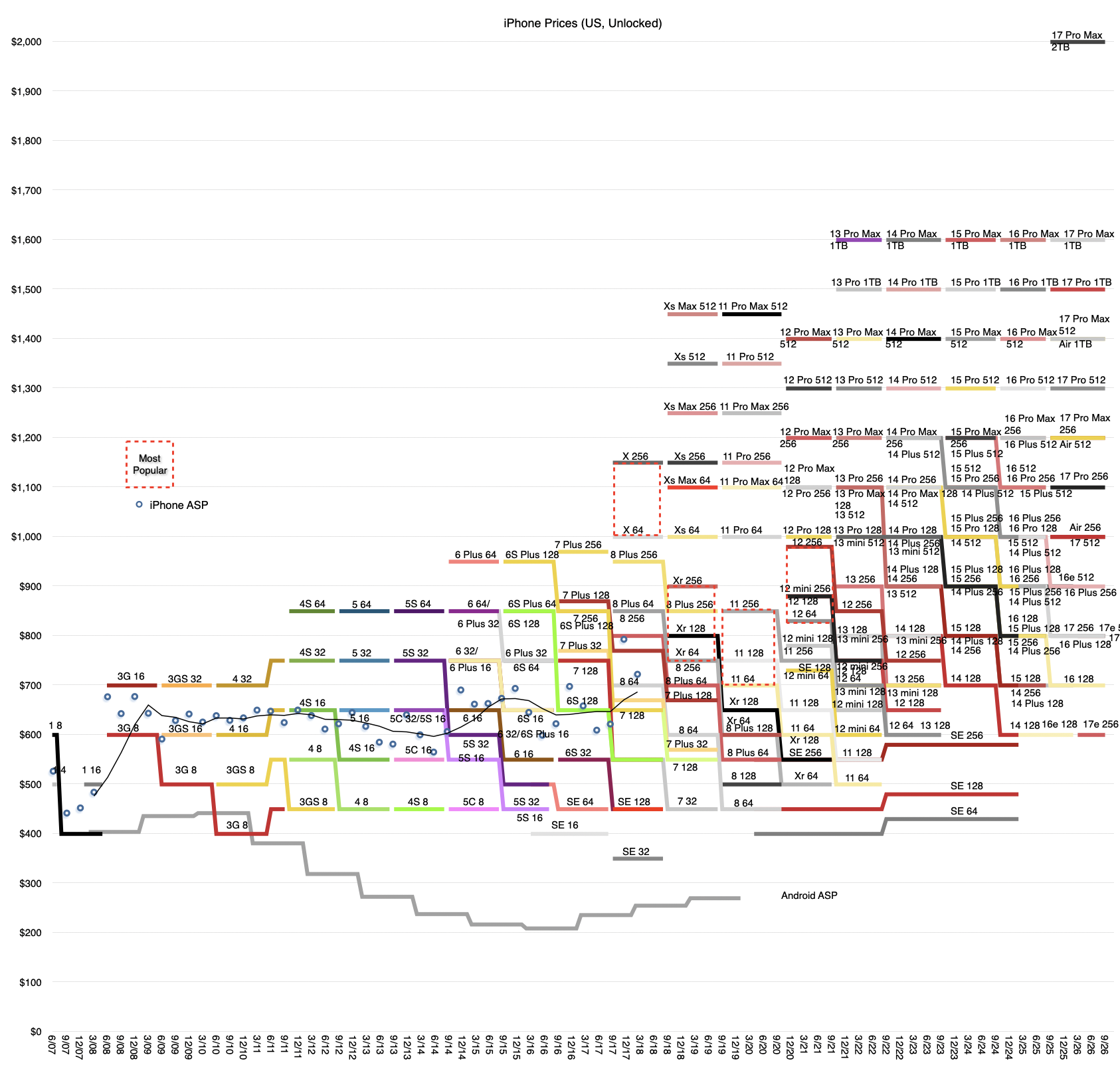
Pricing may change. Memory costs have increased so much that Apple has had to increase prices across all products apart from the iPhone. The iPhone may not be spared any longer and the normal pricing cadence may be disrupted. This cadence has been illustrated over the years as the "stairway to heaven" graph.
There might be a new form factor. Rumors are abundant about a folding iPhone being launched this fall. If true, it will probably be priced above the iPhone Pro Max given the size of the screen, battery and overall mechanical complexity. How well this product will do given the new form and new price is difficult to predict. The supply/demand balance may take some time to optimize.
Normally i don't use rumor information as it's easily corrupted, however in this case the confluence of multiple factors could cause a disturbance in the usual reliability of guidance. Here's why.
If there are new products or even a split launch, the company will not pre-announce this at earnings time. These changes in the portfolio could have a significant effect on growth relative to the previous year but the reason cannot be specified. This leaves a dilemma for providing guidance. If they provide accurate but historically divergent guidance they are tipping their hand on the mix/split/pricing. If they withhold guidance to protect the launch then they might be seen as signaling a miss.
Alternatively they might not provide any guidance since they don't know the exact impact of the new mix and pricing.
Either of these changes will undoubtedly be misinterpreted or falsely attributed to declining demand for the products.
It's also possible that the new CEO will change how it communicates guidance overall. This is not unprecedented as guidance changed a few times in the last twenty years:
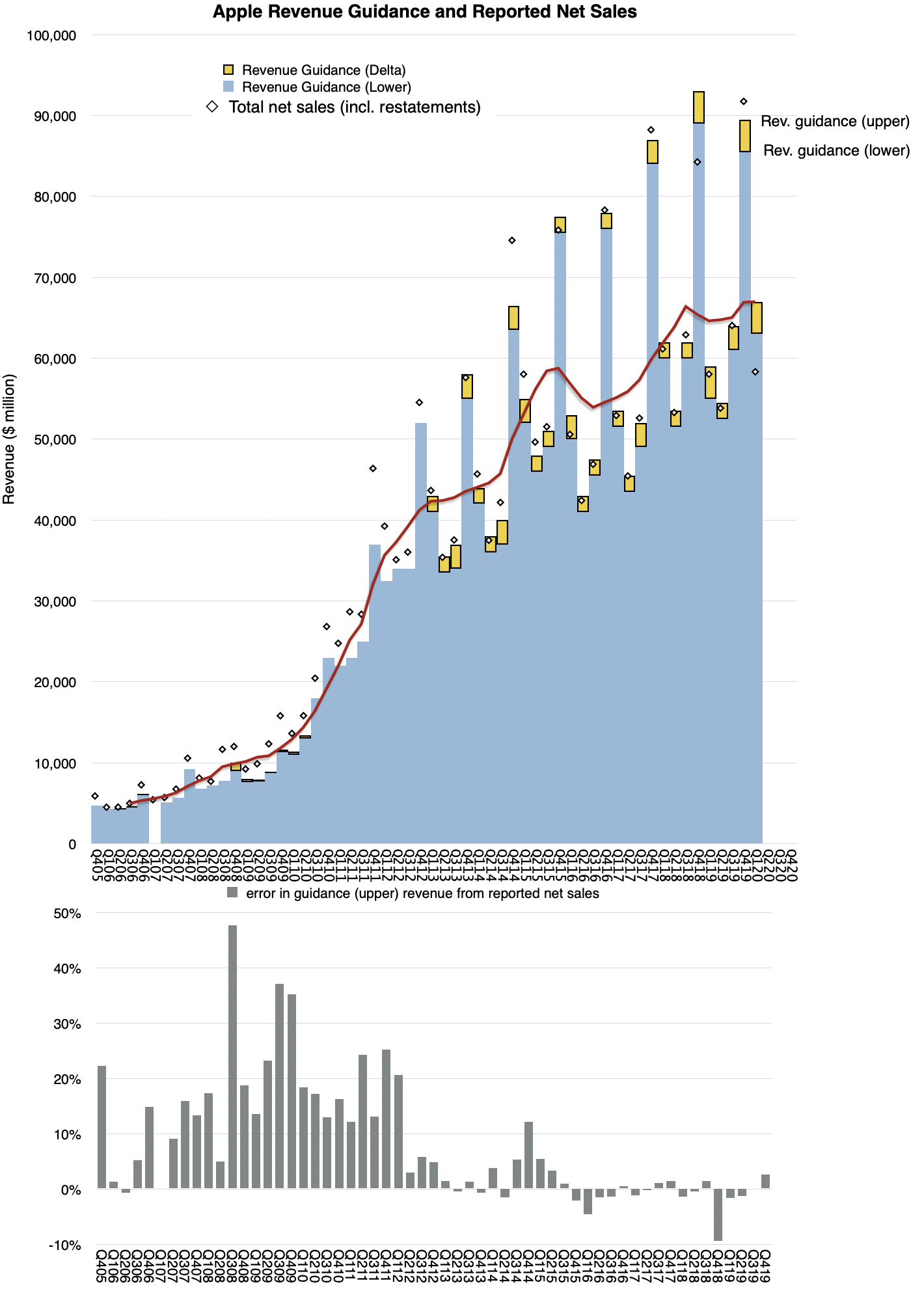
During Steve Jobs' time as CEO, guidance was "sandbagged" and results were far higher than predicted. (See graphs below)
Guidance on earnings was withdrawn altogether during Covid and replaced with revenue growth range, margin and operating expenses guidance (leaving the EPS as a calculation requiring a guess of the buyback rate).
Unit sales of products (and hence average selling prices) were also excluded from reporting as of 2018.
Overall, the next few quarters will be different and transitory. Products are changing, costs are changing and management is changing. However, the fundamentals are likely getting stronger. Competition will be weakened, products will be better positioned, new customers will be attracted. The reporting on this topic will be all over the place and if history is any guide, the negatives will overwhelm reason.
As we move ahead into the June quarter, I'd like to review our outlook, […]. Importantly, the color we're providing assumes that global tariff rates, policies, and their application remain in effect as of this call [and that] the global macroeconomic outlook does not worsen from today.
We expect our June quarter total company revenue to grow by 14%-17% year-over-year, which comprehends our best view of constrained supply. On iPad, keep in mind, we face a difficult compare driven by the launch of the A16-powered iPad in the prior year.
We expect services revenue to grow at a year-over-year rate similar to what we reported in the March quarter after removing the favorable year-over-year impact from foreign exchange tailwinds. Keep in mind, during the March quarter, FX was a 2.5 percentage point tailwind to the total company growth rate, and for services, that impact was slightly more favorable.
We expect gross margin to be between 47.5% and 48.5%. We expect operating expenses to be between $18.8 billion and $19.1 billion. We expect OI&E to be around $250 million, excluding any potential impact from the mark-to-market of minority investments, and our tax rate to be around 17%. - Kevan Parekh, CFO
Apple will report results on July 30th. We will conduct Office Hours to discuss them the next day. In anticipation, here are my estimates:
The revenue guidance of 14% to 17% follows a 16.6% increase in the previous quarter. My estimate is growth of 15.9% consisting of the following segments:
iPhone +21%
Mac +15%
iPad -3%
Services +16%
Wearables +4%
My gross margin estimate is 48.5% based on the following segments:
iPhone 38.2%
Mac 31%
iPad 26%
Services 77%
Wearables 41.8%
My estimate for operating expenses is the maximum of the range ($19.1 billion.) OI&E is set at the same level as guidance ($250 million) and the tax rate also set at the estimated 17%.
I expect the number of outstanding shares to decrease by 74 million to 14.625 billion. This is a reduction in the rate of re-purchase from the previous quarter's 80 million and the average over the previous 4 quarters of 83 million. This is due to higher share pricing.
As a result of these estimates, the fully diluted Earnings Per Share should be $1.93, a 23% increase from the prior year. Trailing 12 months' EPS would thus be $8.63, with a corresponding trailing P/E of 38.6 at the closing price last Friday.
My estimates were made soon after the May conference call quoted above.
Has something happened since to change these estimates?
The biggest concern is the increase in memory pricing which would have a direct impact on margins. Especially on Mac, iPad and Wearables. Less so on the iPhone as that supply is provisioned and priced well in advance.
I suspect that management factored in all the data known one month into the second quarter and that any changes in memory pricing that forced a price increase to be announced in July would not have affected June and July Mac and iPad inventory. For this reason I'm still comfortable with what the company guided for the June quarter. There might even have been some pull-forward of demand across all hardware lines as the channel began anticipating a price increase. Anecdotally, we saw Amazon and other big retailers running summer sales even after the price increases were announced. This implies channel inventory was quite high heading into July.
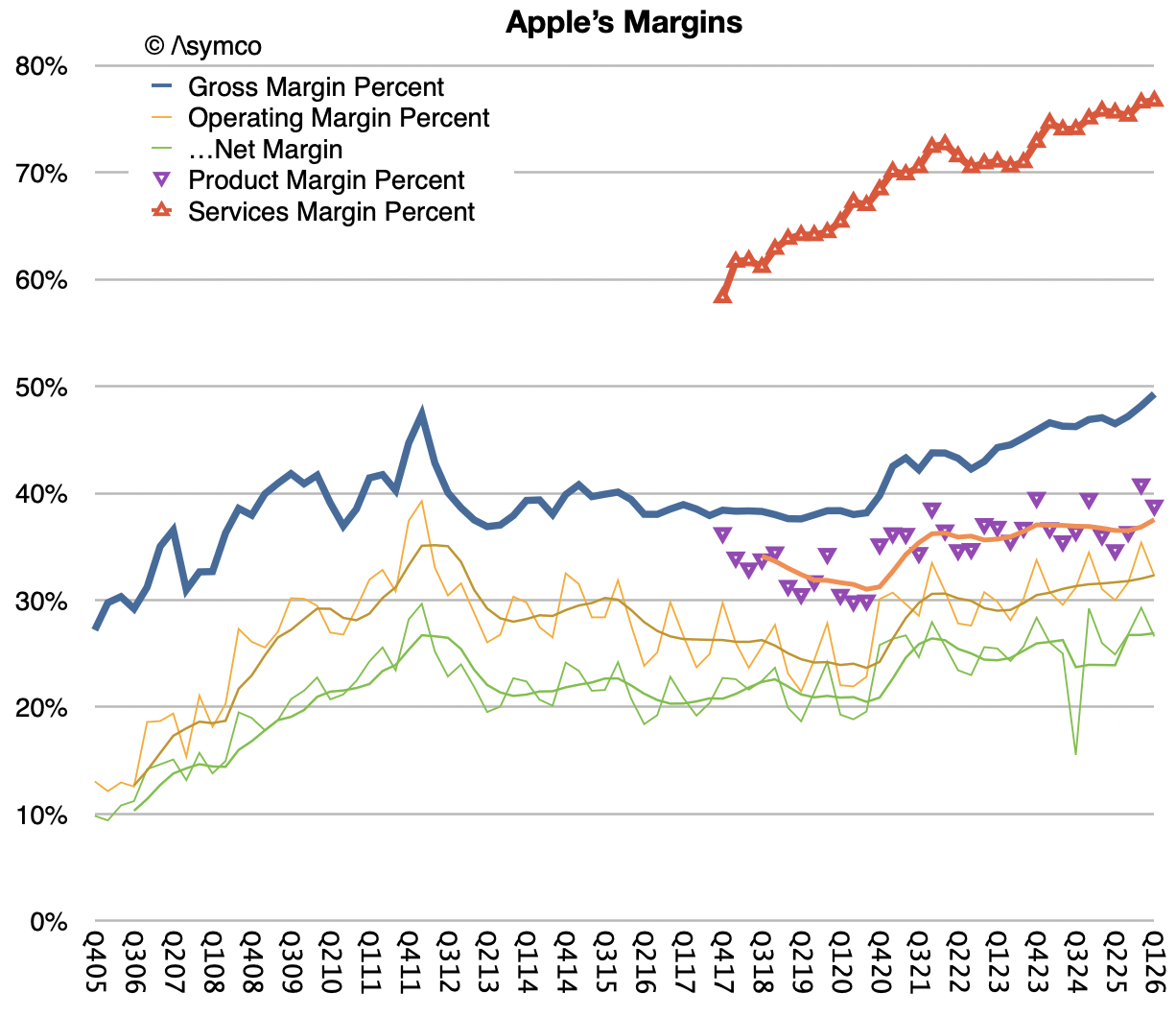
To summarize, I'm not worried that there will be a margin miss this quarter but there might be a significant reduction in margin into the next quarter's guidance. Margins are currently at record levels (48%!).
A reduction to 45% into the next quarter would not be surprising.
The September quarter will be minimally affected by the new iPhone relative to the December quarter but it might signal how iPhone margins will change.
Low 40% range will be a possibility into CQ4 though that depends on what iPhone pricing changes we will see. I still expect approximately a $100 increase across the board on iPhone. $200 is where the worry lies.