Asymco

Asymmetric Intelligence

Latest from Asymco

  1. The Composition of Active Devices
    Research · 8 comments

    Measuring the future

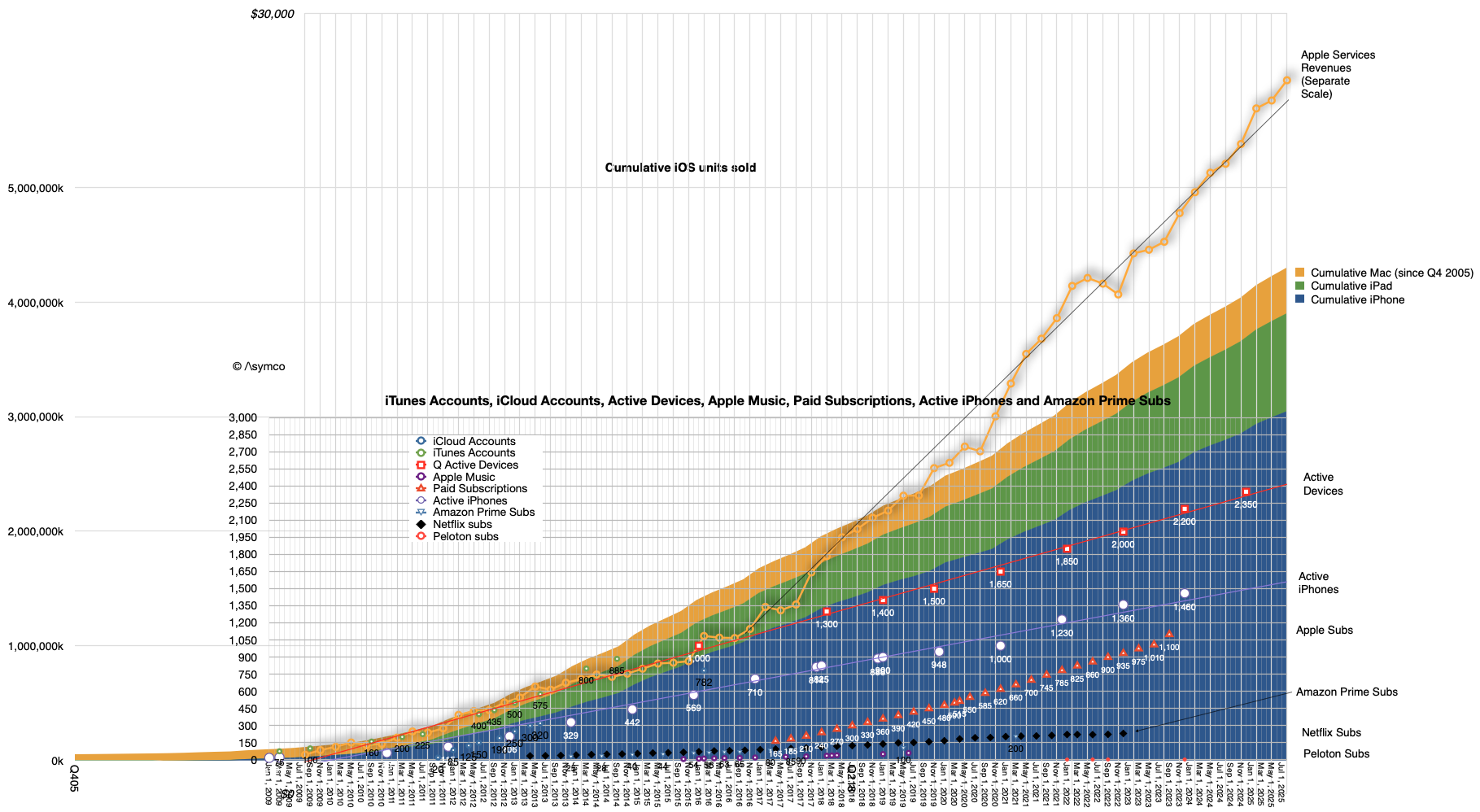
    In January this year Apple reported that there were 2.5 billion active Apple devices in use. This figure has been getting updated for years and I've been reporting its trajectory and other measures that are correlated to it. For instance the number of Apple subscriptions, Apple Services revenues and other historical indicators such as iCloud accounts and Apple Music.

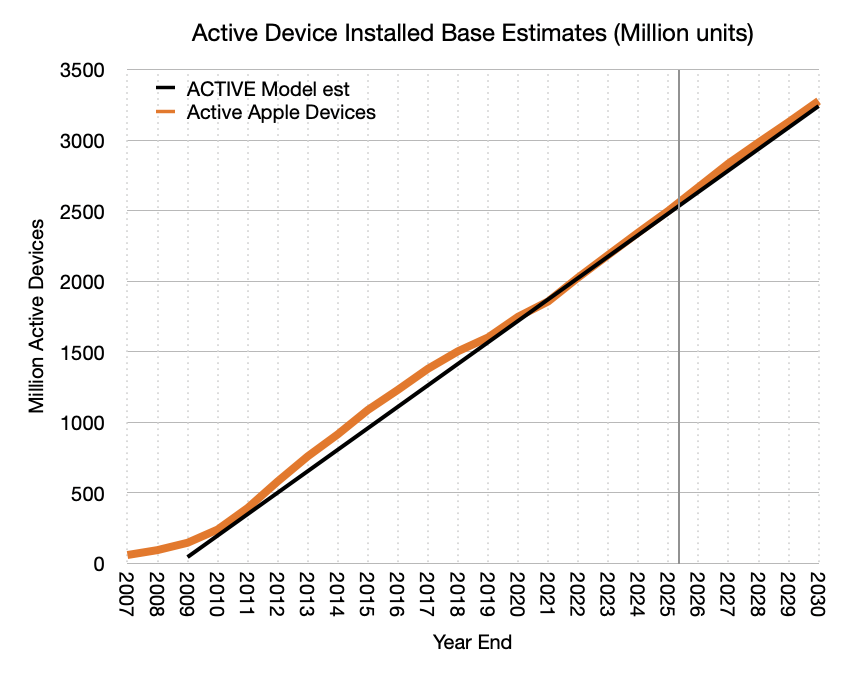
    Simplifying, I published the "ACTIVE" model which makes some basic projections of this total device count and it's shown below"
    One element of the analysis that has eluded me was the more precise composition of this total "devices". In other words, which devices and what is their mix. We have seen numbers for iPhones but not for other types of devices. I should note that this is not easily derived because we have neither the units sold (only revenues) and we don't know how long they stay in use. The measure of active population implies that the products are bought, used and eventually retired.

    The only clue we have, beside quarterly revenues--and even there wearables and home are not separated by product--is that management occasionally mentions that "more than half" of buyers of a specific product are "new to the product". It's not much to go on.

    But there are other data sets we can tap. StatCounter provides a share of platforms in use by aggregating browser identifying data for a moderately large set of web sites. That may help with share of base but not with how much the total base is. Various other analysts do try to summarize some of the installed base for particular dates.

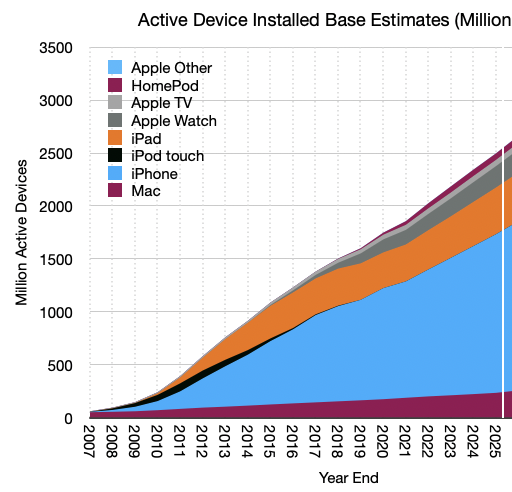
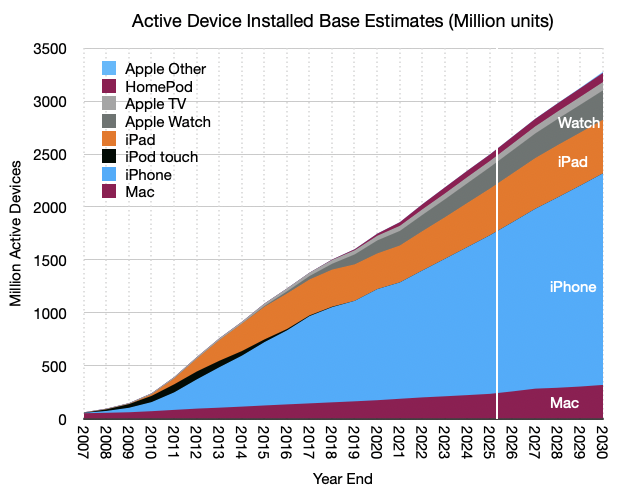
    Combining all the available data and some interpolation, I set out to do is to provide a yearly count of the population of Apple devices for each year since 2007. Then to try to forecast this population to 2030. The result is shown below:

    The following is a summary for the components for the end of 2025 in millions:

    Year-endMaciPhoneiPadWatchApple TVHomePodOther
    2025233150044220358.561.750.5

    This history looks like this:

    What about the future? Let's dig in.


    The forecast is shown in the graph and table below. The model predicts about 3.2 billion active devices by 2030.
    YearMaciPhoneiPod touchiPadApple WatchApple TVHome PodApple Other
    20075045
    20085417157
    20095942359
    20106986591510
    201182166765513
    2012932767512115
    20131023826119517
    20141124824325918
    201512359926308822.49
    2016133700133362027.135
    201714382573393331.36
    201815390053505635.674.2
    20191629503459538.8510.1
    2020173105033812343.86519.9
    2021186110034913847.8434.7
    2022200120037215452.30548.3
    2023210130039317054.9157.8
    2024221140041818757.7560.60.2
    2025233150044220358.561.750.5
    2026257160046221862.566.750.7
    2027282170048023366.571.751
    2028291180049524870.576.752
    2029302190050226374.581.754
    2030317200050727878.586.7510

    By 2030 the iPhone will be about 60%, Mac 10%, iPad 15%, Wearables 10% and Home products about 5%. The difference from 2025 will not be great. The iPhone today is about 60%, Mac is 9%, iPad 18%, Wearables 9% and Home 4%.

    The revenue impact in the growth of this ecosystem can be computed. Although we have a figure in terms average revenue per device, looking at individual products allows a more precise view. For instance, revenue per Mac per year vs. revenue per Watch per year can be now separated.

    That will all be forthcoming.


    This is a future five years away. Is this growth rate and consistency in mix a reasonable assumption?

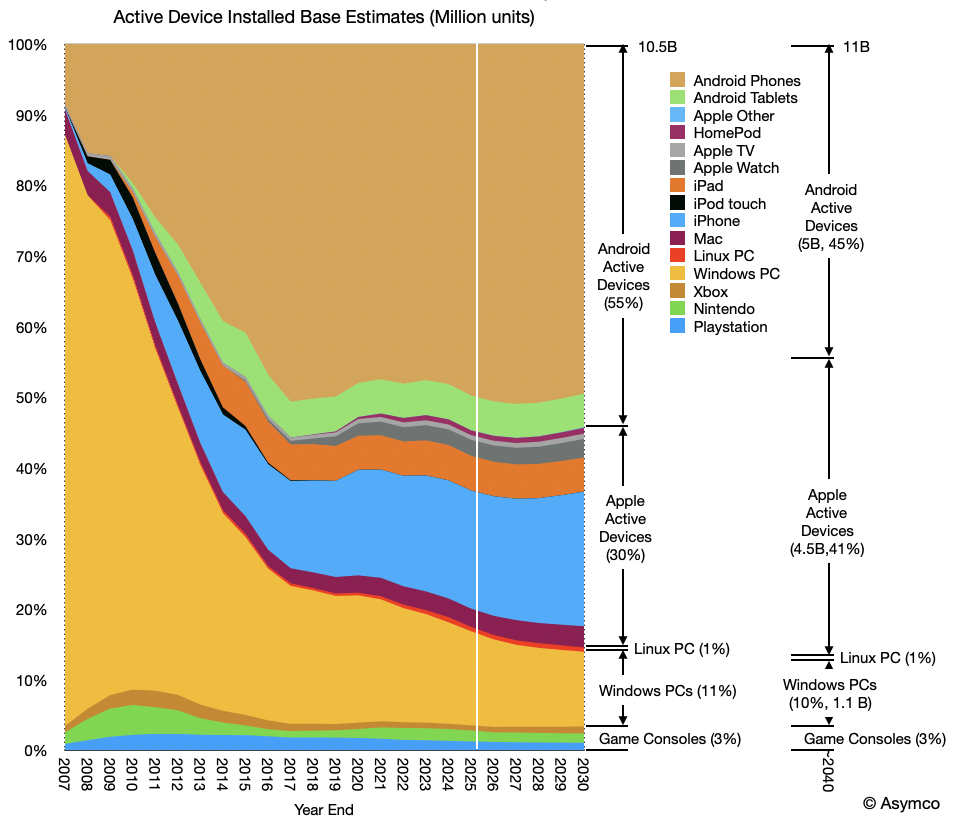
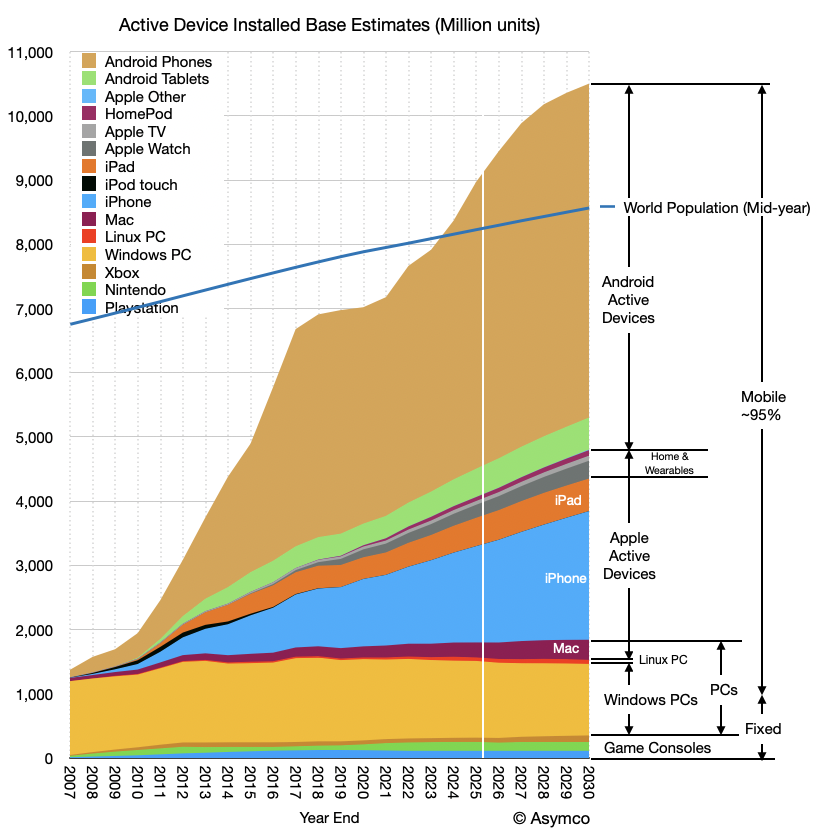
    To answer, we should zoom out and look at not just Apple's device base. The following graph shows also Android phones and tablets, Windows, Linux (PC) and Game Consoles.1 It contrasts mobile and "non-mobile" computing and shows the total global population (blue line).
    I have several observations:

    • The total device population now exceeds the total human population. The total number of phone lines was already higher for some time2 but what are shown here are "computers" insofar as they have CPUs and operating systems that can run third-party apps.
    • Given the device count exceeds human count, how much higher can this total go? The forecast shows a slowing of growth within the next five years but this is not a certainty. The attach rate of devices/person could well exceed 1.2 to 1.3 and go to levels seen in wealthy countries (above 2.) If that is the case then the device total may exceed 16 billion at saturation. This has implications for how far current strategies and business models can run.
    • The composition of device types is fairly constant and form factor substitution is rare. New categories beyond phones and current wearables are hard to anticipate but even if they emerge, the evidence suggests they are additive. Evidently the phone did not so much displace the PC but build on top of it. The potential for wearables and home devices to explode is there but it's hard to image these stealing "share of pocket" any more than phones stole "share of desk or share of backpack". If they do explode, they will add to the total via higher attach rates. 3x human population (24 billion) is possible with new wearables and home3.
    • AI holds many promises but how AI is accessed is not necessarily requiring of or benefiting from new device types. The smartphone is still the best AI device imaginable4. Ambient or passive computing can be provided by existing wearables but, as the graph shows, these are augmentative to phones. If AI introduces a completely new form factor, the impact will take decades to diffuse. As the graph shows, the mobile era is now approaching 20 years with the next five years foreseeable with some confidence. The next 15 years will be discussed in a future post.
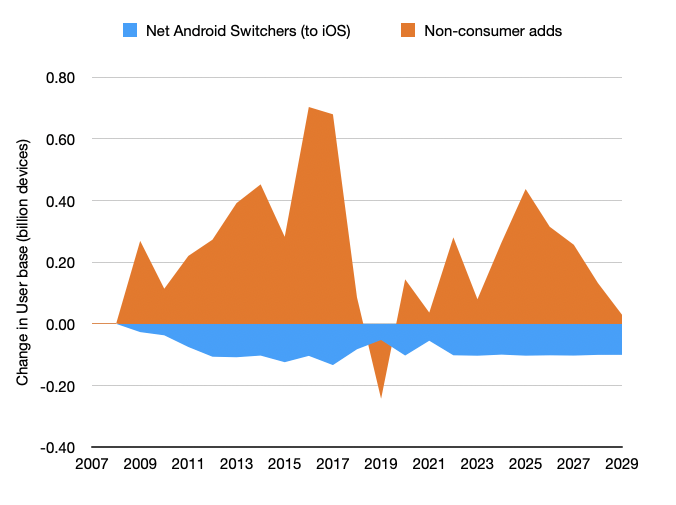
    • Android typically captures non-consumers who eventually churn into Apple devices. This means that as long as non-consumption exists, Android grows and as long as Android exists Apple grows. If and when Android growth stops then the dynamics will change and Apple might change strategy to accelerate churn.5
    • Google and Apple will be the primary distributors for all software and services into the foreseeable future. Try as they might, challengers face over 9 billion in installed base. Note well how entrenched Windows has been on the desktop even as (free) Linux and (better) macOS alternatives have harvested usage. This rigidity has held over the 1.5 billion addressable market for 30 years now. For additional evidence consider the dynamics, or lack thereof, of the game console business.
    1. It excludes servers and early phone platforms such as Symbian, Blackberry and Linux phones.
    2. According to ITU Facts and Figures 2024, there were 112 mobile-cellular subscriptions per 100 inhabitants globally in 2024
    3. Households are 1/3 human population and vehicles are only about 1/7 so Home and Automotive don't move the needle much.
    4. AI is, if anything, putting the "smart" back in "smartphone".
    5. This might be what is happening with the Mac Neo, decades after the PC market saturated. Perhaps pieces have finally fallen into place but apart from Chromebooks, it's been very difficult to challenge the Windows PC head-on. (Though the iPad was possibly designed to displace some of the PC usage, it hit mainly with non-consuming very young or very old and PC use was unaffected.)

    —

    Join me for a live discussion of this research and more at Asymco Office Hours Live Q&A on Friday, May 1, 2026.
  2. Apple FQ2 2026 Earnings Review

    Office Hours · 4 comments

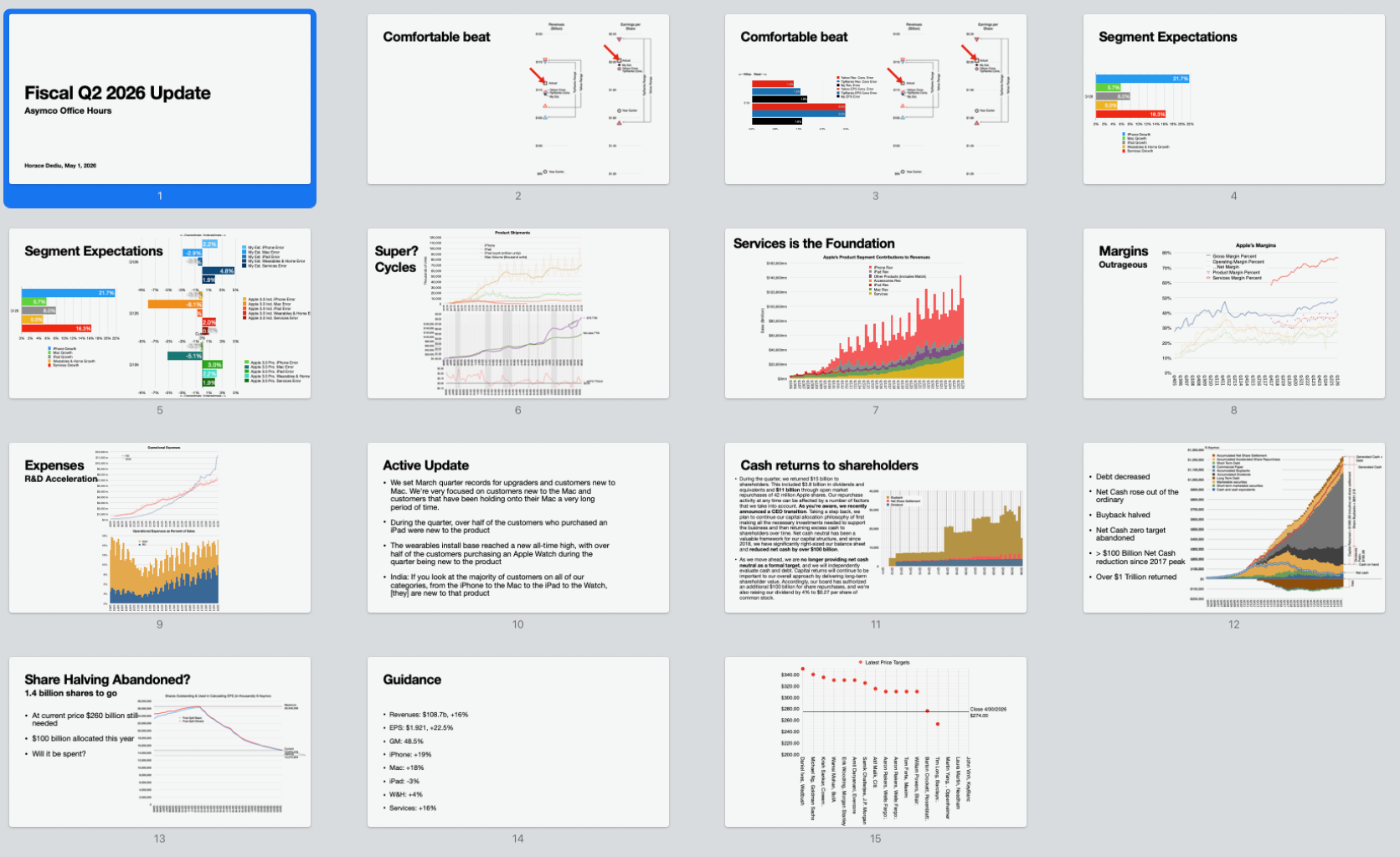
    Join us live for a comprehensive review of Apple's FQ2 2026 Earnings Report by Horace Dediu during our May 2026 Asymco Office Hours.

    What we’ll cover:

    📅 Friday, May 1, 2026 · 12:00pm ET / 9:00am PT

    Asymco One subscribers can participate live:

    Zoom link: https://us02web.zoom.us/j/87550652958

    Have a question? Drop it in the comments below — we’ll prioritize subscriber questions submitted in advance, or email events@asymco.com.

    Not an Asymco One subscriber: Subscribe today & attend live.

    Still not sure? Watch a livecast on asymco.com/live .


    The series so far:

    • Mar 4, 2026 with Ben Bajarin: implications of Apple’s March 4 rollout.
    • Apr 8, 2026: with Gene Munster: China concentration, AI narrative shift, hardware → services → Personal AI.
    • May 1, 2026: fiscal Q2 results & succession.

    Office Hours is a benefit of Asymco One. Recordings and transcripts are archived for Asymco One subscribers only.

  3. What's the consensus on $AAPL?

    Nota Bene

    Buy:Sell is 15:1

    The analyst consensus price target sits at $297.46, with 31 Buy ratings against just 2 Sell ratings across 48 analysts. Both Citi and Morgan Stanley sit above consensus at $315, signaling above-average conviction. Apple stock is up 39% over the past year, so the transition arrives with the stock already reflecting significant strength.

    Citi and Morgan Stanley both maintained Buy/Overweight ratings with $315 price targets on AAPL stock.

    Source: 24/7 Wall St. via Analyst: Atif Malik

    NB: The consensus is positive though share price target does not consider significant share gains and service growth acceleration into 2027.

  4. Goldman forecasts fiscal second-quarter EPS of $2.00

    Nota Bene · 2 comments

    Second call for EPS $2.00

    Goldman Sachs is pushing back on negative sentiment surrounding Apple ahead of its second-quarter earnings, arguing that the stock's recent underperformance reflects fears that do not match the company's underlying position.

    But analyst Michael Ng said, "concerns for Apple are overly pessimistic given its much stronger relative position."

    Goldman Sachs forecasts fiscal second-quarter EPS of $2.00, above the Street consensus of $1.93, with outperformance expected across iPhone revenue, Mac revenue and gross margins.

    Favorable foreign exchange and strong Services revenue growth are also expected to flatter results.

    On Services, Goldman Sachs projects 14% year-on-year growth despite another slow App Store quarter, with iCloud+, AppleCare+, prior price increases on Apple TV+ and solid advertising performance cited as supporting drivers.

    Looking ahead, the bank sees advertising inventory expansion in the App Store and Maps as further tailwinds.

    Recent data points cited by Goldman Sachs include high-end smartphone outperformance flagged by TSMC on its latest earnings call, iPhone share gains in China, and reports that Apple is actively securing mobile DRAM supply while keeping pricing competitive.

    The bank sees further catalysts ahead, including WWDC, where new AI Siri features are expected, and the fall iPhone lineup, which Goldman Sachs described as likely "the most innovative ever with the introduction of the iPhone Fold."

    Source: Yahoo Finance

    NB: My target of $1.98 seems amiss.…

    There was little to argue in this. Management telegraphed more or less the same forecast and the note simply iterates more recent data points from supply chain. WWDC is the perennial "catalyst" though it never turns out that way. A catalyst is a compound or substance that accelerates a chemical reaction. The search for an accelerant is unnecessary as the reaction happens with or without it. Somehow we believe that without a catalyst nothing happens.

    What is always happening, the reaction that is always ongoing, is the creation of 100 million new customers every year. Accelerating this process is not a matter of just new products or change in sentiment with AI. Much of this rate is due to overall global economic and demographic change.


  5. John Ternus has left big shoes to fill

    Research · 4 comments

    April 21, 2040

    It's been 15 years but John Ternus has finally stepped down as Apple CEO. Analysts described the transition as expected rather than disruptive, noting that investors had long anticipated Ternus' eventual departure. Nevertheless, he leaves with many questions still unanswered about Apple's long term strategy. Apple incoming CEO faces a defining challenge: Fixing the company’s Services dependence.

    It's been a tumultuous tenure for Ternus but he is leaving with significant accomplishments:

    • John grew Apple devices to 4.5 billion from 2.5 billion when he took over in 2026. Many have pointed out that he has been building on Tim Cook's success and that John has only added 2 billion devices in 15 years, averaging 110 million per year. The reality is that most of those have been switchers from Android rather than first-time users. Because of this, Android's 5 billion active devices means Android users still outnumber Apple users. Apple's users do have attach rates of over 2.5 devices per user including passive AI wearables but the competition is not standing still. The new CEO will face the challenge of trying to wrest majority market share in a saturated 12 billion active device market.
    • With over 2 billion customers, Apple is capturing over 40% of all AI revenues. Critics point out that the company has not grown beyond its core: high net worth and high income households. Much of that foundation was laid by his predecessor and arguably all that John has done is maintain a base that grew organically as global income has risen. Over a billion middle/high income individuals have joined the world economy as Apple users but that is hardly attributable to Ternus. His engineering acumen did not give him the insight into marketing to low income countries where most of the users are shunning Apple products.
    • John has had to navigate a challenging geopolitical situation with the rise of India as the world power and the decline of China. Critics pointed out that Apple's dependence on India is an Achilles' heel and that his transition of production and market growth from China to India has been rough and challenges remain with regulation and labor unrest. The Indian middle class has been the growth engine for a decade but, as all eyes are on Africa and South America, Apple has been on its back foot.
    • Apple grew the AI business but now depends too much on in. Growth since 2038 has slowed from mid teens to low teens and analysts are pointing out that Apple is too dependent on Services as its biggest source of revenue. Apple's P/E ratio is now below the average of the Fab Five reflecting investor skepticism that it can capitalize on submersible data centers in international waters. Its insistence on local sovereignty for data storage goes against the bathospheric consensus.
    • Competition has been kept at bay, so far. Apple has seen off challenges by Anthropic, Netflix and SpaceX but there are hundreds of startups looking to build the next Services killer. Billions of satisfied customers are not the moat they used to be.

    Apple has made it this far, recently celebrating its 65 anniversary but there is no guarantee that it can continue its run as the world's most valuable company. The next CEO has to steer the ship Ternus just managed to helm through stormy seas.

  6. Succession, study of the firm vs. study of the person

    Research · 2 comments

    The Asahi Shimbun Interview Part 5

    Coronation of Celestine V; ~1215 – 1296. The only Pope to be crowned twice.1

    Horace Dediu / Takeshi Narabe & Dylan Weir / Asahi Shimbun Interview, April 1, 2026

    Dylan Weir • 31:51
    There's been some reports that Tim Cook is on the way out and some speculation about who might replace him. Is that your sense, that he will be leaving soon?

    Horace Dediu • 32:06
    One thing that hints in that [direction] is that the board members are actually limited to age 65 and he is on the board although they can extend that by vote. So one should imagine that there is an age limit. The hypothesis however is that he's too valuable. Not so much as the manager but as the negotiator and as the diplomat. Because we live in such difficult times from a geopolitical point of view he somehow has managed, i don't know how, nobody knows how, even Warren Buffett recently pointed out that he thinks that's one of his greatest skills: that everybody likes Tim Cook.

    That includes China that includes Trump that includes Europe. Somehow he gets along with everyone. So his ability to be the diplomat, will it be perhaps valued further? One possibility would be that he actually becomes executive chairman as opposed to CEO. That he continues in that role without having to do day-to-day operations.

    There are people who are very good at that. And who've been on the bench for a long time and who've been cultivated for a long time to step in his place. So in that sense, on these fundamental questions of biological life...

    You know, I think one hypothesis that makes sense is that he might stay as long as there's a Trump administration, because again, he's able to navigate that world. But yes, I think ultimately, though, he will be gone. And there's no question. And when he joined, he knew he'd be gone some day. There's no naiveté about his need to hand things to the next generation. And I think that was part of the thinking under Steve as well: How do we hand this off? And they've been thinking about it ever since.

    But anyway, the speculation is John Ternus is the next in line. I think that's a very plausible hypothesis. And one reason, by the way, is I always maintain if you study the company from a cultural point of view, you'll realize that there are people who cannot be CEO. You may not know who it's going to be, but I can tell you who won't be. Many people over the years suggested candidates, and I would say no, never. And here are examples. Johnny Ive would never be CEO. An external hire would never be CEO. Even a head of marketing would never be CEO. Many people think that Apple is a brilliant marketing company. No, it's an engineering company. It's a huge secret out there.

    If you look at the headcount, if you divide the employees by their job functions, you'll see that engineering is by far, three to four times, bigger than the next category, which would be perhaps marketing or operations. So what does that mean from a cultural point of view? It means that the people who are engineers want to have a boss who can listen and understand them. And they don't think, if you know engineering culture, […] that someone who's from marketing is going to be able to understand them because they don't have the cultural and the educational background or the mentality around engineering.

    And so the people who need to run Apple have to be competent with engineering. In the case of operations, it's one of those acceptables because they are at least covering engineering as one of their constituencies. So they have to bridge between manufacturing, distribution, and all these things. So engineers respect operations. Engineers respect manufacturing. So in that sense, when you look at the candidates, I do think John is one of those who fits the bill. Of course, there could be many others as well.

    Dylan Weir • 36:36
    That's fascinating. Thank you.

    Horace Dediu • 36:41
    I think if I may just summarize, I think it's very rare that any analysis--and I come from an engineering background and I did my work always in a lot of data, using a lot of data. But the more I study Apple, the more I think it needs to be analyzed culturally. And it's a very difficult thing to do because we have no data. We have only some anecdotes. But you have to, as an analyst, you have to be humble and see that the data, perhaps that [which is] most important, is not available.

    When it's dark outside and you're searching around the lamp, well, that's the only area that you have light. but the truth could be in the darkness. And that area under the light, that's your data set. And the solution is somewhere else perhaps. And that's why you have to have this idea: what tools can we use other than looking at the light? Use all your senses. Use other perceptions.

    And so that's why I think Apple is a peculiar thing. And by the way, the analysts out there who do try to stay out of the data [delve] more into psychology, they tend to really study the man or woman. They'll study the personality as an alternative [to the data]. So they'll say, well, the company's success depends on Zuckerberg. We have to know who he is. Or Tim Cook or Steve Jobs or Larry Ellison, whomever it is.

    There are people who specialize in understanding that person but i don't think Apple is that. I think [personality is] important but you have to study the whole. The whole way they do things internally. They give us plenty of hints; they say all the time that it's a team effort. They'll always say "no it's not me, it's it's a group effort".

    And and they always say "we" [not I].

    You know, we have a lot of debates [but I believe] we have to take them at their word that it isn't just the individual.

    Takeshi Narabe •

    Thank you so much it's very you know insightful analysis thank you very much.

    Horace Dediu • 38:57
    i love your questions. You have great questions and that's always my my biggest thrill. And not that i'm not being asked what color is the next iPhone.

    Previous in series: Part 4: How not to over serve; The machinery of vanity

    Interview as published: 聞 Asahi Shimbun on Apple & Innovation

    1. Sic transit gloria mundi means "thus passes the glory of the world". The phrase was used in papal coronation ceremonies between 1409 and 1963. As the newly chosen Pope proceeded from the sacristy of St. Peter's Basilica, the procession stopped three times. On each occasion, a papal master of ceremonies would fall to his knees before the Pope, holding a silver or brass reed, bearing a tow of smoldering flax. For three times in succession, as the cloth burned away, he would say in a loud and mournful voice, "Pater Sancte, sic transit gloria mundi!". These cautionary words served as a reminder of the transitory nature of life and earthly honors.
  7. MacBook Neo Sold Out Through April

    Nota Bene · 3 comments

    I keep holding out that this is not a problem

    Apple's MacBook Neo has been a huge hit, and it's still in high demand over a month after it launched. The ‌MacBook Neo‌ is just $599, and with PC makers raising prices because of global RAM shortages, the Neo's low price tag and Apple allure are even more appealing.

    Source: MacRumors

    NB: Microsoft's cheapest laptop is three times more ex…

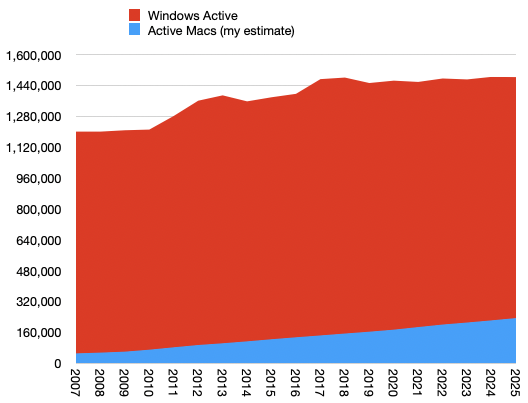
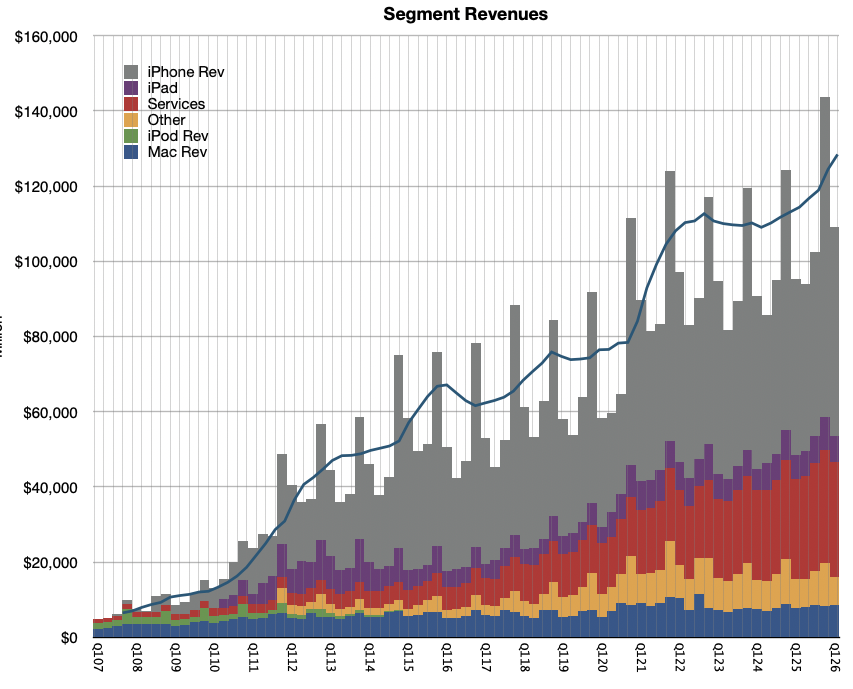
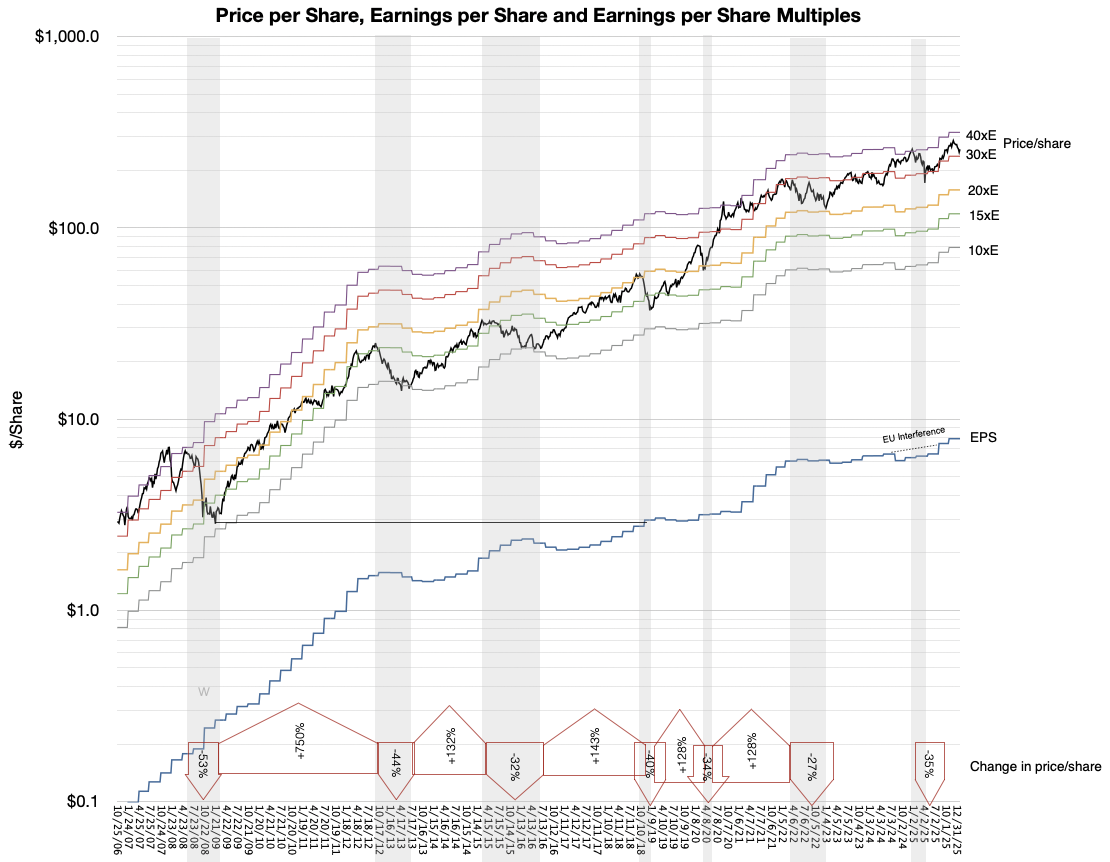
    …pensive. Selling out is a problem is customers will abandon the purchase and buy something else. I suspect some may but some may even buy another Mac. The Mac Mini and Studio are also in stockout status. It's a windfall for the Mac but the big picture is shown in the graph below. Can Apple bend the blue curve?

    As I will argue in a further post perhaps this is one of those pivotal moments.

    MacBook Neo Sold Out Through April


  8. IDC: Apple Grows 33.3% in China as Market Declines 3.3% in Q1 2026

    Nota Bene

    Counterpoint says 20% and -4%

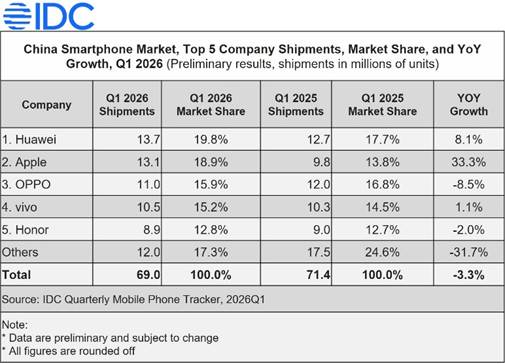
    China smartphone shipments fell 3.3% in Q1 2026 to 69M units, with Huawei and Apple driving premium demand despite rising costs and supply constraints.

    Source: IDC

    Separately, CounterPoint research reports;

    China’s smartphone shipments declined 4% YoY in Q1 2026, as memory shortages disrupted supply and drove up costs across OEMs.

    Huawei led the market in Q1, supported by its domestic supply chain advantages and stable pricing. As a result, the brand recorded its highest-ever quarterly share in China since Q4 2020.

    Apple delivered the strongest growth among the top six brands, and it is widely seen as best positioned to navigate the memory crunch.

    NB: Both researchers say Apple share in China is about 19%, nearly tied with Huawei at 20%…

    …. The big loser seems to be "Other" down 32%. Clearly Apple management saw this coming and guided accordingly.

    Some analysts are increasing their targets finally realizing that the memory supply crisis might be beneficial to Apple. This should have been noted already three months ago when Apple provided extraordinary guidance for the March quarter.


  9. Asymco Bulletin 009 - Apr 19, 2026

    Bulletin

    Asymco Bulletin is a digest of all the work we have published for the week ending Apr 19, 2026.

    Research

    Estimates for Apple’s March Quarter 2026

    Estimates for Apple’s March Quarter 2026

    Revenues and growth rates for iPhone, Mac, iPad, Services, Wearables, plus Net Sales, Gross Margin, Operating Expense, Other Income and Expense, Tax Rate, Net Income, Share Count and EPS with a comparison to CFO guidance.

    Ref. conference call's guidance, Kevan Parekh, Apple CFO: As we move ahead into March, I would like to review our outlook, […]. We expect our March total company revenue to grow by 13% to 16% year over year, which comprehends our best estimates of constrained iPhone supply during the quarter. We expect services revenue to grow at a year-over-year rate similar to what we reported in December. We expect →

    The Inevitability of Combining the Digital and Physical Worlds

    The Inevitability of Combining the Digital and Physical Worlds

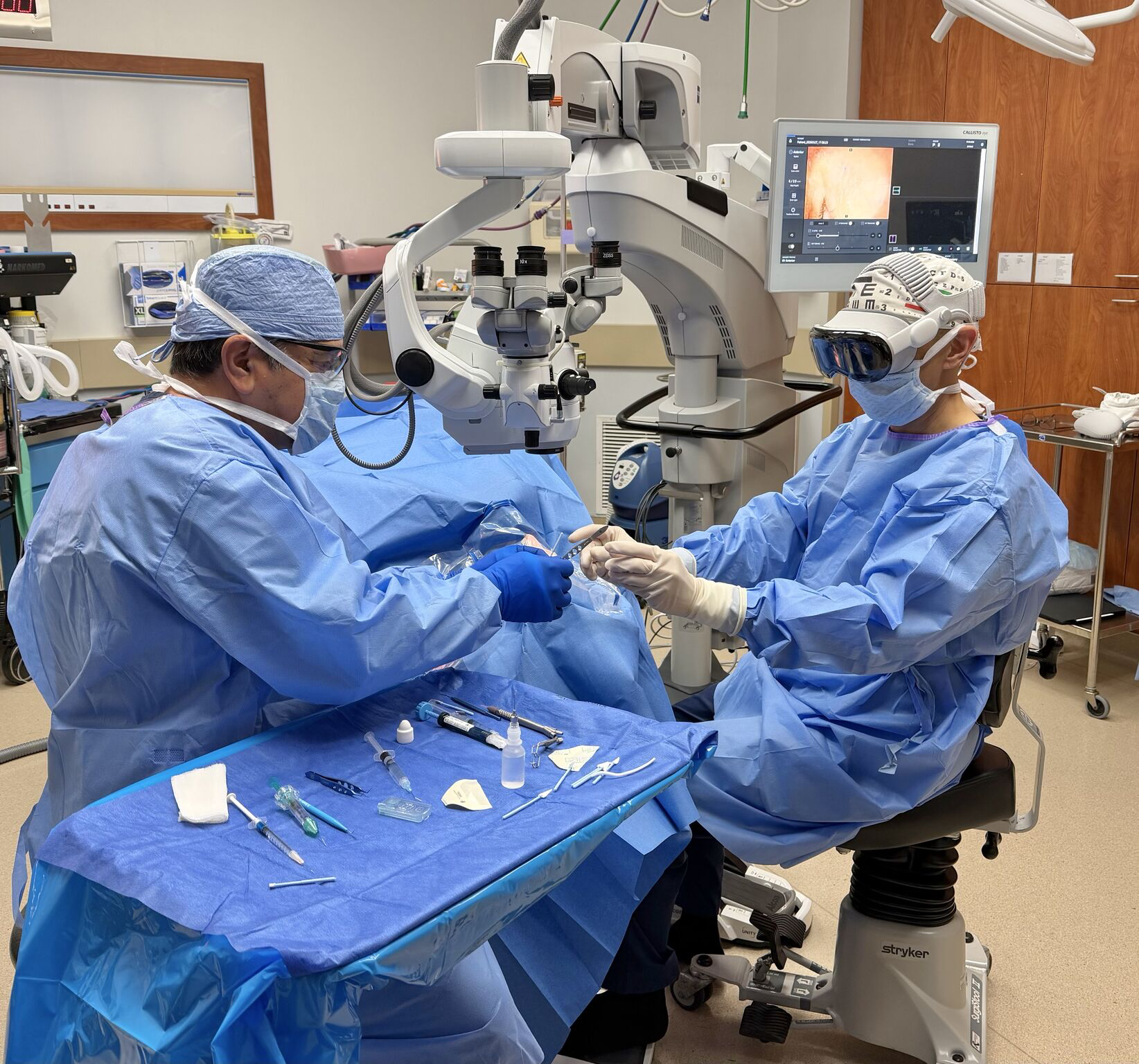
    In a recent interview Apple management was asked about AI, which is perceived as an area where Apple has been struggling. Greg Joswiak replied: We’ve been doing things with intelligence for many years, right? And gen AI allows us an opportunity to do that even more. So I’m excited about that, but boy, this is not a sprint. This is a marathon.

    In contrast to AI, Spatial Computing is being largely ignored. It is however making significant leaps in utilization, especially in verticals. →


    Nota Bene

    Monday Notes: Neo still sinking in

    Monday Notes: Neo still sinking in →

    Apple's potential to double its Mac user base through strategic budget expansion and memory supply tactics presents a promising growth trajectory.

    260 million Mac users? Huge room for growth.

    Two analysts, two stories. The Neo will move the needle and the supply crunch will hamper competition…

    Nevertheless, a doubling of the Mac user base is certainly a worthy and achievable goal over the next decade. →

    Apple Studio Display XDR Now Cleared for Diagnostic Radiology

    Apple Studio Display XDR Now Cleared for Diagnostic Radiology →

    At just $3,000, the Studio Display XDR democratizes medical imaging, undercutting specialized monitors by up to 90% and revolutionizing healthcare accessibility.

    The ‌Studio Display‌ XDR is priced at $2,899 with a VESA mount, and it is more affordable than many specialized medical imaging monitors.

    It allows a new set of people to do what previously required only specialists to do and allows specialists to do more than they used to do. →

    Antelope standing beside a wooden desk with a vintage Macintosh computer

    All of a sudden, everyone is doomed except Apple →

    Despite optimistic predictions for Mac growth, persistent skepticism argues Apple faces inevitable doom due to supply issues and product flaws.

    As honored as I am to be the recipient of an antlers tip, I must respectfully disagree…

    The only thing you could be sure of is that Apple is doomed. →

    Computer History Museum interviews Bertrand Serlet

    Computer History Museum interviews Bertrand Serlet →

    Bertrand Serlet, a pivotal yet understated architect behind Apple's OS X, exemplifies the profound impact of tech's quiet innovators.

    Pay attention to the quiet ones

    This is one in a series on Apple’s quieter heroes.…

    That this interview only has 6000 views after three years shows how much untold history exists. →

    Bank of America raises Apple price target to $325 from $320 →

    BofA slightly ups Apple's price target to $325, forecasting $113B revenue and $2.00 EPS for Q2, driven by strong iPhone sales and Services growth, slightly above my estimates of $110B and $2.00.

    Q2 forecast update

    My own estimates for Q2 revenues and EPS are $110B…

    More to follow as we get closer to the earnings release date but this is a good preview. →

    Omdia releases first estimate for Q1 PC unit shipments →

    Apple's Mac shipments grew 5.4% to capture 11% market share in Q1 2026, driven by MacBook Air and Neo sales, with revenue estimates slightly differing from unit projections.

    Apple growing at double market rate.

    Omidia estimates that Apple reached a market shar…

    …e of 11% with shipments growing 5.4% due to solid MacBook Air sales performance and the initial sell-in of the MacBook Neo.. This means 5.4% growth for Apple y/y. As I noted in my Office Hour yesterday, I adjusted my Mac growth from 0% to 6% based on the new products launched. This is an estimate of revenues not units but it might be pretty close. Omidia estimates 7,112 million units whereas I’m a little above 6 million. We seem to disagree on ASP. →

    Apple and Amazon Partner on Satellite Deal

    Apple and Amazon Partner on Satellite Deal →

    Amazon's acquisition of Globalstar boosts its satellite internet ambitions and strengthens ties with Apple, while highlighting the limited reach of space-based networks compared to terrestrial ones.

    I assume Apple has wanted to steer clear of Starlink but it’s not clear that was a primary consideration in choosing Globalstar.

    Starlink, considered the dominant player, serves about 11 million users. I would note that 11 million is 0.1% of the number of cellular subscriptions worldwide. →

    iPhone vs Android Switching Rates →

    iPhone users boast nearly quadruple the loyalty of Android counterparts, with actual annual switching rates favoring Apple slightly, despite inflated survey intentions.

    I did a deep dive into the data and came up with graph above. The original report shows intention numbers which seem quite high. For instance, the net switching rate between iOS and Android is 10% in favor of Apple. This would imply that the entire user base would flip in 10 years. It would also imply…

    I think actual net churn is 1.7% of the base each year. That’s still 100 million a year. For now it seems Apple is happy to maintain that rate. →


    Office Hours

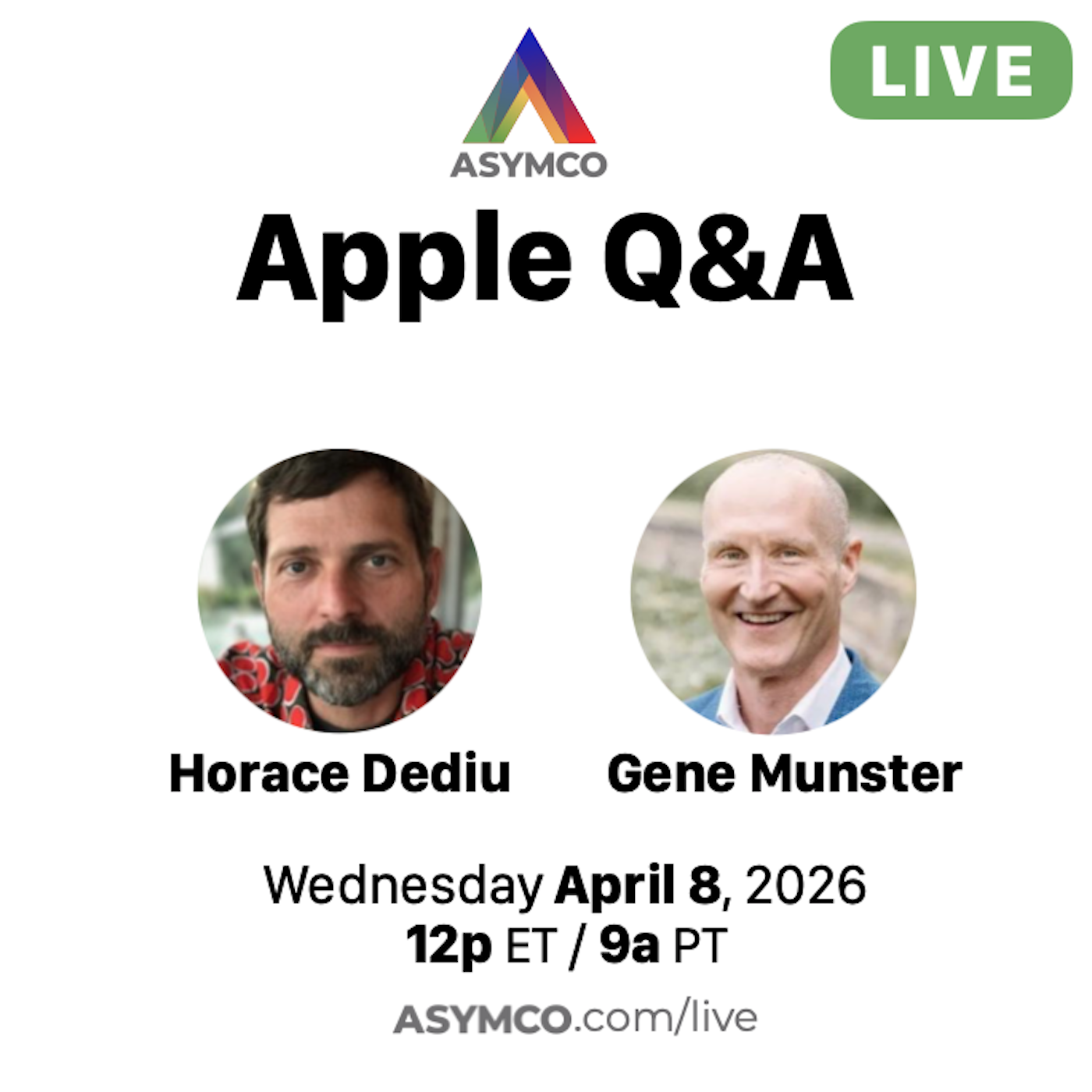
    Asymco One Office Hours Live Q&A with Horace Dediu & Gene Munster: April 8, 2026

    Asymco One Office Hours Live Q&A with Horace Dediu & Gene Munster: April 8, 2026 →

    Asymco Office Hours, April 8, 2026

    Hosts: Horace Dediu and Gene Munster

    This episode of Asymco Office Hours covers a wide range of topics related to Apple, including geopolitical risks, financial performance, AI developments, and business strategy. The discussion is led by Horace Dediu and Gene Munster, with insights from industry experts.


    Podcast

    Asymetric Podcast: Waterloo

    Asymetric Podcast: Waterloo →

    In this Asymmetric Podcast episode, Horace muses on buying flowers, highlights Apple's distinguishing product, and teases his new research. →


    Asymco One gives you full access to our research, analysis, and commentary. Subscribe with code BULLETIN for a discount.

    Feedback: Have questions or comments? Reach out to us at contact@asymco.com. We’d love to hear from you.

  10. iPhone vs Android Switching Rates

    Nota Bene · 3 comments

    Bitchin' ain't Switching

    SellCell’s Smartphone Loyalty Survey 2026 shows iPhone and Android loyalty at record highs, but Android users still switch more.

    Key findings

    iPhone loyalty stands at 96.4%, up from 91.9% in 2021

    iPhone switching stands at 3.6%

    Android loyalty stands at 86.4%, with switching at 13.6%

    Android users are nearly four times more likely to switch than iPhone users

    Samsung loyalty stands at 90.1%, up from 74% in 2021

    Samsung switching stands at 9.9%

    Google loyalty stands at 86.8%, up from 65.2% in 2021

    Google switching stands at 13.2%

    The loyalty gap between iPhone and Android now stands at 10 percentage points

    Price and value are the biggest drivers of switching

    Technology is the second biggest driver

    Overall, loyalty has increased across all major brands since 2021

    Source: SellCell.com Blog

    NB: I did a deep dive into the data and came up with graph above. The original report shows intention numbers which seem quite high. For instance, the net switching rate between iOS and Android is 10% in favor of Apple. This would imply that the entire user base would flip in 10 years. It would also imply...

    ... that Apple gains over 400 million new users every year as Android base is about 4 billion. But we know that Apple gains about 100 million a year based on the active device tally (now at 2.5 billion active devices and 1.5 billion active iPhones).

    Therefore, based on the known install bases and growth therein, we can determine that the actual switching rate from Android to iOS is about 2.6% for any given year and the switching rate from iOS to Android is about 0.9%. Android still gains overall users since new users are converted from non-consumption.

    About 300 million are still being added to Android while 100 million are lost to iOS.

    As time goes on and saturation is reached (near 5 billion active smartphones) then the churn will imply that Android will eventually become a net user loser.

    That probably won't happen before 2030. When saturation does happen however, I will be watching to see if Apple chooses a different strategy to accelerate switching similar to what it is doing with the MacBook Neo at a time of PC market saturation.

    The lesson here is that switching intention surveys showing a net 10% churn rate don't mean that the actual switching rate is net 10%. The intention to switch is a sentiment but actual switching is often more difficult than a wish to do so.

    I think actual net churn is 1.7% of the base each year. That's still 100 million a year. For now it seems Apple is happy to maintain that rate.

  11. Apple and Amazon Partner on Satellite Deal

    Nota Bene · 2 comments

    Counting satellites and subscribers

    Amazon said on Tuesday that it’s agreed to acquire satellite company Globalstar, a major step for the e-commerce business as it works to build out a space-based Wi-Fi service through its Leo initiative.

    Amazon also announced that it signed an agreement with Apple to provide satellite connectivity for current and future iPhone and Apple Watch features. The partnership was made possible via an existing deal Apple already had with Globalstar.

    Amazon said on Tuesday that it plans to work with Apple on future satellite services. “Amazon will continue to support iPhone and Apple Watch models currently using Globalstar’s existing and planned upcoming low Earth orbit satellite constellations, being manufactured by MDA Space, and collaborate with Apple on future satellite services using Amazon Leo’s expanded satellite network,” a news release read.

    Source: Barron's via Apple Stocks

    NB: I assume Apple has wanted to steer clear of Starlink but it's not clear that was a primary consideration in choosing Globalstar.

    The deal gives Amazon access to Globalstar’s network of two dozen satellites. Amazon has the aim of deploying about 3,200 satellites in Earth’s low orbit by 2029. Amazon currently operates a network of more than 200 satellites and is preparing to roll out its satellite internet services later this year.

    Globalstar powers Apple’s “emergency SOS” feature and had received an investment of $1.5 billion for 20% share. Under that development, the network would expand to 54 satellites. Amazon and Apple have signed an agreement to continue the services.

    Incidentally, given the acquisition price, Apple's $1.5 billion investment is now worth $2.13 billion.

    The acquisition of Globalstar by Amazon is a positive for Apple as it ensures there is additional investment in space-based networks and thus there isn't the possibility for a single supplier situation. Apple's investment in Globalstar was already a signal of their intention to sustain competition. However, it should be understood that space-based networks were never going to rival land-based except for remote locations and emergency or military use.

    Starlink, considered the dominant player, serves about 11 million users. I would note that 11 million is 0.1% of the number of cellular subscriptions worldwide.