Why give all your cash to Nvidia? Why not make your own chips? Then why not sell them?
Google said that it plans to sell its custom Tensor Processing Units (TPUs) to select customers who will install the chips in their own data centers.
The move is a change from Google’s prior strategy, which saw it rent out TPU capacity to customers from its own data centers — and is yet another strike at AI chip king Nvidia.
The announcement, during the company’s Q1 earnings call, comes a week after Alphabet announced two new TPUs: its TPU 8t for AI training and TPU 8i for inferencing.
Alphabet didn’t disclose potential customers, but it signed a multiple-gigawatt agreement for next-generation TPUs with Anthropic earlier this month, with chips expected to begin coming online in 2027.
And according to The Information, Alphabet has also entered into a multibillion-dollar chip deal with Meta (META).
NB: Alphabet Q1 sales grew 22% to $110 billion, with Cloud up 63% to $20 billion. Operating margins grew by 220 basis points, with services and cloud operating margins both increasing y/y.
The search business continues to benefit from AI. AI overviews and AI mode are sustaining as search sales grew 19%.
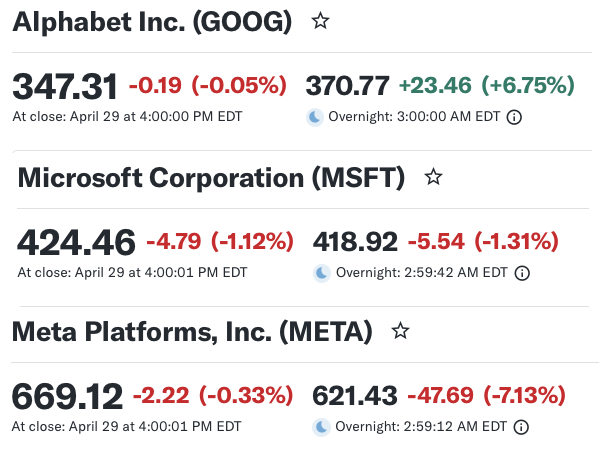
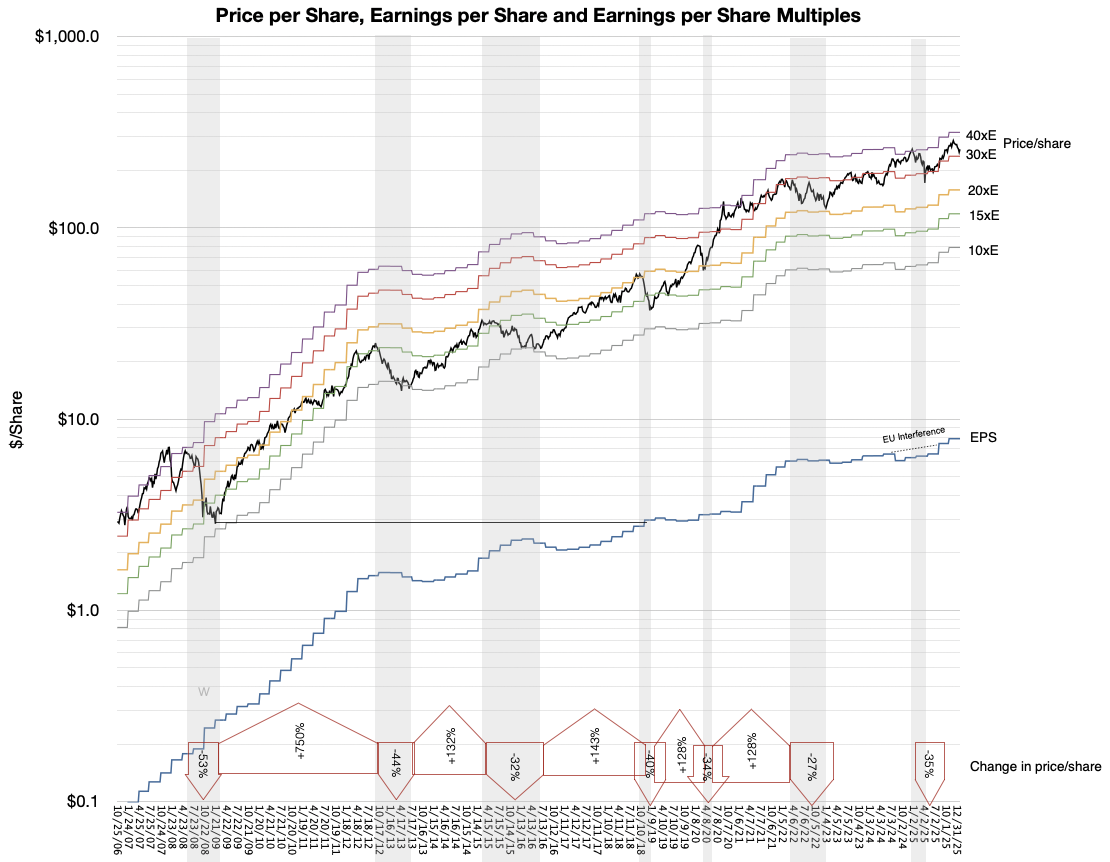
A year ago, Google was trading as if it had lost the artificial intelligence race. Shares are up 6.8% after-hours to all-time high even after growing 114% from a year ago.
Though Google is considered an Apple competitor, the reality is that the two companies are very much in a partnership with Google's payments to Apple being treated as "advertising" revenues (part of Services). The relationship is being expanded with the Gemini deal.
In many ways Apple has effective equity in Google and Google is demonstrating how sustaining AI is to its core business. That sustenance is transitive to Apple.
Moreover, as Google's TPU strategy puts them in direct competition with Nvidia, it exposes the age-old adage that "there is no shortage that is not followed by a glut".
Amazon is also offering up its own chips to customers and Apple is developing its own AI chips.
In his annual shareholder letter, Amazon CEO Andy Jassy said that the company’s chip business, which includes its Graviton, Trainium, and Nitro processors, has an annual revenue run rate of greater than $20 billion.
When Apple ships the inevitable edge AI silicon in a billion devices, the democratization of AI compute will dawn. Remarkably, some can see the dawn already at sunset.
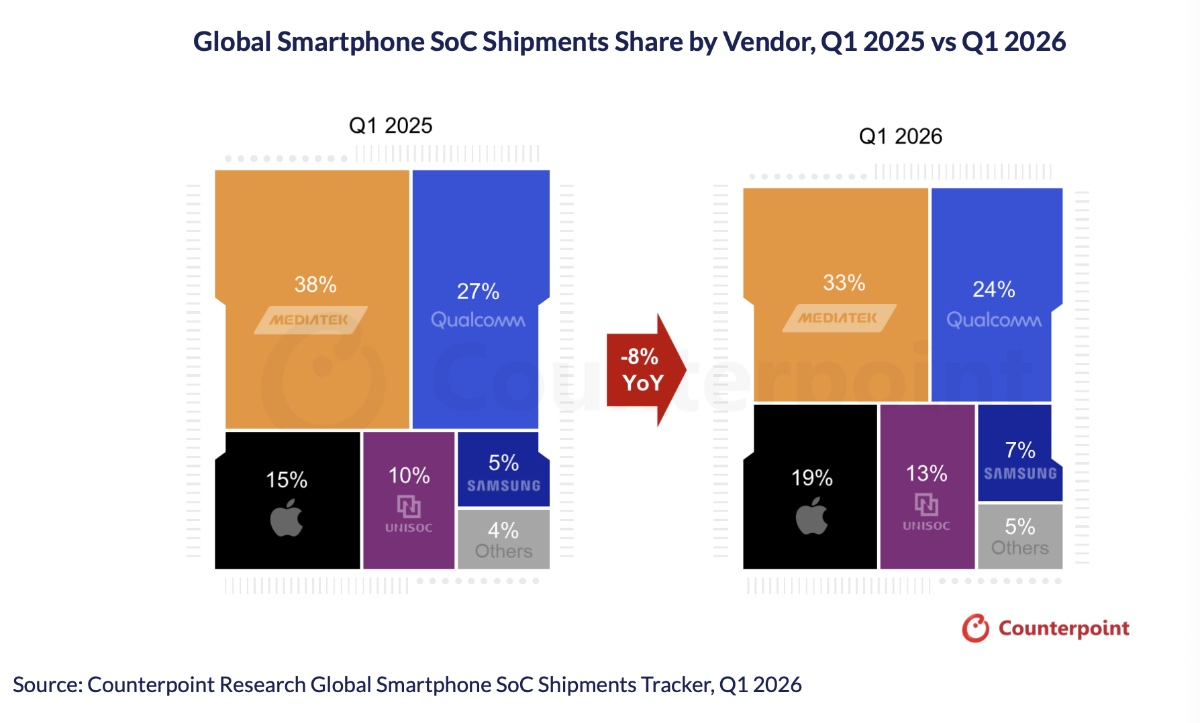
Global smartphone system-on-a-chip (SoC) shipments declined 8% year-over-year (YoY) in quarter one (Q1) of 2026, according to Counterpoint Research’s latest Global Smartphone SoC Shipments Preliminary View report. However, it’s good news for Apple.
Counterpoint says the premium segment has remained relatively resilient, with higher costs largely passed on to end consumers. Meanwhile, the entry-level manufacturers are increasingly adopting lower-cost chipsets to keep smartphone prices competitive.
Qualcomm and MediaTek recorded double-digit declines in shipments. In contrast, Apple, Samsung, Google and UNISOC posted positive growth.
Apple saw its share of the global smartphone SoC market grow from 15% in the first quarter of 2025 to 19% in the first quarter of 2026. Some explanation: A smartphone SoC (System-on-a-Chip) is a single, integrated chip that combines all essential computing components—CPU, GPU, memory, and connectivity modems (5G/Wi-Fi)—into one unit.
Apple silicon is a series of proprietary, ARM-based systems-on-a-chip (SoCs) designed by Apple for its ecosystem, providing high-performance computing through a unified memory architecture and specialized components. They power iPhones (A-series), Macs (M-series), iPads, and wearables (S-series), focusing on superior power efficiency and security.
NB: Counterpoint Senior Analyst Shivani Parashar says that their integrated supply chains helped …
…Apple, Samsung and Google to better mitigate the impact of the ongoing memory crunch. Supply crunches affect the smaller more than the stronger. It always surprises me when the reactions to such events (such as Covid disruptions) suggest negative impact on Apple, the strongest of the market leaders.
On March 18, 2026, Bernstein SocGen Group reaffirmed its “Outperform” rating and $340 price target for Apple Inc.
Comparing it to Samsung’s 2009–2013 strategy, which saw Samsung increase its global smartphone share from 4% to 32% in Q3 2013, Bernstein emphasized Apple Inc.’s recent product launches as a strategy to widen portfolio price bands, driving share gains at the low end while raising prices at the high end to maintain margins. Although Samsung eventually lost market share to Chinese manufacturers, the firm said the stickiness of Apple’s iOS ecosystem will help it sustain long-term market share.
Bernstein projected a 12% increase in fiscal 2027 EPS from share gains, split equally between hardware and services, assuming Apple Inc. captures 10% of Chinese manufacturers’ smartphone market share amid their supply issues. Some noteworthy product developments include the introduction of the $549 AirPods Max 2, the App Store cost reduction in China from 30% to 25%, and plans for a foldable iPhone.
NB: Separately, it's been reported that Samsung might see its first operation loss from its phone division, resulting in Apple capturing 100% (or more) of global smartphone profits. Simultaneously, Samsung is seeing huge profit gains from memory, even overtaking Nvidia's profitability. This is remarkable…
Samsung seeing windfall profits from a memory shortage but a contraction from its phones suggests a migration of value in the value chain. AI has effectively pushed profit "down" the stack from device/OS to components, and perhaps up also to services.
Apple has over the years invested down the stack to Silicon and up the stack to Services. What a surprise! The commentariat has not quite grasped this but has already jumped to conclusions that Apple is getting squeezed from supply chain and AI.
The future however is not so sweet for either components or AI-as-a-service. There has never been a shortage that was not followed by a glut. The semiconductor business is known for this boom/bust cycle and this time it's not different. Unless AI conquers distribution, privacy, experiences and understanding & mastery of jobs-to-be-done while preventing commoditization through replication and scale economies of compute, there will not be a break-out new business model. There is no clear reason why Apple won't figure out any of the unknowns while preserving an ecosystem advantage.
Samsung has the same challenge they've always had: how to create its own ecosystem and control over its future via its own platforms.
Expectations are low due to memory pricing, apparently.
Apple has multiple catalysts for strong revenue growth, so investors shouldn’t be spooked by any margin pressure from rising memory…
“Memory inflation will pressure margins, but this is well-known, and iPhone revenue upside sets up for a better than feared June quarter guide,” Woodring wrote.
He added that any announcements regarding an AI powered Siri at the company’s Worldwide Developers Conference in June, and the expected release of a foldable iPhone, would be positive tailwinds that can help push the stock higher after earnings.
Woodring, who rates the stock as Overweight with a $315 price target, also thinks Apple stands out against large tech peers as the company continues to report strong free cash flow while competitors continue to spend massive amounts of capex on building out AI infrastructure.
We expect gross margin downside to be more than offset by revenue upside in the June quarter guide, making for a better than feared earnings and a clearing event into WWDC this June, and the iPhone launch in September.
While our gross margin forecast remains below Consensus given rising memory cost pressure, continued strength in iPhone, Mac, and Services revenue should more than offset this pressure and result in a June quarter implied EPS guide in-line with Street estimates (~$1.74) – a better-than-feared outcome against relatively low expectations.
At 28x next year GAAP EPS – roughly the midpoint of Apple's historical 24-34x valuation range – valuation is neither cheap nor taxing, but with our ~$10 of FY27 EPS 5% above Consensus, we see a path to $300 for Apple shares by this September, driven by modest multiple expansion and more robust positive EPS revisions.
Apple is set to report fiscal second-quarter results on April 30, and investment firm UBS is expecting a “slight” upside to the consensus, based on Mac and iPhone-related strength.
“Supply chain checks and analysis of sell-through data suggest modest upside to our iPhone estimates while demand for the Neo and Mac mini suggests demand at least in-line with our Mac rev forecast,” UBS analyst David Vogt wrote in a note to clients. Vogt reiterated his Neutral rating on Apple but raised his price target to $287 from $280.
Turning to guidance, Vogt said he is expecting a “solid” offering for the June quarter and upped his earnings estimates as a result.
“Rising memory prices and Apple's ability to secure adequate supply is driving smartphone share gains for the iPhone product line at the expense of the broader Android ecosystem in our view,” Vogt explained. “In addition, solid demand for the Mac portfolio in part driven by initial success of the lower priced 'Neo' as well as demand for the 'mini' increasingly used to run AI agents like OpenClaw should drive incremental upside relative to our expectations.”
A consensus of analysts expects Apple to earn $1.94 per share on $109.73B in revenue for the fiscal second quarter.
NB: Missing the forest for the trees. Tune in to the post earnings discussion on Office Hours.
"At least in-line" is as weak as one can be in enthusiasm. “Supply chain strength and sustained demand/share gains for the iPhone 17 series should lift iPhone rev up ~20% YoY,” is more robust.
The neutral rating suggests that he does not see any strategic leverage gain as weak phone hands are shaken out.
TD Cowen analyst Krish Sankar reiterated a Buy rating and a $325 price target on AAPL stock. He expects Apple to report over 15% year-over-year revenue growth for the March quarter and to guide June-quarter revenue up about 10% year-over-year, driven by healthy iPhone 17 demand and the new MacBook Neo.
Key watch items: Apple’s ability to manage memory cost inflation and the launch of a compelling AI‑powered Siri. Sankar believes Apple will continue gaining share in both smartphones and PCs, with sentiment already positive heading into earnings.
Apple is set to report earnings on April 30. Currently, analysts expect AAPL to post revenue of $109.45 billion in fiscal Q2, up from $95.36 billion in the year-ago quarter. Further, the company is expected to report earnings of $1.95 per share, compared with earnings of $1.65 in the prior-year quarter.
NB: Consensus building that memory crunch will be neutral to positive.
Forward looking growth guidance is the key question now. 10% is a good guess. I am not putting forward a number but double digits seems plausible given the apparent success of both the iPhone and Mac in this product cycle.
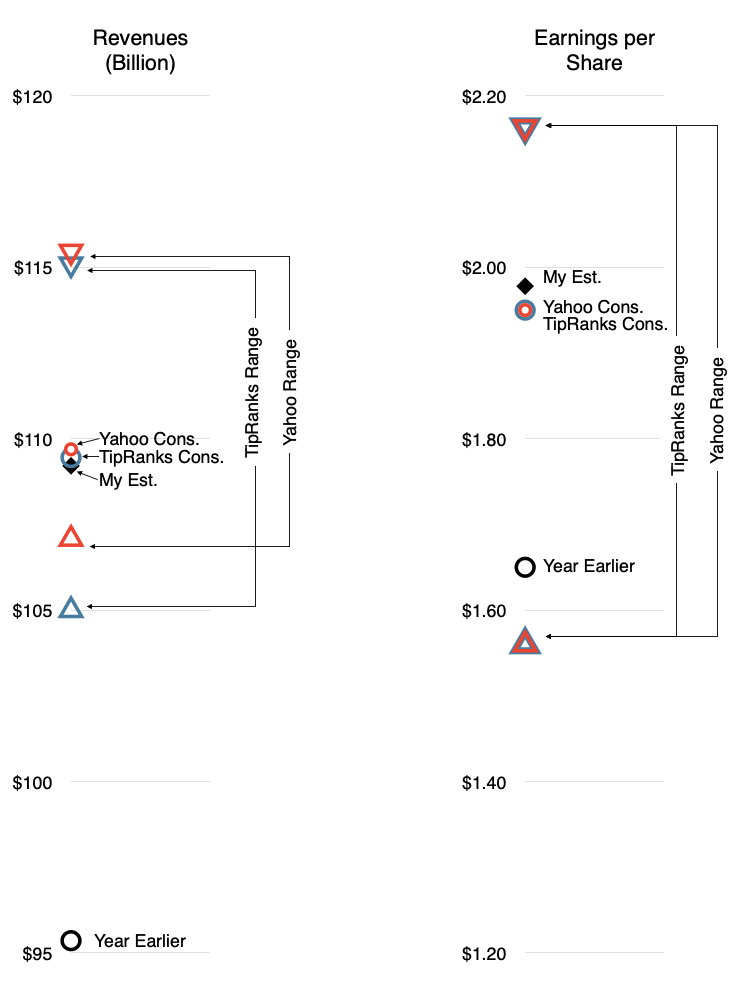
Revenue and EPS consensus, year-ago results and my expectations
Yahoo Finance
Yahoo Finance's revenue estimate for Apple in Q2 stems from 31 analysts. As of April 25, the average estimate is $109.69 billion, with a low of $107.08 billion and a high of $115.37 billion.
For the earnings per share estimate, 32 analysts put it at an average of $1.95. The low is $1.56 and the high is $2.16.
TipRanks
TipRanks also does its own analyst polling on Apple's quarter. In its forecast as of April 19, its consensus is for a revenue of $109.45 billion, with a high of $115 billion and a low of $105 billion.
On the earnings per share, the consensus is $1.95, with a high of $2.16 and a low of $1.56.
A summary of the expectations include year earlier results and my own estimates is shown the following graph:
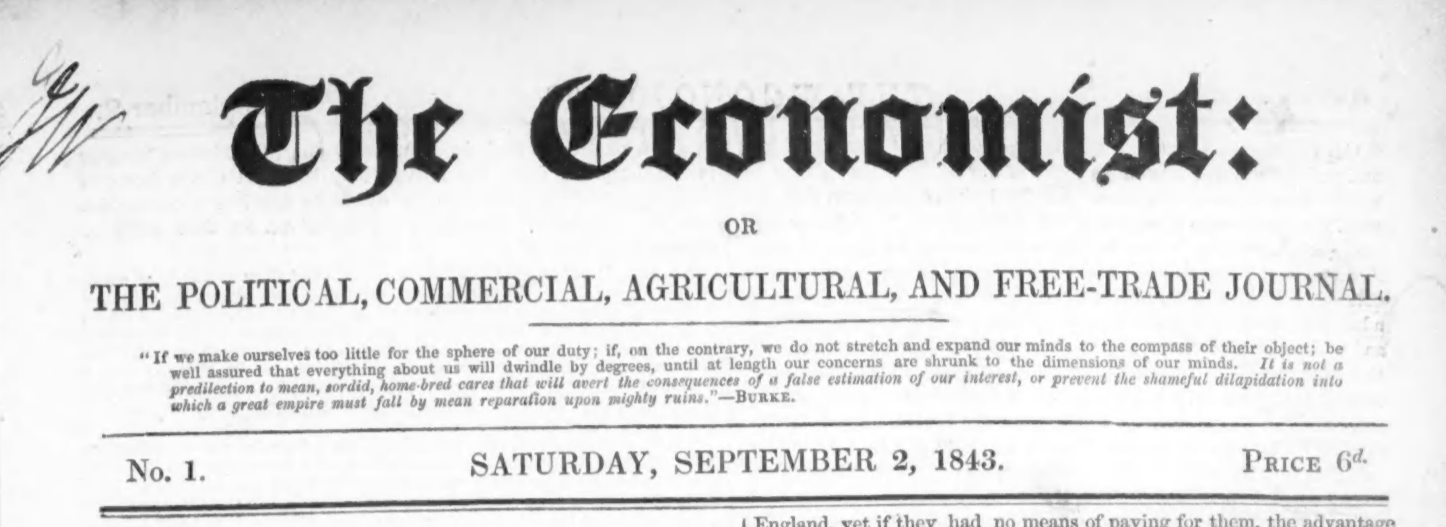
"Apple’s new boss needs to restore its magic for the AI era"
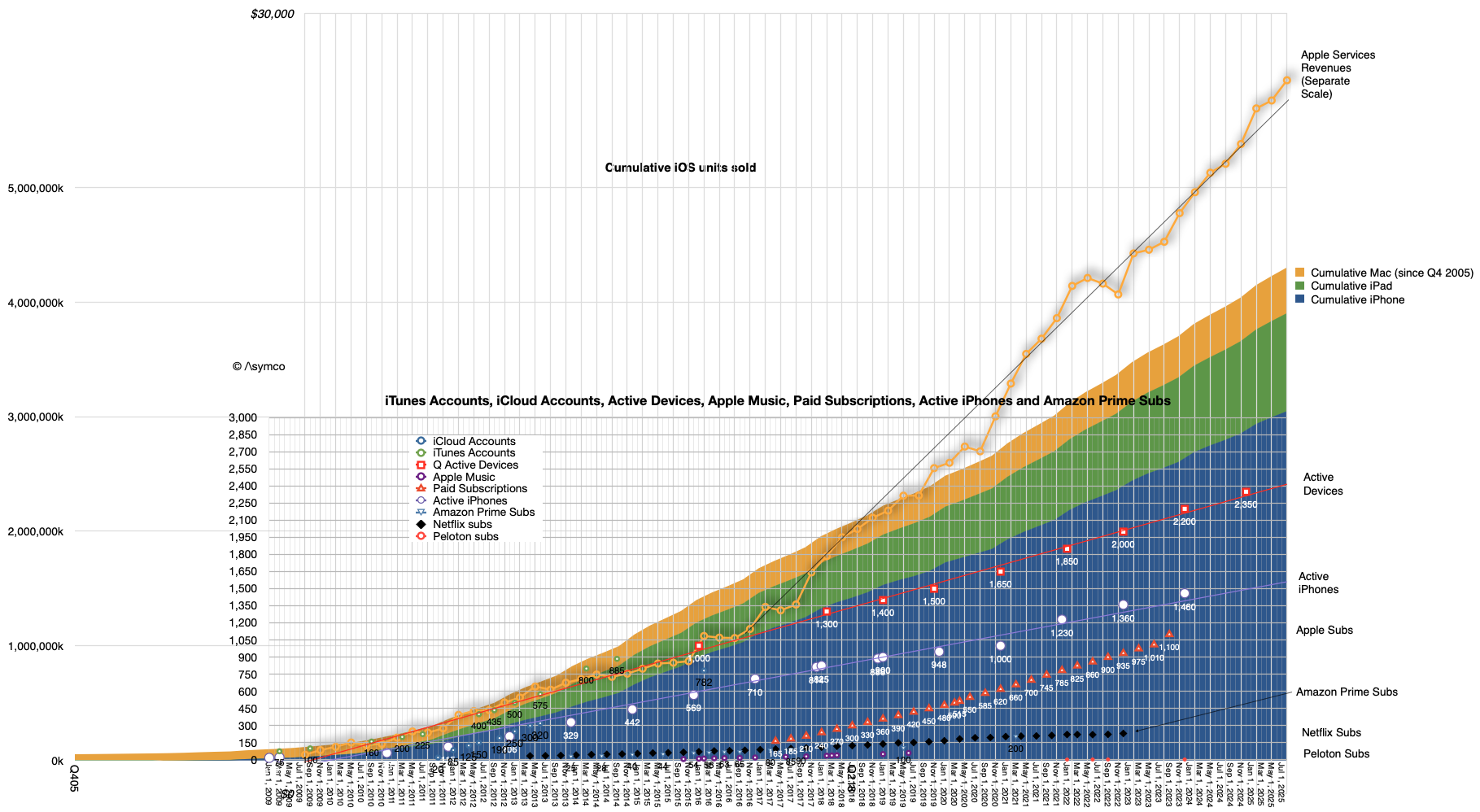
If Mr Ternus does “nothing but keep the ship on course”, Apple could almost double its number of devices from 2.5bn globally to 4.5bn over the next 15 years, reckons Horace Dediu, a veteran Apple analyst. That would be a huge platform on which to run—and monetise—AI apps. As users subscribe to ChatGPT or other AI apps, “Apple will just take a cut,” Mr Dediu adds. By one estimate, Apple is close to generating $1bn in ai revenues so far this year via the App Store, despite having no flagship ai product.
Azeem Azhar, author of Exponential View, another newsletter, adds that to overcome bottlenecks in cloud-based AI, routine queries may be shifted to “edge” devices, creating a big opportunity for Apple. In Mr Azhar’s telling, the future will involve “a combination of the highly portable phone with the persistent desktop or server. Both play to Apple’s strengths.”
There is, however, a more radical path available to Mr Ternus, which is to develop a new “form factor” beyond the iPhone that is more suitable for the interactive nature of ai than doomscrolling on a touchscreen. Competitors are already trying to turn the smartphone into yesterday’s technology. Meta, the social-media giant run by Mark Zuckerberg, is selling millions of AI-powered smartglasses. Sir Jony Ive, the design guru who helped Jobs create the iPhone, has teamed up with OpenAI to develop a brand new gadget of unknown form. To keep up, Mr Ternus may have to reinvigorate Apple’s product line-up with a determination that eluded Mr Cook.
Apple’s Vision Pro virtual-reality headset, though an over-priced flop, may help the new boss develop Apple smartglasses. The company is also reportedly working on a wearable AI pin. Mr Dediu says that one of Mr Ternus’s main strengths may be his devoted following among Apple’s engineers, who have been pivotal to the firm’s success. “Ternus will come out as an engineer’s engineer,” he says. “He is hard-core. That might energise the teams.”
NB: As is often the case, a 45 minute discussion turns into two sentences. The article sadly does not provide hints at the future direction of the company. But we can…
…What we can foresee with certainty is what I said: the momentum is there for a doubling of the business without any new initiatives. The cultural fit for Ternus is 100%. That is based on the data we have but it is not the limit of what can be done. It is up to Apple to create the future.
This is not about AI or any new form factors but about harnessing the new technologies with Apple's existing operational capabilities and existing market access in a way that competitors cannot replicate. Thus unforeseen growth can be created and, by definition, it's not possible to tell what that may be.
But I can foresee that the organization is robust and well managed enough to create this unforeseen growth.
A part of Horace's interview with Asahi Shimbun on the 50th Anniversary of Apple's founding. The portion here discusses management succession and occurred on April 1. Apple announced the succession of Tim Cook as CEO to John Ternus last week. This analysis of Apple leadership decisions focuses on culture and attributes of the firm rather than attributes of the persons leading it. It may prove a more reliable predictor in future leadership changes.
…, the speculation is John Ternus is the next in line. I think that's a very plausible hypothesis. And one reason, by the way, is I always maintain if you study the company from a cultural point of view, you'll realize that there are people who cannot be CEO. You may not know who it's going to be, but I can tell you who won't be. Many people over the years suggested candidates, and I would say no, never. And here are examples. Johnny Ive would never be CEO. An external hire would never be CEO. Even a head of marketing would never be CEO. Many people think that Apple is a brilliant marketing company. No, it's an engineering company. It's a huge secret out there. →
Writing the story of John Ternus' tenure as Apple CEO from April 21, 2040. What changed and what didn't.
It’s been 15 years but John Ternus has finally stepped down as Apple CEO. Analysts described the transition as expected rather than disruptive, noting that investors had long anticipated Ternus’ eventual departure. Nevertheless, he leaves with many questions still unanswered about Apple’s long term strategy. Apple incoming CEO faces a defining challenge: Fixing the company’s Services dependence. It’s been a tumultuous tenure for Ternus but he is leaving with significant accomplishments: John grew Apple devices to 4.5 billion from 2.5 billion when he took over in 2026. Many have pointed out that he has been building on… →
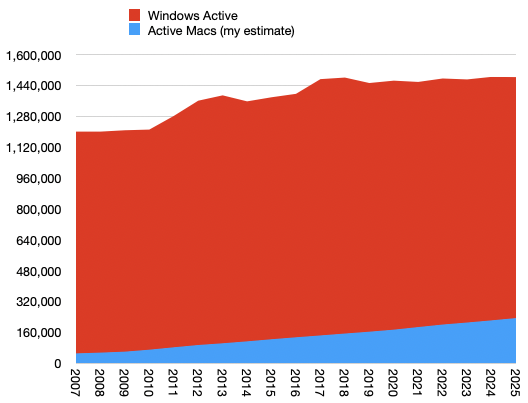
In January this year Apple reported that there were 2.5 billion active Apple devices in use. This figure has been getting updated for years and I’ve been reporting its trajectory and other measures that are correlated to it. For instance the number of Apple subscriptions, Apple Services revenues and other historical indicators such as iCloud accounts and Apple Music.
Simplifying, I published the “ACTIVE” model which makes some basic projections of this total device count and it’s shown below” One element of the analysis that has eluded me was the more precise composition of this total “devices”. →
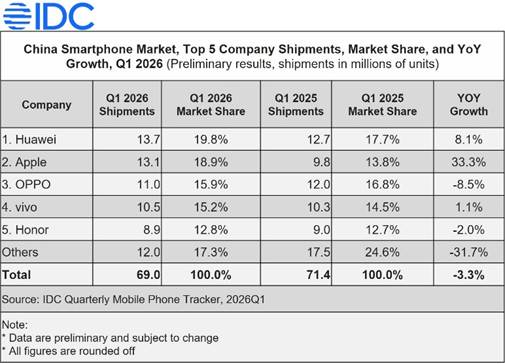
Both researchers say Apple share in China is about 19%, nearly tied with Huawei at 20%…
Some analysts are increasing their targets finally realizing that the memory supply crisis might be beneficial to Apple. This should have been noted already three months ago when Apple provided extraordinary guidance for the March quarter. →
MacBook Neo Sold Out Through April → Despite high demand and stockouts, Apple's strong brand and competitive pricing could turn challenges into opportunities for market expansion.
Microsoft’s cheapest laptop is three times more ex…
As I will argue in a further post perhaps this is one of those pivotal moments. →
Goldman forecasts fiscal second-quarter EPS of $2.00 → Goldman Sachs remains bullish on Apple, forecasting $2.00 EPS driven by strong iPhone and Services growth, dismissing overly pessimistic sentiment as the company consistently gains 100 million new customers annually.
My target of $1.98 seems amiss.…
What is always happening, the reaction that is always ongoing, is the creation of 100 million new customers every year. Accelerating this process is not a matter of just new products or change in sentiment with AI. Much of this rate is due to overall global economic and demographic change. →
What’s the consensus on $AAPL? → Apple's strong analyst backing with a 15:1 Buy:Sell ratio and $315 target contrasts its 39% year-to-date rise, overlooking potential future growth.
The consensus is positive though share price target does not consider significant share gains and service growth acceleration into 2027.
NB: The consensus is positive though share price target does not consider significant share gains and service growth acceleration into 2027. →
Apple 3.0: JP Morgan expects that Apple will beat its own guidance next week → Analyst Samik Chatterjee projects Apple's EPS to rise to $2.05 from $1.96, driven by strong iPhone and Mac demand, with a revenue boost to $112.7 billion, while I estimate a slightly lower 20.2% EPS growth, anticipating guidance will be met.
Read the original for a more detailed commentary from Chatterjee. He implies Apple will grow EPS 24%…
…My own estimate is about 20.2%. I look forward to a lively quarterly update. The primary source of growth must be the iPhone and I have that growing at 19% revenue growth. Last quarter the growth was 23%. Perhaps Chatterjee is assuming a similar growth rate into March quarter. That is not impossible but I am assuming guidance will be met rather than exceeded. →
AI makes the strong stronger. That is the opposite of disruption.
The iPhone appears stronger than ever despite Apple’s AI struggles, and that’s not a coincidence, says Perplexity CEO Aravind Srinivas.
Speaking on the latest episode of the This Week in AI podcast, Srinivas indicated that the iPhone only stands to benefit from continual AI improvement.
"Here’s my opinion. I haven’t said this before. The phone, the iPhone is actually not getting disrupted by AI at all. In fact, the more AI works better, the iPhone essentially becomes your digital passport."
Perplexity’s CEO touts Apple’s ecosystem and silicon advantages as some of the reasons why the iPhone is positioned for continued success. It’s also, in his view, why Apple can afford to move slow with its long-delayed Siri overhaul.
"My sense is that even though a lot of people have opinions on how bad Siri is or good Siri is, [Apple has] the ability to take time and do things they want to do, because they have advantages as a brand that people truly trust. The ecosystem lock-in is underrated. Auxiliary hardware devices, the chip advantage, all of this is really underrated right now. Srinivas also mentions how the iPhone is central to people’s lives for many reasons that have nothing to do with AI."
He says, “It has your wallet, it has all your cards, it has your passes, it has your health records, you connect with other human beings through it, you do FaceTimes, you do calls, you have photos of precious moments in your life.” All of these are extremely personal, and as a result, users won’t easily switch away from iPhone.
NB: Knowing the theory of disruption provides a three year lead in decision making. The observation...
...is that the iPhone is "entrenched" or protected by a moat or ecosystem or some other euphemism of "lock-in". But these are not the reasons why iPhone is sustained by a new technology. It's simply that Apple is incentivized to embrace it. The company has all the resources necessary to participate and can observe that the new technology is beneficial to its customers.
Therefore it will fold the new ideas into its business model. Disruption means it find the new thing either less profitable, not relevant or addressing customers that it does not have or want.
None of these conditions apply to AI. AI leads to more profit for Apple, is very relevant and aimed squarely at its best customers.The question becomes not why would Apple not embrace AI but why wouldn't it.
"Our expectations for March-Q (F2Q) earnings include beats on revenue relative to the telegraphed outlook, helped by both better demand for iPhones... as well as better demand for Macs." — Analyst Samik Chatterjee
Chatterjee has raised his top and bottom line estimates significantly in the last 3 months. Revenue: To $112.7 billion from $109.6 billion (up 2.8%) .
NB: Read the original for a more detailed commentary from Chatterjee. He implies Apple will grow EPS 24%…
…My own estimate is about 20.2%. I look forward to a lively quarterly update. The primary source of growth must be the iPhone and I have that growing at 19% revenue growth. Last quarter the growth was 23%. Perhaps Chatterjee is assuming a similar growth rate into March quarter. That is not impossible but I am assuming guidance will be met rather than exceeded.