Asymco

Asymmetric Intelligence

Industry

  1. Windows Phone Classic Phones not upgradeable to Windows Phone 7 Series

    Research

    "Because we have very specific requirements for Windows Phone 7 Series the current phones we have right now will not be upgradable,"

    Microsoft cuts off Win Phone 7 upgrades for all WM6 devices | ElectronistaInvites ‹ Asymco — WordPress

    Now why would anyone buy a WinMo 6.x (aka Windows Phone Classic) phone today? Is this is a classic example of the Osbourne effect?

    Maybe there is more to this story. Buried in the WP7 launch was news that Classic would carry on and a new "starter" edition would also be made available. Said Starter edition would be sold only in emerging countries and target 2G and 2.5G networks.

    Furthermore, Ballmer made it clear in a Q&A that they would "continue to invest" in "Classic" WinMo/Windows Phone.

    So Microsoft is not quite foolish enough to ignore the consequences of an orphaned platform. The impact of the dual platforms on the ecosystem is another story.

  2. Rubinstein on why Pre is not Selling

    Research

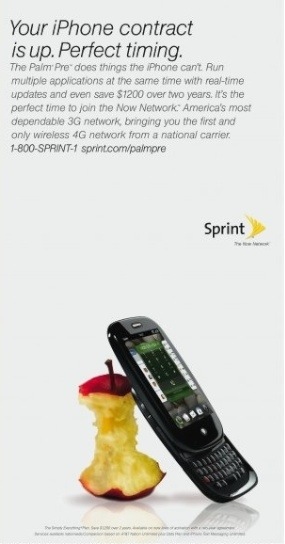
    Dave Whalen and I just returned from a very successful meeting with Verizon Wireless, where they acknowledged that their execution of our launch was below expectations and recommitted to working with us to improve sales. To accelerate sales, we initiated Project JumpStart nearly three weeks ago. Since then, nearly two hundred Palm Brand Ambassadors, supplemented by Palm employees from Sunnyvale, have been training Verizon sales reps across the U.S. on our products. Early results from the stores have already shown improvement on product knowledge and sales week over week. You may have also seen a growing number of Palm ads on billboards, bus shelters, buses, and subway stations-all getting the word out about Palm.

    How hard can it be to explain multitasking?

    link: WSJ Posts Palm CEO's Letter to Employees

  3. Skype and Adobe Jump off WinMo Ship

    Research

    Weak spin from both on reasons to leap off a sinking ship.

    Skype has just discontinued Windows Mobile version of Skype client:

    We’ve chosen to withdraw Skype Lite and Skype for Windows Mobile because we want to offer our new customers an improved mobile experience – much like the version that has proved so popular on the iPhone, and which is now available on Symbian phones.

    Meanwhile, Adobe was promising to bring Flash 10.1 to Windows Mobile but now Adobe is leaving Windows Mobile 6.x:

    As for WinMo, we have made the tough decision to defer support for that platform until WinMo7. This is due to the fact that WinMo6.5 does not support some of the critical APIs that we need.

  4. Palm's Forecast

    Research

    full-year revenue would be "well below" its previous target of $1.6 billion to $1.8 billion. Wall Street was expecting $1.6 billion

    If we assume $1 billion/yr. revenues, that works out to about 3 million smartphones a year out of a market that Gartner just forecast to be 215 million this year. That gives Palm just 1.4% share of smartphones.

    The WebOS is a fine piece of code, but one has to understand that success in this business is not just doing something right. You have to do everything right:

    • Nokia has great distribution and logistics, not so good software or platform story
    • Palm has great software, not so good distribution or platform
    • RIM has great distribution and service, not so great software
    • Android has good software but not great integration of solution
    • Apple's software and platform are great, but distribution is still weak
    • Microsoft has nothing good at all

    The question of acquisition invariably comes up. The obvious answer would be to pair Palm with somebody who needs what they have and who has what they don't. Unfortunately no perfect fit arises.

    UPDATE 3-Palm cuts revenue view on weak phone sales | Reuters

  5. But... it has multitasking!

    Research

    Palm warns of 30% miss on estimates.

    Feb. 25 (Bloomberg) -- Palm Inc. said it expects that adjusted revenue for the third quarter of fiscal year 2010 will be in the range of $300 million to $320 million. The average estimate of analyts surveyed by Bloomberg was for adjusted third-quarter revenue of $409.3 million. The company said revenue for the quarter and full year are being affected by “slower than expected consumer adoption of the company’s products.”

    link: Palm Sees Third-Quarter Adjusted Revenue $300 Mln to $320 Mln - Bloomberg.com

  6. App Stores Grow Dramatically, Ovi Climbs to Third Place

    Research

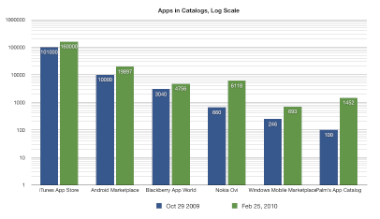
    The last four months have seen tremendous app growth. Apple grew by 59k apps while Android added nearly 10k and Nokia added 5.5k apps to Ovi.

    As a percent, Palm grew the fastest with 1,352%, followed by Ovi with 827%. The slowest growing was actually Blackberry App World with a mere 56% growth.

    More curious is the popularity of certain categories. Games and Books are dominant in the App Store, while Personalization and Music account for more than half of Ovi (ringtones and wallpapers?)

    Finally, in terms of catalog ranking overall, Ovi climbed the league table to third spot behind Apple and Android and overtaking Blackberry App World. Palm overtook Windows Mobile Marketplace which is now dead last with 693 apps.

    link: Distimo Mobile World Congress 2010 Presentation - Mobile Application Stores State of Play

  7. HP continues to say that it is serious about smartphones

    Research

    The consequences of licensing a mobile OS:

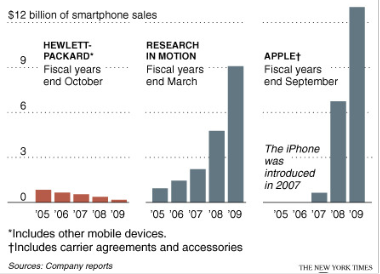
    Sales of H.P.’s hand-held products, including its iPaq smartphone, dropped to $25 million in the quarter, down from $57 million in the same period last year. Apple, by contrast, had sales of $5.6 billion for iPhones and related products during its most recent quarter.

    To put it in more perspective, $25 million at an ASP of $350 a phone means HP sold about 70k phones last quarter, or what Apple sold every 17 hours.

    link: Hewlett-Packard, a Technology Powerhouse, Stumbles in Smartphones - NYTimes.com

  8. From Apple Computer Inc to Apple (Mobile) Inc

    Research

    Tim Cook confirmed at a Goldman Sachs press conference yesterday that Apple is calling themselves a "mobile device company" officially. The "traditional model" of having companies sell different things -- hardware, software, peripherals -- just doesn't work on today's world, according to Cook. So Apple is no longer a computer company, or an OS maker, or a media giant. Its main focus is mobile devices.

    link: Tim Cook: Yes, we're a "mobile device company"

  9. Apple vs. Exxon-Mobil

    Research · 1 comment

    Tim Cook :

    We can put all of our products on the table you're sitting at. Those products together sell $40 billion per year. No other company can make that claim except perhaps an oil company.

    We are the most focused company that I know of, or have read of, or have any knowledge of.

    We say no to good ideas every day; we say no to great ideas; to keep the number of things we focus on small in number.

    Goldman Sachs technology conference, February 2010.

  10. 100 Million Windows Mobile Devices

    Research

    by 2007. The goal was set 6 years and 3 months ago:

    On November 3, 2003, Microsoft announced that it intends to sell 100 million Windows Mobile devices by year 2007. This goal has been set by Steve Ballmer. Majority of Windows Mobile devices that are expected to be sold will be smarpthones, not just PDAs (Pocket PC).

    Linux.com :: 100 million mobile Windows devices by 2007

    Two years after that goal, in 2009, Microsoft sold 15 million units, down from 16.5 million in 2008.

    AppleInsider | Gartner: Apple's iPhone was No. 3 worldwide smartphone in 2009

  11. Microsoft and Nokia agree: Apple is hindering Innovation in Mobile market

    Research

    From the GSMA Mobile World Congress 2009 (one year ago):

    Kallasvuo used Apple and its "closed" ecosystem as an example of what could limit innovation in the mobile market in the future. He said Apple's vertically integrated model, where its hardware and software are tightly controlled by the company, further fragmented the market. And he added that what is truly needed is more openness in developing applications.

    Yes, prior to the iPhone innovation was zipping along rapidly, but now it's stuck because the iPhone is closed. The iPhone is hindering innovation because it's highly integrated.

    Ballmer argued that device openness was important to give customers more choices. And he pointed to the number of choices that Windows Mobile customers have when choosing a device.

    We'd all have more choices if we'd all choose Windows Mobile.

    Fast-forward one year and Microsoft decides to offer more choice by adding a new operating system (in parallel to its existing OS) and Nokia decides to solve fragmentation by launching a new platform called MeeGo (in parallel to Symbian).