Google has taken on Microsoft with free good-enough web services for a few years. Gmail for business against Exchange, Chrome against Internet Explorer, and soon Chrome OS against Windows. But it's Android vs. Windows Mobile which is shaping up to be the first success story for Google.
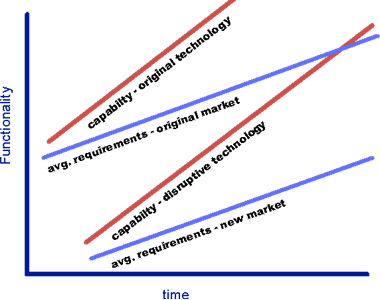
Windows Mobile has to deal with Android as a classic low-end disruptor. Both are competing for OEM deals and it's plain to see how Android is a better opportunity:
lower cost means lower BOM, and higher margins
easier differentiation through customization of the UI. WP7 went so far as to eliminate this option
open source beats closed for devices any day
a fragmented ecosystem beats a dysfunctional one
WP7 appears to be something so different than what WinMo was that it may indicate Microsoft abandoning the licensing market to Google.
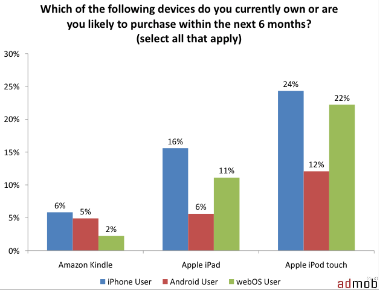
Admob did an interest survey. Although limited by its methodology (see below) the data is incrementally interesting as it also relates to the ChangeWave survey.
ChangeWave suggested that 13% of early adopters claim they are likely to buy an iPad. Admob suggests that 16% of existing iPhone users would be likely to purchase an iPad in the next 6 months.
If we assume 45 million iPhone users by time of launch (42 million units have been sold as of end of December) and 15% would buy iPads it would therefore not be unreasonable to assume about 7 million iPads will go to iPhone users alone.
Being conservative, let's round that down to 5 million. This does seem quite a bit more than the 2 million most analysts are forecasting. I'm partial to 5 million but I might now be inclined to increase that to maybe 7 to account for a portion of 33 million iPod touch users.
The aggressive scenario would see 16% of the 75 million iPhone + iPod touch installed base buying an iPad--resulting in 12 million units.
All data in the feature section is based on an opt-in survey taken by users on their mobile device.
Respondents were sourced by responding to mobile ads throughout AdMob's iPhone OS, Android and webOS networks. There was no incentive offered to participate in the survey.
There were 963 total respondents: 318 Android, 244 iPhone, 356 iPod touch and 45 webOS. The survey was run from February 5th - February 16th.
The geographic representation of the respondents was designed to approximate the distribution of users in the AdMob network. The respondents were sourced from English-speaking countries in the AdMob network.
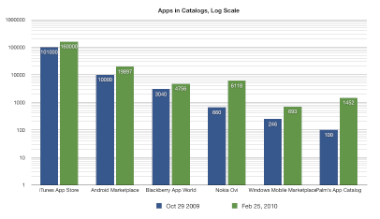
The last four months have seen tremendous app growth. Apple grew by 59k apps while Android added nearly 10k and Nokia added 5.5k apps to Ovi.
As a percent, Palm grew the fastest with 1,352%, followed by Ovi with 827%. The slowest growing was actually Blackberry App World with a mere 56% growth.
More curious is the popularity of certain categories. Games and Books are dominant in the App Store, while Personalization and Music account for more than half of Ovi (ringtones and wallpapers?)
Finally, in terms of catalog ranking overall, Ovi climbed the league table to third spot behind Apple and Android and overtaking Blackberry App World. Palm overtook Windows Mobile Marketplace which is now dead last with 693 apps.
When I heard about Android being positioned against the iPhone, I thought about how that decision must have been justified internally at Google. I wondered how Andy Rubin added up the benefits of his product vs. the risks of losing whatever value Google derived from the iPhone.
On the benefits side, Android’s original business plan called for zero direct revenues with indirect revenues from search. The actual value would be somewhat dubious during the half decade it will take to get a significant installed base. Of course, with the Google-as-retailer model, Android can also be justified as earning some margin from devices, but as we’ve seen, these numbers don’t add up to much.
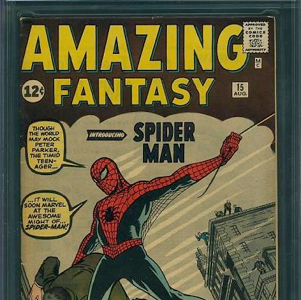
On the risk side there is the potential loss of the screen real estate on the iPhone (see photo above). Being the default search engine in mobile Safari might be worth hundreds of millions to Google.
Silicon Alley Insider reports a rumor that Apple's current deal with Google to provide default search functionality for the iPhone is currently worth over $100 million per year to Apple in revenue sharing.
So the iPhone may be a bigger money maker for Google than Android will, at least for a long time.
Which begs the question of whether by picking a fight with Apple, Android is biting the hand that feeds it.
If there is any logic to this Android adventure it might be that Google really feels it needs to have an option on the future mobile computing platform and that Android is worth the risk of losing placement on the iPhone.
I, for one, don’t think this is a risk worth taking.
Google sold about 80,000 Nexus One smart phones in their first month on the market, according research firm Flurry,Dow Jones Newswires reports.
By contrast, Apple sold about 600,000 iPhones when it launched the device in 2007, the story notes; the Motorola Droid sold 525,000 in the first month, according to Flurry.
Flurry estimates sales by measuring mobile applications usage and then extrapolating overall ownership.
Andy Rubin, head of Android said they hoped to sell 150k units, so this would be a very good start for the brand.
I would also like to estimate the revenue that Google probably earned from this phone so far. Assuming HTC receives a gross margin of 35% and the bill of materials is $174, then Google would have a gross income from the device of about $270/unit (based on $529 price).
Google could still have to pay for shipping, returns, warranties, etc. so their income might be closer to $220.
The income before operating expenses would therefore be $17.5 million in the first month.
I should point out that this would be the first income Android has ever received as the software is available free of charge.
It's time to re-evaluate the categorization of smartphones. The term has always been problematic. It loosely means a phone that runs an advanced operating system and has third party SDKs. There is no industry standard definition and some call it a converged device or a multimedia device. One analyst famously said that the iPhone did not count as a smartphone on launch because it was not open to developers.
I'd propose a different definition, not based on the attributes of the device, but the jobs that the device is hired to do. This is in a way, the same distinction between Facebook and MySpace. They are clearly hired to do different things by their users and as a result don't directly compete. When you do this job-based segmentation, you realize that iPhones, Android devices and Windows Mobile and Palm are fairly similarly used. Blackberry, however, does not match the profile. (Neither do most recent Symbian devices, though for different reasons.)
The most common jobs I can see in use with the first cohort of devices is (Comscore data exists to back this up)
browsing
social networking
applications/games
email
media consumption
navigation
The Blackberry has relatively poor utilization of any function except for email and perhaps social networking (though the latter is not likely in company-sourced devices). The focus on a large number of jobs to be done is what distinguishes smartphones from the more limited "feature phones". By this logic Blackberry is hired as a "feature phone".
It's also instructive to follow commentary among enthusiasts. It's fairly clear that this segmentation exists implicitly: Android, iPhone, Palm and WinMo are comparable while Blackberries are for a different demographic, different user, different usage.
Finally, there is the gut check. It's become clear to me that what users do with Blackberries is similar to what they do with voice phones: voice and messaging. Although additional functionality is available, it hardly gets used because it's hard to use.
But you may ask: so what? The reason this is significant is that smartphones are embryonic mobile computers with a clear trajectory for improvement. Feature phones are overshot voice phones which are likely to be disrupted by data-centric entrants.
On a different level, it also means that growth stats for the two product types are not comparable. Saying that the Blackberry is outgrowing the iPhone (or vice versa) is meaningless.
It also means that Blackberries, being an evolution of voice products, still have a huge growth potential with those customers which are looking for messaging as an improvement for their good enough voice products and for whom smartphones are over-serving.
The common thread among the Android fans is that Google is the agent of disruption of a hated operator business model. Since disruption is well understood (though not by many) it is fairly easy to evaluate this hypothesis.
The problem with disrupting network operators is that disruption can only happen when the underlying service/product they provide becomes "good enough" i.e. more than what customers can absorb. A new basis of competition emerges and we all know what happens.
Here's the problem: since mobile broadband is by all accounts not good enough, it cannot be disrupted. Operators are very critical in building out this new mobile computing future and they are investing and will reap rewards. Bitpipe models will only emerge after 4G when there will be ubiquitous high speed networks and competition will shift away from coverage and more to price and convenience of plans.
What is happening instead of operator disruption is that mobile voice which is more than good enough is being disrupted. Businesses built around mobile voice (e.g. handset vendors who have not developed a viable business model around data) will simply evaporate and their profits will condense around entrants who have mobile computing platforms.
Google is moving on this opportunity but they are not executing in a way that ensures they control the future platform due to the their being on the wrong side of the modular/integrated dichotomy.
Android will disrupt but I expect it will take 10 to 15 years. The life cycle of a new global network generation rollout is about 10 years. We're in the middle stage of the 3G cycle that traces its beginnings to early this decade. 4G will take another 10 years.
A Google spokesperson confirmed for eWEEK that there are 16,000 Android free and paid apps, not 20,000 as others previously reported. (iTunes App store is around 120k now with over 130k apps having been "seen").
A few more data points re. Android:
There are 5 Android instantiations of varying distribution through the first two weeks of December: 1.1, 1.5, 1.6, 2.0 and the fresh 2.0.1. It seems Google is prepared to see that number go much higher. You can see the distribution of platform versions in a pie chart here:
If a developer chooses only the most popular platform version, he gets to target about 54% of the installed base.
Motorola's Droid ships with only 256 MB available for app storage. Google Android does not support installation of apps to SD cards, so developers face a very real limit. Many of the most popular iPhone apps (games) easily exceed 100 MB, so not very many quality apps would fit on Droid (and some won't fit at all: Magellan RoadMate app ($59.99) alone weighs in at 1.36GB). That's why Droid only offers users three measly panels for displaying apps; users probably won't even be able to fill up two before they run out of storage space.
Droid comes with a built-in turn-by-turn app Google's Maps Navigation likely because no other nav app would come close to fitting into the Droid's limited 256MB app storage space.
There is an implied message in Android advocacy that once more licensees join in, volumes will be distributed among a broad set of companies benefiting from a healthy rivalry. This broad licensing will be a boon for volumes and for user choice and the platform itself will prosper.
I'm going to argue here that there will be no healthy distribution of volumes or profits in the Android platform.
History shows that volumes for an openly licensed mobile platform concentrate in the hands of a single vendor. To illustrate, I attached a list of all the devices which shipped (to date) with a flavor of Windows Mobile. The list includes 911 different phone models (search on your own on pdadb.net under the pdamaster tab--search criteria are on the last page of the PDF).
The Windows Mobile platform "took off" and had hundreds of concurrent licensees in the middle of this decade. In spite of this wide adoption, one vendor captured 80% of the volumes for all instances of the platforms: HTC. Having started with the iPaq as a PDA and followed by being the first to market with a WinMo device, HTC dominated Windows Mobile volumes even when faced with literally hundreds of competitors. These competitors included all the big names: from PC vendors like HP, Dell and Toshiba, to cellular incumbents like Motorola, Sony Ericsson, Samsung, LG and every ODM and OEM in between. The reason HTC won is mundane: they have the experience and the distribution to make an impact and they iterate rapidly and are intimate with the details of making a tough-to-integrate product work. They basically worked their way up the value chain from a contract design shop to a branded top tier vendor.
But if you exclude HTC, dividing the number of units of WinMo shipping at any given time by the number of licensed products in the market at that time, one gets about 50,000 units/licensee. Think about that: except for HTC, an average licensee could hope to ship 50k units for any phone they engineer and market. And they also need to prepay Microsoft the minimum license fee of $10/unit (approx) for a minimum order of 50k units or half a million dollars.
This is actually a paradox. Put yourself in the shoes of a business manager at one of the potential licensees. Consider the situation where there are 200 competitors in a market all shipping undifferentiated products, and one competitor has 80% share. Would you want to be the 201st? Saying yes implies hoping to split the remaining 20% 200 ways or obtaining, on average, 0.1% share? But this is not a share of all phones, it's a share of that platform, which itself is, at best 10% of all smartphones which make up maybe 20% of all phones. So you are committing a few million dollars to pursue (.2*.1*.001=) .00002 of a market. That target is 3 orders of magnitude less than what Apple obtained in 2 years (without the margins). It never adds up unless you expect your entry to blow out of the 20% ghetto and take on the incumbents.
As it turned out there were dozens upon dozens of business managers who opted to be the 201st (or 301st). Unsurprisingly, the result was that every Windows Mobile business plan failed (except that of HTC). Every decision to join this ecosystem on the device side was a value destroying decision, repeated 900 times.
Why?
I don't have an answer as to why so many are taken in by this. I have a hypothesis that it has to do with excess R&D capacity (e.g. idle engineers) that compels small companies to build product with no hope of market penetration, but I cannot prove it. They may also couple the low barrier to entry to the premise from the platform vendor that a no-name licensee could be the next Dell/Acer/HTC if the platform "takes off".
Regardless of the cause, the proliferation of WinMo SKUs did nothing for the success of the platform overall. For consumer products, it does not matter what jockeying for position happens within the value chain if the end user/developer experience is painful and uncompetitive.
Android will win or lose on the user/developer experience. It will not win or lose on the proliferation of licensees.
In comparing two platforms like iPhone and Android, the question of addressable market for developers must come first. Apple has the advantage of an early lead plus its iPod touch devices which add another 40% to volumes. As a result, Apple created a 57 million units base with 100% yearly growth. It's not a stretch to assume that before the end of 2010, Apple will have 100 million units in the field with 150 million by 2011.
All told, current Android licensees offered up less than 4 million devices to developers to date. When accounting where future Android volumes will come from, the chances are that Nokia, Samsung and RIM will not deploy Android widely as they have their own platforms to protect. That leaves Motorola, Sony Ericsson, HTC and LG and the current Windows Mobile licensee base. Even assuming unprecedented growth (270% y/y--greater than iPhone ever achieved) from this less-than-stellar list of vendors, it's hard to imagine more than 30 million Android installed base by end of 2011.
One Android device for every five iPhone OS devices does not compel ecosystem switching costs for developers. Fragmentation and low volumes coupled with a tenuous vendor story leads us to conclude that iPhone will still have the upper hand by 2011.
Nice summary: Essentially, Android isn't Google's phone platform, it's an open alternative for failing hardware makers to use in place of Symbian, Windows Mobile, and Linux to create the same type of convoluted, fractionalized, and poorly integrated products they're already making. This is also why Symbian, Windows Mobile, Motorola, and Sony Ericsson are all failing commercially.
Google's primary and most significant contribution won't be any major innovation in the core Android platform but rather in its own bundled apps, where Google plans to earn its revenues from via, to put it bluntly, adware and spyware.