Asymco

Asymmetric Intelligence

Google

  1. Android vs. Google Part II

    Research · 3 comments

    AppleInsider | First AT&T phone with Google Android will feature Yahoo search

    As the Backflip will mark the first time U.S. customers under contract with AT&T will have the option to choose between Android and the iPhone, every Motorola Backflip that AT&T sells might potentially be at the expense of an iPhone.

    That Backflip sold will not generate Google any ad revenue since it will offer Yahoo/Microsoft search exclusively. Nor will the Backflip generate any license revenue for Google, because Android is licensed without a fee.

    If that buyer would instead have bought an iPhone, the search from mobile Safari would have some non-zero value.

    It is therefore pretty obvious that, at least in this instance, Android is destroying value for Google.

    See also:
    Android vs. Google (part I)

  2. Mobile Platforms: First Market Where Google Beat an Incumbent

    Research

    No, that incumbent is not Apple.

    Google has taken on Microsoft with free good-enough web services for a few years. Gmail for business against Exchange, Chrome against Internet Explorer, and soon Chrome OS against Windows. But it's Android vs. Windows Mobile which is shaping up to be the first success story for Google.

    Windows Mobile has to deal with Android as a classic low-end disruptor. Both are competing for OEM deals and it's plain to see how Android is a better opportunity:

    • lower cost means lower BOM, and higher margins
    • easier differentiation through customization of the UI. WP7 went so far as to eliminate this option
    • open source beats closed for devices any day
    • a fragmented ecosystem beats a dysfunctional one

    WP7 appears to be something so different than what WinMo was that it may indicate Microsoft abandoning the licensing market to Google.

  3. The Apple of Traders Eyes

    Research

    Of all the world’s companies, Apple ranks as the 11th most valuable. As a technology company its market capitalization is second only to Microsoft.

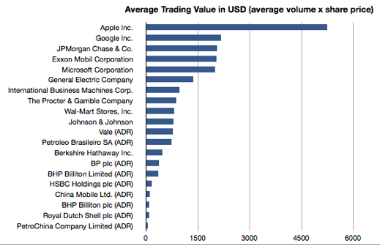
    Of the top 20 largest companies, all of which are above $150 billion in market cap (listed in graph above), Apple has the highest volume of trading as measured by dollar value (average volume multiplied by last share price is $5.2 billion per day--see graph). In fact, it’s more than twice as popular as a traded equity than the next highest, Google and 2.6 times as popular among traders as Microsoft.

    This trading volume might also be reflected in its beta (the correlation of price with the market with 1 meaning perfect correlation). Apple’s Beta is 1.59, nearly the highest of the super-large caps and the highest by far of the tech large caps.

    Surely, this confirms that Apple is not only huge but hugely popular and highly visible among investors. Suggestions that its current discounted value is due to obscurity among IT buyers translating to obscurity among investors does not wash.

    Source: Google Finance

  4. Android vs. Google

    Research · 2 comments

    When I heard about Android being positioned against the iPhone, I thought about how that decision must have been justified internally at Google. I wondered how Andy Rubin added up the benefits of his product vs. the risks of losing whatever value Google derived from the iPhone.

    On the benefits side, Android’s original business plan called for zero direct revenues with indirect revenues from search. The actual value would be somewhat dubious during the half decade it will take to get a significant installed base. Of course, with the Google-as-retailer model, Android can also be justified as earning some margin from devices, but as we’ve seen, these numbers don’t add up to much.

    On the risk side there is the potential loss of the screen real estate on the iPhone (see photo above). Being the default search engine in mobile Safari might be worth hundreds of millions to Google.

    Silicon Alley Insider reports a rumor that Apple's current deal with Google to provide default search functionality for the iPhone is currently worth over $100 million per year to Apple in revenue sharing.

    So the iPhone may be a bigger money maker for Google than Android will, at least for a long time.

    Which begs the question of whether by picking a fight with Apple, Android is biting the hand that feeds it.

    If there is any logic to this Android adventure it might be that Google really feels it needs to have an option on the future mobile computing platform and that Android is worth the risk of losing placement on the iPhone.

    I, for one, don’t think this is a risk worth taking.

  5. Nexus One: 80k units in first month -Flurry

    Research

    Google sold about 80,000 Nexus One smart phones in their first month on the market, according research firm Flurry,Dow Jones Newswires reports.

    By contrast, Apple sold about 600,000 iPhones when it launched the device in 2007, the story notes; the Motorola Droid sold 525,000 in the first month, according to Flurry.

    Flurry estimates sales by measuring mobile applications usage and then extrapolating overall ownership.

    Andy Rubin, head of Android said they hoped to sell 150k units, so this would be a very good start for the brand.

    I would also like to estimate the revenue that Google probably earned from this phone so far. Assuming HTC receives a gross margin of 35% and the bill of materials is $174, then Google would have a gross income from the device of about $270/unit (based on $529 price).

    Google could still have to pay for shipping, returns, warranties, etc. so their income might be closer to $220.

    The income before operating expenses would therefore be $17.5 million in the first month.

    I should point out that this would be the first income Android has ever received as the software is available free of charge.

  6. HTC: Hard to Compete

    Research

    HTC is the world’s fourth largest smartphone company. It ships 80% of all Windows Mobile and probably a similar proportion of Android devices. Like Microsoft in 2003, Google turned to HTC for its first smartphone, the G1 and its latest, the co-branded Nexus One. The company shipped a total of 11.7 million mobile phones in 2009.

    It would appear that HTC is very well positioned in what amounts to be the best industry in technology.

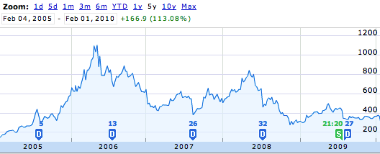
    However, not all is well. A few days ago HTC issued revenue guidance below analyst estimates and its stock price is at 2005 levels, 70% off its peak (see graph--source: Google finance).

    Part of this could be explained by its continuing reliance on Windows Mobile which is fading fast, but also it’s because, as management acknowledged, there is significant price pressure.

    HTC prides itself with having a “premier” product with typically high-end feature sets and positioning. HTC invested in its own UI to differentiate its products and has mounted a branding campaign to move away from being a white-label ODM.

    It seems all for nought. The rules of the smartphone market do not favor modular component players. As HTC does not front its own OS, it still struggles to stand out in the eyes of the consumer.

    Looking at the list of top 3 vendors: Nokia, RIM and Apple, we see hardware companies that field an integrated OS/service bundle.

    It’s hard to compete against this.

  7. Google the Shopkeeper

    Research

    The Nexus One is an HTC branded and developed phone. The only thing that Google is doing (beside the software) is acting as retailer.

    Still don't see what the point is as a Web page does not make a very good retail experience for a phone. It reminds me of when the iPhone was launched, Apple's head of retail said that their stores were basically "built for this type of product".

    http://www.engadget.com/2010/01/05/googles-nexus-one-is-official/

    Om Malik Interviews Google’s Mobile Chief Andy Rubin

    Regarding Android partners like Verizon and Motorola being upset about the Nexus One:

    “People shouldn’t focus too much on the device (Nexus One),” said Rubin. “What’s more important is the strategy behind the devices.”

    John Gruber:

    Yes, what better way to get the press not to focus on a device than to hold a big press conference to announce a device, talk about how great it is, and give one away to everyone who attends?

  8. Is Android Disruptive?

    Research · 1 comment

    The common thread among the Android fans is that Google is the agent of disruption of a hated operator business model. Since disruption is well understood (though not by many) it is fairly easy to evaluate this hypothesis.

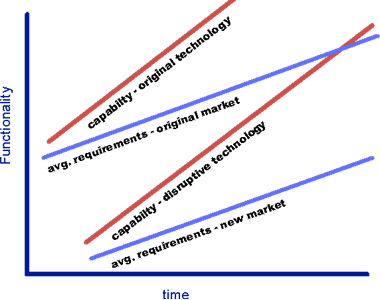
    The problem with disrupting network operators is that disruption can only happen when the underlying service/product they provide becomes "good enough" i.e. more than what customers can absorb. A new basis of competition emerges and we all know what happens.

    Here's the problem: since mobile broadband is by all accounts not good enough, it cannot be disrupted. Operators are very critical in building out this new mobile computing future and they are investing and will reap rewards. Bitpipe models will only emerge after 4G when there will be ubiquitous high speed networks and competition will shift away from coverage and more to price and convenience of plans.

    What is happening instead of operator disruption is that mobile voice which is more than good enough is being disrupted. Businesses built around mobile voice (e.g. handset vendors who have not developed a viable business model around data) will simply evaporate and their profits will condense around entrants who have mobile computing platforms.

    Google is moving on this opportunity but they are not executing in a way that ensures they control the future platform due to the their being on the wrong side of the modular/integrated dichotomy.

    Android will disrupt but I expect it will take 10 to 15 years. The life cycle of a new global network generation rollout is about 10 years. We're in the middle stage of the 3G cycle that traces its beginnings to early this decade. 4G will take another 10 years.

  9. Android Device Dashboard

    Research · 2 comments

    A Google spokesperson confirmed for eWEEK that there are 16,000 Android free and paid apps, not 20,000 as others previously reported. (iTunes App store is around 120k now with over 130k apps having been "seen").

    A few more data points re. Android:

    • There are 5 Android instantiations of varying distribution through the first two weeks of December: 1.1, 1.5, 1.6, 2.0 and the fresh 2.0.1. It seems Google is prepared to see that number go much higher. You can see the distribution of platform versions in a pie chart here:

    http://developer.android.com/resources/dashboard/platform-versions.html

    • If a developer chooses only the most popular platform version, he gets to target about 54% of the installed base.
    • Motorola's Droid ships with only 256 MB available for app storage. Google Android does not support installation of apps to SD cards, so developers face a very real limit. Many of the most popular iPhone apps (games) easily exceed 100 MB, so not very many quality apps would fit on Droid (and some won't fit at all: Magellan RoadMate app ($59.99) alone weighs in at 1.36GB). That's why Droid only offers users three measly panels for displaying apps; users probably won't even be able to fill up two before they run out of storage space.

    Droid comes with a built-in turn-by-turn app Google's Maps Navigation likely because no other nav app would come close to fitting into the Droid's limited 256MB app storage space.

    http://www.eweek.com/c/a/Mobile-and-Wireless/Google-Android-Device-Dashboard-Highlights-Fragmentation-804428/?kc=EWKNLITA12222009STR4

  10. Android Business Fashion Model

    Research

    Nice summary: Essentially, Android isn't Google's phone platform, it's an open alternative for failing hardware makers to use in place of Symbian, Windows Mobile, and Linux to create the same type of convoluted, fractionalized, and poorly integrated products they're already making. This is also why Symbian, Windows Mobile, Motorola, and Sony Ericsson are all failing commercially.

    Google's primary and most significant contribution won't be any major innovation in the core Android platform but rather in its own bundled apps, where Google plans to earn its revenues from via, to put it bluntly, adware and spyware.

    http://www.appleinsider.com/articles/09/11/11/inside_googles_android_and_apples_iphone_os_as_advancing_technology.html

  11. Open Always Wins

    Research

    That may be. Open only wins when the underlying service is a commodity for which improvements (other than price) will not be valued.

    In my way of speaking, openness is semantically equivalent to "modular" and that is in contrast to "integrated". Integrated is the only way to develop systems when they are not good enough. Modular is the only way to cheapen systems when they are more than good enough. Figure out where the technology is on the "good enough" trajectory and pick the winners and losers by the level of integration. It's that simple.

    There were hundreds of companies backing Windows Mobile for half a decade. And it made all the promises that Android is making now (non-phone devices, millions of developers, source code, Intel backing, contractors ready to build to order.)

    The Android fan counter to this is (I'm guessing) that Microsoft could not execute! Google hired swathes of WinMo people into their mobile efforts. It's the same crowd. Is execution some sort of magic pixie dust only available to Google?