The latest litigation lollapalooza over Android reminds one of the old web adage that if you're not paying for content, you're the asset being sold.
That's certainly one of the consequences of the Android licensing model. The mobile phone vendors with no software intellectual property are pawns in a game between IP holders. It's clear that Microsoft and Apple and Oracle (and perhaps Nokia) have IP issues with Google. But it's the licensee device vendors which are most often the accused. Whether Google indemnifies or not is an open question, but the evidence is that the vendors are exposed.
The proof is in the fact that HTC is paying Microsoft for the use of Android. It's conceivable that Microsoft also asked Motorola for Android royalty payments but were rebuffed. It's also possible that since HTC is still a large scale Windows Mobile licensee, they were given a way out of the Android IP trap by Microsoft. We don't know if there were confidential deals between LG and Samsung on this issue (as they are both committed to the Windows Phone platform but shipping Android). In either case, Motorola may be forced to do the same and pay (Microsoft) for Android.
It's understood that Google gains some value from Android but also has hidden costs from it as well. Now the licensees have to recognize their hidden costs of the platform as well. There is the IP tax but also the question of control over one's destiny. Google is selling the vendors as an asset class to advertisers. Is that a positive consequence for their brands?
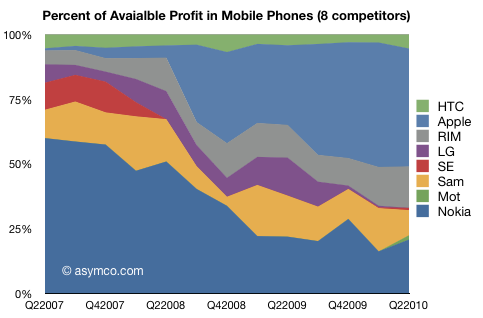
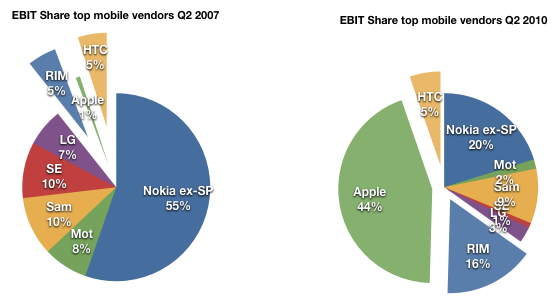
A quick update on the analysis of mobile phone profits. If the available profit[1] (i.e. excluding losses) were summed and each vendor's profit were measured as a percent of this total, this chart would tell the story of the last three years:
Note that profit share has mostly shifted from Nokia to Apple, though Sony Ericsson and LG were also casualties and Motorola has not had anything to lose.
Some assume that the future belongs to the Koreans but we see that the relatively small amount of profit that Samsung has (less than RIM actually) has not changed much. HTC is also shown to be a steady performer but not having displaced much from competitors.
Will Android change this picture? As I've argued before, Android is most attractive to the unprofitable and the strategically constrained. Can having undifferentiated new products change this? As Nokia is unlikely to license Android, and RIM seems very unlikely and Apple is out of the picture, the only possible contenders are Samsung, LG, HTC, Motorola and Sony Ericsson.
Motorola and Sony Ericsson have both returned to profitability but with a very small volume Android strategy. However the incumbents fielding Android are really facing a far more sinister threat: the smaller local brands in China (e.g. ZTE) and emerging markets.
On profitability, the smaller challengers are unlikely to make a large impact, but they will constrain the profits of other licensees. The distribution of phones on a global scale is challenging without a brand, and brands are very expensive to build. It's still possible over a longer timer frame that a small brand like HTC can emerge on a global stage. But in terms of profit capture, challengers will mostly "steal" from the already constrained big brands running with Android.
--
[1] Profit is not the only measure of success and can sometimes be a deceptive indicator. For this reason I look at a longer time frame so that anomalies, seasonality and business cycles are smoothed over. As flawed as it is as a measure, the most important reason to pay attention to profit is that it's the only fuel for growth in the long term. Companies that are consistently unprofitable (e.g. Motorola) face diminishing degrees of strategic freedom further lubricating a downward slope toward financial distress.
Lots of people apparently think it’s a big deal that Gartner is predicting Android will surpass iOS for second place. But why is that necessarily a good thing, given that they’re predicting Symbian will remain in first place? Who thinks Symbian is actually doing well? Nokia’s board sure doesn’t.
I also noted with amusement that by 2014 "other" is slated to sell 85 million units or nearly 10% share, up from 6.1% in 2009. These "others" will be selling more than twice what Apple is expected to sell this year. Is "other" WebOS, Bada, MeeGo, LiMO? If so they're in for a healthy future.
But dwelling on details like these is missing the point. To see how improbable this prediction is, let's go back to 2006 and ask what Gartner was forecasting would happen now.
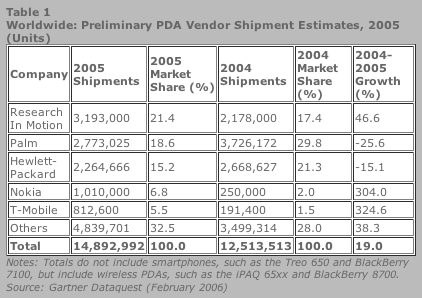
First thing to note is that in 2006 Gartner was busy tracking PDA sales. You might wonder why this is relevant. The reason is because a significant proportion of RIM's Blackberries counted as wireless PDAs and were therefore considered to compete with Palm's Treos, HP's iPaq and Dell's famous Axim. Nokia was in the running with its Communicators. Here is how Gartner characterized the equivalent market in early 2006:
So I'll just come out and say it: In 2006 Gartner did not have a clue what a smartphone was. By their admission:
Gartner defines a PDA as a data-centric handheld computer weighing less than one pound that is primarily designed for use with both hands. These devices use an open market operating system supported by third-party applications that can be added into the device by end users. They offer instant on/off capability and synchronization of files with a PC. A PDA may offer WAN support for voice, but these are data-first, voice-second devices.
In other words, in 2006 Gartner was splitting phones with operating systems into two separate markets: data-oriented wireless PDAs and voice-oriented smartphones. The split was mostly based on the judgement of the analyst on whether a device was "voice" or "data" oriented. I suppose they used the primary input method as a proxy: numeric keypads meant the device was one-handed and therefore voice-oriented. If the device had a full keyboard and/or a stylus-actuated touch screen then it was a two-handed data-oriented device. But even this proxy was not quite enough, sometimes devices were classified whimsically.
To make it more complicated, they bundled non-cellular but Wi-Fi enabled PDAs with wireless PDAs. This made some sense from a corporate IT point of view (their primary customer base) as these data-oriented devices would be used either on a LAN or a WAN (Wide Area Networks: what Gartner anachronistically called cellular networks.)
The presence or absence of a cellular radio did not enter into their view of these devices. So if you asked Gartner in 2006 to forecast smartphones (as we know them now) in 2010, I suppose you'd get what they forecast for "data-centric" devices.
So assuming that today's smartphones are mostly "data-centric" we would have to look back on their view of that market and not the voice market which was seen as an entirely different thing. Their answer should have had something to do with the market leaders and participants in 2006. As the table above shows Gartner showed that RIM, Palm and HP led in 2005 with Nokia and T-Mobile[1] pulling up the rear.
However, from a platform point of view, at the beginning of 2006
Microsoft Windows CE was the No. 1 PDA operating system (OS) in 2005 as 7.05 million PDAs were loaded with the OS, up 33 percent from 2004 shipments of 5.28 million units. Palm OS PDA shipments declined 34 percent to 2.96 million units in 2005.
In late 2006, Gartner made further predictions for the year:
In 2006, Gartner expects the PDA market to increase by 6.3 percent to 16 million units. The market will continue to be driven by broader availability of cellular-enabled PDAs from wireless carriers. Gartner estimates that 53 percent of all PDAs shipped in the first half of 2006 featured integrated cellular capability, up from 46 percent during the same period in 2005. “The share of PDAs purchased by enterprises will continue to increase; it accounted for 49 percent of all PDA shipments in the second quarter of 2006 and Gartner expects that the enterprise market will account for 52 percent of all PDA shipments in 2006,” said Todd Kort.
At this time I have not yet dug up a Gartner "Wireless PDA OS" four year forecast from the year 2006 but I suspect it would not show devices running Google's Android operating system or any running something called iOS.
[1] T-mobile is in the list because it was common practice in 2006 for operators to market Pocket PC Phone Edition devices made by HTC under their own name. Orange, Vodafone and Verizon also had own-brand HTC Windows touch-based devices. Now what does that strategy remind me of?
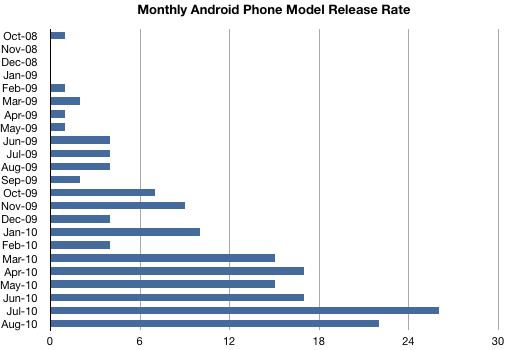
Next month will be the 24th since the first Android device launched in October 2008. The G1 was followed by another HTC device in February of 2010 and a few others in the spring. The summer of '09 showed a steady release of up to four new phones every month. Since then the number of Android phone stock keeping units (SKUs, uniquely identifiable stockable products) increased dramatically, with the release rate increasing to 26 per month during July of this year (source: pdadb.net).
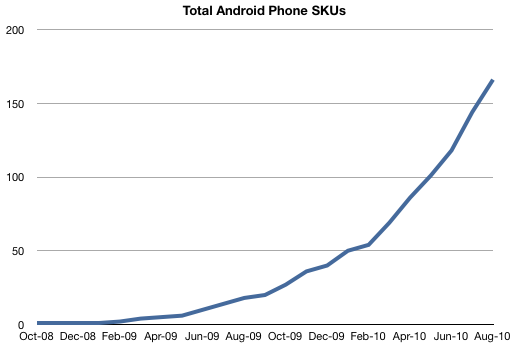
Altogether, there are have been 166 Android phone SKUs in the market with another probable 25 or so ready to launch in the next few months.
Now this may seem like a large number of different phone models in a short time, and it is, but Windows Mobile was even more proliferated as a licensed OS. At its peak over 50 new devices were released every month. The total now is over 1700 and it's still growing.
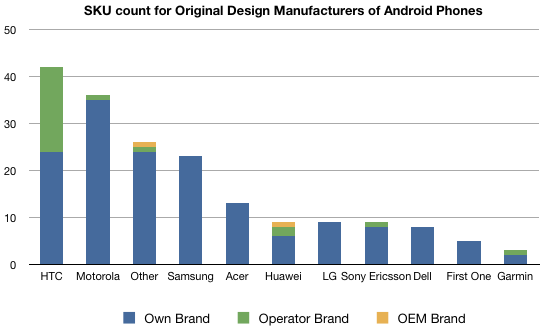
The 183 known Android devices are distributed among 10 principal vendors with another 18 minor vendors. The 18 "other" vendors (see footnote 1) have either one or two devices in the market.
The vendors or original design manufacturers list ranked by most devices follows:
I broke out the devices also by the number of operator branded devices designed by the same manufacturer (green) and any devices designed and built by one vendor but sold under a different vendor's brand (orange). It shows how, excluding "other", HTC is the most prolific Android builder (and seller) but also how it still depends a lot on Operator branding.
The proliferation of Android devices is indeed striking, but as I've pointed out before, the licensing model for Android is symmetric with that for Windows Mobile with the exception that Android is both open source and cost-free to license. This should make it highly disruptive to the paid-license model that Microsoft worked so hard to implement. It should be no surprise then that the adoption dynamics for the platform are very similar, with the same licensees that took Windows Mobile a few years ago embracing Android today.
The proliferation still has a while to go. There is production capacity for over 2000 SKUs among all the vendors in the market (especially the "other" category) and it's only been two years since a stable version of the OS has been available. So it would not be surprising if the total number of licensed Android products will overtake the 1700 or so Windows Mobile SKUs.
So what's the paradox?
The question that should jump out from this data is what's the value to the participants in this, or any mobile OS licensing model? When I analyzed the Windows Mobile field in 2007 or so, it was pretty evident that very few vendors other than HTC shipped enough volumes to make a product profitable. In fact, I coined the phrase Pocket PC Paradox to describe the situation where hundreds of vendors would line up to make undifferentiated products competing for a shrinking pie. This went on first with Pocket PC PDAs, then repeated with Windows Mobile and is now repeating with Android. Nobody ever made money except for HTC, not even Microsoft.
It's still a mystery to me why any manager would decide to make the (n+1)th Android/WinMo phone. It must be difficult to make market projections that justify the cost of developing and marketing this new product.
But here's some help: The total number of Android phones sold through the end of last quarter was about 23 million units. The total number of SKUs launched to date then was about 118. That means that the average Android phone SKU sold 200k units (2).
Now this may seem comically low, but I will again bring up history and point out that while the WinMo bubble was in its zenith, the average Windows Mobile SKU had 50k units sold. With the SKU count increasing more rapidly than the sales rate (40% more SKUs since June) it's very likely that the average units per SKU is dropping. So by my reckoning there's plenty more in the Android bubble to go.
-----
(1) The "other" category includes the following vendors:
Lenovo
Gigabyte
Highscreen
Notion Ink
WayteQ
Forsa Posh
Inventec
Kyocera
Pantech
TechFaith
Saygus
Sharp
Ziss
Alcatel
General Mobile
(2) I'm fully aware that the distribution of sales over the products is not even and very likely exponential, but there is no way to predict whether a given new product will be a "hero" or DOA. The dream for every manager must be that his product will be a star, but the odds get worse and worse over time and the average units sold has to be considered as including these odds.
I did not include all vendors for various good reasons. The first survey (market share) did include an "others" category that made the volume data complete, but in the financial data sets, I chose to include the top 7 vendors that make up 80% of device volumes.
One noteworthy vendor that was not included was HTC. HTC is an important vendor for several reasons:
it's a pioneer in smartphones having made the first Windows Mobile devices and the first Android devices
at one point it sold 80% of all Windows Mobile devices
even if it did not brand its devices, it was the name behind many re-branded or white-label operator branded phones
it has a brand of its own today and is expanding its reach
HTC has been around building devices since 2001 and so it would be a pity to exclude them from any analysis of the effect of iPhone on the market or any discussion on the effect of smartphone disruption on feature phones.
The challenge with HTC was that historically their branded devices and white label devices were not reported by the company separately. This matters because white label devices are valued differently. Typically these devices are not marketed by the original manufacturer so SG&A is not applied to their cost base. Operating margins, ASPs and hence profitability is not directly comparable with other OEMs.
But HTC has recently changed its reporting. Thanks to a reader I discovered that, since 2008, HTC has been listing its ASP and Operating Margin making direct comparisons possible. I still don't have all the data, but enough to add HTC to the analysis.
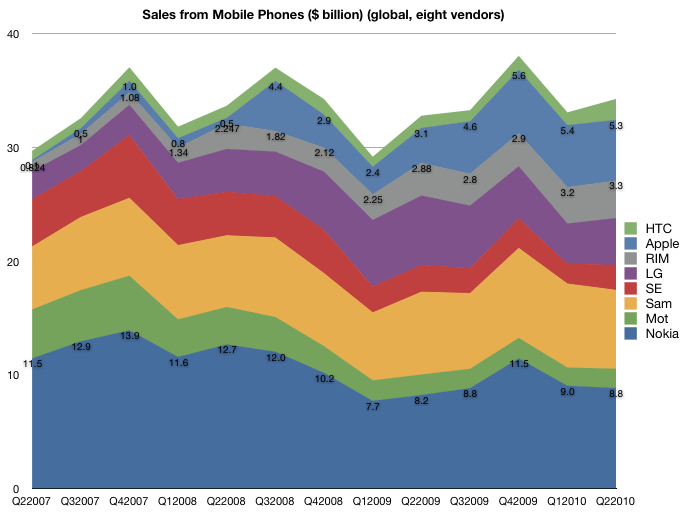
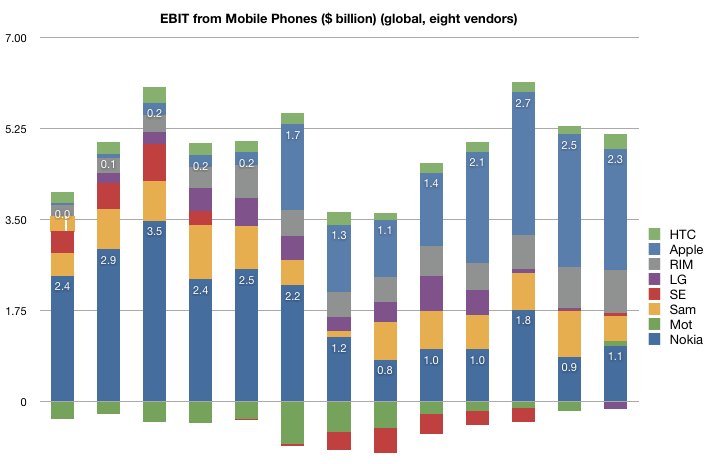
So, here are the 5 industry performance criteria, now with eight vendors listed.
Volumes
Note that HTC volumes start in 2008.
The volume of units HTC sold has been increasing at about the rate of market growth.
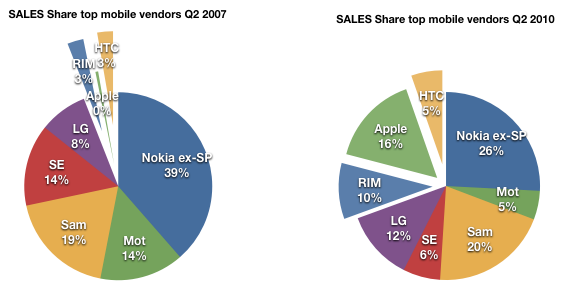
As a result, HTC's share has not increased as dramatically as those of the other smartphone entrants.
Sales
A similar story in the sales picture. Although a consistent performer, the growth has not matched that of RIM and Apple.
ASP
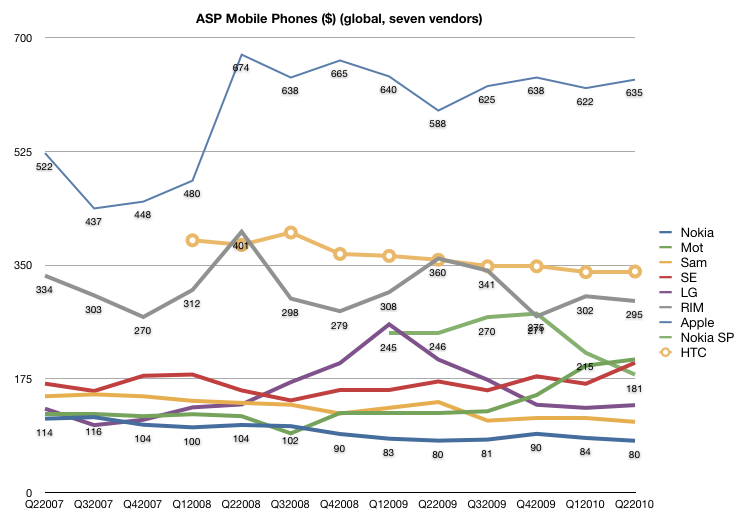
The pricing story is also a mixed one. Although HTC lies between RIM and Apple in price, the erosion is more consistent with RIM and the rest of the industry.
Margin
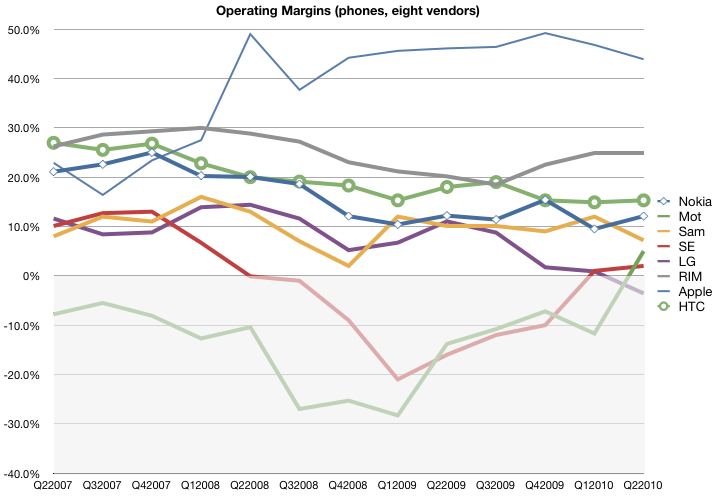
The margin story is also not as positive as one might expect. The margins for HTC started out above Apple and RIM but have dropped to closer to industry average. This is not what one might expect from an exclusive smartphone vendor.
Earnings
The share of earnings has remained unchanged at 5% over the period of iPhone presence. It's perhaps a credit to HTC that they did maintain their position in the market with the massive change that has come to pass.
However, here we also have to ask if HTC is riding a disruptive wave.
When I wrote the last series, my definition of “loser” was a company that had faced a long series of operating losses and has no viable software assets of its own, making it vulnerable to Android (and Windows Mobile). Motorola first, Sony Ericsson second and LG now coming into the picture. Nokia is not a loser in this sense since it has remained profitable and does maintain an investment in software. Same with RIM and Samsung (now with Bada). When/if they do have the near death experience, they might opt for the Android lifeline (flimsy as it is).
However HTC does not fit the mold of either "winner" or "loser". It's the Goldilocks company, not too hot, not too cold.
But I would add that HTC is not an example of a winner because of its adoption of Android. HTC’s dependence on Windows Mobile made their move to Android the most desperate of all. Unlike the larger OEMs, who had their low end devices to fall back on, they are completely dependent on a smartphone OS vendor. When WinMo was showing the first signs of crisis in 2007, they were the first to flee to Android (think of why they would risk the wrath of Microsoft for something so fragile as Android in 07). They are also trying hard to escape the dependence by building up their own UI (SenseUI) and I would not be surprised if they move to their own OS in the future. Being associated with Android does not confirm them as "winners" but in fact, shows their vulnerability.
What does this all say about Android?
Again here my thesis is that Google chose to sustain the industry rather than try to upend it. I don't judge their motives, but the fact is that with Android, Google is not in a position to disrupt telecom. There were high hopes dashed with the Nexus One and hearts broken with net neutrality and now there are patent wars to be fought. Android, with its licensees, is still at the mercy of operators.
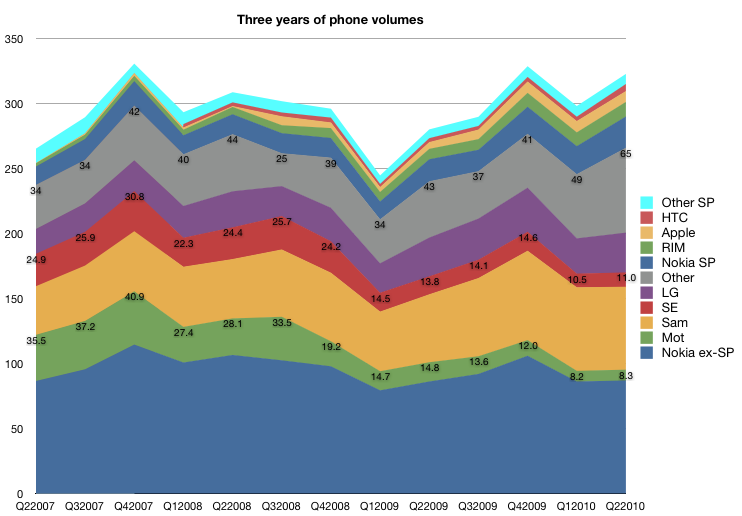
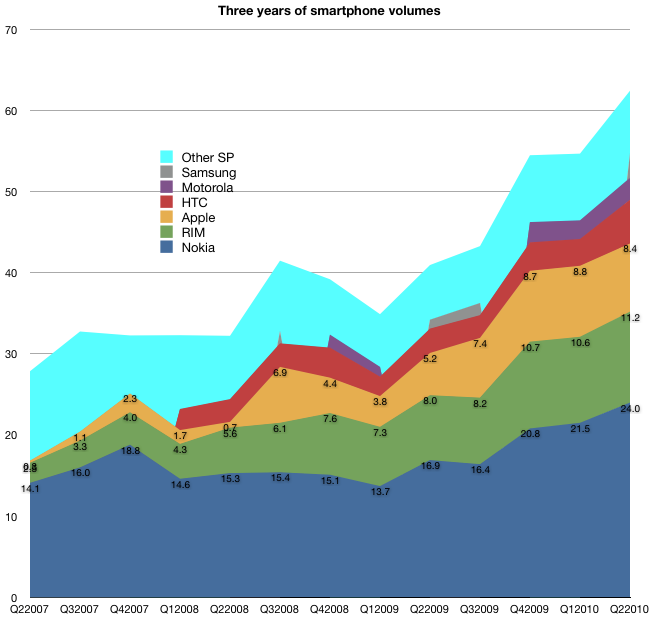
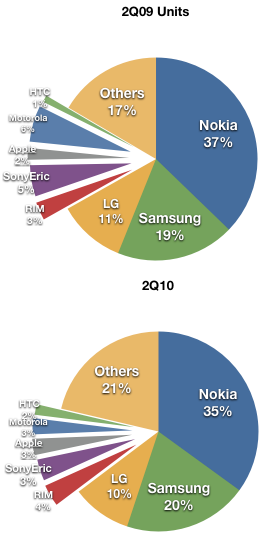
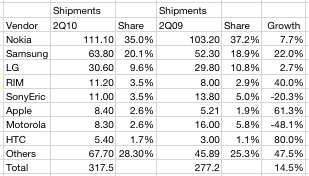
After piecing together the global smartphone shares, it's time to take a look at global mobile phone shares. That's all phones from all vendors that matter.
Unfortunately, just like there are only fragments available from Canalys about smartphones, there are only partial lists from IDC (IDC - Press Release - prUS22441510). Missing are numbers from Apple, Motorola and HTC. But fear not, those can be obtained from company earnings reports.
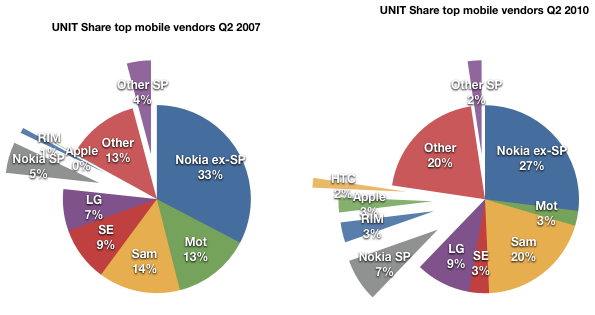
So here is the full picture for 2Q10 vs. 2Q09
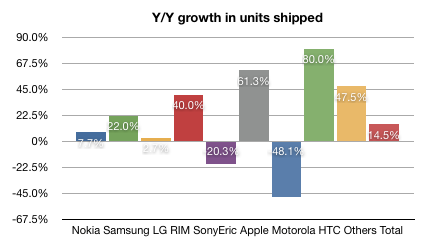
The year-on-year growth for the vendors above is:
The source data is:
Observations:
The pure play smartphone vendors (HTC, Apple and RIM) are growing rapidly and capturing most of the profits.
LG and Samsung are taking share from Nokia but losing margins.
"others" are doing well at the low end.
Sony Ericsson and Motorola are transitioning from mass market vendors of commodity voice products to niche vendors of Android commodity data products.
Text and picture messages will be deleted with this software update. You can back up text and picture messages by forwarding them to an email address.
Open the Messaging application
Tap and hold on the desired text or picture message
Tap Forward
Enter an email address then tap Send
APPLICATIONS
Applications will be deleted with this software update. You will need to re-download the desired applications from the Market after this update completes.
[from the German `klug', clever; poss. related to Polish `klucza', a trick or hook] 1. /n./ A Rube Goldberg (or Heath Robinson) device, whether in hardware or software. 2. /n./ A clever programming trick intended to solve a particular nasty case in an expedient, if not clear, manner. Often used to repair bugs. Often involves ad-hockery and verges on being a crock.
In the free press release linked below Canalys reveals their estimates of vendor shares but not the OS shares for smartphones. However it's not hard to see the OS split due to the high degree of exclusivity of OS's to vendors.
For example, virtually all Nokia devices are Symbian powered, all RIM devices are Blackberries and all Apple devices are iPhone OS. Motorola is only shipping Android and HTC is the only top 5 vendor that now licenses more than one OS. Even HTC's portfolio is now heavily Android weighted.
We can carve out Palm (960k units shipped) from the "others" and we're left with mostly Windows Mobile. My estimate would be about 5 to 6 millionWinMo made it out.
That leads me to the following estimated OS shares:
Symbian (Nokia): 42%
Blackberry OS (RIM): 19%
iPhone OS (Apple): 16%
WinMo (Microsoft): 10%
Android (Google): 10%
WebOS (Palm): 2%
If anyone knows the actual Canalys OS shares, let me know.
While Apple's patent lawsuit against HTC remains ongoing, the Taiwanese handset maker has reached a licensing agreement with Microsoft to avoid another lawsuit over its Android-powered handsets.
The problem will be in using some comparable as a measure of reference. This is a problem because first, there is no equivalent product in history, second, there are few similar products that are pre-ordered and sold without user samples being available, and third it's being sold through a very limited channel (on-line Apple Store). Lastly, the number includes only delivered units vs. reservation for pick-up.
Nevertheless, the figure is intriguing. One class of comparable products might be new smartphone products from companies that were launching on new platforms.
One example is the Android G1--the first Android device. It sold 663k units in the launch quarter. Another is the Nokia 5800, Nokia's first touch capable device. It sold 536k units in the first quarter (up to 1 million in the first 3 months). Sony Ericsson's first Windows Mobile device was the X1. It sold 237k units in the first quarter of sales. The first Sense UI HTC device (the Diamond) sold about 1 million units. The RIM Storm, RIM's first touch device sold 1.6 million units. Finally the iPhone which sold 1.1 million units in the first full quarter of sales (about 1.4 million if we include the weekend sales that fell outside the first quarter).
The iPad does seem to be doing rather well relative to these products. Again, their figures were for a full 90 days of sales and were sold through physical retail channels in a variety of geographic markets.
I will be surprised if the number of units sold in Apple's CQ2 don't exceed 1 million. (Apple will book all these sales only on delivery which means they won't appear in CQ1 sales figures). This will probably mean better performance with a new platform than Nokia, Google, Sony Ericsson or HTC and perhaps better than the iPhone.