Asymco

Asymmetric Intelligence

iOS

  1. WWDC Special: Asymco Office Hours - June 2026 - Live Q&A with Horace Dediu: Recording & Transcript

    Office Hours

    Recording and transcript of the June 9, 2026 Asymco One Office Hours, recorded the day after Apple's WWDC 2026 keynote. Horace Dediu shares his impressions of the event and takes questions from Asymco One subscribers.

    Recording

    Subscribe to Asymco One to listen to the recording and read the transcript.

    Transcript

    Sign up and latest updates at asymco.com/live.

  2. Bank of America increases AAPL price target considering agentic and on-device AI

    Nota Bene · 4 comments

    Upgrades keep coming but are they justified?

    Bank of America upped its price target on the tech giant, citing a potential boost from agentic artificial intelligence.

    Shares rose 0.5% in premarket trading.

    “In an agentic world, value accrues to the platform that controls user intent, personal context, app access, permissions, identity, authentication, payments, and trust,” analyst Wamsi Mohan wrote in a note to clients. “Smartphone is the scaled consumer device where these factors already converge. If AI assistants become the new front door to search, apps, commerce, scheduling, payments, and workflow completion, we think Apple should have meaningful leverage over model providers, app developers, merchants, advertisers, and payment networks.”

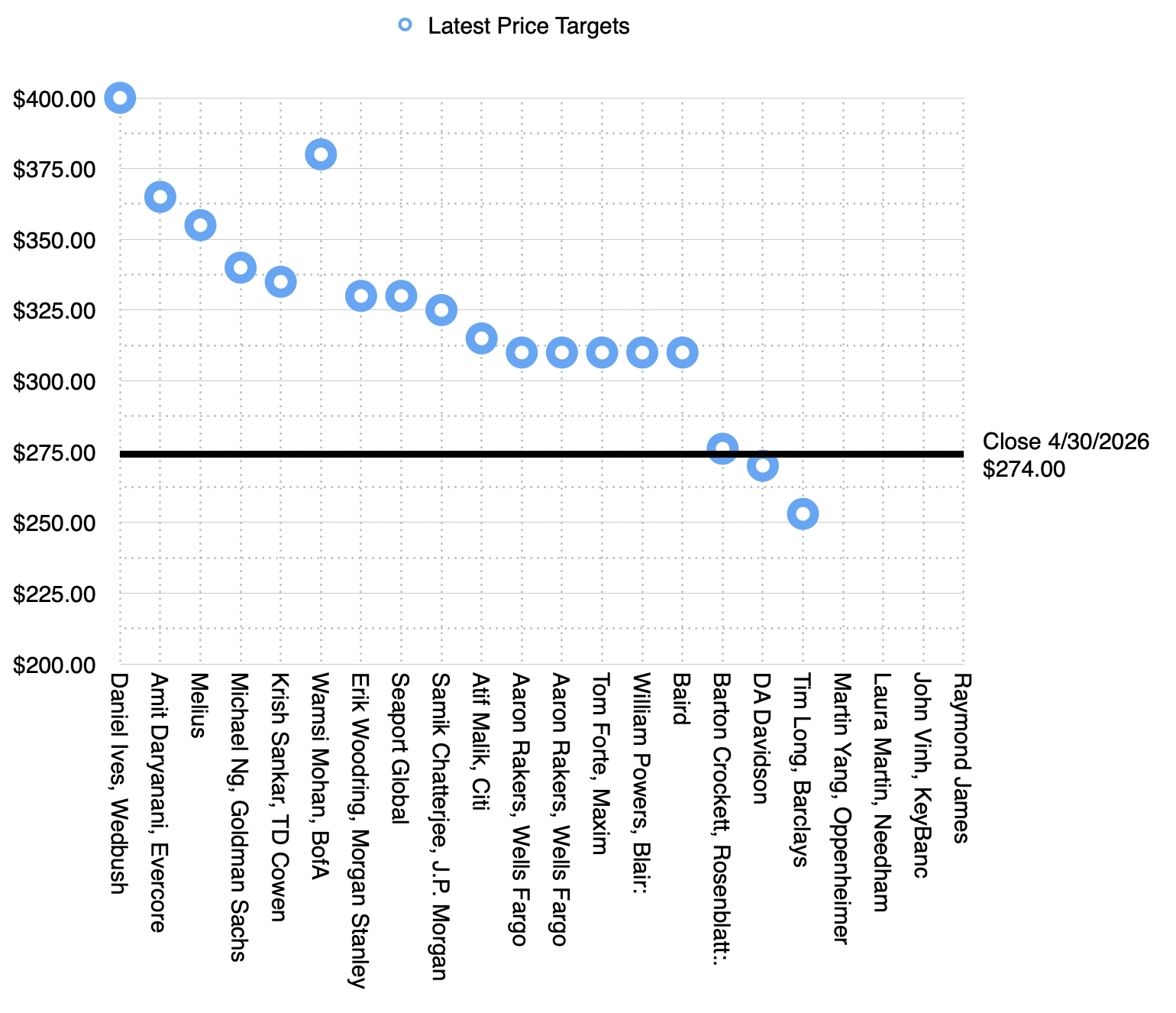
    Mohan raised his price target to $380 from $330 and reiterated his Buy rating on Apple.
    Delving deeper, Mohan said that the company's benefit in agentic AI comes from its semiconductors and iOS, as Apple's silicon can dictate what happens on a devices (which is important for latency, reliability, privacy and costs) and iOS will determine how the AI is used by the user. “Our analysis around token usage suggests Apple will need to rely on distributed compute (on device), Private Cloud Compute and third-party compute to deliver a robust AI experience,” Mohan added. “Removing the net cash neutral target, in our opinion, is a reflection of a new period of AI-driven investments to enable this agentic era.”

    As such, Mohan believes that the coming Siri redesign needs to be integrated into the iPhone and make it an agent that is capable of understanding intent, retrieving context, bringing up apps, and completing workflows. If this were to happen, an agentic version of Siri could boost fiscal 2030 revenue between $15B and $30B, or as much as $40B to $65B if users really became acclimated to it.

    Source: Seeking Alpha

    NB: Updated price targets with BofA change highlighted.

  3. iPhone vs Android Switching Rates

    Nota Bene · 3 comments

    Bitchin' ain't Switching

    SellCell’s Smartphone Loyalty Survey 2026 shows iPhone and Android loyalty at record highs, but Android users still switch more.

    Key findings

    iPhone loyalty stands at 96.4%, up from 91.9% in 2021

    iPhone switching stands at 3.6%

    Android loyalty stands at 86.4%, with switching at 13.6%

    Android users are nearly four times more likely to switch than iPhone users

    Samsung loyalty stands at 90.1%, up from 74% in 2021

    Samsung switching stands at 9.9%

    Google loyalty stands at 86.8%, up from 65.2% in 2021

    Google switching stands at 13.2%

    The loyalty gap between iPhone and Android now stands at 10 percentage points

    Price and value are the biggest drivers of switching

    Technology is the second biggest driver

    Overall, loyalty has increased across all major brands since 2021

    Source: SellCell.com Blog

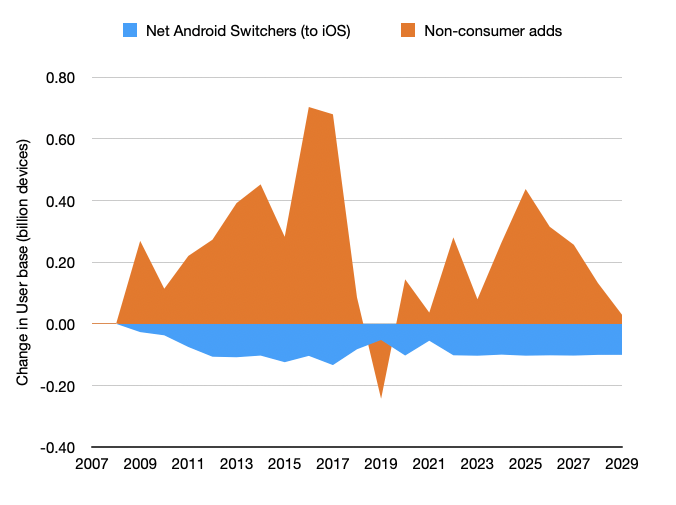
    NB: I did a deep dive into the data and came up with graph above. The original report shows intention numbers which seem quite high. For instance, the net switching rate between iOS and Android is 10% in favor of Apple. This would imply that the entire user base would flip in 10 years. It would also imply...

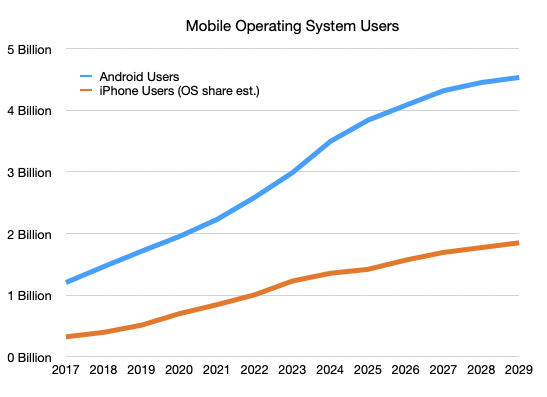
    As time goes on and saturation is reached (near 5 billion active smartphones) then the churn will imply that Android will eventually become a net user loser.

    That probably won't happen before 2030. When saturation does happen however, I will be watching to see if Apple chooses a different strategy to accelerate switching similar to what it is doing with the MacBook Neo at a time of PC market saturation.

    The lesson here is that switching intention surveys showing a net 10% churn rate don't mean that the actual switching rate is net 10%. The intention to switch is a sentiment but actual switching is often more difficult than a wish to do so.

    I think actual net churn is 1.7% of the base each year. That's still 100 million a year. For now it seems Apple is happy to maintain that rate.

  4. We know that Macs last longer in use. How much longer?

    Nota Bene · 1 comment

    What did I just say?

    A new analysis of computers used in the enterprise finds that Macs and iPhones last much longer and have far fewer problems.

    Macs in enterprise settings typically last for five years, besting the three-year lifespan for Windows PCs, according to a company that makes software to help businesses manage their computers.

    But the really shocking revelation from the report is that more than half of Windows PCs used in big business get replaced within a year.

    While factors like software compatibility, IT familiarity and customization options also play a role, upfront hardware cost remains the biggest driver for most organizations.

    By comparison, Macs are often seen as premium products, which can make them harder to justify at scale (although the recently released $599 MacBook Neo is changing that equation).

    Companies making these sorts of computer buying decisions should pay attention to a new report from Omnissa.

    “Compared to Windows, 6.5x more Macs are seen in service into year 6, and 3.3x more Macs are seen in service into year 3+,” noted Omnissa’s report.

    “Only 17% of macOS devices were replaced within one year, compared to 54% of Windows devices, reducing disruption tied to frequent hardware replacement,” said the analysis.

    Macs are far less likely to crash. The benefits of using Apple computers don’t stop at longevity, though. Employees using Macs also run into far fewer bugs.

    “The telemetry reveals that Windows devices exhibit 3.1x more total forced shutdowns (including system crashes and unexpected restarts) than macOS devices,” said Omnissa. “Windows devices experience 2.2x more app crashes and a staggering 7.5x more app hangs (unresponsive software states) than Macs.”

    “A forced shutdown is much more than an IT support ticket — it’s a disruption to an employee’s work that translates directly into lost work hours,” said Omnissa.

    Apple’s lifespan advantage extends to iPhones as well. When compared to Android handsets, “the data suggests that iOS devices display longer service life, with twice as many devices in service into year 6,” said Omnissa.

    “iOS is updated 8.1 times faster than Android,” said Omnissa. “macOS is updated 1.5 times faster than Windows.”

    The long-term cost benefits of using macOS or iOS in the enterprise are starting to overcome companies’ habit of making buying decisions based on short-term savings.

    Source: Cult of Mac

    NB: “Penny wise but pound foolish…

  5. Asymco Bulletin 002 / March 1, 2026

    Bulletin

    Asymco Bulletin is a digest of all the work we have published for the week ending March 1, 2026.

    Office Hours

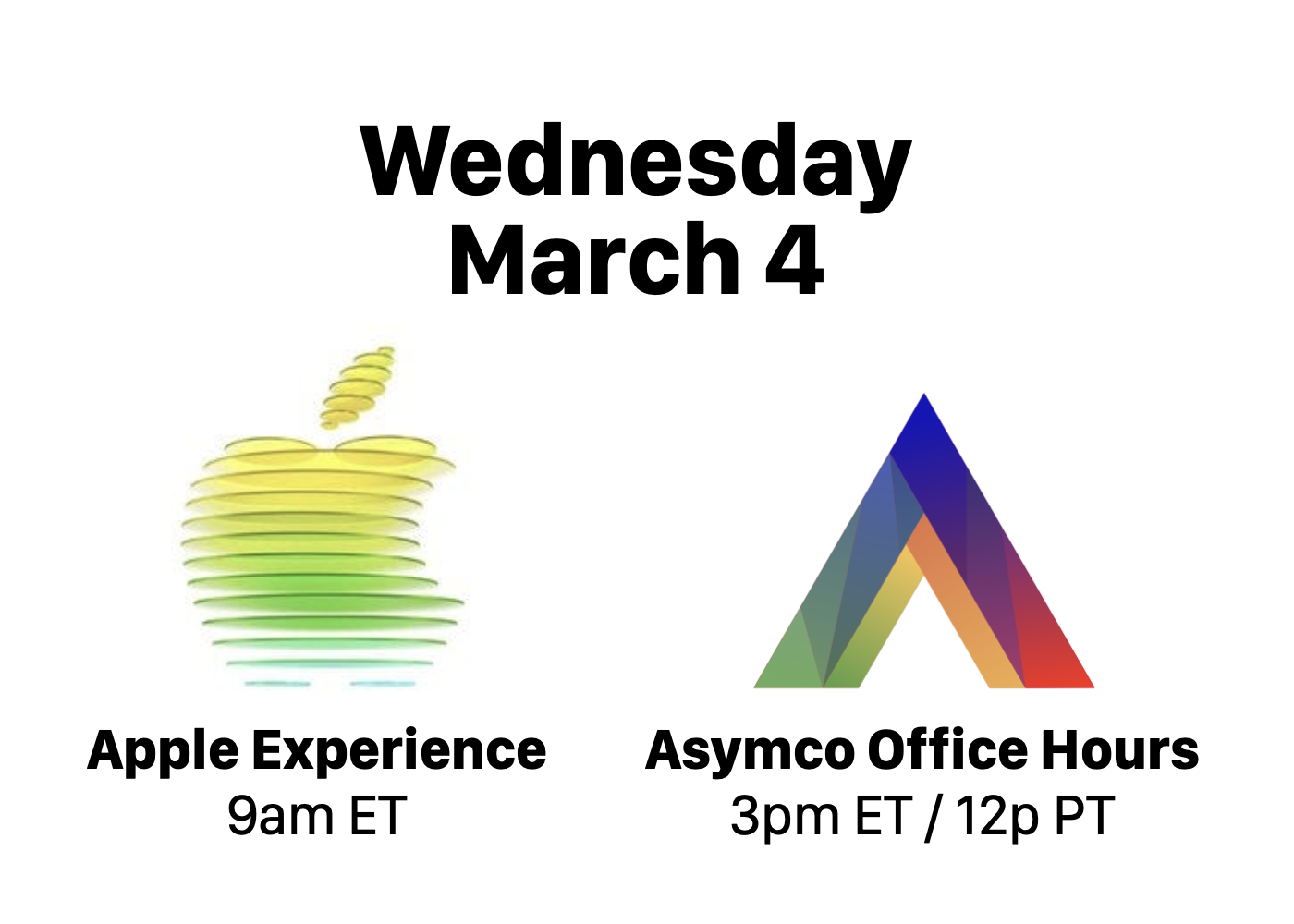
    Our first Office Hours interactive seminar and Ask Me Anything questions/answer session will be on March 4th, after, presumably all the new announcements Apple will be making during the week. I will be broadcasting to you en vivo y en directo from Paris.

    Apple March 4 Special Event – Q&A

    Apple March 4 Special Event – Q&A → Join us for an exclusive Asymco One live Q&A on March 4 at 3pm ET to dissect Apple's latest business moves. →

    Research

    How many Apple users are in China?

    Greater China (GC) is a specific reporting segment for Apple, encompassing Mainland China, Taiwan, Hong Kong, and Macao, with a combined population nearing 1.5 billion. This region is not just a significant contributor to Apple's revenue—accounting for 18% of net sales in Q4 2025—but also a dynamic landscape of technological adoption and consumer behavior. The smartphone user base in GC has surged from 690 million in 2016 to nearly a billion in 2025, with projections reaching 1.08 billion by 2029.

    The iOS ecosystem within GC exhibits varied dynamics across its constituent regions. While Macao maintains a steady iOS share of around 60%, Mainland China and Taiwan show different trajectories. Analyzing these trends through mobile OS share data reveals iOS's ascent, suggesting robust potential for further penetration and user engagement. As Apple navigates this complex market, understanding GC's historical growth patterns and future prospects is crucial for capitalizing on emerging opportunities and sustaining its competitive edge. →


    Nota Bene

    Apple #1 phone vendor in Europe → Apple leads Q4 2025 with a 7% YoY shipment rise driven by iPhone 17, while Samsung follows with 4% growth; Xiaomi faces a 6% decline amid shifting regional dynamics. →

    Are Solid State Batteries Finally Here? → Donut Lab has partnered with VTT for independent battery tests, with full reports and videos to follow. →

    iPhone becomes India’s top single export item → In 2025, Apple's iPhone exports from India, driven by Tata and Foxconn plants and a robust supply chain, reached $23 billion, making smartphones the top export category. →

    Apple’s App Store growth is reaccelerating → Apple's Services, beyond just the App Store, are poised for robust growth, driven by global market expansion and strong hardware demand. →

    Here’s why demand for Macs has spiked → Mac lead times have surged to multi-year highs due to increased demand, notably impacting models like Mac Studio, MacBook Pro M4, and Mac Mini. →

    A resource for AVP news → "AVP VIP offers a weekly, ad-free digest of tech news and insights, accessible to Asymco One members." →

    Apple to Start Assembling Mac mini in the United States This Year → Apple revamps the Mac mini with M4 chips and boosts U.S. chip sourcing, starting at $599 without display, amid rising demand. →

    Apple Pay Aiming Launch in India This Year → Apple Pay aims to launch in India by late 2026, pending regulatory approvals and fee negotiations with card issuers. →

    iPhone and iPad approved to handle classified NATO information → Apple's iPhone and iPad achieve unprecedented NATO compliance, marking a pivotal shift in secure mobile technology acceptance. →

    Eddy Cue says Brazil is Apple TV’s second-largest market, talks Netflix-Warner merger → In an interview, Apple's Eddy Cue highlighted Brazil as the second-largest and fastest-growing market for Apple TV subscribers, while noting potential impacts from proposed streaming regulations and a possible Netflix-Warner deal. Specific user and device numbers were not disclosed. →

    DRAM Shortage Will Cause ‘Seismic Shift’ in Smartphone Market, But Apple Will Be Less Affected → A looming DRAM shortage due to AI demand will slash smartphone sales by 13% in 2026, forcing a market shift towards pricier devices, with relief not expected until mid-2027. →


    Asymco One gives you full access to our research, analysis, and commentary. Subscribe with code BULLETIN for a discount.

    Feedback: Have questions or comments? Reach out to us at contact@asymco.com. We’d love to hear from you.
  6. iPhone and iPad approved to handle classified NATO information

    Nota Bene · 1 comment

    First and only, defining moment

    Today, Apple announced iPhone and iPad are the first and only consumer devices in compliance with the information assurance requirements of NATO nations. This enables iPhone and iPad to be used with classified information up to the NATO restricted level without requiring special software or settings — a level of government certification no other consumer mobile device has met.

    iPhone and iPad previously received approval to handle classified German government data on devices using native iOS and iPadOS security measures, following an extensive evaluation by the Federal Office for Information Security (Bundesamt für Sicherheit in der Informationstechnik, or BSI). Now, iPhone and iPad running iOS 26 and iPadOS 26 are certified for such use in all NATO nations.

    As part of this effort, BSI conducted exhaustive technical assessments, comprehensive testing, and deep security analysis, ensuring Apple’s built-in platform security capabilities met NATO nations’ exacting operational and assurance requirements.

    “Secure digital transformation is only successful if information security is considered from the beginning in the development of mobile products,” said Claudia Plattner, BSI’s president. “Expanding on BSI’s rigorous audit of iOS and iPadOS platform and device security for use in classified German information environments, we are pleased to confirm the compliance under NATO nations’ assurance requirements.”

    The approval marks a defining moment for Apple’s mobile platforms, as iOS 26 and iPadOS 26 are now listed on the NATO Information Assurance Product Catalogue in recognition of their built-in security capabilities.

    Source: Apple Newsroom

    NB: There is a "movement" or inclination to reduce or eliminate dependencies among European countries and companies on US technologies. This is due to the perceived and actual threat posed by the current US Administration...

  7. How many Apple users are in China?

    Research · 2 comments

    Greater China.

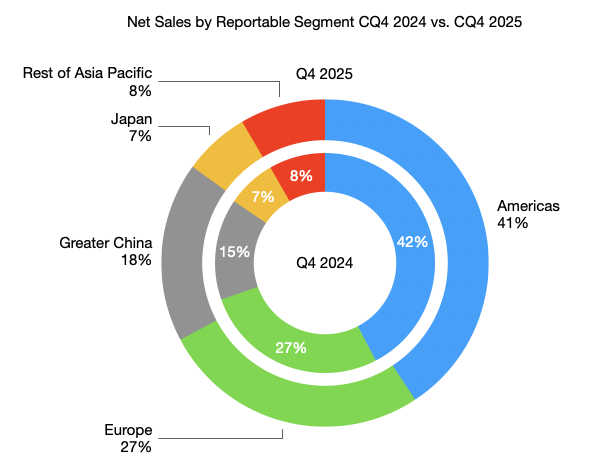
    As previously reported, China represented 18% of net sales for Apple in the fourth quarter of 2025. This was up from 15% the year before and the third largest reporting segment. The segment grew by 37.9% year-on-year.

    It's time to understand precisely how big this market is in terms of users, iPhone install base and device install base, with an eye toward understanding the history and potential for growth.

    First, it's important to note that Apple refers to "Greater China" (GC) not just China. That means within this reporting segment are Mainland China, Taiwan, Hong Kong and Macao. The populations are approximately, 1.4 billion, 23.2 million, 7.5 million and 700k respectively.

    Second, the population of smartphone users has been growing dramatically. In 2016 there were about 690 million (GC) and in 2025 the number is about 997 million. The forecast for 2029 is 1.08 billion.

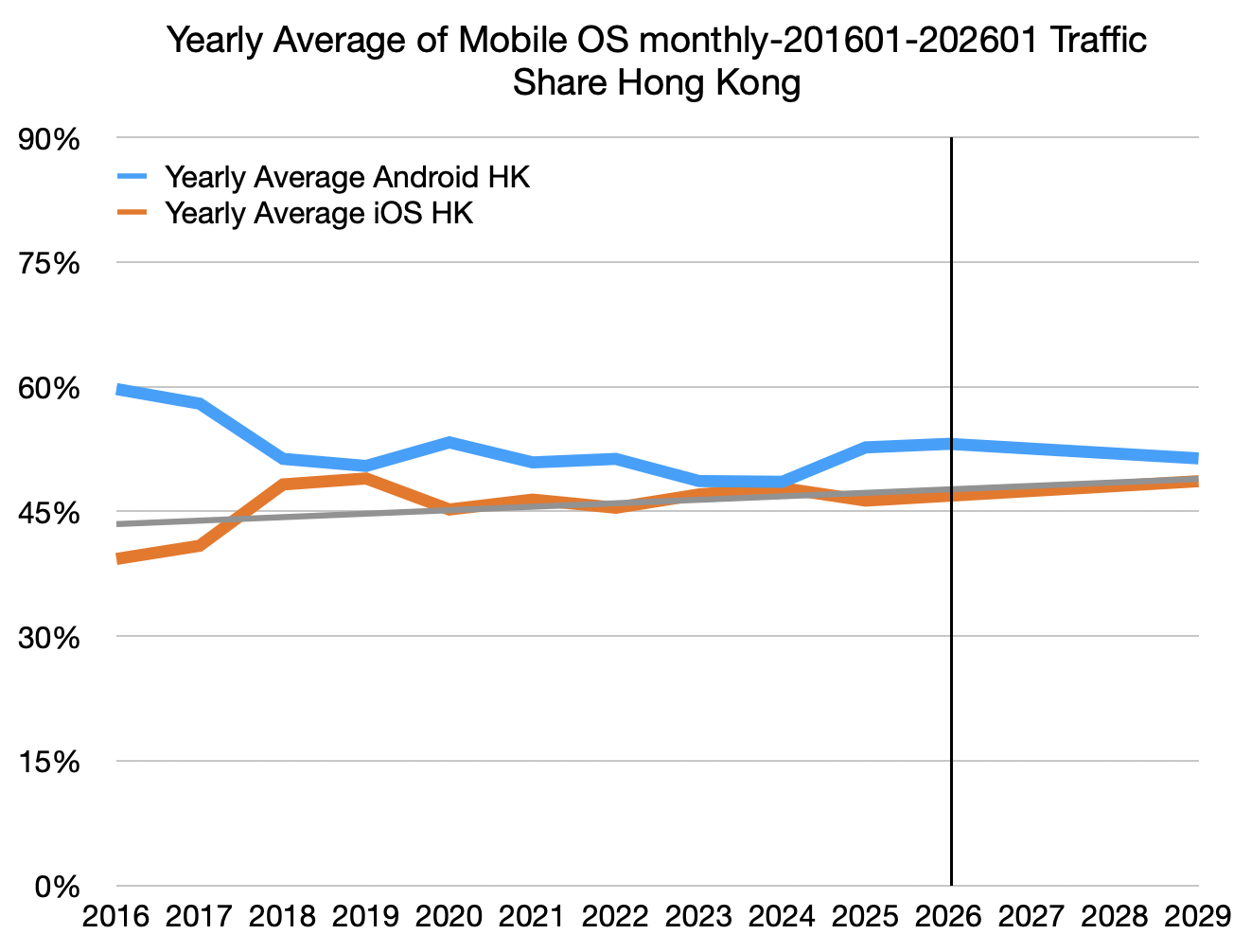
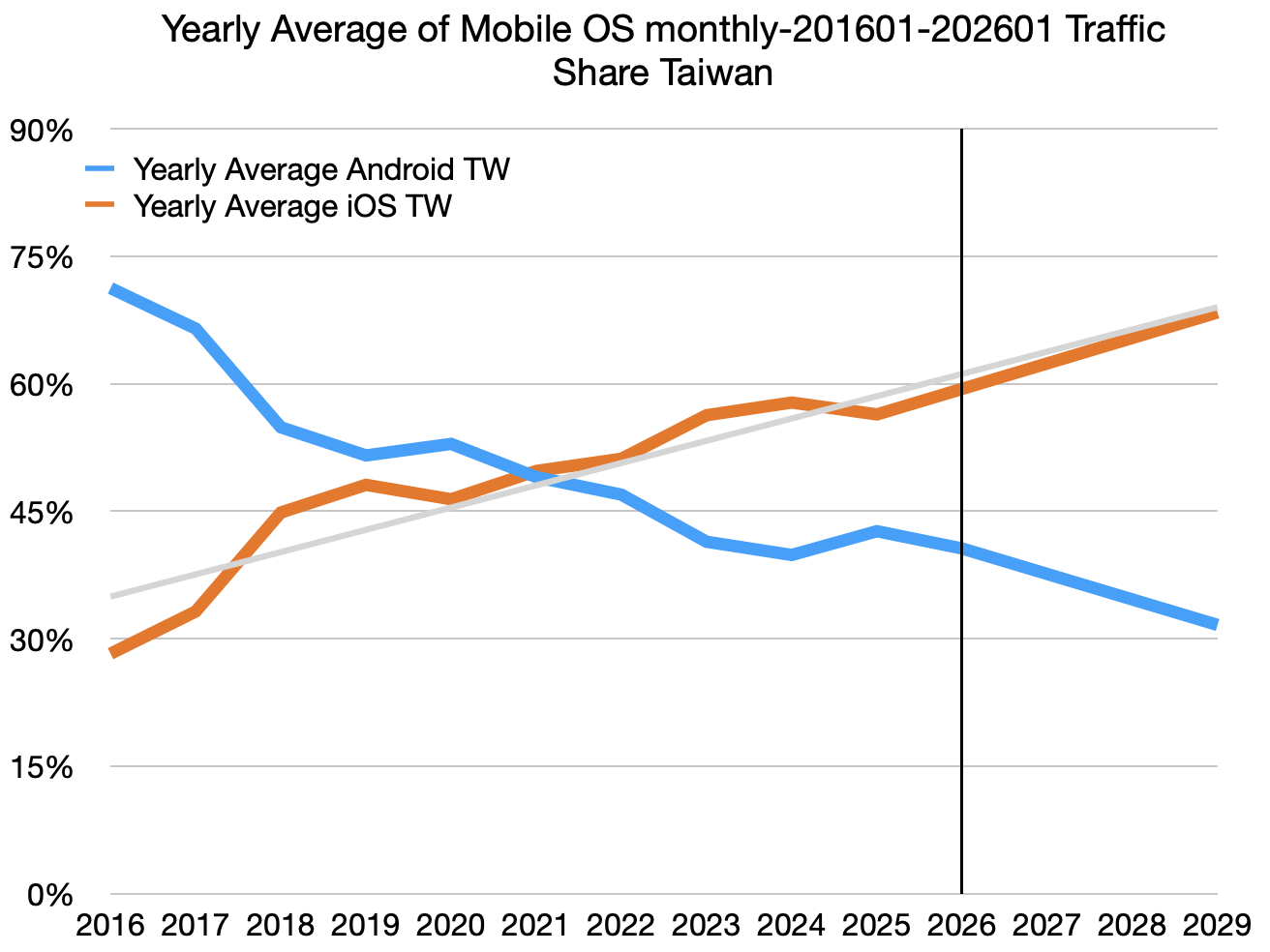
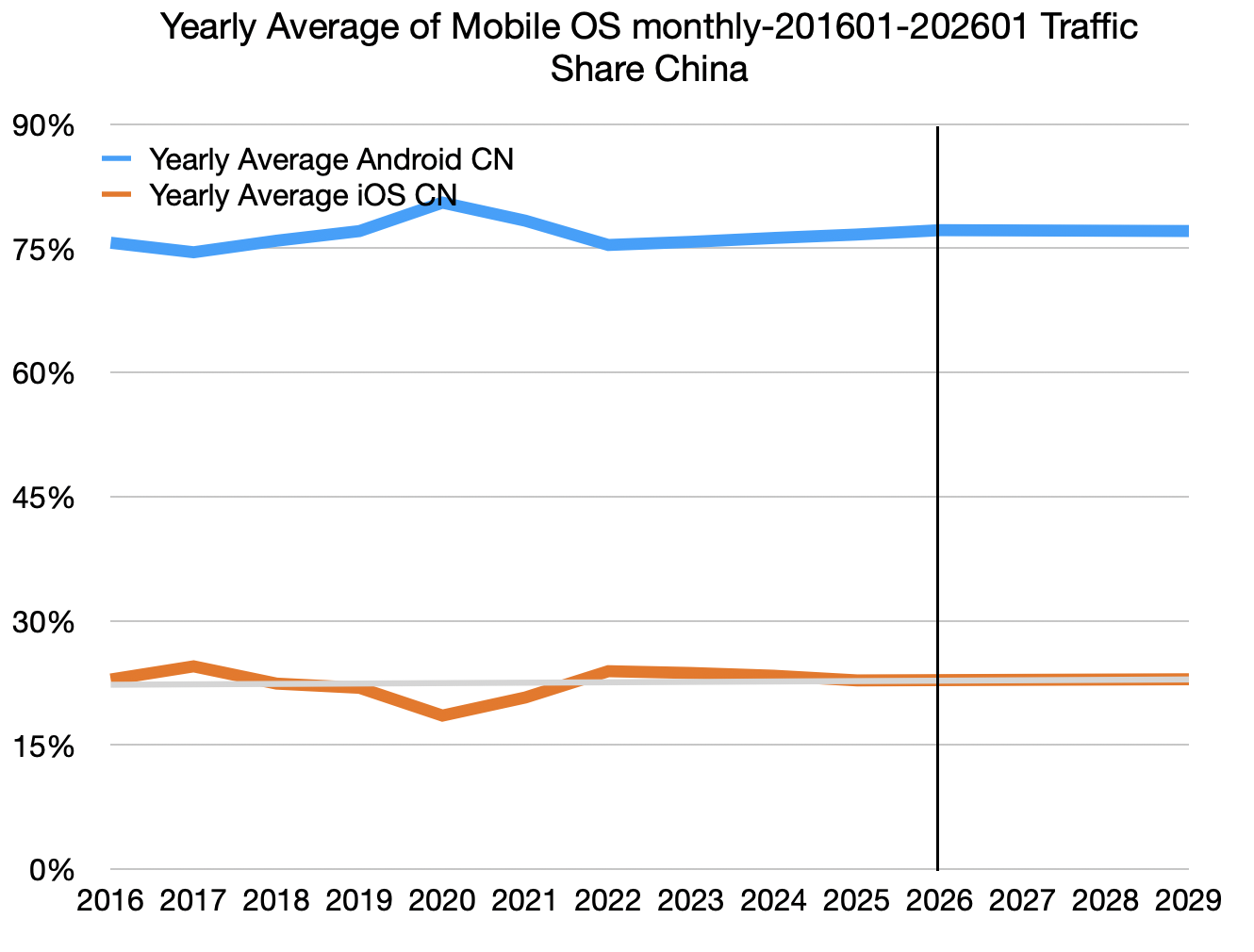
    Third, the share of iOS has been rising but at different rates in the three regions (Macao is excluded because of small relative size, but Apple is holding iOS share steady at about 60%.)

    These graphs represent the trends in Mobile OS share as collected by Statcounter and trendlines for iOS are shown with projections to 2029.

    Multiplying the share numbers by the user numbers, including projections gives the following iOS users summary.

  8. Asymco Bulletin 001 / 22 Feb 2026

    Bulletin

    Asymco Bulletin is a digest of all the work we have published for the week ending Feb 22, 2026.

    Research

    Teen Survey Update: What happens when teens grow up?

    Latest data indicates 88% of teens own and intend to purchase iPhones, marking a decade-long trend of increasing adoption. This phenomenon transcends mere functionality; the iPhone has become a cultural icon, symbolizing status and identity.

    Unlike other Apple products, such as Apple TV+ or Apple Music, which struggle for traction among teens, the iPhone's appeal is deeply woven into the social fabric, partly due to generational continuity—the children of early iPhone adopters are now loyal users themselves.

    In contrast, social media platforms illustrate the fickle nature of tech usage among younger demographics. While Facebook remains prevalent among older millennials, Gen Z gravitates towards Instagram and TikTok, reflecting shifts in cultural preferences and digital behaviors.

    For Apple, success in services like Music and TV+ hinges on leveraging existing family dynamics through bundling.

    Read More →→→

    Apple in Europe: How many iPhone switchers are addressable in the near term?

    On the Q4 call, Tim Cook highlighted Greater China’s 38% year-over-year revenue growth, fueled by record iPhone sales, strong upgrade activity, and double-digit retail traffic gains.

    Europe, however, drew little attention—despite generating more revenue for Apple than China. This is peculiar.

    Europe’s smartphone market shows steady structural gains for iOS. Since 2018, share has risen from 24% to 39%, while Android has fallen from 74% to 60%—a 15-point swing equal to roughly 70 million additional users. With an installed base near 459 million users versus about 300 million in the U.S., Europe combines scale with affluence.

    In sum, the pattern for Apple in Europe is not saturation but share transfer, signaling durable competitive strength in a mature market and an inkling of how all markets will eventually behave in maturity.

    Read More →→→

    Estimating 2035 iPhone Users

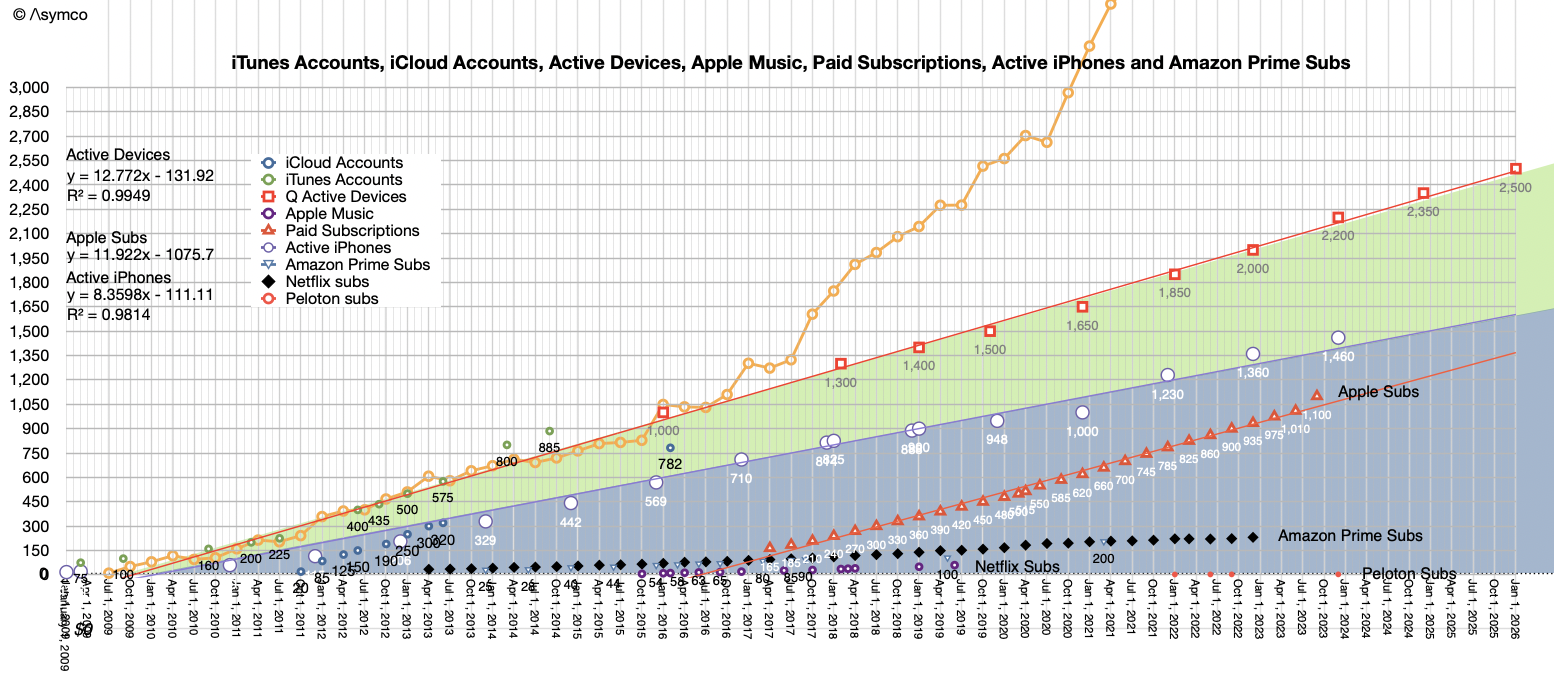
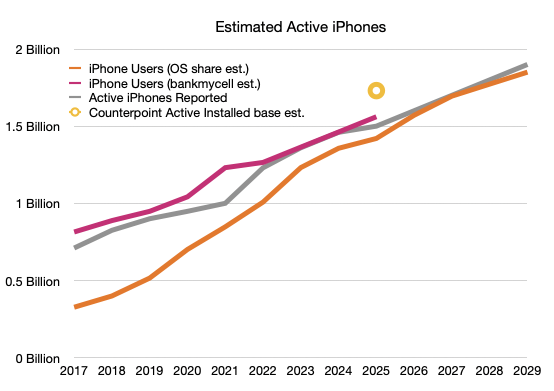
    In the last quarter Apple reported 2.5 billion active devices. Of those, I estimate 1.6 billion are iPhones.

    Using this as a base, I've created an iPhone installed base estimate looking forward to 2030, integrating Statcounter’s market share data, Ericsson’s global smartphone user forecasts, and BankMyCell’s smartphone install base.

    The sources broadly align through 2025, though Statcounter’s historical iOS share (2017–2023) diverges somewhat, possibly reflecting Android’s heavier web traffic footprint due to usage patterns and bot activity rather.

    Taken together, the data points to iPhone nearing 2 billion active devices by 2030, consistent with overall smartphone adoption. Android’s projected rise toward 4.5 billion users signals continuing headroom.

    If switching dynamics and monetization trends persist, Apple’s ecosystem could expand to 2.5–3 billion users by 2035, with growth thereafter driven by switching and increased engagement depth and value extraction per user.

    Read More →→→


    Nota Bene

    Apple Announces Special Event in New York, London, and Shanghai on March 4 → Apple is hosting intimate, global "Special Apple Experience" events on March 4, 2026, likely unveiling new products like the iPhone 17e and M5-powered MacBooks, marking a fresh twist on traditional live-streamed launches.

    Apple adds video experience to Apple Podcasts → The "pod" in podcasts originated from Apple's iPod, with the company popularizing the medium by integrating podcasting into iTunes in 2005, and continuing to innovate with features like video podcast support and dynamic ad insertion.

    Why not maroon? The Macalope ponders the power of color → Apple's upcoming lineup, featuring color-excited anticipation for the iPhone 17e and modest updates to iPads, promises subtle yet intriguing tech advancements.

    Dan Ives Says Apple’s AI Alone Could Be Worth $1.5 Trillion → Apple's unparalleled distribution through its vast user base offers a significant competitive edge for rapidly monetizing AI innovations, potentially adding $1.5 trillion in value.

    While big tech burns cash on AI, Apple waits → As foundation models commoditize, Apple strategically curates top AI tech into its ecosystem, prioritizing user experience over engine development.

    Secure the chips, absorb the costs, and grab more market share → Apple faces memory cost inflation potentially raising iPhone prices, yet its strong ecosystem and execution provide resilience, whereas competitors like Samsung may struggle more due to lesser volume leverage.

    iPhone Emergency SOS via Satellite Helped Six Skiers Survive Tahoe Avalanche → Six skiers survived a deadly Lake Tahoe avalanche by using iPhone's Emergency SOS via satellite, highlighting its transition from luxury to essential. This feature enabled crucial communication with rescuers in remote areas lacking cellular service. The evolution mirrors mobile phones but faces slower adoption due to satellite bandwidth constraints.

    The US Supreme Court has ruled against US President Donald Trump’s decision to impose a raft of global tariffs → Apple and other affected companies may soon seek refunds for tariffs paid, following the Supreme Court's decision to invalidate Trump's tariffs, though the exact timeline and amount remain uncertain.

    Bankers complain that Apple has a tight grip on mobile payments → Canadian banks struggled to compete in the mobile wallet market, dominated by tech giants like Apple and Google, due to their risk-averse nature clashing with tech's innovation-driven approach.


    The all new Asymco One

    Introducing Asymco One Early Bird Pricing. → Asymco celebrates 17 years of insightful Apple analysis, launching Asymco One to guide stakeholders through Apple's evolving era with comprehensive content and community engagement. →

    Introducing: Asymco One Office Hours → Join Asymco One's monthly Office Hours with Horace to get live insights on Apple's business and financials, with special editions during key events.

    All Asymco Podcasts. All in One: Asymco One. → Exciting news: All Asymco Podcasts now under Asymco One subscription with remastered classics and new episodes.


    Asymco One gives you full access to our research, analysis, and commentary. Subscribe with code BULLETIN for a discount.

    Feedback: Have questions or comments? Reach out to us at contact@asymco.com. We’d love to hear from you.
  9. Estimating 2035 iPhone Users

    Research

    Surveying multiple sources

    We have a firm hold on the number of active devices as well as the number of iPhones in use. This is due to Apple reporting the data. The latest active device count was 2.5 billion and the estimate for active iPhones is 1.6 billion.

    This patters also allows us to forecast the active base pretty accurately as the growth is predicted by the tight fitting linear approximation.

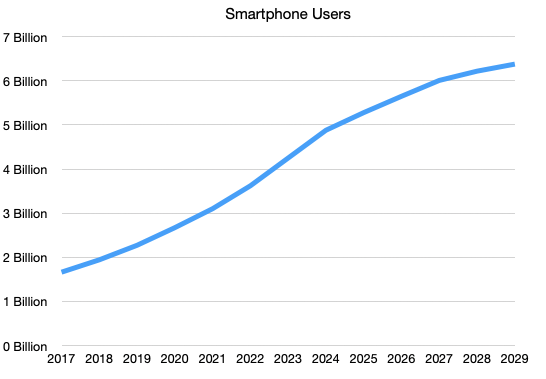
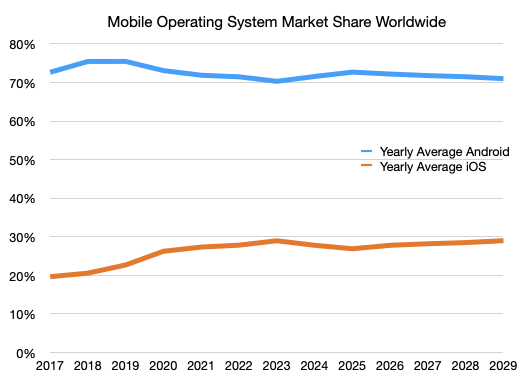
    For more confidence it would be useful to confirm these predictions with different estimates. For this I turned to two additional sources: the Statcounter GlobalStats measure of Mobile Operating System Market Shares Worldwide coupled with Number of Smartphone Users Worldwide (forecast by Ericsson) and the Number of of iPhone Users from Bankmycell.

    The total Smartphone Users history and forecast is shown below:

    The Mobile Operating System Market Share Worldwide is shown below:

    Multiplying these two yields the Mobile Operating System Users

    The iOS users (orange line) can now be compared to Apple's own reported active device total (grey line) and the Bankmycell estimate as well as a derived estimate from Counterpoint (24% share of install base)

    The graph includes forecasts from 2025 to 2029.

    Discussion:

    That, coupled with value captured per customer will determine the value of the firm.

  10. Apple in Europe: How many iPhone switchers are addressable in the near term?

    Research · 2 comments

    An update using operating system market share

    Apple's performance in China is often noted and scrutinized. During the last quarterly earnings call Amit Daryanani asked:

    ... the other second question I have for you is maybe just touch on the China strength you folks had. I think this is very close to all-time high revenues you have had in China. What is driving the strength over here?

    To which Tim Cook gave the following answer:

    Greater China was up 38% year on year. It was driven by iPhone, where we set an all-time revenue record. So it was the best iPhone quarter in history in Greater China. It is driven by the customer enthusiasm for the iPhone 17 lineup. And I would tell you that during the quarter, traffic in our stores in China grew by strong double digits year over year. It was a terrific quarter. Our installed base reached an all-time high in both Greater China and Mainland China. And we set an all-time record for the upgraders, and we saw strong double-digit growth on switchers.

    That's remarkable growth and every quarter we get this sort of discussion. But I don't recall ever there being a similar discussion about Europe. This is strange because, and the following graph shows, Europe is a bigger market for Apple than China.

    Europe also grew, and at 12.7%, grew faster than the Americas and faster than Japan.

    Regional Sales CQ420252024Growth 
    Americas58,52952,64811.2%
    Europe38,14633,86112.7%
    Greater China25,52618,51337.9%
    Japan9,4138,9874.7%
    Rest of Asia Pacific12,14210,29118.0%

    So why is Europe not discussed. Management does offer some mentions:

  11. The Purpose of the App Store

    Research

    According to JP Morgan analyst Samik Chatterjee, citing Sensor Tower, Apple's App Store revenue for May 2025, increased by 4.9% month-over-month (which compares to an average sequential increase of 2.3%) and an acceleration of year-over-year revenue to 13.0% in May versus up 11.8% in April. On a year-over-year basis, the App Store downloads increased by 3.1% in May (versus +5.8% in April) according to Chatterjee.

    This analysis is based on app download sampling and may be indicative of the activities of consumers on the App Store. Services revenue in the first calendar quarter was $26.6 billion, up 12% year-over-year and at an all-time revenue record. Services gross margin was 75.7%, up 70 basis points sequentially, also an all-time record.

    The world however seems to be having a problem with Apple Services. After years of skepticism of its relevance, now that it has achieved a run level above $100 billion/yr., it's being criticized for being harmful to competition.

    The comments that it's unfair to developers or that it deters innovation are uninformed to say the least. What is missing from that analysis is that the App Store is only a small fraction of the entire ecosystem around Apple's platforms and that the economic activity the platforms enable is immense.

    Let's learn.

    Over the last year Apple reported a bit more than $102 billion in revenues for Services at a very high margin. The reason it was such a high margin was partly due to the fact the Services does book all payments from customers through the App store as revenues. In other words it does not include payments to developers as either revenue or costs. Those payments pass through but they are certainly part of the economic activity on the store. It would be indeed unusual for a physical store not to report what it pays for what it sells as part of revenues. But this is the basis Apple chose (or was obligated to choose) as the way to report App Store revenues.

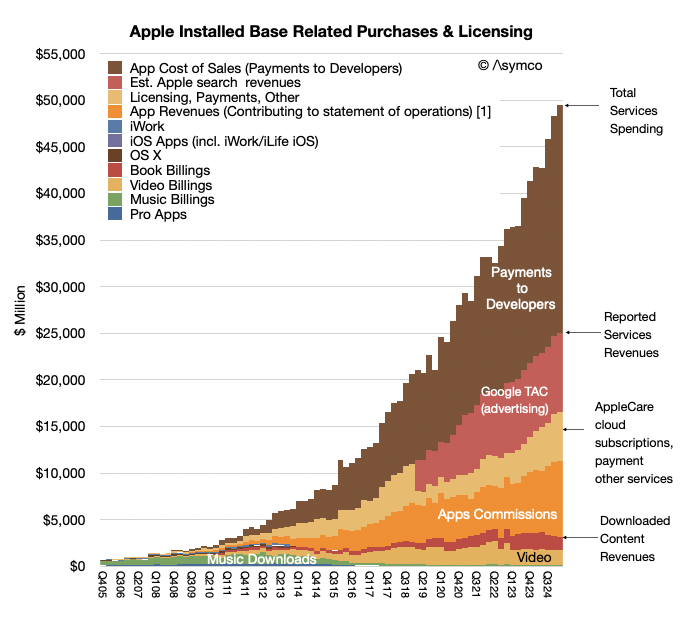
    Thus considering the payments to developers, the economic activity directly related to the App Store amounts to $120 billion/yr which includes commissions of about $30 billion/yr (last 12 months) and payments to developers of about $90 billion/yr (implying about 25% blended average commission rate.)

    So including payments to developers the Services business grosses $186 billion/yr. of which 102 billion is reported as revenue, with the 75% gross margin and $90 billion is paid to developers "off the books".

    But that $102 billion in revenues is only about 30% App Store commissions. The rest includes many types of income: It includes:

    • Advertising which consists of Apple's own advertising services and third-party licensing arrangements notably the distribution fees for Google search (accounting for most of Googles "TAC" or traffic acquisition costs.
    • AppleCare, Apple's own extended warranty service.
    • Cloud Services which provide content synchronization.
    • Digital Content which not only includes the App Store but also stores for books, music, video, games and podcasts. Apple also offers digital content through subscription-based services, frequently bundled, including Apple Arcade, essentially a game subscription service; Apple Fitness, a personalized fitness service; Apple Music, which offers music streaming and on-demand radio stations; Apple News, a subscription news and magazine service; and Apple TV, which offers exclusive original content produced by Apple and live sports access licensed sometimes exclusively by Apple.
    • Payment Services which offers Apple Card, a co-branded credit card, and Apple Pay, a cashless payment service.

    The quarterly view is summarized in the graph above. So a fixation on the commission is only a view into 16% of Services as an economic foundation (the orange area in the graph above).

    But that's still only a sliver of the whole picture.

    A report written by Jessica Burley, Analysis Group and Professor Andrey Fradkin, Boston University Questrom School of Business has estimated that the global App Store ecosystem facilitated $1.3 trillion in developer billings and sales in 2024. As the report writers say: "For more than 90% of the billings and sales facilitated by the App Store ecosystem, developers did not pay any commission to Apple."

    How is this not visible? The reason is that this economic activity is distributed over the millions of purchases Apple users make through its iOS Apps every day. This includes traditional App Store "Billings" including paid downloads and in-app purchases, including subscriptions, that use Apple’s in-app purchase system and “Sales” which includes money spent by customers purchasing goods and services in general using any iOS and iPad OS apps. Apps developed by Apple such as Apple Music, Safari or browser apps such as Chrome are excluded from this analysis.

    The economic activity unleashed by the App Store now reaches well over $1.3 trillion/yr. As the authors further explain,

    While the present analysis captures the major app monetization strategies available to developers, the full economic impact of the App Store ecosystem extends beyond the estimates provided in this report, as the current methodology does not capture all of the ways in which the App Store ecosystem facilitates sales, or all of the benefits created by apps. For example, the App Store supports “companion apps” that raise the value of a company’s goods and services, including smart home apps and health apps. In addition, many apps now use different monetization strategies. As such, this analysis does not account for all the ways in which the App Store ecosystem creates value.

    Furthermore the report breaks down the categories as Digital Goods and Services, Physical Goods and Services, M-Commerce (General Retail, Travel, Food Delivery and Pickup, Grocery, Ride Hailing), Digital Payment and In-App Advertising.

    In addition the report estimates these categories from 2019 as well as 2024 providing a growth perspective: Over the past five years, the App Store ecosystem has more than doubled in size, increasing from $514 billion in 2019 to nearly $1.3 trillion in 2024.

    It also identifies regional dynamics between the US, China, Europe (with select countries) and Rest of World (with select Asian countries).

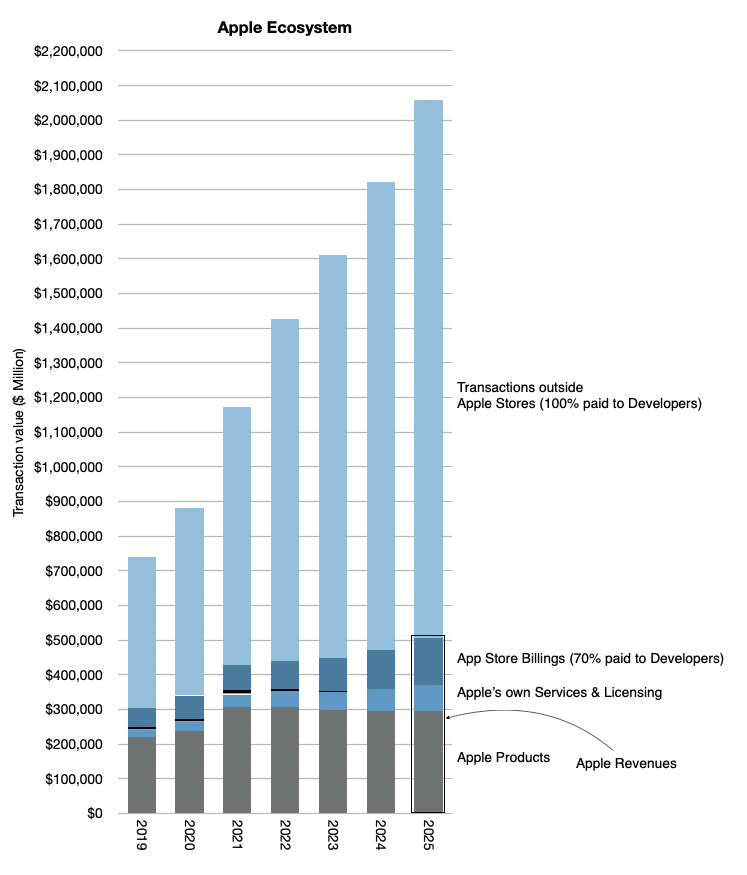
    I've been keeping my own analysis of what I called the Apple Economy and it includes these transactions outside the App Store and Apple's own products and services. If I were to subtract Apple's own revenues from the total, for 2024 I was getting about 1.4 trillion (out of a total of over 1.8 trillion).

    My point was always to estimate the economic impact of Apple beyond its own sales. This gave us perspective to assume that in 2025 the total would reach over $2 trillion. The graph below gives the perspective which also implies a doubling since 2020 to 2024.

    The new report from Burley and Fradkin is a detailed, bottom-up analysis which quantifies what was perceived as the economic value of Apple being far more than what the financial data records.

    Bill Gates once stated in reference to Zuckerberg's assertion that Meta was developing a "platform" that it's not a platform unless the economic value of everybody that uses it exceeds the value of the company that creates it.

    Apple captures about $30 billion as sales but delivers over $1.3 trillion in sales, a multiple of 43! I would call that generous. In addition it doubles the market in 4 to 5 years. I'd call that market expanding not constraining. Finally, it's a market that Apple created out of nothing. I'd call that market creation not destruction.

    If judged on the question of creation and satisfaction of the customer, i.e. the ultimate purpose of the firm, the App Store and Services in general has satisfied 1.4 billion people. That they are spending over $1.3 trillion and doubling in 4 years is nothing short of astonishing.

    We'll discuss this topic and other topics related to Apple at ACTIVE: The Apple Investor Conference, which takes place on next Tuesday, June 10th, the day after the WWDC25 keynote.