Asymco

Asymmetric Intelligence

Microsoft

  1. Global smart phone OS shares (part II)

    Research

    On May 5th, I tried to fill in the blanks on Global smart phone OS shares | Asymco. I estimated that the shares for the mobile OS's were as follows (based on Canalys partial data):

    • Symbian (Nokia): 42%
    • Blackberry OS (RIM): 19%
    • iPhone OS (Apple): 16%
    • WinMo (Microsoft): 10%
    • Android (Google): 10%
    • WebOS (Palm): 2%

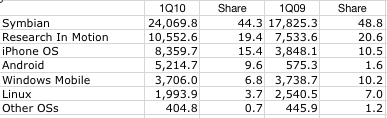
    Now Gartner has published their sell-through estimates:

    • Symbian (Nokia):: 44%
    • Blackberry OS (RIM): 19%
    • iPhone OS (Apple): 15%
    • Android (Google): 10%
    • WinMo (Microsoft): 7%
    • Linux: 4%
    • Other OSs: 1%

    My estimates were within 1 or 2 percent of actuals except for Windows Mobile where I over-estimated by 300 basis points.

    The analysis of Android vs. iPhone market shares (globally and within the US) which depended on this estimation does not change materially.

    The complete data from Gartner follows:

  2. Will Apple rule the iPad market? (part II)

    Research · 12 comments

    Continuing from Will Apple rule the iPad market? | Asymco.

    The first claim is that

    it is unclear if [Apple] will end up dominating the market the way it has come to rule the digital music player market with the iPod.

    After hearing a thousand voices cry out that the iPad is nothing more than a bigger iPod touch (which, plainly, it is) it's amusing to read that its similarity with a sibling ends when it comes to market performance.

    Let me make one claim up-front: the iPad is more of an iPod than the iPod.

    The original iPod was successful because it had a significant integrated value chain bolted on. Apple disrupted music with a value chain, not a product. It changed the way music is bought, consumed and even how it is produced. It changed the economics from retail down to songwriting.

    This is why it came to dominate its market. Every competitor that took a run at it did so with a partial solution to the value chain. Often it was nothing more than a music player, and in some cases (e.g. Zune) it was bundled with some other pieces of technology, but poorly executed and too late.

    The iPad comes with an even bigger value chain bolted on: the App Store. Apple is flogging not just an "app player" but also a new way to develop and distribute software. If you cut "music" and paste "apps" you see the immediate parallel between iPod and iPad. The app ecosystem will quickly grow to be larger than the music ecosystem with the mobile software business already eclipsing the music business.

    A competitor launching a tablet device will have to somehow overcome the momentum of billions of downloads fed by hundreds of thousands of apps built by tens of thousands of developers for hundreds of millions of users.

    The iPod juggernaut pales in comparison to the iPad supernova. The iPod had no apps or dedicated developers. Its ecosystem consisted of a handful of music companies. The only thing that made it "sticky" was the tie-in with one type of content.

    The iPad on the other hand has a thousand other jobs to do for its users. It has a rich tapestry of functionality and a multi-dimensional (literally) user experience.  It's a platform. It's even powerful enough to impose new standards on the web itself and to suggest that search is a bygone activity.

    So to suggest that Asus or Dell will somehow build "iPad killers" sounds asinine. These competitors don't even grasp what the product is and what it's for.  Sony said they don't see a market for it. Microsoft, trapped in the innovator's dilemma and overshooting the market by miles, said they don't understand what the point is because users want full PCs.  Google asked what's the value of a big iPod. I could go on, but there was not a single company in the industry who recognized what they were looking at in January. Apple keeps a tight lid on new products so that competitors don't get a head-start on copying, but in the case of the iPad, advance knowledge would not have had any impact. Competitors look at the iPad and see nothing.  They'll only react once the market explodes and they start to feel belated pain.

    If, and it's a big if, they do recognize what an iPad is, their response cycle is going to be measured in years. On hardware, they were blown away with a product that had twice the power, half the bulk, twice the battery life with half the price of what they had on the shelf. They may catch up on hardware in a year or two and launch some sort of iPad-like assembly of components, but that is like making the first iPod killer in 2002.

    Then there is software. Their software supplier (Microsoft of Google) will have to build a platform that works. That will take years. Years during which the iPad will penetrate every geography, demographic and vertical market.

    Google might move more rapidly than Microsoft, but they will produce an open source poster child of a platform. Fragmented and rough around the edges to the point of looking like a hobby project. Their flea market store will also have the smell of fresh glue about it. Microsoft is so far behind the curve that I don't even think they will try to move the tiller.  Their view of the market was betrayed by the recently knifed Courier demoware. To suggest a challenge to the PC/Windows model inside Microsoft is a career-limiting move so don't expect their brightest to be lining up to propose new platforms to management.

    What about HP? Assuming they overcome the pitfall of NIH that kills 80% of integration efforts, they will still need to perform an enormous amount of heavy lifting to get WebOS to be a competitive experience on a tablet. Most opinions were that Palm came pretty close with a smartphone, but that was nowhere near enough to stay alive, never mind challenge iPhone.

    Then there is the ecosystem. Building it is just not something I can even begin to roadmap. What about developer tools, SDKs, frameworks and evangelism? With a Palm division, HP is the best positioned of the PC vendors but it has a chance at being a player as much as Creative did vs. the iPod, or needless to say, Palm vs. the iPhone.

    So the iPad challengers face five daunting obstacles:

    1. Recognition of a threat from a seemingly benign product
    2. Execution on hardware against the best integrator on the planet
    3. Execution on software against a new UI metaphor fortress surrounded by a patent moat
    4. Integration of hardware and software to a sublime whole
    5. Re-building a value chain for which they have no handle vs. a broad and deep existing universe of app/content creation distribution and consumption enjoying logarithmic network effect value.

    That does not even touch the logistics, sourcing, margin and pricing challenges of world-wide distribution of the whole value chain. Nor does it cover the lock-in of advertisers to new tools for creatives or the billions of daily views from a platform that is blindingly dazzling.

    To put it in the language of disruption, by the time the competitors launch symmetric attacks on the iPad, Apple will be the incumbent. And we all know that symmetric attacks never work against entrenched incumbents who have all the levers of power at hand to deploy in a withering counter-attack.

  3. Mark Bernstein: Platform Control

    Research · 2 comments

    And somewhere in the recovery was a moment when Apple stood on a hill, before the setting sun, and shook its fist at the heavens and vowed that it would never be hungry (and powerless) again Never again would another company decide whether the Macintosh lived or died. So, Apple supplanted Metrowerks and wrote its own IDE. It wrote Keynote to inform Microsoft and the world that, should Microsoft discontinue Office for Mac, Apple would be prepared to replace it without delay. It wrote Safari to ensure that it would have a Web browser option, come what may.

    This is the key to modern Apple. It’s a big company, and it’s now wildly successful. It assumes that it can write a successful software product in any niche. It’s very talented and very confident. But always, at the back of its collective mind, is fear — the fear of depending on the kindness and competence of others, and the fearful memory of the days when it was cowering in a dark closet, waiting for the blow to fall, while the trade press laughed and jeered.

    Mark Bernstein: Platform Control.

  4. HP on Windows Mobile/Phone

    Research · 1 comment

    Will webOS replace Windows on all of your smartphones?

    Microsoft will continue and will always be a huge strategic partner for Hewlett-Packard. Our focus is to create choice for customers around those products and services that will allow them to connect to the information they need as quickly and as safely as they can.

    via HP Gets Its Hands on Palm - BusinessWeek.

    Sounds like a definite non-answer.  My bet is that they have not decided but that when they will decide it will be to show Microsoft the door.

  5. HP WebOS tablets, netbooks

    Research

    "During a conference call about HP's acquisition of Palm Wednesday, Todd Bradley, executive VP of HP's Personal Systems Group, said that there are "a lot of opportunities" with the purchase. Namely, he said, HP could use the WebOS mobile operating system as a touchscreen interface for new hardware such as a tablet or netbook.

    Palm CEO Jon Rubinstein and Brian Humphries, HP's senior VP of Strategy and Corporate Development revealed that HP plans to "double down on WebOS," which is considered the "prized asset" of the acquisition. The two reportedly mentioned the scalability of WebOS, implying that HP plans to bring the platform to multiple hardware form factors. HP even said it has already tested WebOS for its scalability."

    http://www.appleinsider.com/articles/10/04/28/hps_purchase_of_palm_could_lead_to_webos_tablets_netbooks.html

    Oh, and someone from HP also said they will still do business with Microsoft.

    Let's see...HP is adding its own mobile OS, HTC was hunting for its own mobile OS but is living on skinning, Palm made its own mobile OS and managed to escape oblivion, Samsung launched its own mobile OS, Apple has its own mobile OS, RIM has its own mobile OS and bought the kernel of another, Microsoft has its own mobile OS--really more than one, Nokia has its own mobile OS(s), and Google has its own mobile OS (plus Chrome). Chances are that Amazon is building its own OS as well.

    Only Microsoft and Google are still betting that licensing is going to be the way forward but each is hedging its bets: Microsoft with Kin and Google with Nexus One.

    Can anyone seriously suggest that the mobile computing industry is rapidly moving toward horizontal modularity or even consolidating like the Operators are hoping?

    Before you answer, consider also other horizontal players that are no longer with us: PalmSource, Symbian (and, give it a year, Windows Mobile).

  6. One Hundred Million (part II)

    Research · 3 comments

    My prediction is that sometime next year Apple will announce the 100 millionth iPhone OS device sold, making the iPhone the fastest selling platform in history. The iPhone will have been on the market for three years.

    One Hundred Million « Asymco. (five months ago)

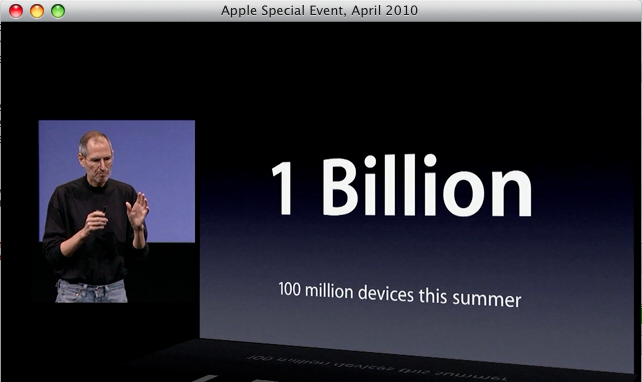
    Did anybody else see the line below the "1 Billion" header in the iPhone 4.0 Launch Event? The segment was about the 1 Billion impressions that iAd will be able to target.  Interestingly this is one of only two forward looking estimates that Apple has ever made on the iPhone.

    100 million

    The 100 million threshold in units is important in several contexts.

    First, on April 9th, 2007 Apple announced that the 100 millionth iPod had been sold, making the iPod the fastest selling music player in history. The first iPod was sold five and a half years earlier, in November 2001.  The iPhone will reach this in 3 years.

    Second, no other platform comes close.  On November 3, 2003, Microsoft announced that it intends to sell 100 million Windows Mobile devices by year 2007. Two years after that goal, in 2009, Microsoft sold 15 million units, down from 16.5 million in 2008.  It has not reached half the targeted installed base.

    Although there could be more than 100 million Symbian devices in use, they are not all running the same software, so they do not offer a targetable installed base.

  7. Google and Microsoft swap mobile share

    Research

    according to a report published Monday. ComScore reported that Google's share of smartphone subscribers rose to 9%, compared to 3.8% at the end of November. Meanwhile Apple's share fell 0.1 points to 25.4%, while Microsoft's share fell 4 points to 15.1%.

    via Google's share of mobile market grows: report - MarketWatch.

    Seems Google's gain is Microsoft's loss.

    BlackBerry, saw its share rise 1.3 points to 42.1%, according to the data. The number of owners of smartphones rose 21% in the U.S. in the three months ended in February compared to the prior period.

  8. The day the Windows died

    Research · 3 comments

    I always thought Windows 2000 was the point of over-service for Microsoft. The book linked below puts a date on the point when Microsoft could and should have created an autonomous division whose task would be to create the platform that would eventually disrupt its core business.

    Clearly Microsoft did not do this but Apple, with iPad, did.

    In September 1999, Kodesh wrote a memo to Gates and Ballmer under the heading “Starting from Scratch.” We need to kill Windows CE for those categories, he argued. Win32 is not an advantage; it’s a tax on device design. It served to further Microsoft’s strategy but not to help consumers. Given all their other alternatives, electronics manufacturers wouldn’t pay the tax. Kodesh wanted to take a small group of developers and work solely on developing the best software for information appliances, unconstrained by the needs of the rest of the company. Gates rejected the suggestions. “It’s very disappointing you feel that way,” he told Kodesh. “We don’t have time to start from scratch.”

    link: Who Fatally Wounded Microsoft? It Was Bill Gates. « Mike Cane's iPad Test