And the most successful market for the iPhone based on the Gartner numbers, is, um, France, where the company has gained over 10% of the market, at the expense of Nokia and Sony. “France is now the most successful market in the world on a relative basis,” says McCourt.
An upswing in the market share of “smart” devices, along with an increase in application focus from OEMs, OS developers and mobile network operators will drive yearly app revenues from US$1.94 billion (2009) to US$15.65 billion in only four years, according to our most recent research findings. The application market’s growth is driven by the widespread push of advanced handset capabilities by the mobile industry and the increasingly-connected global consumer base. This trend will continue, seeing global smartphone users numbering 970 million by the end of 2013.
Nice numbers. Too bad they blew their credibility by showing too many significant digits in their estimate. How can they state with a straight face that the market could reach $15.65 billion without some hint of a potential margin of error?
Dilger in fine form today ripping Microsoft a new one.
The collapse of its Windows Mobile Marketplace has now caused Microsoft to radically reword its mobile app strategy going forward in such a way as to vilify the entire concept of apps. At the launch of Windows Phone 7, the company presented a video that portrayed the iPhone's ability to run mobile apps as a confusing world with too many doors to choose from, each leading to rooms with starkly white walls, an experience that frustrated and puzzled a professionally dressed woman.
It really isn't sporting anymore to pick on Microsoft in mobile. Ridicule turns to pity.
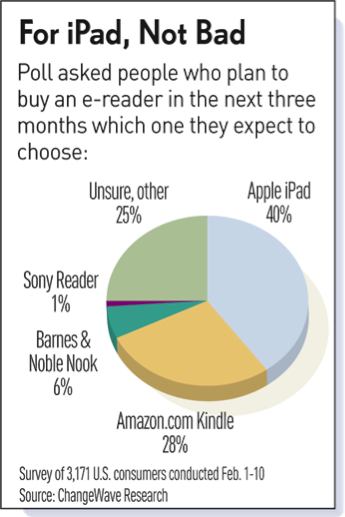
A survey of nearly 3,200 consumers by ChangeWave Research finds that 40% of people planning to buy an e-reader in the next 90 days expect to get Apple's iPad. The current leader, Amazon.com's (AMZN) Kindle, came in second at 28%.
This should be put together with data showing at least 15% of iPhone users showing purchase intent for iPad.
If we assume 45 million iPhone users by time of launch (42 million units have been sold as of end of December) and 15% would buy iPads it would therefore not be unreasonable to assume about 7 million iPads will go to iPhone users alone.
It's unfortunate that we cannot calibrate against installed base of Kindle users since Amazon has never released any sales figures.
Elevation has since sold some of its preferred stock, but according to Palm's SEC filings, it still holds enough common and preferred shares to account for roughly 30% of the business.
Others who bought around the same time as Elevation are struggling with a 33% loss, and that's after accounting for a $9-per-share dividend.
As the Backflip will mark the first time U.S. customers under contract with AT&T will have the option to choose between Android and the iPhone, every Motorola Backflip that AT&T sells might potentially be at the expense of an iPhone.
That Backflip sold will not generate Google any ad revenue since it will offer Yahoo/Microsoft search exclusively. Nor will the Backflip generate any license revenue for Google, because Android is licensed without a fee.
If that buyer would instead have bought an iPhone, the search from mobile Safari would have some non-zero value.
It is therefore pretty obvious that, at least in this instance, Android is destroying value for Google.
Erick Maronak, manager of the Victory Large Cap Growth Fund, says Apple is the best-run company in the U.S.
I would add it's also almost the biggest and at the same time least understood. A lack of understanding is reflected in a high risk rating, which is itself shown in the company's Beta.
All told, that makes Apple the fourth largest market cap in the US with the volatility and apparent risk of a startup.
Asymmetries of information don't get better than this.
Well, I don't want to talk about any specific company. I'm just making a general statement that we think competition is good. It makes us all better. And we are ready to suit up and go against anyone. However, we will not stand for having our IP ripped off, and we'll use whatever weapons that we have at our disposal. I don't know that I could be more clear than that.
Tim Cook, my favorite Apple exec, in January 2009.
One thing should be obvious: the accusations against HTC are aimed at Google and Microsoft or more broadly still, they are aimed at any mobile software competitor that intends to use touch and gesture inputs.
When Jobs said in 2007
We've been pushing the state of the art in every facet of this design. We've got the multi-touch screen, miniaturization, OS X in a mobile device, precision enclosures, three advanced sensors, desktop class applications, and the widescreen video iPod. We filed for over 200 patents for all the inventions in iPhone and we intend to protect them.
he implied that Apple had approached this new input method with much more care than when they introduced the mouse and windowing interfaces in 1984.
Unlike the fight over Windows, which was a copyright debate, this will be all about patents. Apple ultimately lost the GUI fight over the MasOS windowing interface, which is why I think they are much more prepared this time.
Given this strategic intent, the only questions were how the war would be engaged and on what terms. A few skirmishes caused some head fakes.
First, came apparent threats against Palm. Apple was certainly debating going after Palm, but I think they realized it would not be a good strategy. Mostly because the signal would be weak. There would be few consequences to Palm being punished. Palm's integrated model is not employed by many of the larger device vendors. Except for Nokia, all other vendors license their OS, Samsung, LG, Sony Ericsson and Motorola would not be infused with anxiety over Plam taking a hit.
Second, came the pre-emptive attack from Nokia. Apple was not ready to go after Nokia last year because Nokia did not yet have a UI "worthy of being infringing". In other words, there was no target to shoot at. Nokia's suit was pre-emptive in that it centered on their desperate wish to have a cross-license agreement--trading GSM patents for touch patents.
That skirmish should not detract from what's the real goal here: securing monopoly rights to mobile computing interfaces.
Palm unveiled the webOS and Pre on Jan. 8th, and the stock skyrocketed from $3.30/share the day before to $7.14/share on Jan. 15th.
January 2009 predictions for Palm by Morgan Keegan:
About Palm at Sprint: Storm/iPhone-type Success At Sprint For the Palm Pre Would Lead to About 630k-1mm/quarter
Our 450k/quarter Estimate For Pre Look Wholly Realistic Based On Success Of Other "Hero" Campaigns
Your correspondent, January 2009:
Now that the land grab is over, expect Bono to get his payoff as Palm gets acquired by a hardware vendor desperate for relevance. As Motorola is on its knees, my bet would be on Samsung, though a bidding war with Sony Ericsson would not be a surprise.
Now I'm not so sure. Faucette of Pacific Crest today:
While we believe that Palm could ultimately be a very attractive acquisition target, we are concerned that if the company is not prudent in maintaining balance-sheet resources, any potential acquirer may be content to just wait until things become even more desperate.
Google has taken on Microsoft with free good-enough web services for a few years. Gmail for business against Exchange, Chrome against Internet Explorer, and soon Chrome OS against Windows. But it's Android vs. Windows Mobile which is shaping up to be the first success story for Google.
Windows Mobile has to deal with Android as a classic low-end disruptor. Both are competing for OEM deals and it's plain to see how Android is a better opportunity:
lower cost means lower BOM, and higher margins
easier differentiation through customization of the UI. WP7 went so far as to eliminate this option
open source beats closed for devices any day
a fragmented ecosystem beats a dysfunctional one
WP7 appears to be something so different than what WinMo was that it may indicate Microsoft abandoning the licensing market to Google.