Citi reiterated a Buy rating and a $315 price target on the stock in a research note. The nod of approval comes ahead of Apple’s week-long Worldwide Developers Conference, which begins June 8.
Analysts believe the headline at next week’s conference will be Apple’s long-overdue revamp of its digital assistant, Siri. Citi expects a new Siri app to resemble something like OpenAI’s ChatGPT chatbot while also serving as an AI assistant across applications on Apple’s operating systems.
“Siri will handle multi-step requests, understand personal data, analyze on-screen content, generate emails or messages using both web and device context, and surface rich card-based results for everything from news to calendar data, while also completing actions across apps and shortcuts,” predicted Citi analyst Atif Malik.
Apple will pair that overhaul with deeper AI integration across its Mac, iPad, and iPhone operating systems, Citi said. Examples could include more AI features in writing, search, and photo editing.
“Edge AI has not yet taken off, but its long-term potential is substantial as consumers and enterprises increasingly prioritize low-latency, privacy-preserving, and cost-efficient AI experiences over cloud dependence,” Malik wrote. “We believe a meaningfully upgraded Siri will be a key to unlock the potential.”
Strong demand for the Mac Mini, which can run AI agents like OpenClaw, shows how edge AI is already spurring more hardware sales. Extend that demand across phones and tablets, and Apple could be an edge AI winner.
Morgan Stanley analyst Erik Woodring believes Apple’s upcoming Worldwide Developers Conference could begin to change that perception. The 5-star analyst reiterated his Overweight rating and $330 price target, arguing that a successful AI strategy could unlock a higher valuation for Apple stock, with a bull-case scenario reaching as high as $440 per share.
He noted that Apple’s recent strength has been driven by its products and services business rather than AI. However, companies viewed as “AI winners” have often earned higher valuations over the past two years, and Woodring believes Apple could soon be seen as one of them.
Why WWDC Could Be a Turning Point for Apple
Woodring believes Apple now has more of the tools needed to compete in AI. He pointed to Google’s Gemini models supporting Apple Foundation Models, Apple’s strong focus on privacy, and what appears to be a renewed push around Siri and Apple Intelligence. Unlike many of its rivals, Apple is not spending heavily on building AI infrastructure. Instead, the company can use its massive base of iPhone, iPad, and Mac users to bring new AI features to consumers. That approach could help Apple grow its AI offerings without the huge costs faced by some competitors.
The analyst also sees an opportunity for Apple to help ease some of the industry’s AI capacity constraints. A more capable Siri and improved Apple Intelligence platform could bring AI tools to millions of users through Apple’s existing ecosystem.
For investors, the bigger story may be valuation. Woodring believes that if WWDC shows a clear path for Apple’s AI plans, the stock could earn a higher multiple. In that scenario, he sees shares reaching $365 to $385, with a bull-case valuation of as much as $440.
NB: Not much new here but a $330 target is not much above the $315 high recently reached. Perhaps this is his foreshadowing of upgrades post WWDC…
…The premise is that Apple could get a higher multiple on AI re-rating. I am always skeptical of re-ratings as Apple does not respond to market fads (unless they are negative.) Apple has always been valued very conservatively, sometimes derisively so. A multiple above 40 is almost never experienced. If it were to run on AI euphoria well above that I'd be very surprised.
Disappointment after WWDC is almost guaranteed as it's always hyped by pundits expecting new strategy, new products and new directions whereas it's always been strictly a software and tools show.
Japanese industry led the world from the 70s through the 90s because constraints forced lean, efficient manufacturing. Apple was in awe of this. What Japan missed starting in the late 90s was software, a cultural problem more than a technical one, because managing software engineers is more like herding cats. The deeper miss was customer discovery: Japan assumed quality alone would convert buyers. Many of the best product ideas start as taboos, and you never get them from surveys; you get them by observing what people actually do. →
Why the most common measure for valuation is inadequate in an age of AI Software and services. Companies like Google, Microsoft, Amazon, Meta are spending on Capital Expenditures at the rate of heavy industry manufacturing. This defies their description as "asset light" business models which depend on services, distribution or platform economics. The problem isn't just semantic. It is that for their entire existence, these companies were valued for their profitability and measured in terms of a P/E ratio and earnings growth. The situation has changed dramatically. Their revenues are up, the earnings are up and growth is up and shares are up but not their P/E. Why is that? First of a series on Valuations in the age of AI→
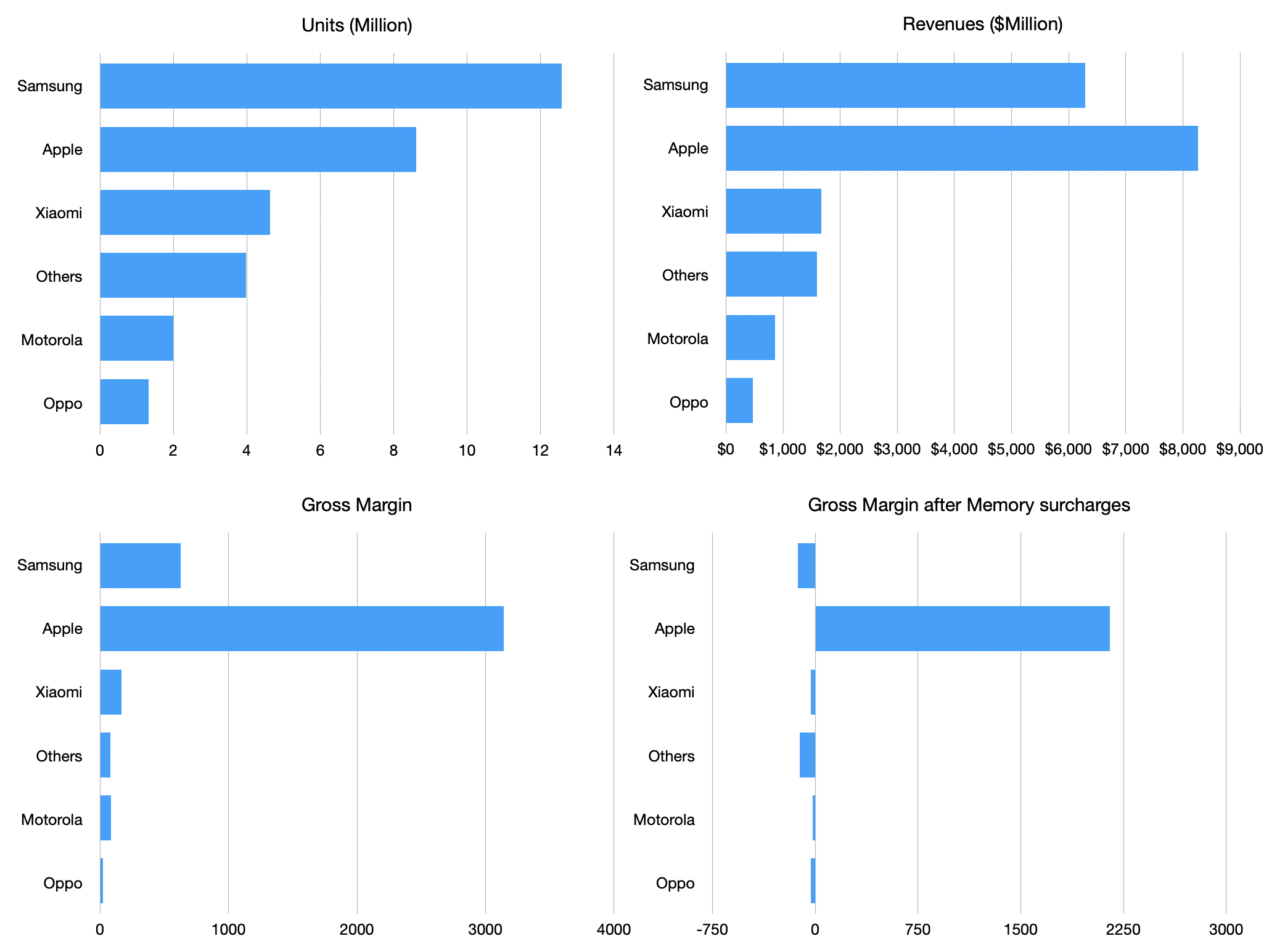
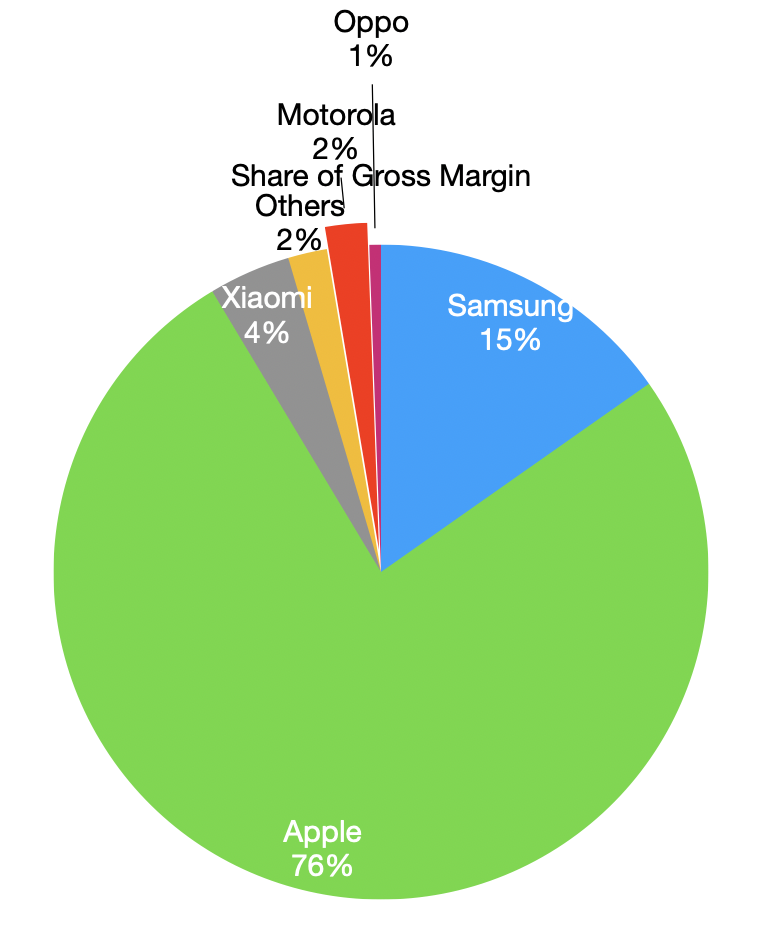
Market contraction expected for second half of year. Omdia reports that Europe smartphone market grew 2% to 33 million units in 1Q26. Samsung was Europe's largest vendor as it grew 3% to 12.6 million units. Effective discounting of the Galaxy A16 4G helped Samsung boost volume, offsetting declines related to the delayed launch of the Galaxy S26, A57 and A37. In contrast, Apple grew 9% to 8.8 million iPhones, driven by robust iPhone 17 series demand in addition to benefiting from a wider mid-range coverage from the iPhone 15 and iPhone 16e. Apple currently captures 26% of unit volume, 43% of revenues and about 75% of the gross margin. →
Console makers overshot by listening to their heaviest spenders, who only ever asked for more performance, while mobile gaming won on user count because it served the billions who were never asked. The AI risk to Apple is the emergence of screen-less devices, where Apple typically does not compete. Given the increase in information density and the fact that our optic nerve carries far more bandwidth than other senses, the screen will likely stay dominant, and so will whoever owns it. →
Nota Bene
Bank of America increases AAPL price target considering agentic and on-device AI → Bank of America raised its Apple target to $380 on the agentic AI thesis, and at $310 the share price is approaching the median of current targets, so more upgrades are likely. The basis is a recognition that distribution still matters in an age of AI and that any agentic functionality has to integrate into the OS for cross-platform leverage, privacy, and safety. I am most impressed by how sustaining AI has been to Google, a company that looked vulnerable because of its dependence on link-based search. If Google can prosper with AI, certainly Apple can as well. →
Melius' Ben Reitzes raises price target on Apple to $385 → Melius raised Apple to $385, joining Bank of America's $380, on the thesis that an agentic Siri could replace ChatGPT-style usage for 2.5 billion devices and ignite a new App Store-scale developer cycle. I struggle to understand why none of this was evident three years ago to anyone actually following Apple and the business of technology. The allure of a new technology somehow changing everything, including human nature, economics, and centuries of business theory, is a recurring pattern. See also Tesla and SpaceX for more magical thinking. →
IDC Forecast: The smartphone market is on track for its worst year ever → IDC now sees the global smartphone market shrinking 13.9% in 2026, the steepest drop ever, with Android down 20% and the iPhone holding to a 5% decline against a $550 record ASP. The analyst story is that Apple secured memory early and positioned itself for the cycle, but the truth is simpler: scale alone ensured the supply, and Apple did not act any differently than it does every other year. Apple is forecasting 20% iPhone growth for the half while every regional analyst is reporting single digits, which means either the methodologies are failing on Apple or the company is selling into channels nobody is tracking. As with Covid, a crisis favors the strong, and in times of uncertainty a flight to value makes a lot of sense. →
Takeshi Narabe • 16:20 [Y]ou also mentioned about the Japanese companies, overshooting, performance oversupply was also one of the reason that Japanese electronics giants were outmaneuvered by Apple: the insistence on in-house component manufacturing and a critical absence of software and service-led business as you mentioned now.
Horace Dediu • 17:02 It's a tough one. I think I know what you're getting at, but I think the puzzle there is that you try to make things better and you think by making things better you're going to be more successful and that was another observation by Christensen that sometimes you if you listen to your customers they'll ask you to do things better because that's all [the customer] can imagine.
I think the canonical example for me would be the game consoles. [...]Every new generation was more powerful and the way [the platforms] would decide how to improve it would be by talking to their customers and who are the best customers?
They are those who spend the most on games and the most on consoles. and they would survey those [customers] and [the customers] would always say "we need more performance in terms of refresh rate or, I don't know, how many dimensions of performance there are in games--i'm not particularly a user.
So the problem is that it's not just Sony but Nintendo, Xbox, everyone in the gaming industry was listening to the gamers and the most prolific and demanding gamers were those who spent the most money.
But if you compare mobile gaming to console gaming, it was always worse on all those dimensions. But if you [instead] measure how much time people spend on on mobile games, initially it was quite small, but over time it grew and grew and the number of people using phones for gaming is in the billions. In contrast, the number of people using consoles saturated at most at 30 percent of households in the United States. I don't know what it is in every country and there are many still. That's an okay business but it's not measured in the billions of users and arguably those users are not the ones you want to listen to.
The only exception was Nintendo with the Wii, which actually tried to expand to non-consumers, tried to expand to elderly people (so that they can do some movement) with the product or to young children. And that was a brief moment of success in the incumbents. But I think fundamentally, even that too gets passed to the phone.
So this is a classic example. How Apple plays in this game is a very tricky one because...
...they don't want to be doing "low end." So what they do is they improve the product and they let the previous generations of products to be passed to people who haven't got the money. There's a huge resale market for iPhones. And this is something that requires much more research, but we're observing that the longevity of the product allows the second or third owner of an iPhone to afford owning one.
And that improves the user base. It is, in fact, one of those interesting phenomena, that the iPhone is designed to last much longer than the Android phone, typically. And it's supported longer with software updates. And as a result, more people use the product. And that's a very different priority. So in that sense, they are protecting a little bit against low-end disruption.
But it is a challenge for Apple is to be careful because somebody might introduce something good enough at the low-end. I think in the AI time we live in, it's about something that doesn't even have a screen. And we've seen these challengers appear, which suggest that, it's only an audio interface or it's only something you wear that has perhaps a camera and is perhaps listening and gives you some information, but without a screen.
That is a very dangerous interface for Apple because they have no incentives to make screenless devices. The AirPods are an exception, but they are connected to the phone. So the challenge for AI is that if companionship through a voice interface is all that people care about, then there is a struggle for Apple because they don't add so much value.
But I do believe that the visual interface is still primarily what people want. I think the visual interface [through] the optic nerve is much more bandwidth than the hearing nerve. The ear doesn't process as much information as the eyes do. So people will always be interested in seeing.
And when you look at the social media or you see how automatically people migrate towards short video and less towards text. Because text requires understanding, [encoding]. Reading is hard. And it's also, by the way, language dependent. Video can be independent of language. So you have a lot of interesting experiments there. So I'm still bullish on Apple controlling the screen and becoming dominant or staying dominant in anything with a screen. But there is a challenge in the low end there. And that's why knowing disruption theory is very helpful to predicting some of these potential changes in the market.
AI-driven memory shortage continues to hammer sales; Android sales to drop 20%
According to analysis firm IDC, smartphone shipments are headed for a 13.9% decline in 2026, a downward revision from the 12.9% decline IDC had anticipated for the year in February. It would also mark the steepest drop in smartphone history, the company said.
“these pressures are compelling vendors to reduce shipments, raise prices and concentrate on higher price tiers — elevating smartphone [average selling price] to a record $550, up $100 from last year,” IDC senior research director Nabila Popal said in a statement.
“2026 will be a defining year for the industry as [a] new reality of structurally higher costs take hold,” she added. “For consumers, it means the era of ultra-cheap smartphones is over. For vendors, it means only those that can adapt their strategies to this new cost environment and sustain demand at elevated price points will survive.
The broader Android smartphone market is set to take the biggest hit, with IDC projecting a 20% year-over-year drop in shipments. Despite that, Samsung is expected to increase its market share in the space at the expense of smaller smartphone companies thanks to its midrange and premium device lineups.
Apple, the research firm said, is also expected to perform relatively well, with shipments forecast to fall 5.2% on the year, an improvement from a previously anticipated decline of 8.1%.
In its most recent earnings report, Apple announced iPhone revenue growth of 20% for the second consecutive quarter, thanks to its strong iPhone 17 lineup and improved sales out of China.
But CEO Tim Cook also warned of supply constraints due to both the memory shortage and the dearth of iPhone processors.
NB: I would add that Apple also announced that revenues for June quarter would increase at the same rate as they did for March quarter, thus for at least half the year the company will achieve 20% growth in iPhone sales. This is in sharp contrast to both what IDC and Omdia have been reporting.
I am reading the regional reports showing single digit growth for the iPhone in Europe, Latin America and China during the first quarter and months since. Apple is either reporting or forecasting 20% growth during the same period globally. Either Apple is selling in far-flung markets that are not being tracked or the methodologies of the analysts are not working for Apple.
We have to appreciate that the job of the market analysts is not easy. They do not obtain direct sales information but rely on secondary sources such as retail transactions or supply chain or some sampling of distribution. The accuracy is often falsely precise. Especially with respect to Apple which uses much of its own distribution: Apple stores both physical and online.
IDC forecast of 5% drop for the iPhone is actually a concession to increasingly positive data from Apple. They adjusted from a decline of 8%. Simultaneously they are adjusting Android sales down sharply. Samsung may manage through this period but it looks increasingly grim for other Android vendors.
Then there is the ASP.
“That’s elevating smartphone [average selling prices] to a record $550, up $100 from last year,” she said. According to IDC, Apple was better prepared than peers for the global chip shortage
“Apple has done three things that few of its competitors have managed: it secured memory supply early, it built a portfolio strong enough to drive a remarkable turnaround in China, and it positioned the iPhone 17 to capture demand exactly when consumers in developed markets are extending replacement cycles and trading up,” Francisco Jeronimo, vice president for worldwide client devices at IDC, wrote.
I don't think Apple anticipated or acted differently in this cycle. They started down the road for the 17 much more than a year ago, well before the memory crisis was anticipated. Scale alone ensured that they secure supply and position as they do. As always, Apple does not come to the market. The market comes to Apple.
All analysis agree implicitly that Apple will gain significant share this year. Whether that turns into a permanent shift depends on many things. Almost all new iPhone users will stick with the platform but they may extend their buying cycle as the products last longer.
As was the case with Covid, a crisis favors the strong. What is portrayed as an economic crisis, somehow leads to the priciest products gaining share. This is not a contradiction as it seems. In times of uncertainty a flight to value make a lot of sense.
The company “may be on the brink of some real AI sizzle.”
Reitzes said people are becoming more comfortable using voice commands, and Apple could benefit from this shift as technology becomes more voice-driven.
Reitzes also said the upgraded Siri could become a standalone tool that many Apple users rely on, even instead of apps like OpenAI’s ChatGPT. He described it as an “agent-style interface” that could make the Apple ecosystem more unique and spark fresh excitement among developers.
Additionally, he highlighted that no other consumer tech company has both parts of that system under one trusted setup. He added that this advantage will become even clearer—and more valuable—as AI systems get more complex and start acting more independently.
Overall, he expects Apple to post about $613 billion in revenue by fiscal 2028.
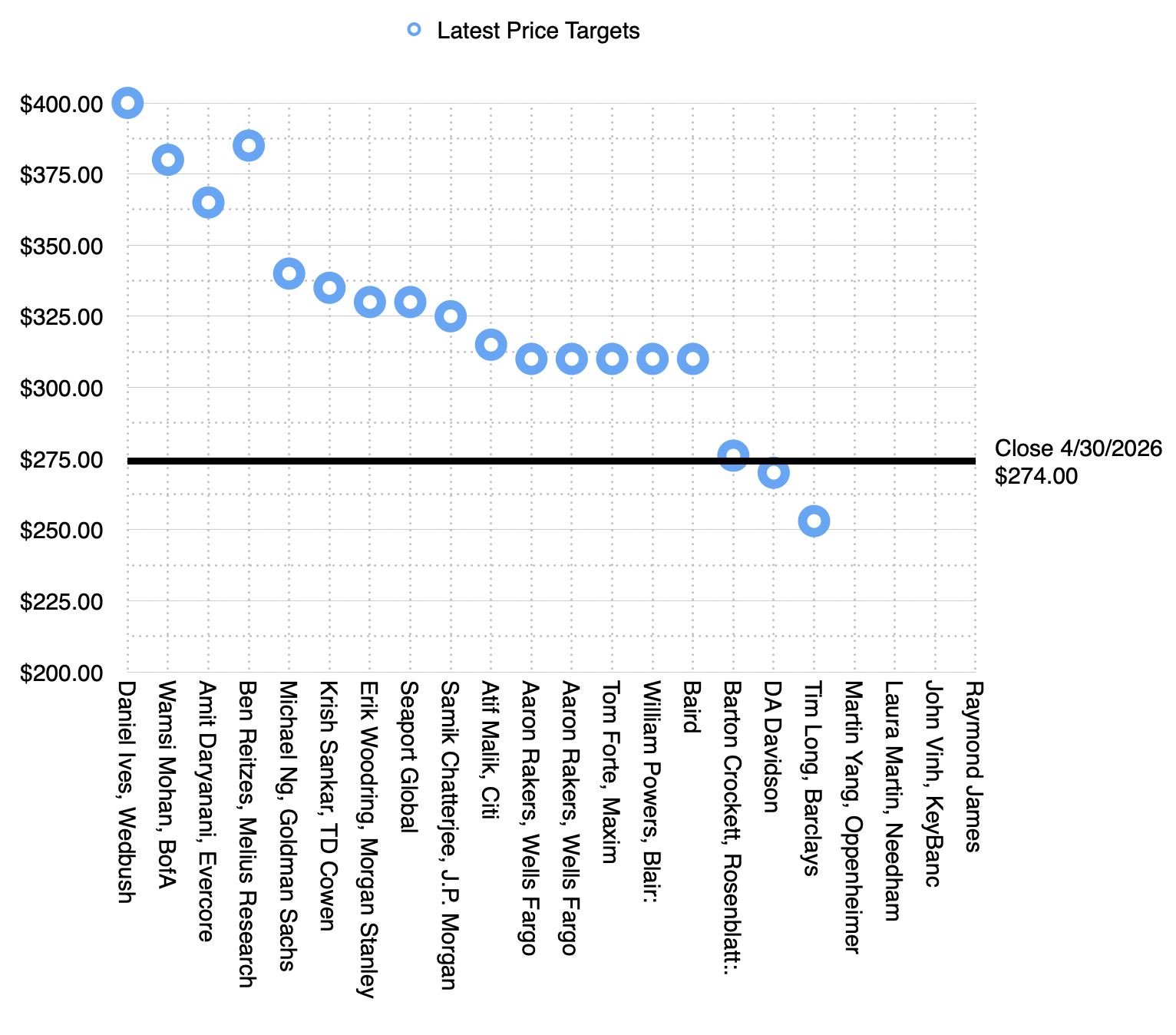
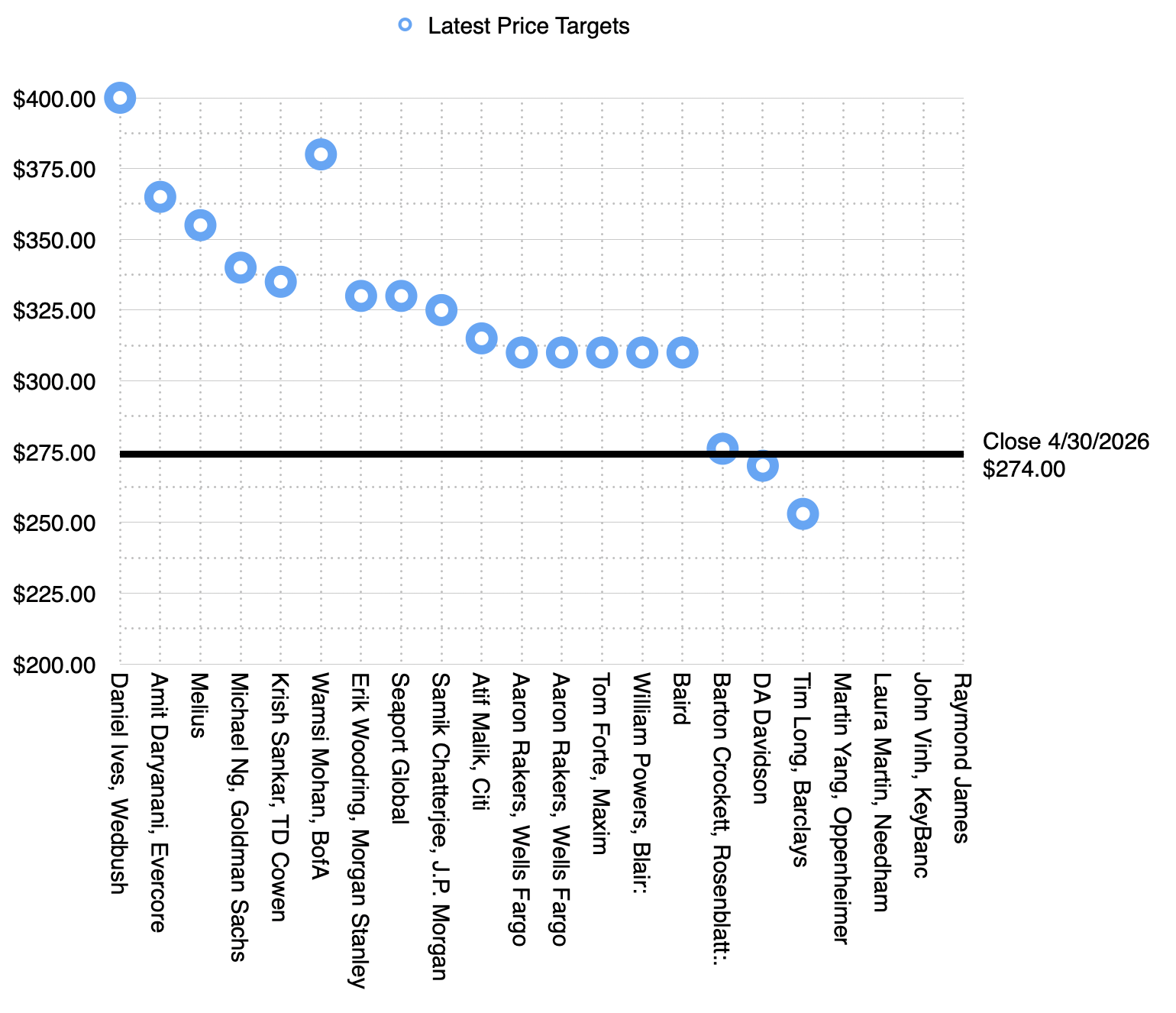
NB: Latest analyst targets are shown with Melius' stepping up. Analysts are coming round.
This upgrade follows Bank of America boosting its price target to $380 a share.
“In an agentic world, value accrues to the platform that controls user intent, personal context, app access, permissions, identity, authentication, payments, and trust,” said BofA’s senior equity research analyst Wamsi Mohan.
“Smartphone is the scaled consumer device where these factors already converge,” he added. “If AI assistants become the new front door…we think Apple should have meaningful leverage over model providers, app developers, merchants, advertisers, and payment networks.”
An agentic version of Siri could boost 2030 revenue by as much as $65 billion, Wamsi and his team estimated, adding up to $2 billion in incremental earnings over the next four years.
Reitzes sees the new Apple Siri as a stand-alone app that has the potential to replace ChatGPT for Apple's 2.5 billion installed devices, while proving to be “an agentic interface that can further differentiate the Apple ecosystem and ignite a level of excitement with developers not seen since the early days of the App store.”
But it’s also likely to establish Apple as the leader in consumer-use AI.
“If agentic AI shifts the market from answering questions to taking actions, the critical control point becomes centered around owning the endpoint,” Wamsi said. “Apple does not need to own the best frontier model if it owns the trusted interface that routes intent across local models, Apple-controlled cloud models, external models, and app actions.”
Reitzes at Melius sees that shift, which he describes as a “shot in the arm” for Apple’s app store, driving “a massive new product cycle that keeps iPhone growth going.”
He’s also observing that Apple’s architecture, with on-device models handling lighter workloads and its private cloud taking on the larger ones, makes it unique.
“No other consumer technology company has both legs of that architecture under a single trust model, and we think that gap becomes more visible, and more valuable, as agentic complexity scales,” he said.
“Agentic AI is a structural tailwind that will force consumers to get the latest and greatest Apple device because it will work better than other brands.”
I still struggle to understand why none of this was evident three years ago to anyone following Apple and the business of technology.
There is always the allure of a new technology somehow "changing everything" including human nature, economics, management behaviors, business theory, innovation theory and centuries of patters thereof.
See also Tesla and SpaceX for more magical thinking.
Market contraction expected for second half of year.
Omdia reports that Europe (ex. Russia) smartphone market grew 2% to 33 million units in 1Q26.
Key vendor highlights from 1Q26 include
Samsung was Europe’s largest vendor as it grew 3% to 12.6 million units. Effective discounting of the Galaxy A16 4G helped Samsung boost volume, offsetting declines related to the delayed launch of the Galaxy S26, A57 and A37.
Apple grew 9% to 8.8 million iPhones, driven by robust iPhone 17 series demand in addition to benefiting from a wider mid-range coverage from the iPhone 15 and iPhone 16e. Noticeably, Apple’s strong results came despite lower and fewer discounts than in previous years.
Xiaomi retained third place despite declining 15% to 4.5 million units, as it was more immediately impacted by supply-side difficulties. However, Xiaomi’s ASP grew 21% compared with 1Q25, boosted by a record-strong Xiaomi 17 and 15T series performance, which drove year-on-year value growth despite the shipment decline. Premium sales were particularly strong in France, Germany, and Spain.
Motorola grew 17% to 1.9 million units, driven by rapid expansion in Spain and Portugal, alongside continued progress in France and Italy.
OPPO grew 9% to 1.3 million units, largely driven by its comeback in France alongside growth in Romania and Poland. With both realme and OnePlus now under its umbrella, OPPO is restructuring to optimize its portfolio and strategy with ambitions to strengthen its European position.
HONOR, ranking sixth, was the fastest-growing vendor among the largest players, with shipments increasing more than 60% compared to 1Q25. HONOR’s growth is underpinned by its portfolio being expanded further down the price-tiers.
"The average-selling-price (ASP) of smartphones in Europe surged to a record-high level of €580 in 1Q26," added Bjorhovde. "This was largely caused by lower availability of devices costing less than €200, which made up an all-time low of just 25% of shipments. Additionally, the high-end remained resilient thanks to Apple’s growth. The focus from both vendors and channel partners has shifted from volume to value to deliver results and operational sustainability. Many vendors who normally focus on the mass market segments are increasingly concentrating on the mid-to-high-end, hoping to benefit from less price-sensitive and upgrade-willing buyers."
[My emphasis]
"The first quarter of 2026 delivered beyond expectations, but the outlook remains bearish as the rapidly escalating memory bottleneck worsens," commented Bjorhovde. "Omdia forecasts shipments into Europe to decline 12% in 2026, but the majority of this will come in the second half of the year.
Applying average pricing per vendor and average gross margins gives the following picture of the market:
Apple currently captures 26% of unit volume, 43% of ...
… revenues and about 75% of the gross margin:
In a contracting market with memory costs increasing, I expect Apple to capture 100% of available margins and to gain share.
Bank of America upped its price target on the tech giant, citing a potential boost from agentic artificial intelligence.
Shares rose 0.5% in premarket trading.
“In an agentic world, value accrues to the platform that controls user intent, personal context, app access, permissions, identity, authentication, payments, and trust,” analyst Wamsi Mohan wrote in a note to clients. “Smartphone is the scaled consumer device where these factors already converge. If AI assistants become the new front door to search, apps, commerce, scheduling, payments, and workflow completion, we think Apple should have meaningful leverage over model providers, app developers, merchants, advertisers, and payment networks.”
Mohan raised his price target to $380 from $330 and reiterated his Buy rating on Apple. Delving deeper, Mohan said that the company's benefit in agentic AI comes from its semiconductors and iOS, as Apple's silicon can dictate what happens on a devices (which is important for latency, reliability, privacy and costs) and iOS will determine how the AI is used by the user. “Our analysis around token usage suggests Apple will need to rely on distributed compute (on device), Private Cloud Compute and third-party compute to deliver a robust AI experience,” Mohan added. “Removing the net cash neutral target, in our opinion, is a reflection of a new period of AI-driven investments to enable this agentic era.”
As such, Mohan believes that the coming Siri redesign needs to be integrated into the iPhone and make it an agent that is capable of understanding intent, retrieving context, bringing up apps, and completing workflows. If this were to happen, an agentic version of Siri could boost fiscal 2030 revenue between $15B and $30B, or as much as $40B to $65B if users really became acclimated to it.
NB: Updated price targets with BofA change highlighted.
Share price at 310 is approaching the median of the current distribution. Upgrades are likely.
The basis of these has been a realization that distribution still matters in an age of AI and the profits might at least be parceled out to distributors.
Moreover, AI functionality may be agentic and require integration into the OS for cross-platform leverage. Not to mention privacy protection and safety guide rails. The more we learn about the application of AI the more it reveals itself to be sustaining to incumbents.
I am personally most impressed by how sustaining it is to Google, a company that seemed very vulnerable due to its dependence on link-based search. If Google can prosper with AI, certainly Apple can as well.
Why the most common measure for valuation is inadequate in an age of AI
Software and services companies like Google, Microsoft, Amazon, Meta are spending on Capital Expenditures at the rate of heavy industry manufacturing. This defies their description as "asset light" business models which depend on services, distribution or platform economics.
The problem isn't just semantic. It is that for their entire existence, these companies were valued for their profitability and measured in terms of a P/E ratio and earnings growth. The situation has changed dramatically. Their revenues are up, the earnings are up and growth is up and share prices are way up. But not their P/E ratios. Why is this?
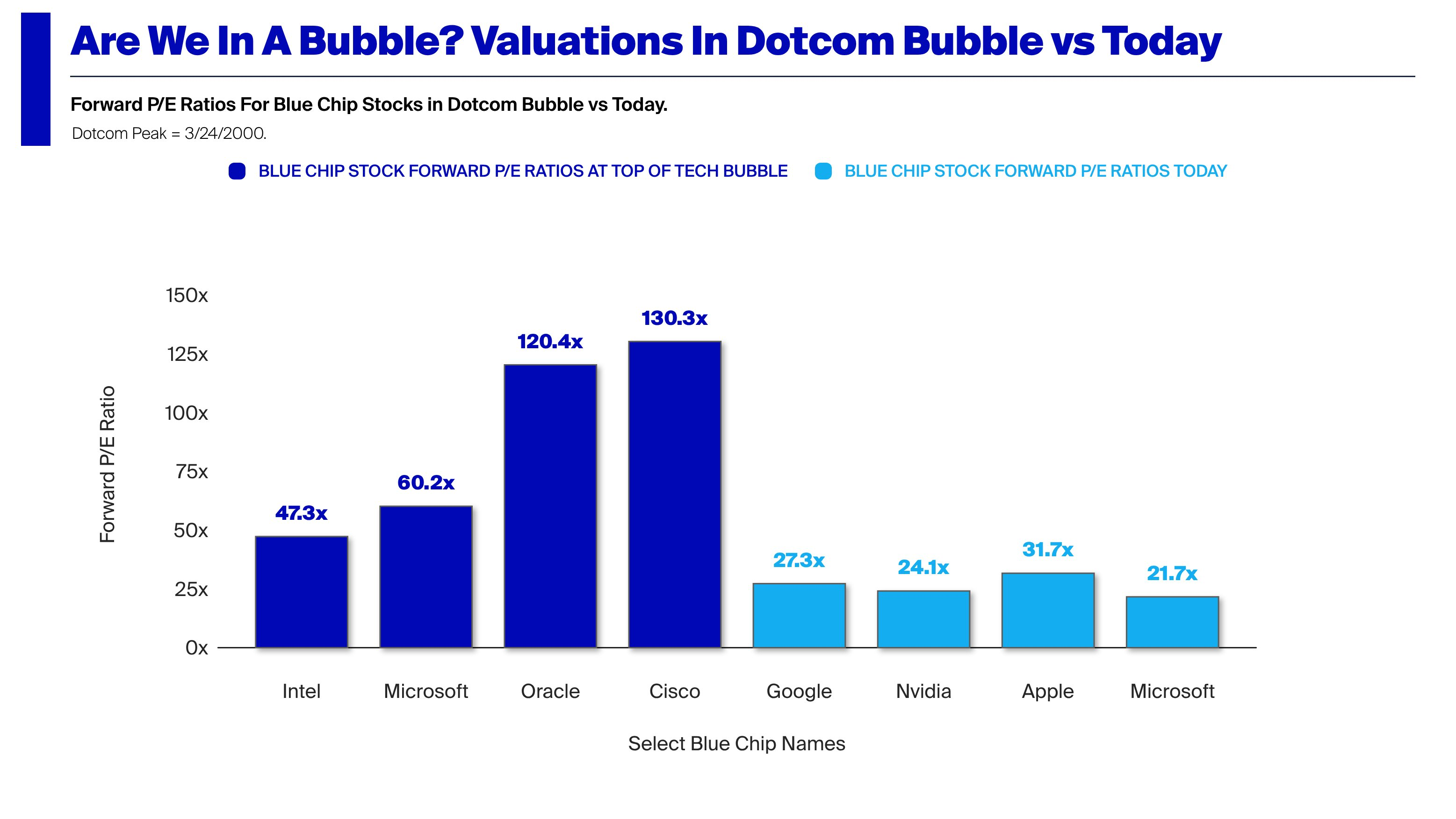
Consider the graph below showing the (forward) P/E ratios of the Dot Com market leaders vs. the market leaders today.
This even as share prices and value concentration have risen even faster than in the Dot Com era. Seen from the P/E basis, it does not look like we are in a bubble. Earning growth is way up so the share prices are not outrageous on that basis. That is contrary to 1999 when P/E ratios in the hundreds were considered normal. Expectations of an internet fueled boom were speculative. Expectation of an AI earnings boom seem well founded.
But these companies could still be over-valued. The P/E ratio is not the full picture. It is in fact a simplifying shortcut which ignores significant pockets and omissions of value.
For this analysis I'll use a sample including some of the largest market caps in the world with two exceptions. The exceptions are Lilly (LLY), Berkshire Hathaway (BRK-B) which are on the list but not in the top 10 (though in top 15) and Saudi Aramco and Broadcom which are in the top 10 but not on the list1.
Company
Market Cap
NVDA
$5,709,746,405,376
AAPL
$4,379,916,369,920
GOOG
$4,811,891,146,752
MSFT
$3,041,424,048,128
AMZN
$2,874,514,866,176
TSM
$2,166,463,135,744
TSLA
$1,664,912,326,656
META
$1,569,837,154,304
BRK-B
$1,044,046,610,432
LLY
$897,716,060,160
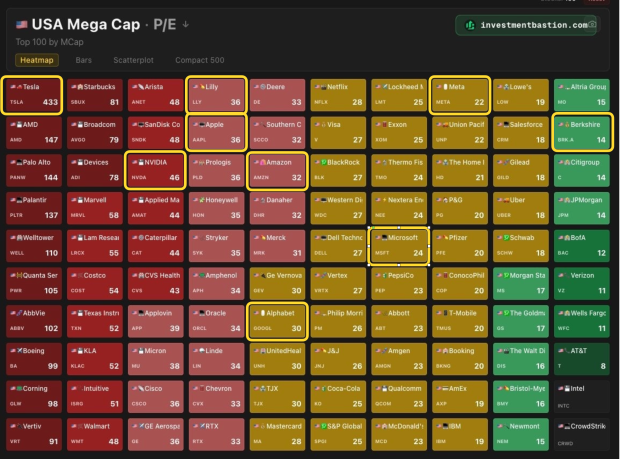
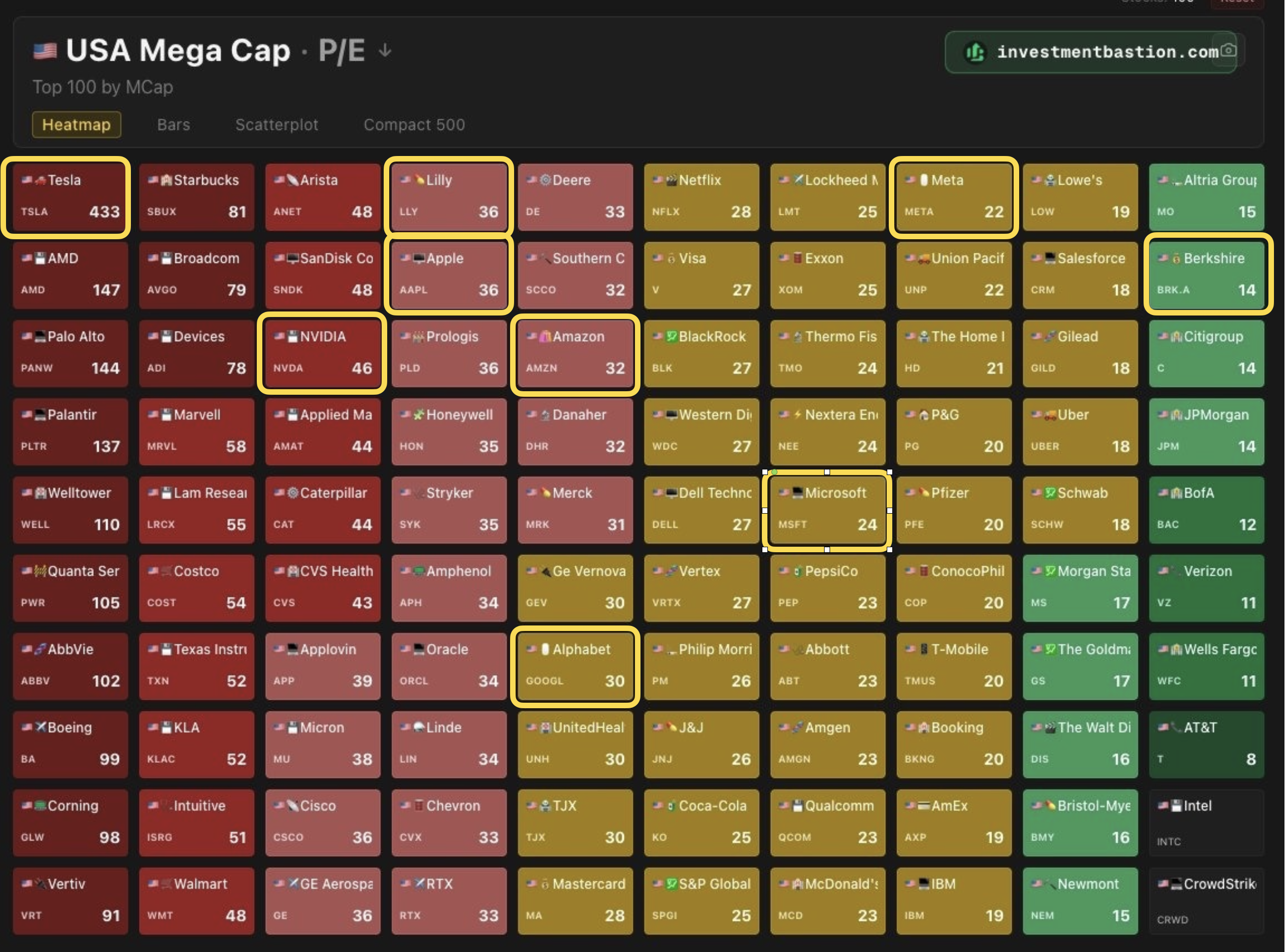
The following diagram shows the P/E ratios of the sample relative to the top 100 US market caps2. Note that, with one exception, the companies are not in the dark red zone with above P/E of 60. The exception is, of course, Tesla, which, at P/E of 400+ is 14x the average multiple.
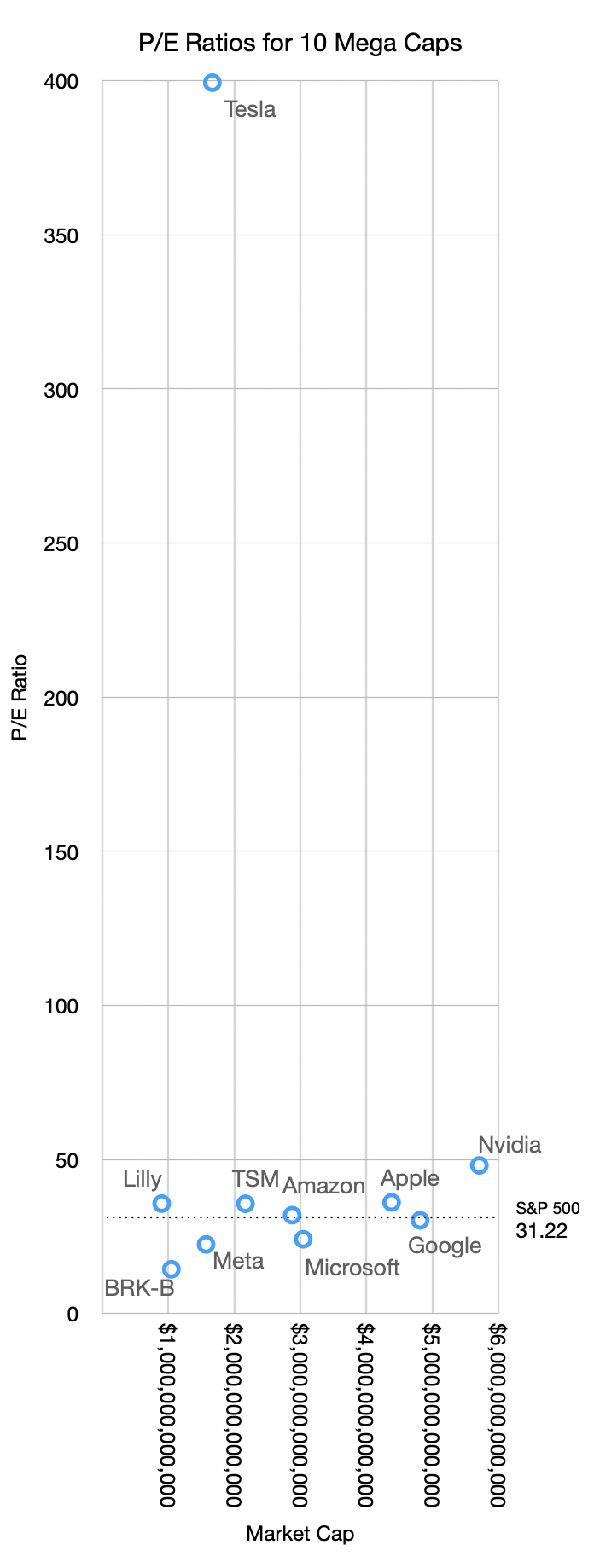
Moreover, compared with the S&P 500, these P/E ratios are in-line with the median. The following graph shows the sample set with P/E ratio vs. Market Cap.
Excluding the one anomaly the relationship seen is that higher market caps roughly correspond to higher P/Es. Nvidia has a market cap over $5.7 trillion with a P/E of 48 while Meta has a market cap of $1.5 trillion and a P/E of 22.5.
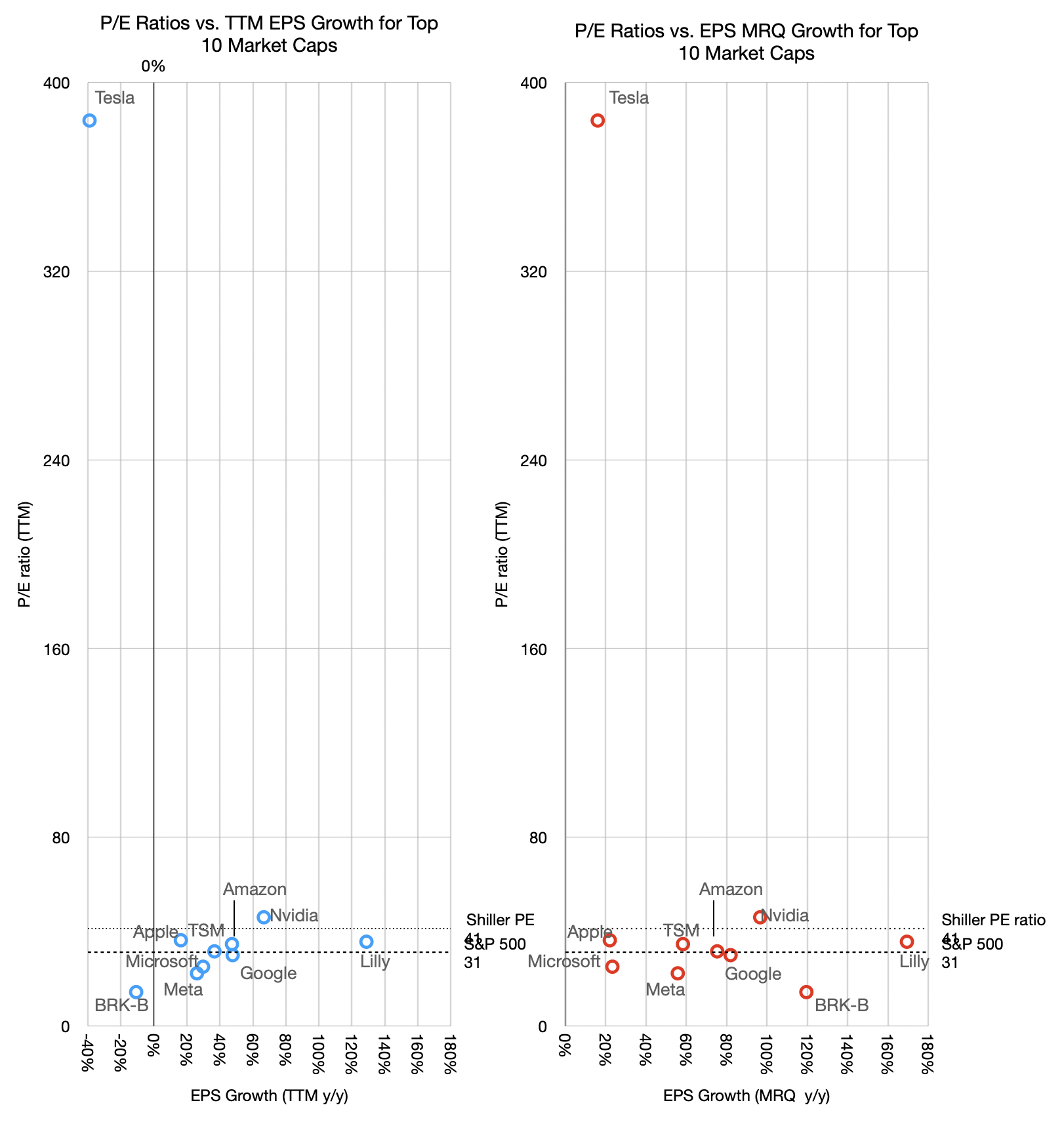
Higher P/Es should also correspond to higher growth rates. The graph below shows the relationship between P/E and growth, both in the most recent quarter (MRQ) and trailing twelve months (TTM).
There is a loose relationship between P/E and TTM growth but not with last quarter's growth. The one anomaly is even more prominent as it shows negative growth with exceptional valuation. Fundamentally however the relationship between P/E and growth is weak. Companies having widely divergent growth show similar P/E ratios. Alphabet for example has seen its P/E ratio in the 20s with growth in the 80s TTM and 50s MRQ.
This might sound familiar. From 2008 to 2020 Apple was trading at a P/E ratio in the teens and low 20s while growing as fast as 80%. The logic was captured by my analogy of the goose that lays the golden eggs. Apple was able to create extraordinary products but the market considered such hits fleeting. It valued consistency over heroism. Getting on base vs. home runs. And so the P/E began to rise only once Services became more prominent. Regardless of how foreseeable this pattern was, it took a decade and is still ongoing for the pricing to catch up.
But the situation with AI companies (that is, all the big tech companies but Apple) is that their earnings today are somewhat an illusion.
An old maxim that says "earnings are an opinion while cash flow is a fact.3"
This is because Net income can be manipulated by accounting abstractions, whereas cash flow is based on bank transactions.
To wit: Net income (earnings) is calculated using accrual accounting, which relies heavily on judgment calls rather than bank balances. Companies recognize revenues the moment a contract is signed, even if the cash won't be collected for months. Or they can dial in a delay as they desire.
Because of varying accounting policies, two identical companies with the exact same physical business can report vastly different earnings figures.
Cash flow is objective and simply tracks the actual movement of money in and out of the business. Real dollars either enter the bank account or they don't. A company can look highly profitable on an income statement but still go bankrupt if its cash is trapped in unpaid invoices or unsold inventory.
Finally, cash flow can be strongly negative while earnings are strongly positive. This is because investment in capital equipment does not appear in the income statement.
Therefore true economic value is determined by the cash a company can actually distribute or reinvest rather than how it declares profitability based on accounting abstractions.
AI companies are not necessarily hiding behind suspect earnings but their extraordinary capital expenditures are draining their cash and thus what investors have access to.
Earnings seem to be soaring so the ratio P/E suggests a modest valuation. This is based on opinion or at least incompleteness.
We should look at a better indicator. It's the EV/FCF ratio. We will look at this next.
The top 10 ranking can change rapidly and it makes analysis difficult over longer time periods. The inclusion of LLY and BRK-B allow for visibility outside of the tech sector and they were in the list mid 2025. Saudi Aramco is in a completely different environment influenced by non-economic factors.
TSMC is absent from the table as it is US only companies. It is notable perhaps that of the top 15, three are not US companies (TSMC, Samsung and Saudi Aramco). Furthermore the top Chinese company, Tencent is 25th, valued at $532 billion and the top European company is ASML at 21st and $610 billion.
Takeshi Narabe • 06:41 So you also compared [Apple] with the Japanese companies. Actually Japanese companies are very keen on marketing and doing some anchors many times. And I think [historically] they didn't know what consumers want. But you mentioned that is also […] their advantage […] because they only made what [management] wanted. But on the other hand, Apple exceeds the consumer's expectation or make a new market.
Horace Dediu • 07:37 The story of Japanese innovation is fascinating and I hope you give me a little bit of time to reflect upon this because I think it is also part of the story of Apple. I have a great admiration for the history of Japanese innovation. And it was something that, again, Professor Christensen taught me and made me appreciate.
Of course, during the 1970s, and maybe even earlier, but at least from the 70s onward, Japanese innovation was the world leader. It was in consumer electronics, it was in automotive, it was in many heavy industries, it was phenomenal. And the reason a lot of that happened was because Japan was constrained. Japan didn't have access to as much capital or as much land or as much resources as a lot of the industrial nations at the time. And those constraints taught it to be lean and efficient and how to think about "just in time", the Toyota production system, etc. And that wisdom came from a constraint.
As a result, Japan [began to] teach the world during the 90s and onward about how to do better manufacturing. And they taught Apple. Apple at the time was in awe. Steve Jobs was in awe of Japan. Nobody could come close. Also, Sony was a phenomenon. In fact, in interviews with executives; I was just watching an interview with [Jon] Rubinstein, who was at the time heading the iPod.… He said they were absolutely paralyzed with fear that Sony would beat them at this game. Even though [Apple] were by far the market leader, […] it wasn't Microsoft, it wasn't Motorola, it was Sony that was the worry.
Now, what happened? I think one of the things that Christiansen doesn't say--[which I do] because I come from a software engineering background--one thing that I think Japan didn't understand starting in the late 90s was the power of software. And I think it's a cultural problem. Software has a different culture fundamentally. The software engineers in general are like cats. You know, managers want to manage dogs because dogs are predictable and they tend to follow the instructions. People who do software tend to be very much more independent, but they need to be coordinated.
So it's a very difficult management problem, and it doesn't fit so well, perhaps, with corporate culture in Japan, at least at the time we're speaking of. And so one of the aspects, I think, that was critical in the late 90s was this, I would say, cultural crisis. By the way, it's also a problem in Europe. One of the reasons Europe did not succeed with software was precisely because of the cultural aspects as well.
But that's one element and I think it's not the only element but you address the question of customer understanding and this is very crucial as well. I think the Japanese were for many decades thinking that if you build good things, especially as they were better than what was in the market, then customers will buy. Simply focus on quality and the customer will decide eventually to switch.
That's a very logical decision, a very logical plan. And you don't have to worry too much about marketing and branding and all of these aspects, which are again, perhaps a cultural difference. Or you could hire someone to do that for you, but fundamentally the management inside Japan couldn't think in the same kind of marketing ways that American marketers would think.
But as far as the customer discovery problem, this is true. And it is something even American companies don't know how to do, or European companies don't know how to do. […] The way Apple suggested they do it (this is what they've told us,) is that they have to talk amongst themselves. They talk to each other as they did about the iPhone and said: "What do we dislike about our phones? How can we make them so more usable?"
And this fundamentally is because they always had this inquiry internally about why are things hard to use? Why can't we make things easy? Some of that is evident in Japan, but I think it wasn't thought of through the lens of interfaces. It was thought of more like being compact, being portable, being good [to the touch]. But it wasn't as much about how do you interact visually with something. A lot of things go into that. Obviously, you have to have a different sensibility about the two-dimensional display and so on. 1
And so my point is that the Japanese weren't stepping back enough and asking these, what Christiansen would call, jobs-to-be-done questions. "What do people really want to accomplish with products", even if we haven't yet envisioned what they are? How do we work, how do we think about these design questions. Designers, by the way, say "we don't just make things look good. We think about how they are to be used". You know that philosophy of deeply understanding the user behaviors that is part of the Jony Ive philosophy. But it wasn't just him. It was before him and after him. [Apple designers] have been thinking the same way.
So it's a design philosophy. It's a real introspection, asking yourself, how should the world be? How should we improve the lives of people? And that's hard to really be very concise about. So I apologize, I'm [going on] so long about it. But it is part of the decision, part of the culture, again, of Apple, where they are looking at themselves.
Famously, by the way, this is another anecdote about Apple. It is that they don't do focus groups. They don't obtain that [product] knowledge by surveys. They don't obtain it by asking even indirectly what the customer wants or gathering loads and loads of market data. Lots of [research] companies will sell you market data and tell you all kinds of insights, cutting everything into demographics, into segmentations of various kinds.
The theory of jobs[to be done] is that usually you need to ask [only] five people. You don't need a large sample. You don't need to survey 10,000 people to find out that there's a desperate need for companionship. Should a machine be a companion? That's a very basic question.
A question which is, by the way, answered by AI. A lot of AIs are just hired as companions. But you don't discover this by surveying what people own today or what they're buying today, [or] what they ask for. You observe and you maybe do a little bit of inquisition on the spot and you just tease the customer's intentions.
I said many times, many of the best [product] ideas are taboo2. [For instance] People do things on social media which were once considered not just impolite, but sinful. You know, the idea of being vain is a sin. The idea of bragging and being boastful is considered sinful or [at least impolite]. And I used to say that all the social media can be segmented on the seven deadly sins that were part of the [moral] conversation centuries ago.
It was the church who would say these are bad things you shouldn't do them. Gluttony or covet thy neighbor. Every single social media is positioned precisely on [one] sin. Now, the discovery of this wasn't because Facebook surveyed what people do as sinful and provided it to them. Rather, they gave options and then the algorithm discovered it in a way. Apple [by the way] chose, I think [wisely], to stay out of there.
But you can see how the discovery of social media didn't come from a process of surveying people, asking them what would they like. They would have said "I want to have communications" or "I want to have cheap communications." They wouldn't say I want to send selfies, (which by the way didn't exist,) of myself doing everything all day long.3
What I was trying to say here was that the Japanese approach to the display of two dimensional information is different due to the writing style. Japanese visual layouts are denser and more information-rich--some would argue more beautiful. There is less of an expectation by the consumer for simplicity which implies an acceptance or even appreciation of complexity.
By taboo I mean unspoken prohibition, something implicitly forbidden or embarrassing. To which nobody would admit to or request.
Narcissism is an observed behavior predating Christianity and the 7 sins. It was named after the Greek mythological figure Narcissus who fell in love with his own reflection, popularized at least by Ovid before 8 AD.
The Latin American smartphone market grew 3% year over year in 1Q 2026 to 34.8 million units, supported by proactive inventory accumulation and the delayed pass‑through of rising memory costs. Samsung and Xiaomi strengthened their leading positions, while HONOR and Apple saw sharp growth supported by entry-level and premium demand, respectively. Samsung led the region, shipping 12.9 million units (+9% YoY) and lifting share to 37%, its highest quarterly level since 1Q 2023, supported by strong performance of A‑series models across low‑end and mid‑high segments. Xiaomi →
Indonesia Smartphone Shipments Fall 9% YoY in Q1 2026; Premium Segment Surges → Indonesia’s smartphone market fell 9% in the first quarter. Yet the premium tier above $600 hit a record 8.3% share and grew 30%, while the entry level below $150 collapsed 19%. Apple drove most of that surge, and the same split is appearing in Latin America and China. →
The App Store Annual Fraud Prevention Analysis → Apple blocked over $2.2 billion in fraudulent App Store transactions in 2025, part of $11.2 billion across six years. The timing, right before WWDC, is a message to the eurocrats. The alternative stores publish nothing like this, and the EU stops at market access rather than user protection. →
iPhones sales in China grew 3% year-over-year over the May Day holiday → China’s smartphone market fell 16% over the five-day May Day holiday as higher memory prices dampened upgrades. The iPhone still grew 3%, and against a wave of fresh competitor launches. Apple guided to the same growth in June that it delivered in March. →
Asymetric
Asymetric Episode 137 — E is Our Friend → On the podcast I ask whether a crash is coming. Remember that E is our friend: earnings are an opinion, cash flow is a fact, and a share price is a dream. The Mag 7 pour half a trillion into data centers yet still trade like software companies. →
Now in BETA
Asymetric Podcast is now available directly to Asymco One subscribers. See asymco.com/podcasts.
To download Asymetric, login then visit asymco.com/podcasts.