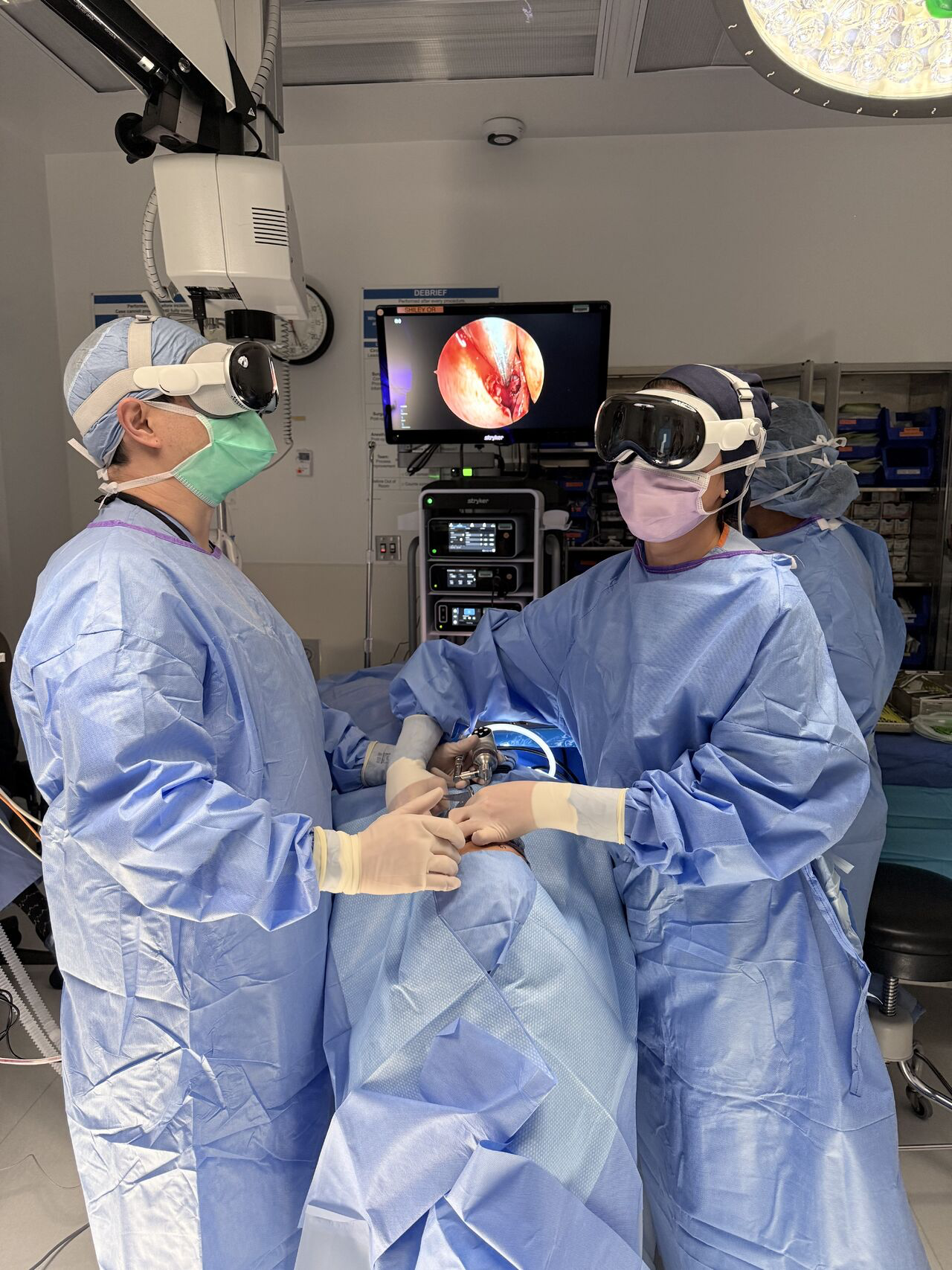
It was an honor to collaborate with the UC San Diego Shiley Eye Institute team on a new paper in AJO International evaluating Apple Vision Pro as the primary display for endoscopic lacrimal surgery. The results: 19% shorter operative times, 100% functional success, lower surgeon workload, and every participating surgeon preferring it. My contribution measured cost and space, where the headset is less than 1% of the cost of conventional OR visualization and smaller than almost any piece of equipment. Criticized in consumer contexts as too big and too expensive, in the operating room the Vision Pro is very small and very cheap. →
Office Hours
Apple 2026 FQ3 Review: The Presentation — Asymco Office Hours, 31 July 2026→ Apple’s best quarter in years, albeit with a warning label. Revenue up 16%, EPS up 29% with an 11 cent tariff refund nobody modeled, and the Mac up 29%, double expectations. Guidance drops growth to about 10% because demand ran double Apple’s own plan and supply, especially silicon, could not keep up; Tim Cook conceded the planning mistake. Inside: 1.5 billion paid subscriptions on the ACTIVE trajectory, R&D nearing 10% of sales, three visits to 40 times earnings, and every Apple Upgrade lease priced to the penny, still a dollar a day. →
Apple’s guidance: in six months there will be a new set of worries→ Joseph B. asked what is up with the guidance and why it was news to Mr. Market. Apple got caught in the AI rotation as a safe harbor, a role management never sought, and the 10% one-day drop was unwarranted by what was reported: a very strong quarter with unusual circumstances in foreign exchange and supply. Nobody talks about memory anymore even though the price increases were a month ago. In six months this will be forgotten and there will be a new set of worries. →
The foldable iPhone: what will it be good for?→ Frederick H. asked what job a foldable iPhone accomplishes. I don’t have that job myself; I carry an iPad mini and never reach for it when the iPhone is in hand. But I was wrong once before, insisting phones should stay one-handed while the market chose the Max, so maybe we need to try it before we learn what it is for. Samsung’s folds have gone nowhere in six years, yet showing you could buy one may drive the first quarters, and if it opens into an iPad mini it becomes an experiment in having your iPad in your pocket. →
An Office Hours question asked by Frederick H., July 31, 2026.
Q: What job does a foldable iPhone accomplish? Aren't iPads suitable for a decent screen experience, and iPhones for what they do, with plenty good screens?
Honestly, I don't feel I have that job to do. I have an iPad mini, in a waterproof case, and the new supposed Fold product — I don't like to talk about rumors, but it is pretty believable by now — is not going to be that much smaller than this. And I don't find myself reaching for the iPad mini if I have my iPhone in hand. Now, if it were to open up, maybe I would watch a few things there. But I'm still so used to the form factor of the iPhone that I'm not sure I would crave a new form factor. But then you never know.
One of the things that surprised me about my own job to be done: back in the day, remember when the iPhone was small. It was tiny — look at an original iPhone. Then the 4, then the 6, began to be bigger. Then there were the Max sizes, and I kept saying the problem with the Max, or any big iPhone, is that you can't reach all the points on the screen with one hand. It becomes a two-handed device, and I thought that was inconvenient. I always thought the majority of people would prefer smaller phones that were easy to put in your pocket and completely usable with one hand. But it turned out I was wrong. Big screens were desirable. I myself ended up with one, and now I only get the Max form factor. So maybe we need to try it before we learn what it can be used for.
I have other reservations — durability reservations, price reservations. Any moving parts are bound to fail sooner than those without moving parts. But some people have convinced me that there is a significant market out there for this product, if only to demonstrate that you are able to buy one. That alone may drive sales for at least the first quarter or two. So it isn't clear what the job is. I do believe, though, it'll do fairly well.
The other thing against it is that the other fold products, from Samsung and others, haven't done that great. They've been around for six years or more, and no one seems to say this is the greatest thing and everyone's switching to it. Perhaps Apple's version will be the perfect match, the perfect package, perfect in every way, that will cause adoption to take off. So I think it's a wonderful addition to the portfolio, but perhaps again a little bit more towards the highest end, and limited in how many users will take it up. Let's see how it goes.
Q (follow-up, Frederick H.): What would a foldable phone do to iPad interest? Is this an experiment? And how does this relate to the apparent convergence of Apple's software platforms?
If, when you open it, it looks like an iPad mini — people are speculating about this — the operating system will be effectively two operating systems: the small screen and the big screen. Apple has a great interface for big screens in iPadOS. Then the question is: is there value in having your iPad in your pocket with you? I think it's going to be an experiment. We'll see how people and developers take to it.
Editor's Note: This was one of the questions asked by participants in Asymco's July 2026 Office Hours live Q&A session, held the day after Apple's FQ3 2026 earnings and open to Asymco One subscribers.
Subscribe to Asymco One for full access to this and other content.
An Office Hours question asked by Joseph B., July 31, 2026.
Q: What's up with the guidance? And why does this seem to be news to Mr. Market?
Start by not getting emotional about this, because I've seen so many times mispricing of Apple. But the market, as they say, is always right. It is simply the voting of a lot of people, and what it determines is the market price. It doesn't determine right or wrong, it just says that's what the market thinks.
The thing about the last few weeks, or even months, has been that Apple's been caught in a debate about whether AI is going to pay off or not. It was used by a lot of people who wanted to rotate out of AI names into something safe, and Apple seemed to be that choice. Apple never wanted to be chosen as a safe harbor. Management doesn't have that as their KPI, or in their plans, or in the product pipeline.
So strange things happen. It was unexplainable to me why the stock went up as it did in many days over the last few weeks. It was good and I felt it was fair. If it had been trading at 50 P/E, I would have been getting a little bit nervous, thinking it's maybe not justifiable. But there are many companies trading at hundreds of P/E, and who's to say that's wrong?
It seemed to have run ahead of itself a little bit. But on the other hand, the reaction is completely unwarranted if it's based on what Apple reported. Apple reported a very strong quarter. It reported some circumstances that are unusual. Foreign exchange is one. The struggle with getting supply is another. By the way, nobody seems to talk about memory anymore. Nobody seems to talk about the fact that we've seen price increases, which was just a month ago. It's all now that Apple is constrained, for other reasons. In six months we'll totally forget about this, and there'll be a new set of worries.
Fundamentally, the company is doing very well. I think it is entering a cyclical period of above-average growth. It might be because products are getting a little bit old in people's hands. It might be that demand will truly pull forward a lot of new consumption, but it's constrained by being able to deliver. Again, not the first time.
It's surprising to me how volatile, though — to see a 10% drop in one day, including after hours. I don't recall there being that much movement even in the times of Steve Jobs, when we did have huge volatility. But perhaps my memory's weak. On fundamentals alone: the next quarter, which isn't even a holiday quarter, growing 10% — as a disappointment? It'll re-accelerate.
Editor's Note: This was one of the questions asked by participants in Asymco's July 2026 Office Hours live Q&A session, held the day after Apple's FQ3 2026 earnings and open to Asymco One subscribers.
Subscribe to Asymco One for full access to this and other content.
Apple's best quarter in years, albeit with a warning label.
July 31, 2026 Asymco One Office Hours, recorded day after Apple's Fiscal Q3 2026 earnings call, Tim Cook's last as CEO. Horace Dediu presents his analysis of the quarter and takes questions from Asymco One subscribers. Hosted by Horace Dediu and Farshad Nayeri.
Presentation Summary
Revenue +16%. EPS +29%. Mac +29%, double what most expected; guidance cut growth to 10%.
See inside:
The 11-cent line item nobody modeled.
Cook's concession
1.5 billion paid subscriptions, following ACTIVE model.
R&D nearing 10% of sales, and where it's going.
Three visits to 40x earnings. Three pullbacks.
Apple Upgrade: every lease, priced to the penny.
Video Recording
Transcript, with Embedded Slide
Horace Dediu: This is the office hours that happens to be right after earnings for Apple, which came out at the end of trading yesterday. We had the conference call, and we've had a little less than a full day to digest. It's quite an interesting quarter. Let's dig in.
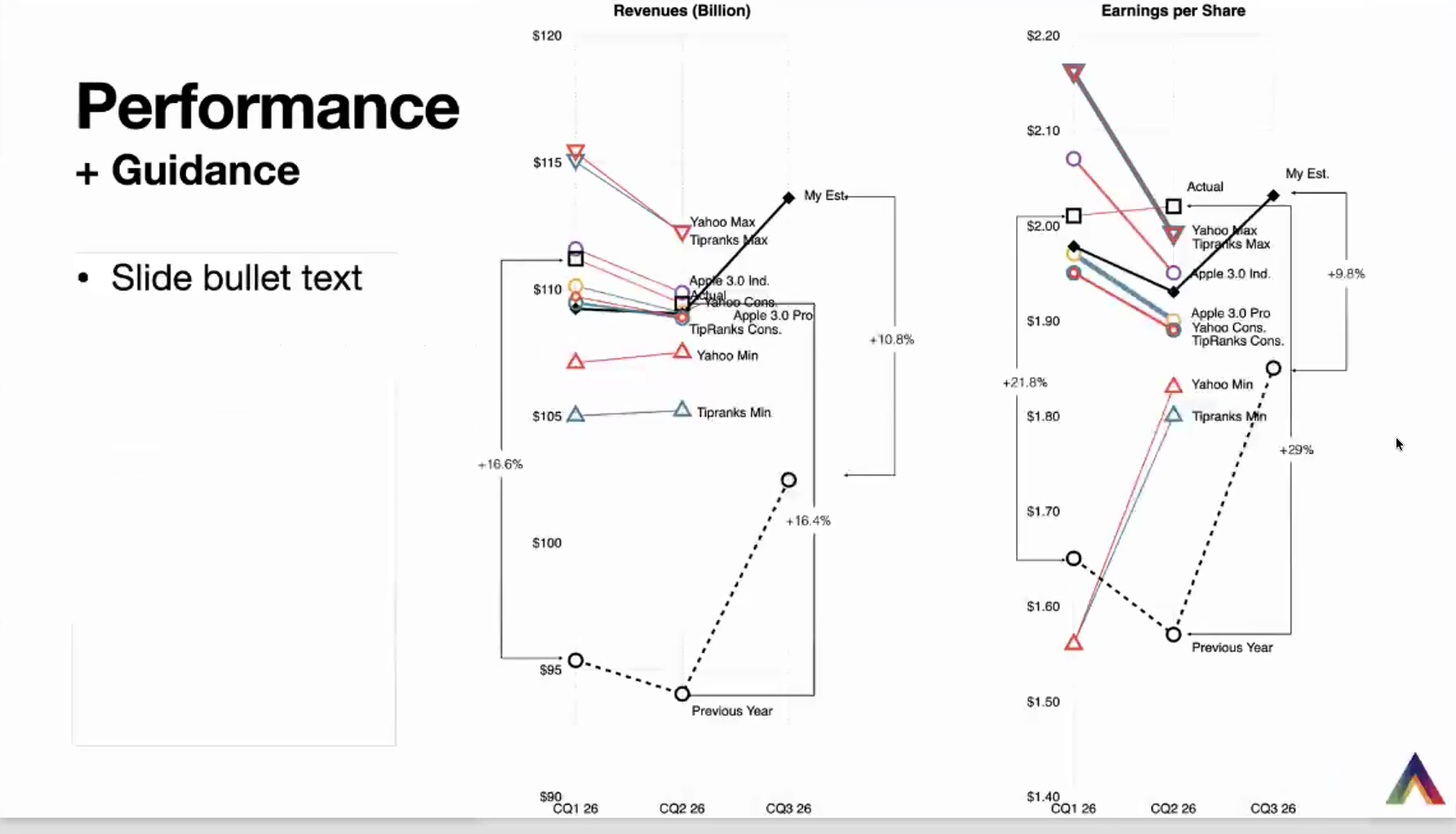
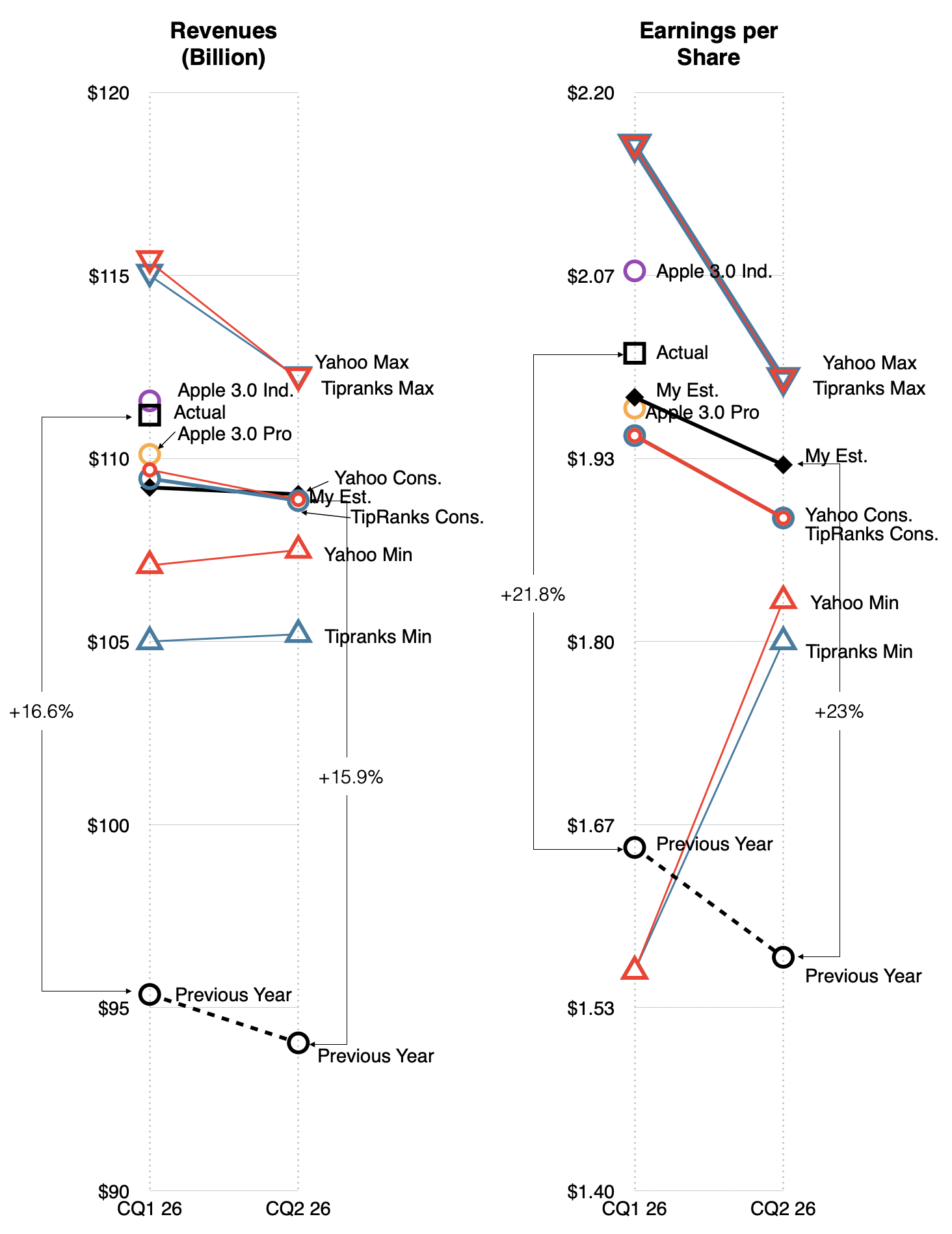
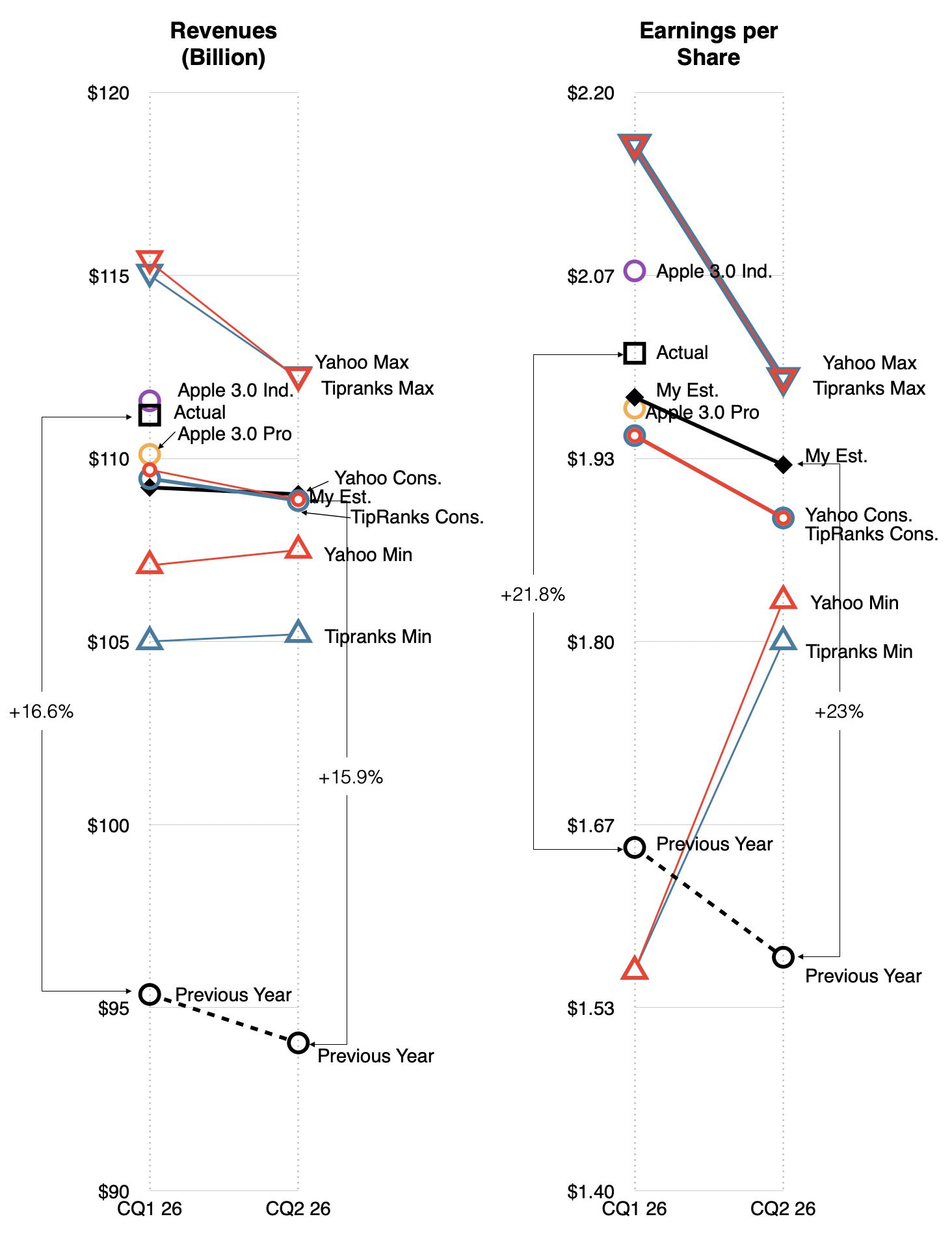
This is a new type of graph. I'm testing it — it's a little complicated, I admit, but I'm trying to put a lot of information in here. For the quarter, we have revenue on one graph and earnings on the other. But I also have the previous quarter, and the next quarter. In the middle, on the vertical, are all the estimates, including the actual results and the previous year, so that it gives us a growth picture.
That middle line represents all the estimates: Yahoo, TipRanks, Philip Elmer-DeWitt's Apple 3.0 — both the professionals and the independents — and my number as well. The growth in the previous quarter was 16.6%, and we had 16.4% in the just-ended quarter. This is very consistent with guidance, so there wasn't a lot of surprise. In fact, you can see how many of the estimates were clustered around the very point where we ended up.
That's revenues. In terms of earnings, Apple really outdid itself. We ended up with 29% growth, versus 21.8% in the previous quarter. The reason a lot of this was outstanding is that about 11 cents of those earnings was tariff refunds. That was a surprise to everyone — no one factored it in, although there were hints of it from the previous quarter and the outperformance in that quarter as well. If those were removed, we would be much closer to the middle — about $1.91. My estimate was $1.93, consensus was about $1.90 ($1.88 even for some). So, in line or a slight beat on earnings, but a huge windfall from tariff recovery.
Now, the guidance is where the surprises came, and we'll get into why. The guidance indicates about 11% — they gave a range, and I'm putting in an 11% estimate on revenue growth and a 10% estimate on EPS growth. As you can see, this is a significant reduction: from about 30% to 10% on EPS, and 16% to 10-11% on revenue. A lot of that is because they're actually way too successful as a company. The demand is off the charts. In fact, the demand into the first and second quarter of this year was far higher than they estimated. Tim is on the record now saying: we made a mistake. We made a mistake in planning this year. We had certain expectations of growth, and they seem to have been double that. As a result, we didn't allocate enough resources on the supply side to meet this demand, especially on the semiconductor manufacturing side.
There are also some headwinds with foreign exchange, and I suspect those have a lot to do with Japan — we've seen the yen. So there's a lot of jitters in the market, a lot of surprised people saying: why is growth decelerating? Apple threw us a curveball with demand — actually, they were surprised as well. But overall, the growth is substantial. Even at 10%, it's healthy, and I think a lot of that demand is going to be delayed into next year, and we're going to end up with a surge, if not a super cycle, as it used to be called, because of this pent-up demand.
The Numbers
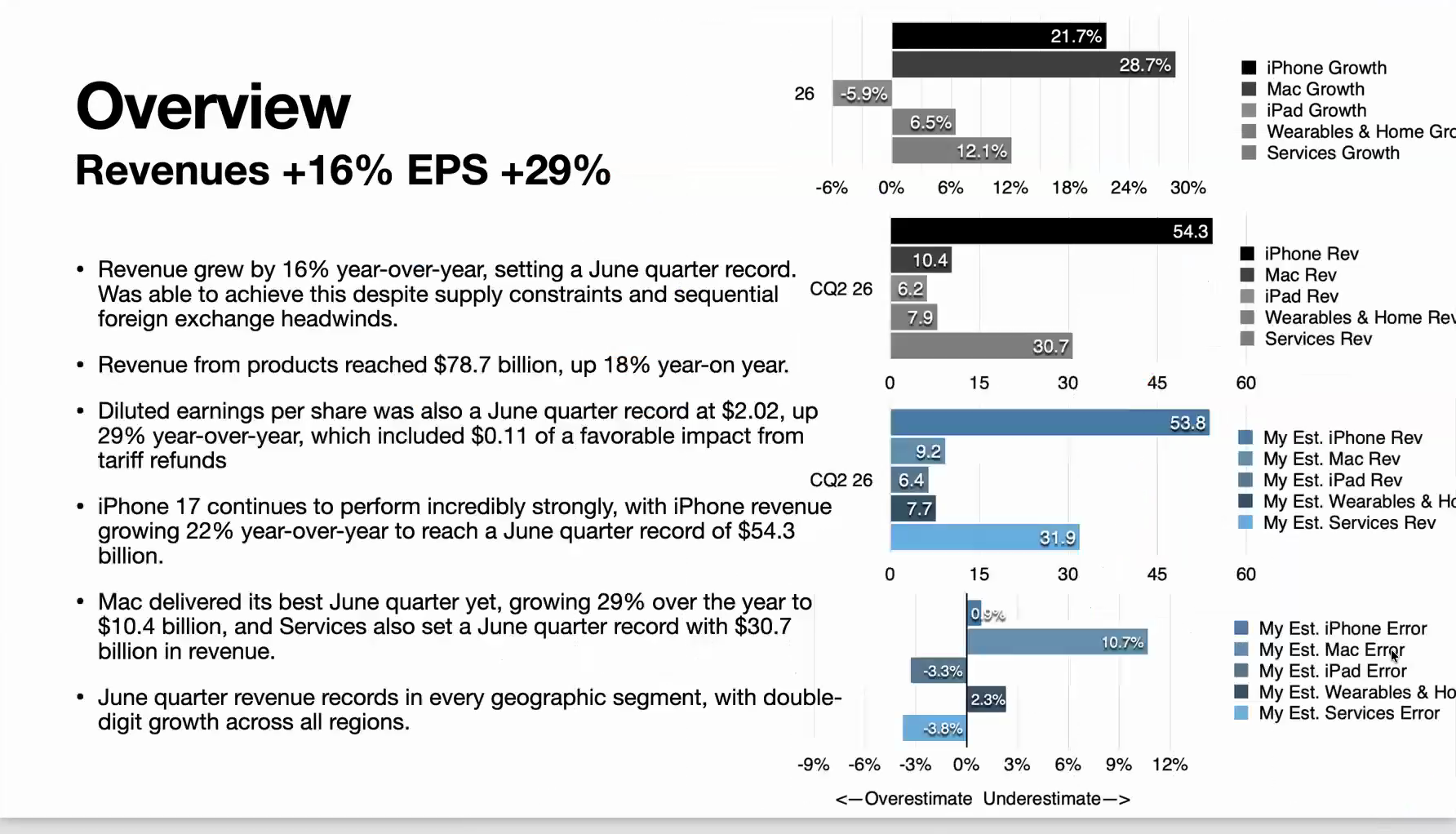
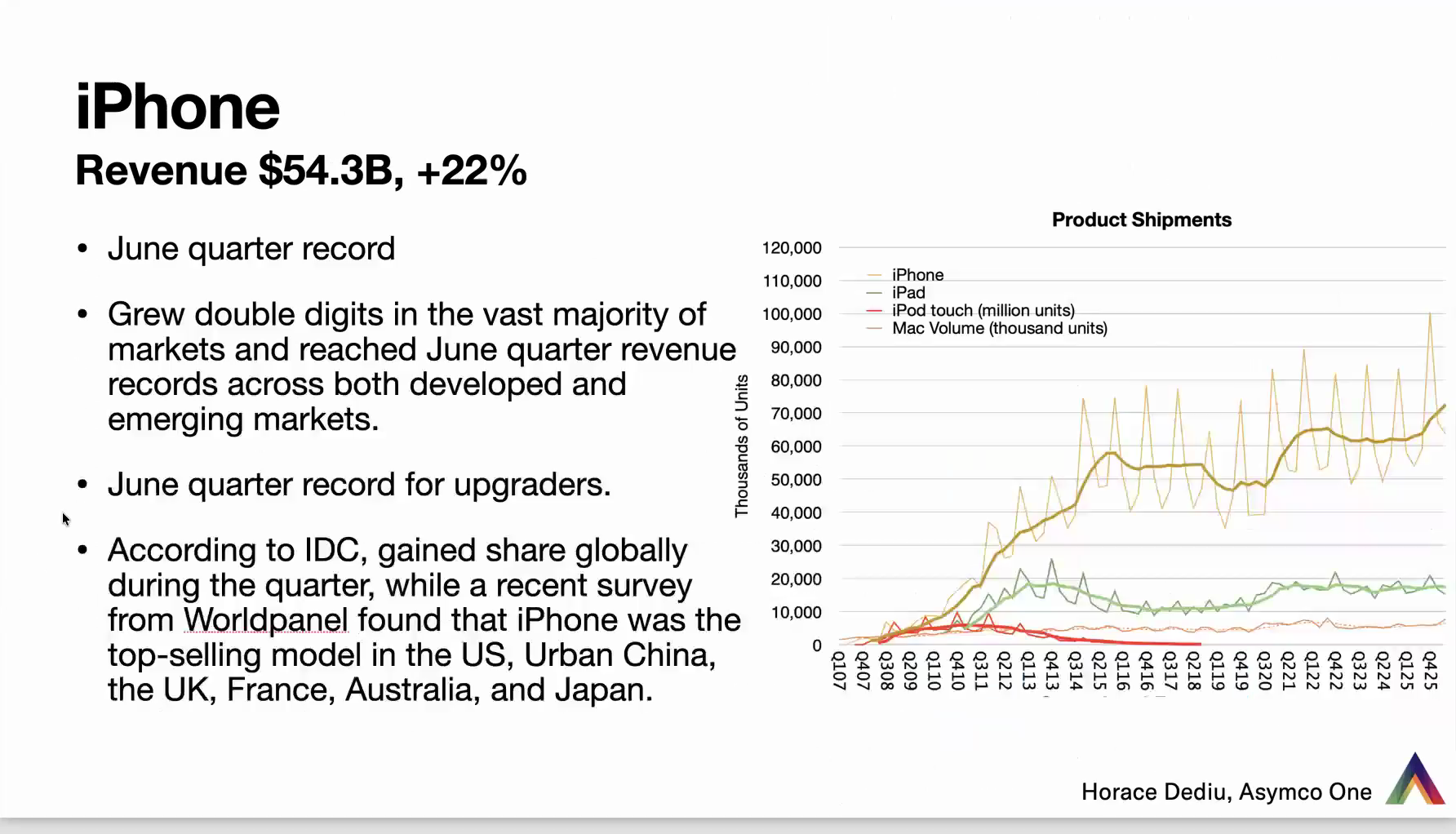
Revenue's up 16%, EPS 29%, as I said. Products up 18%, Services up 12% — a little heavier on products, and Services was a bit of a surprise; a lot of that was, again, foreign exchange. We had the 11-cent favorable impact from tariff refunds. The iPhone itself: $54.3 billion, very strong growth at 22%. A June quarter record — we're talking almost holiday-level sales right now. The Mac: 29%. Outstanding, extraordinary. We expected an outstanding quarter, but we got much more than that — probably double what most people thought. I really thought 15% would have been a very strong quarter.
When you look at my own estimates, my biggest error was on the Mac: I was off by a cool 10 points there. I had overestimated Services a little bit, again due to that foreign exchange issue. iPad, a small miss, but it was a tough comp — they warned us about the comp. It ended up the only category that's down, about 6% (5.9%). But Apple constantly repeats: revenue records in every geographic segment, double-digit growth across all regions, and so on. We don't have the absolute numbers, but a lot of records are being broken.
iPhone
The top line is the smoothed version — a four-quarter average — of iPhone product shipments. This isn't what they report; they give us only revenue numbers, so I'm estimating this. When I talk about a surge, or a super cycle: we had this bump around 2015, then it looked like everybody said growth is over. Then another surge in 2022 — that's COVID — and then again a plateau. And now we're seeing another surge.
Is this due to the periodic nature of the iPhone — the fact that people tend to hold on to the product for a while and then come back to upgrade? Is there pull-forward demand because people anticipate price increases? Is there AI demand? (That wouldn't happen in advance.) To me, this is a cyclical thing that's very much built into the history of the product. So I don't read much more into that, but I do see a surge coming. What I'm surprised by is that Apple themselves were surprised by the surge — they hadn't planned for it, as Tim's comments said.
Mac
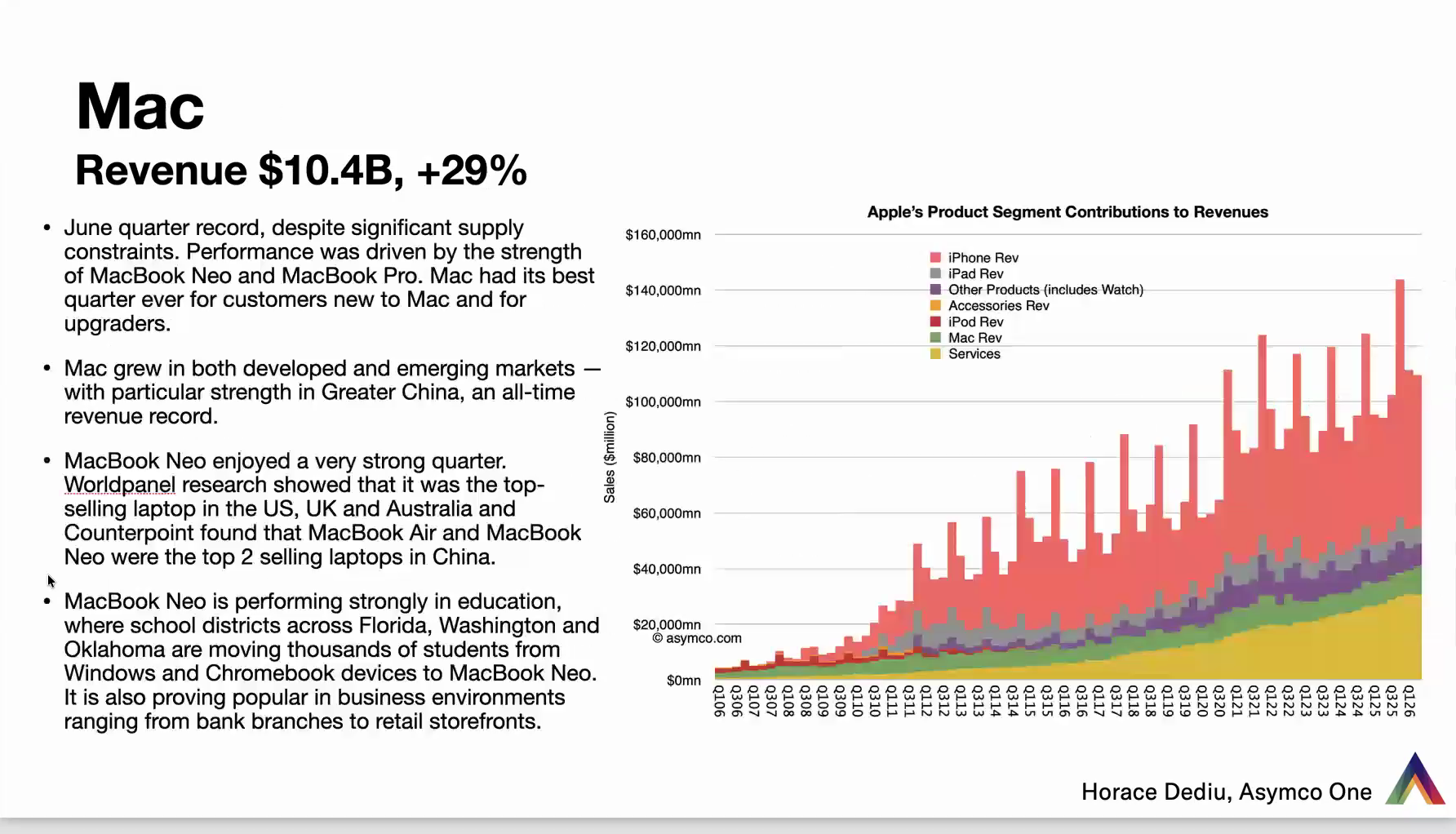
The Mac is hardly a ripple on this scale, but the Mac is also seeing an obvious secular surge right now. According to IDC — and not just IDC, many others are reporting the same thing — there are share gains around the world on all these products.
Back to the Mac: $10.4 billion, 29% growth. They repeat that the MacBook Neo was a big driver. A lot of skeptics would have said it's too cheap to make a dent, it's low margin, it's not available in large enough numbers. But clearly management has highlighted it as the driver, plus the MacBook Pro, and it's driving enormous growth: over $10 billion in a quarter that is not the holiday quarter. They also gave anecdotal evidence about the MacBook Neo being used in retail and in education, replacing Chromebooks and Windows. Nothing new there, but they are confirming a lot of the assumptions people had.
iPad & Wearables
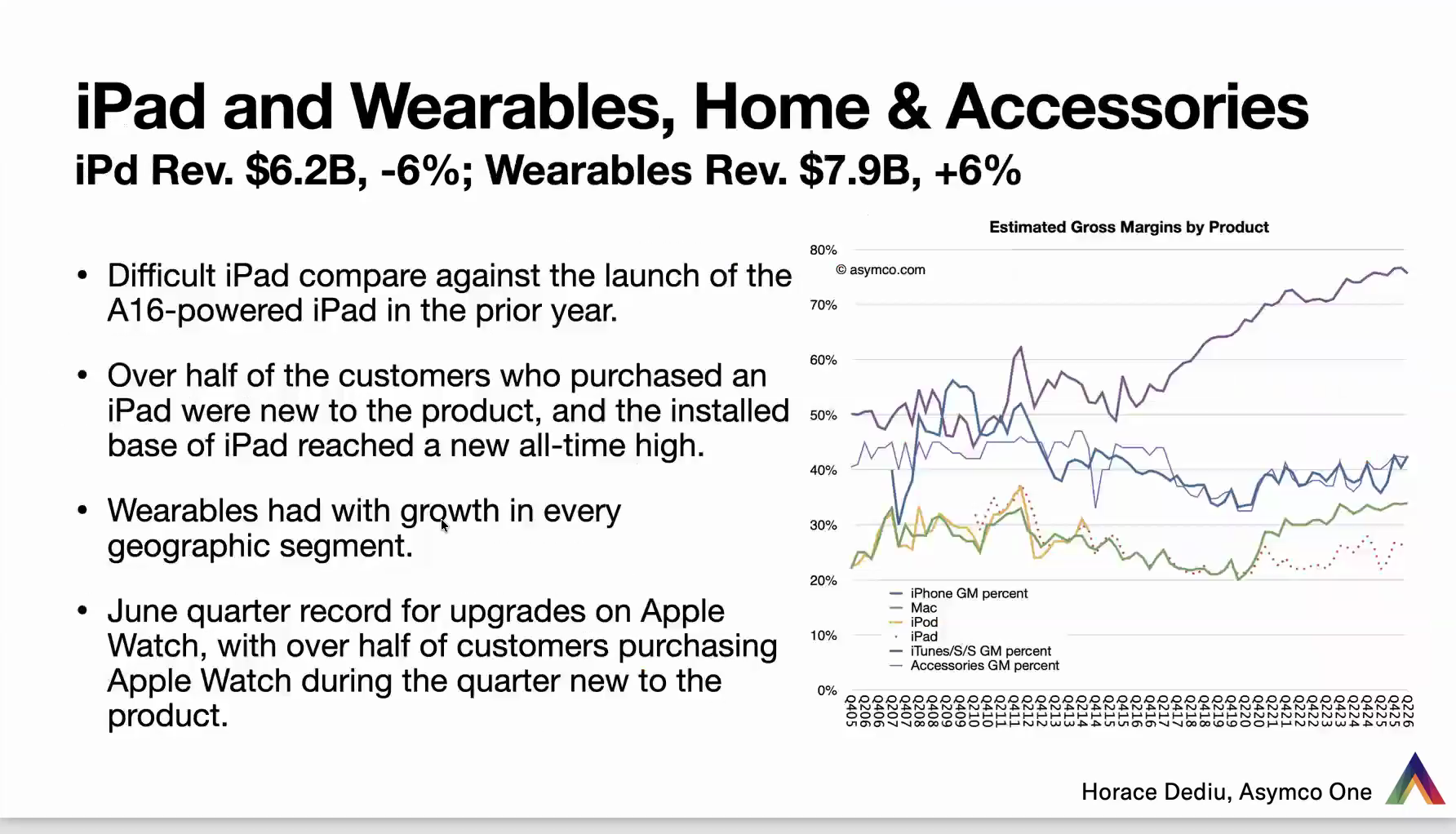
iPad revenue was down, as I mentioned: $6.2 billion, about −6%, on a tough compare. Wearables, Home & Accessories revenue was $7.9 billion, up 6% — a decent amount, actually; it hasn't been growing a lot lately. I also have gross margin estimates on an individual product level. From my deductions (Services margins are not a deduction — everything else is), the margins on the iPhone are holding around 40% and actually growing slightly on average. The Watch, apparently, is doing really well, growing with new customers as well.
Services
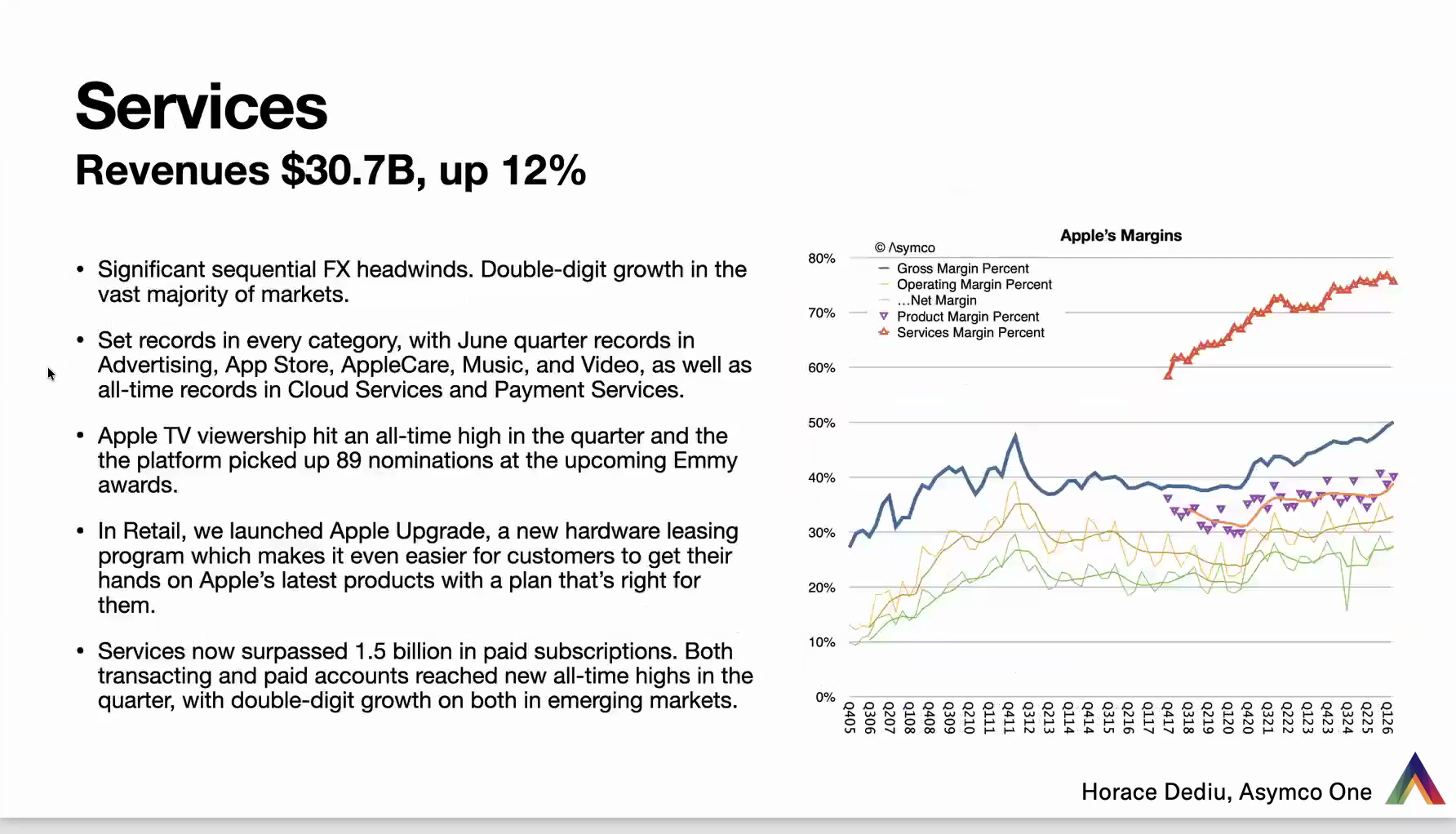
Services was $30.7 billion, up 12%. There were a lot of estimates above 15%. I think they guided pretty close to this, but they missed due to sequential foreign exchange headwinds. This seems like something you could hedge against, but apparently there was a missed anticipation there.
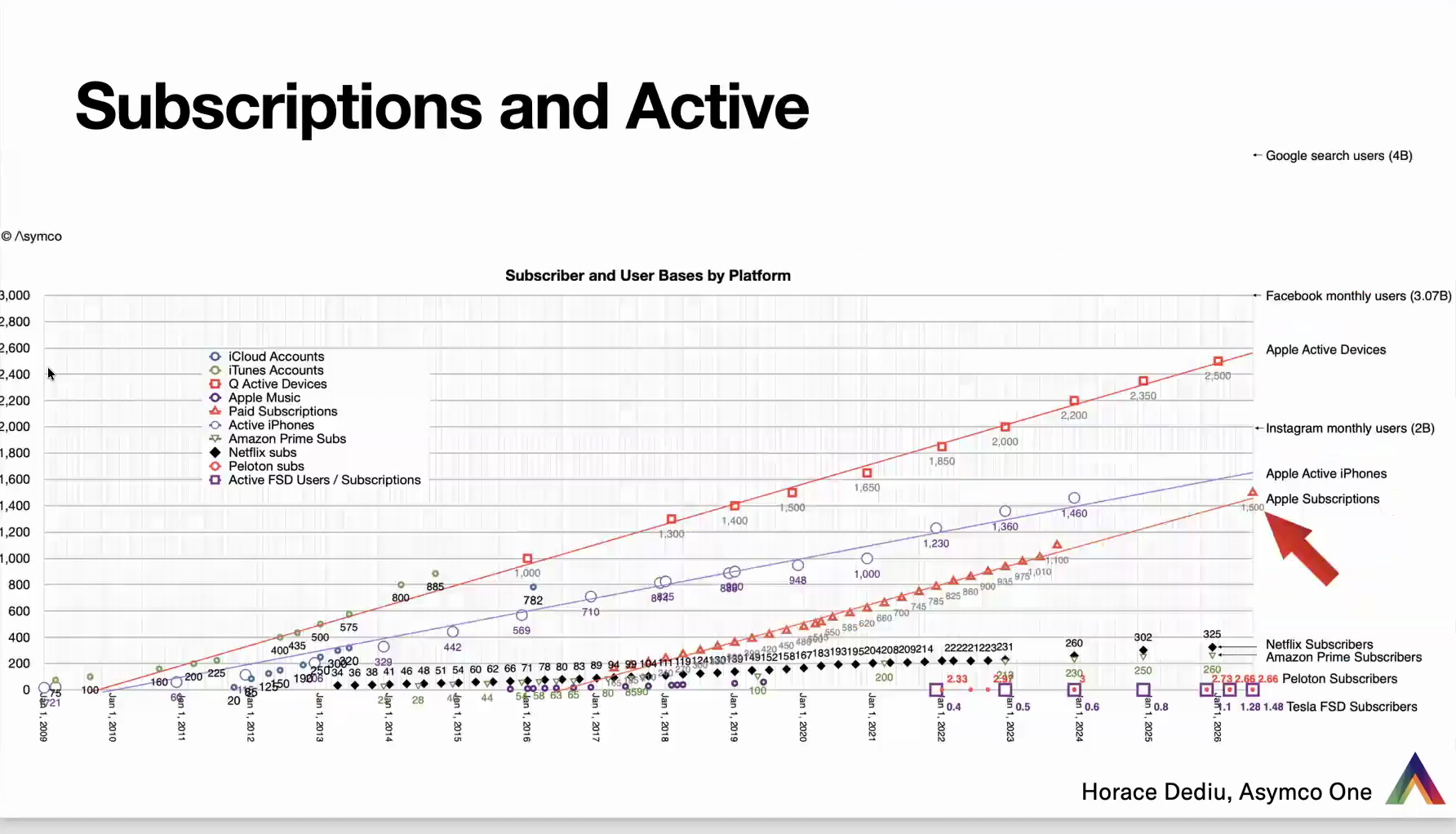
But the bombshell was that they reached 1.5 billion paid subscriptions. This was not a figure we've received an update on since they hit 1 billion, which was a couple of years ago. Everything since has been an estimate on the trajectory we had. 1.5 billion paid subscriptions — this includes Apple's own services, but also third-party services that Apple manages through the App Store. It's significant. It is possibly coming close to the number of users out there, which is probably 1.4 to 1.5 billion. And it's to be contrasted with the trajectory of growth in active devices, which since January has been at 2.5 billion.
This is a famous graph in the sense that it's been maintained for many years — a decade even. It's every data point Apple ever shared about the number of users it has: everything from iCloud accounts to iTunes accounts, active devices, even Apple Music (some of these are no longer reported). I've also mixed in third parties: Amazon, Netflix, even Peloton, and — based on a suggestion I received — Tesla's FSD subscribers. I've also added, as data points, Google search users (about 4 billion) and Facebook monthly users across all properties (about 3 billion). Below the active devices trajectory crossing 2.5 billion, we have Instagram monthly users at 2 billion, then an estimate of the iPhone base, and below that, with the arrow, Apple subscriptions, just printed at 1.5 billion.
How does that fit the pattern? There's the line — and that line is pretty much dead on what we've had since the beginning of that data set. Compare that to Netflix and Amazon and we're talking about order-of-magnitude differences: latest data, Netflix subscriptions were 325 million and Amazon Prime 260 million. Peloton has not moved much at 2.6 million. And there's a lot of pride among Tesla fans that FSD has reached 1.48 million. That's one 1,000th of Apple subscriptions. I'm not saying it's a bad thing, but it's in a different category altogether. The big question, again: can we use this to project? Is this linearity going to continue? As far as I can tell, since starting this more than 10 years ago, it has been holding.
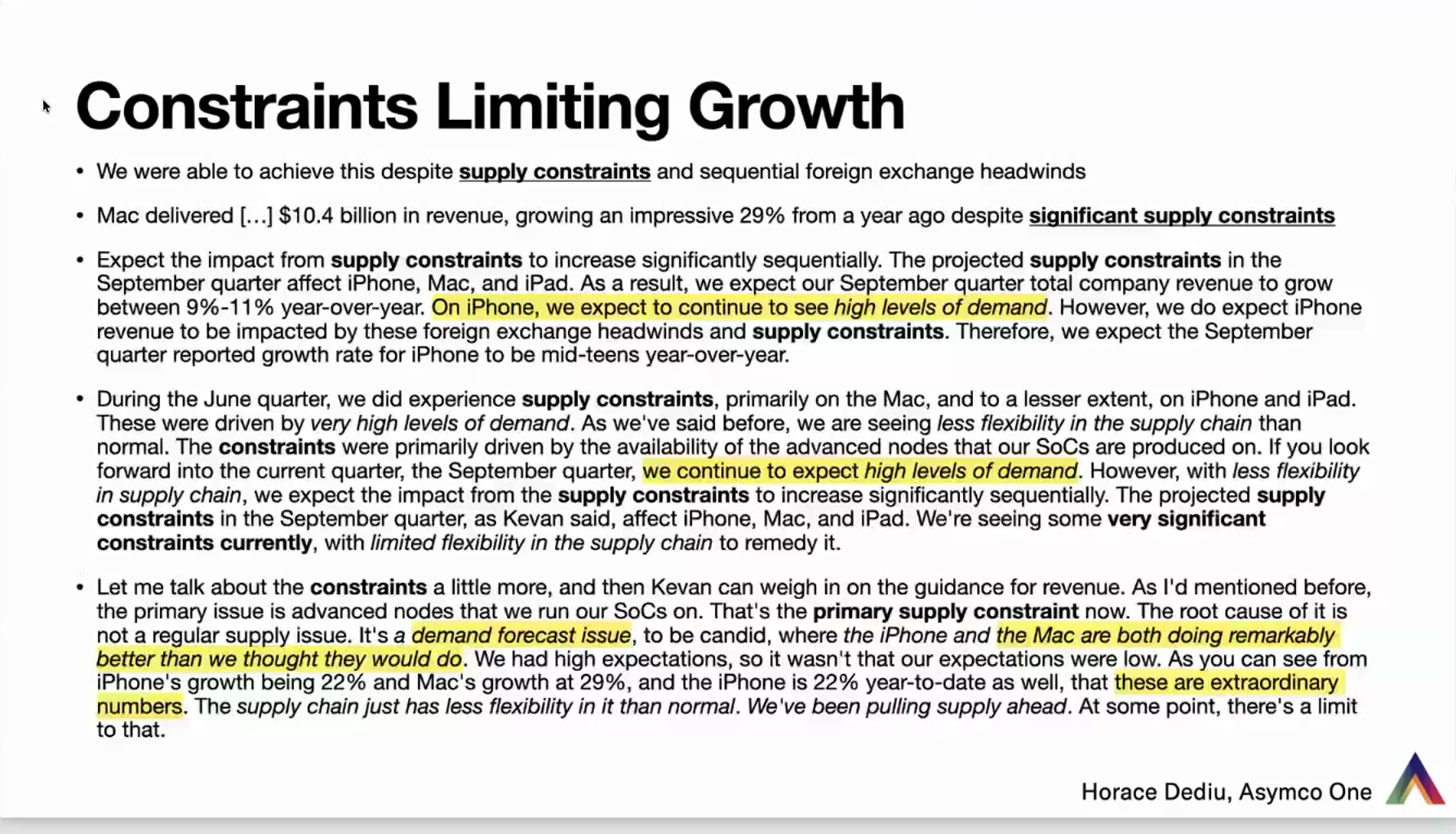
Supply Constraints
This is a very wordy slide because I picked up a lot of text from the conference call — direct quotes from Tim Cook and Kevan, the CFO. I've used bold to identify supply-constraint citations and highlights for the points about demand. Let me summarize: supply constraints are the primary reason they are unable to project growth similar to what they've had before. The reason for supply constraints is that there's excess demand.
As Tim Cook said in response to a question: we had high expectations. It wasn't that our expectations were low. But as you can see from iPhone growth of 22% and Mac growth of 29%, these were extraordinary numbers. The supply chain just couldn't cope. They've been pulling as much supply forward as they could, but at some point there's a limit. By the way, one of the places this shows up is in inventories, which have increased significantly — Apple has pulled a lot of inventory and pushed manufacturing as much as they could to take advantage of the imbalances that are present.
I encourage you to read through, or even search, the transcript for instances of "supply constraints" — this is not even the full set here. And on and on about high levels of demand: "We continue to see extremely high levels of demand. The Mac and iPhone are both doing remarkably better than we thought." The demand is there, and typically with Apple products, if the demand isn't fulfilled, it's delayed. We've had this situation before, especially at the beginning of the iPhone: it was very much constrained on production and supply, and the demand was persistent. It kept going.
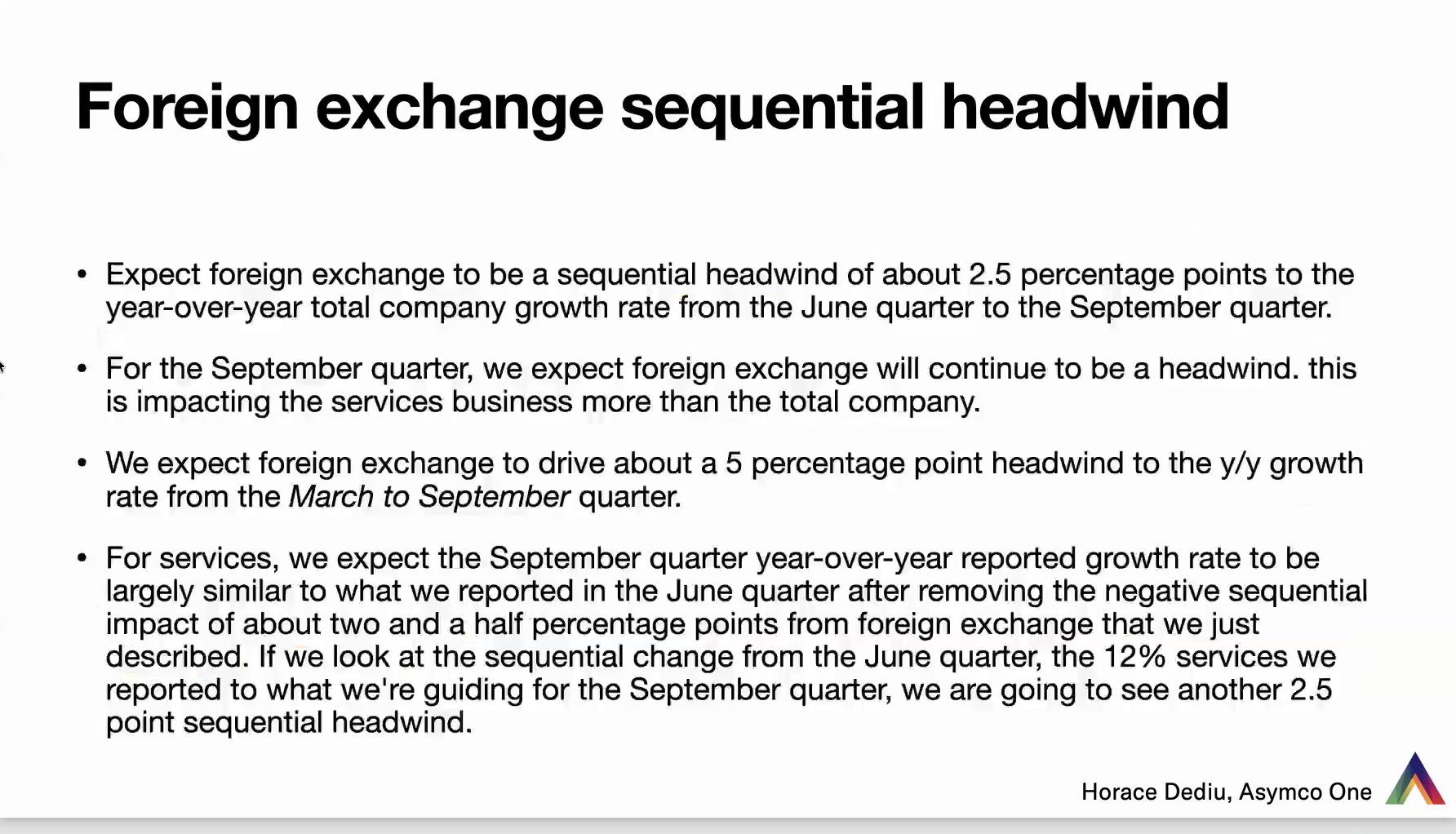
The other, more subtle thing is foreign exchange headwinds — a terrible, jargony phrase. It simply means that if people are paying in a foreign country for product or services, they're paying in local currency. If that currency dropped significantly against the dollar, Apple's getting paid less in dollars, and they report in dollars. From a European perspective, the euro hasn't weakened very much, but in Asia there's been a lot of turmoil — we've heard quite a bit about the yen. I haven't dug into all the currencies Apple is exposed to, but if they're feeling this much pain — two and a half points of so-called headwinds, especially against Services — this is something they felt they needed to highlight. And they have, rather cryptically, put forward that this will impact next quarter as well, to the extent of another 2.5%.
So those are the two primary excuses: first, we can't meet demand, especially on the SoC — the system on a chip, their main processor, which cuts across multiple products — and on Services, because of the foreign exchange headwind.
Capital Returns: Stronger Than Ever
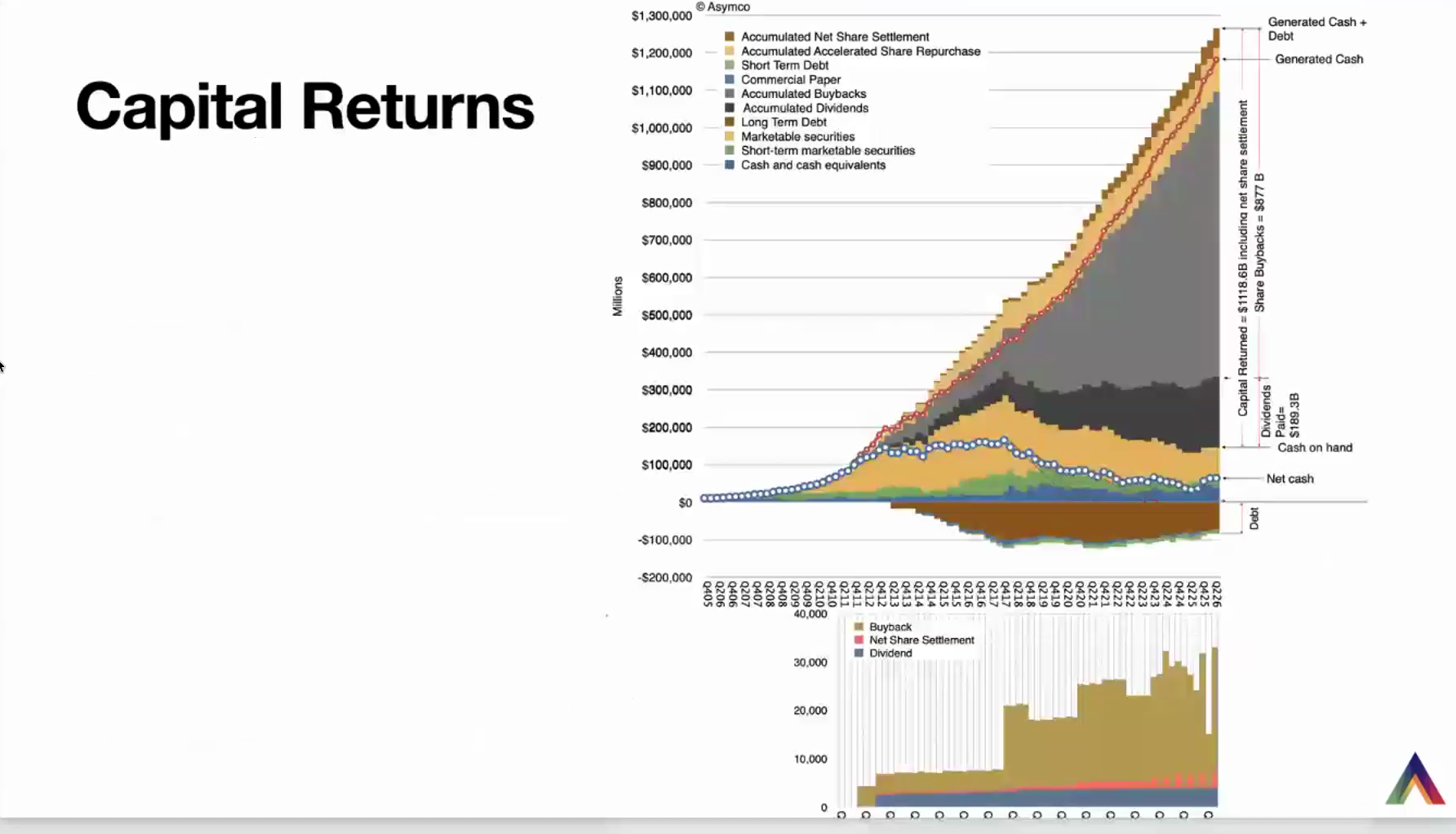
This incredible money mountain graph shows generated cash and capital returned (the gray sections): Apple has generated cash flow of $1.2 trillion for its shareholders and has returned $1.12 trillion of it. It holds a decreasing amount of debt — very low interest rate debt, and it seems they're not raising more as rates have changed; they seem to be paying it down. Net cash is holding flat. They said last quarter that they will no longer be targeting net cash zero. We only have two quarters of that to see what happens, but there's the trend.
Below that, a new graph: the split, for every quarter, of how capital is returned — buybacks in an olive color, net share settlement (a little obscure — it seems to have been constant, now a little more lumpy), and dividends, which have been growing as consistently as ever. As you can see, there was a period last quarter where there was a disturbance in the force, so to speak — the buybacks seemed very weak. But we're back to full blast, and I think the highest ever in that regard.
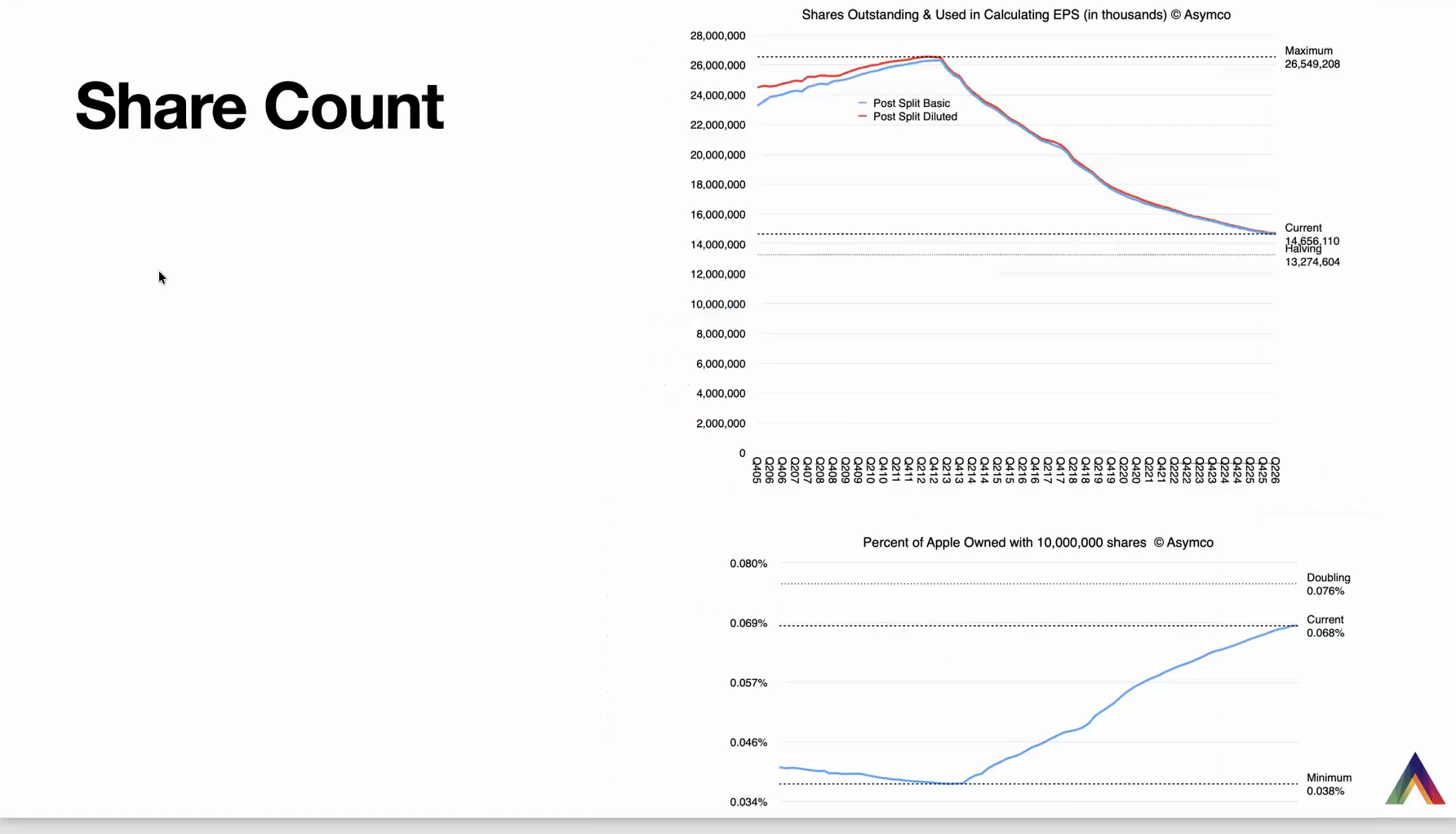
As a result, the number of shares outstanding is decreasing — less rapidly than it used to, which is mathematically understandable: as the shares increase in price, you cannot afford to buy as many as you used to. In the good times, when the market was oblivious, shares were cheap, and the steepness of the curve was far higher. But we're still heading towards what I call the halving point — targeting 13.27 billion shares, half the number since the beginning of this capital return program. And the graph below that shows your percentage as a shareholder — indexed to, say, 10 million shares — your concentration of wealth going up.
The Growth Scorecard
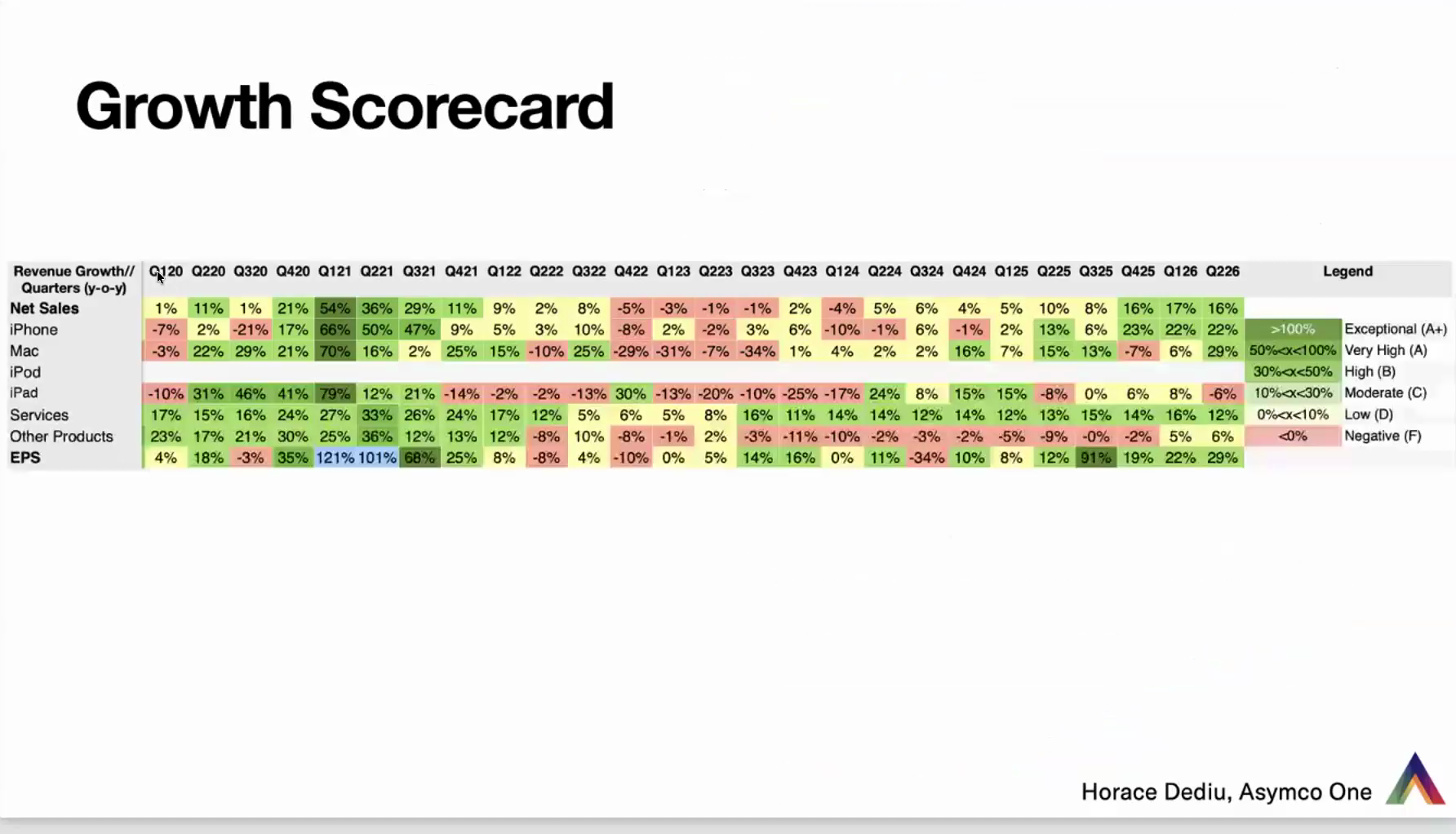
This is a table that is very long — this view goes back to 2020. Every quarter has green, yellow, and red indicators, from net sales at the top to EPS at the bottom and every category in between. We're looking to see green across the board. Dark green is super-fast growth — we saw those back in Q1 2021, in the middle of COVID, that whole area of green. The bottom line was even above green — above 100% turns blue in my algorithm. When you look at the latest, we actually had a better-looking quarter, I think, than the one before. The Mac turned from moderate to very high growth. Going forward, I think these are going to be closer to 10% than 20%, but I think it's green into the next quarter as well.
OpEx: The Cost of AI
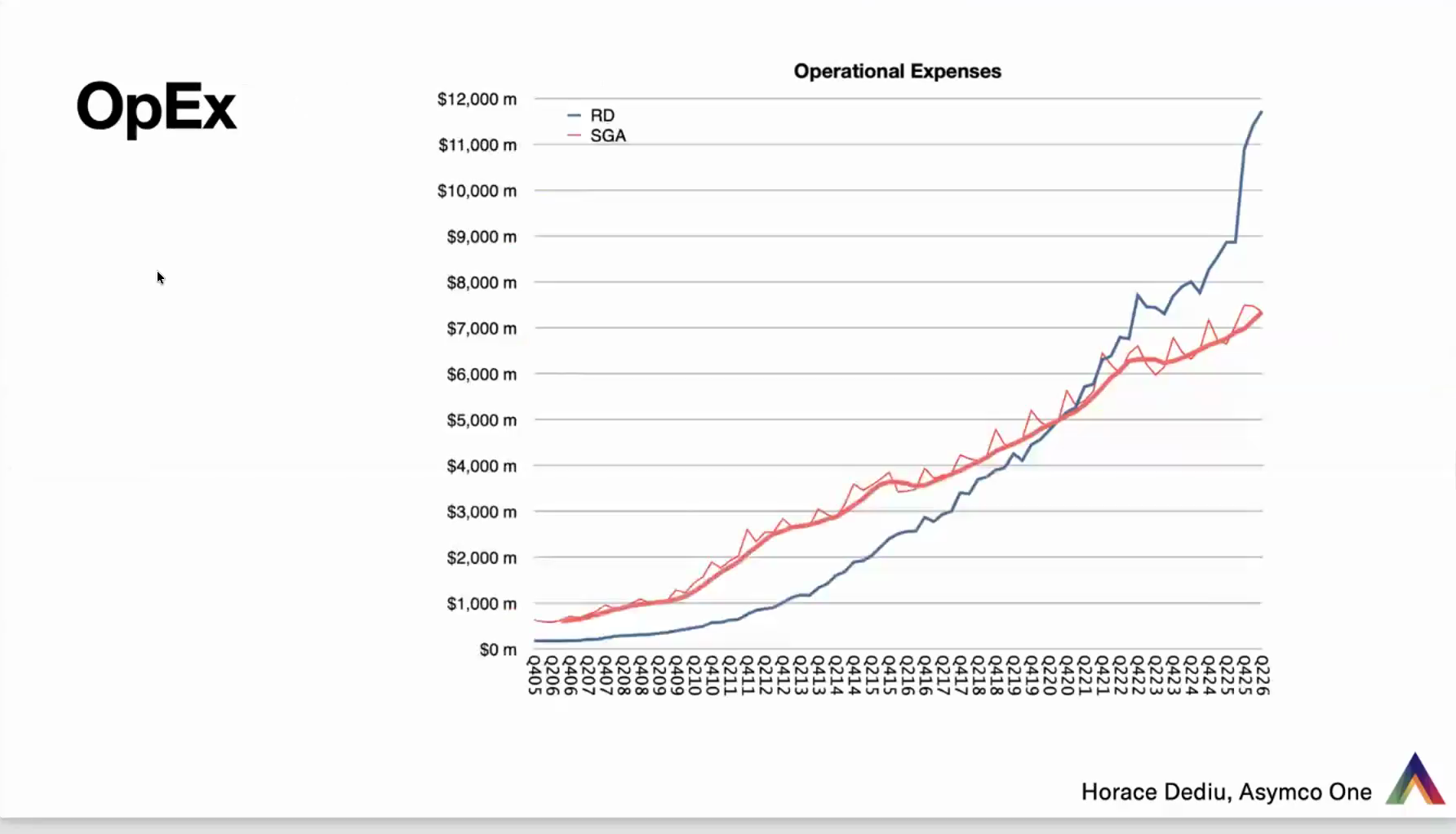
On the cost side: SG&A relative to R&D — together they make up OpEx. R&D has overtaken. Back in the days of Steve Jobs, R&D was far lower than SG&A. That flipped around 2020, and now what we're seeing is incredible growth. I think that's their allocation to AI. It's not just research — I think a lot of the costs baked into AI development are going into R&D for Apple. Since it's core to their business, they can book it as research and development — similar to Amazon putting almost all of their engineering into OpEx, because for them, all of that is not core to retail.
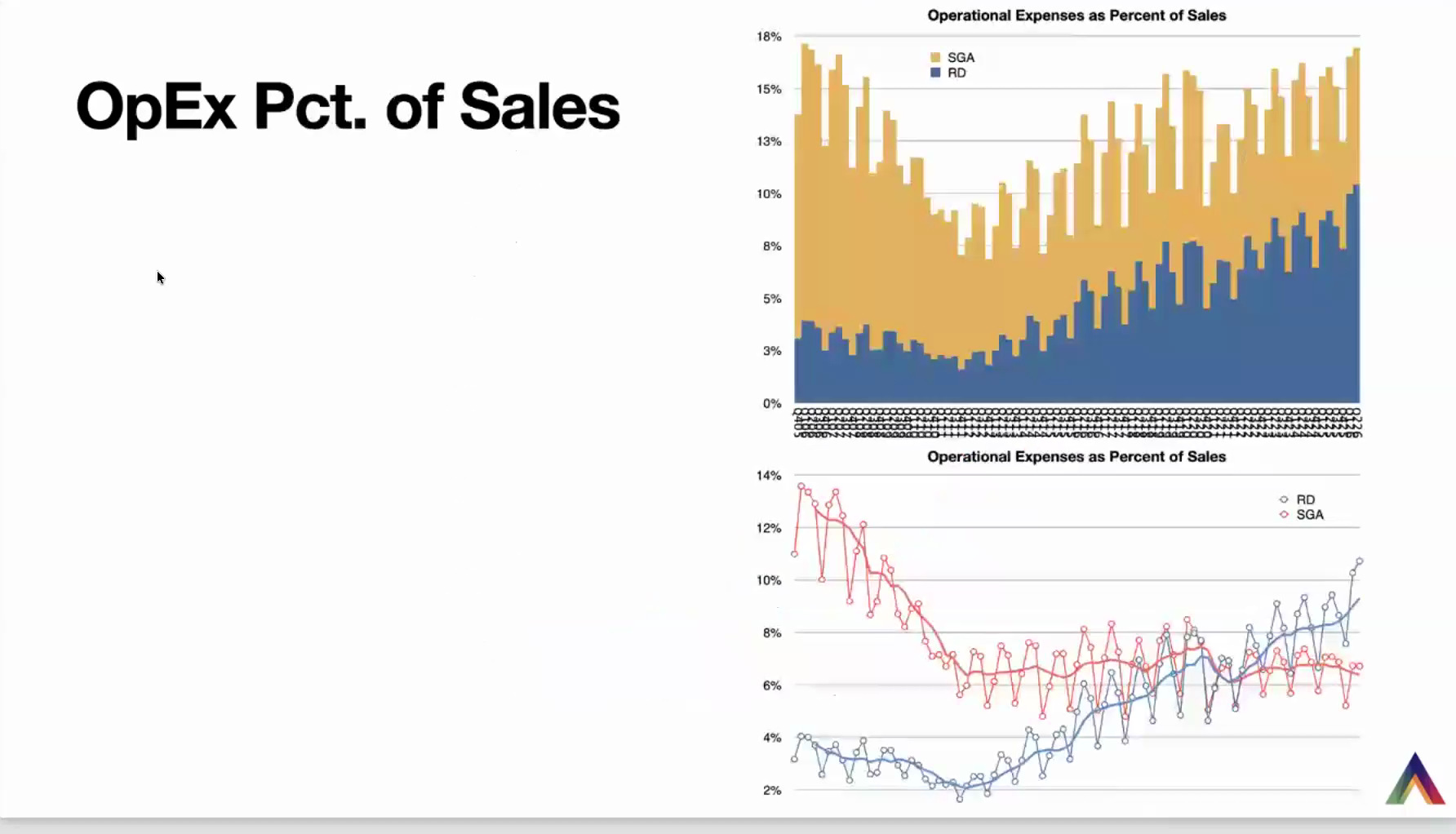
We are seeing the surge, but perhaps a slight tapering off on the rise. As a percent of sales, the two together are reaching higher and higher, closer to the all-time peak of 18% — again, back in the days of Steve Jobs. It's not outrageous, but it is something to keep an eye on. R&D alone reaching about 10% of sales I consider a little bit excessive, but it is the nature of the business today, especially with respect to the need to do more pure research on the hardware side, and on the software side with AI.
Valuation
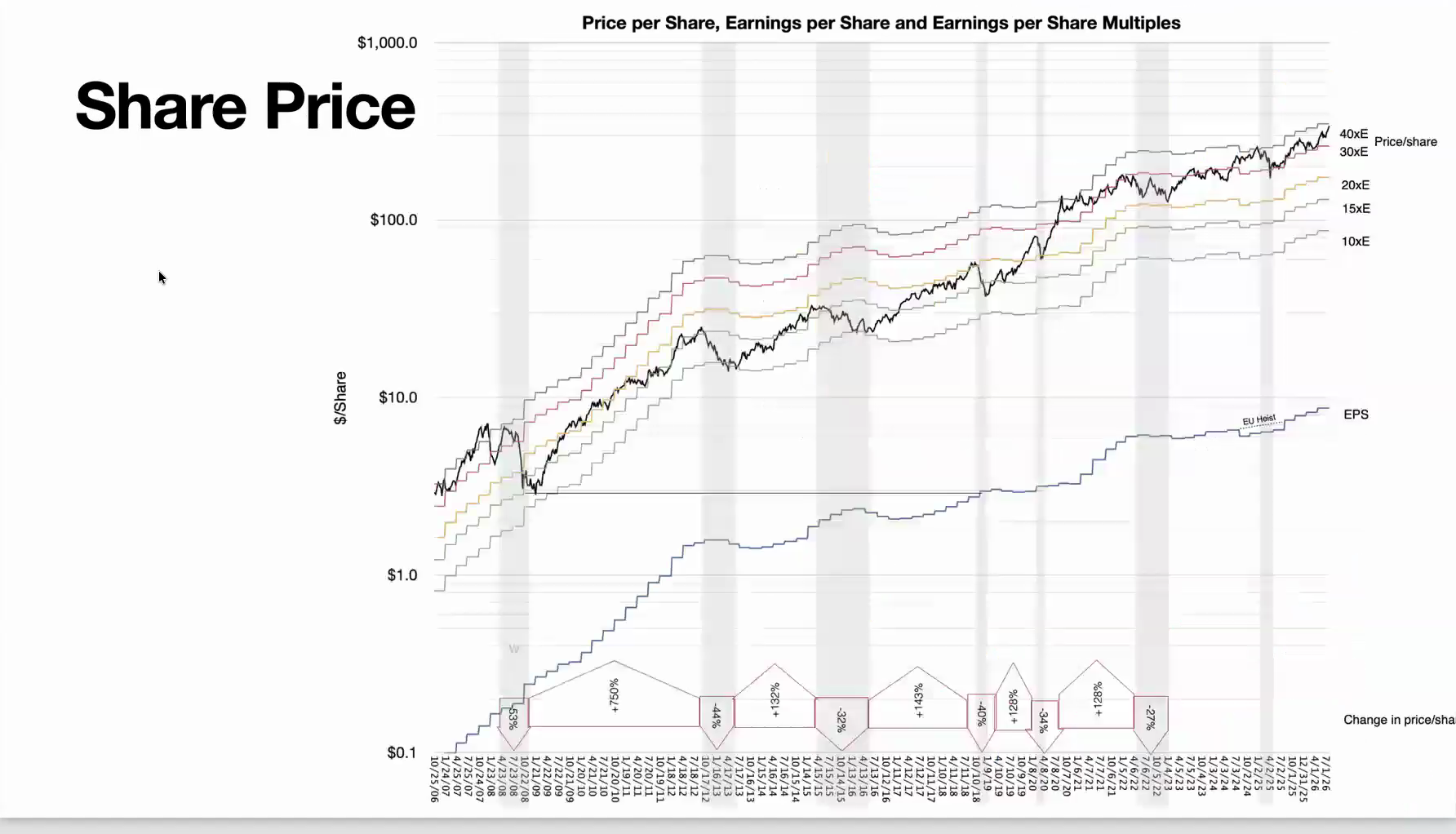
This is one of those graphs that's hard to process, but very rewarding. What we see here is EPS (trailing twelve months, now about $8.70) as the blue line, and multiples of that EPS as parallel curves above it — note that it's a log scale. The black graph is Apple's price per share. Apple touched 40 times earnings. As we speak — I checked a couple of hours ago — it seems to have come down to 34, because the share price fell, but also because earnings went up a bit.
Historically, it seems to bounce off these upper bounds. Around 2010, it was bounded by a P/E of only about 20 — hitting that and bouncing down. We've seen that migrate up to about 40 now, and we've had three episodes hitting P/E 40, with some pullback each time. I'm not here to predict what's going to happen, but it does seem it's a bit bound by a multiple. That's not to say it can't change — we can see euphoria, we can see faster growth rates justifying it. But we also have situations where companies growing very rapidly with very low P/Es slip dramatically in one day.
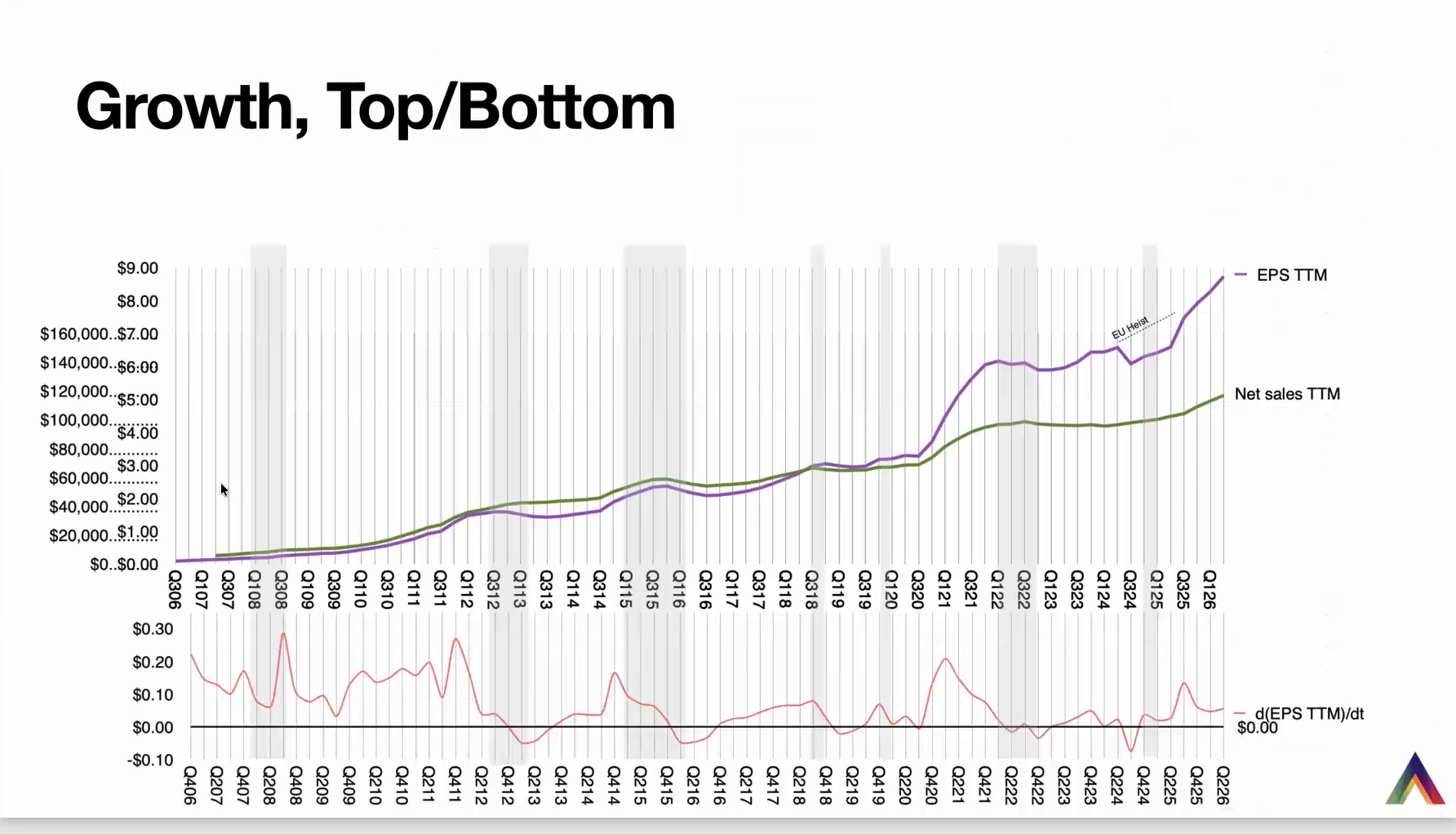
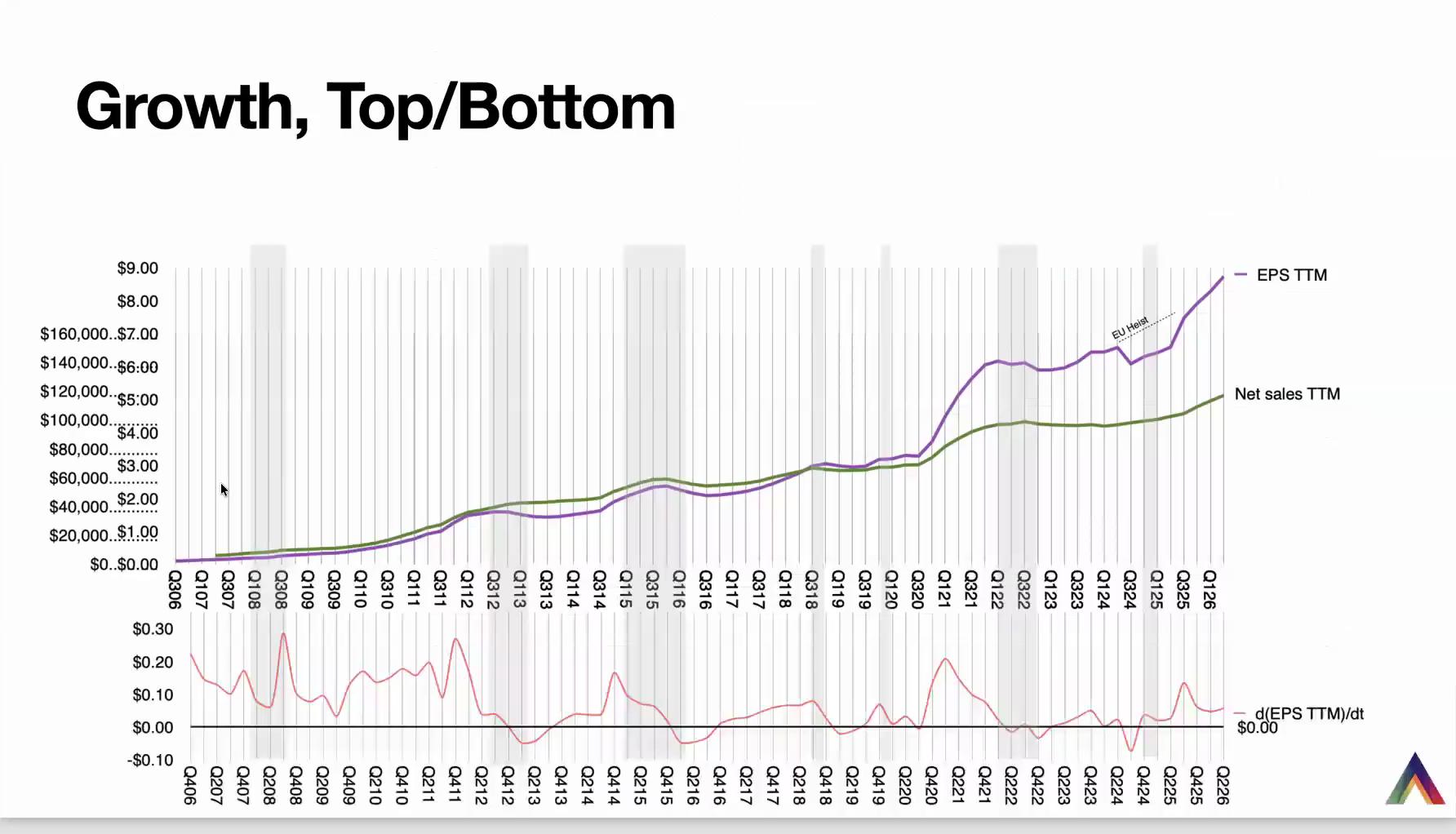
Same view with the drawdown bands carried over: plotting EPS and net sales on a TTM basis, we see the correlation, and the oscillation — product cycles in there. We have a drop due to what I call the EU heist; had that not been there, we would have seen a different picture. Nonetheless, TTM EPS is growing very, very robustly. And its change — the delta in TTM EPS — is the red line below it. You can make your own conclusions about whether it indicates or precedes the share-price sell-offs, but it is at least one indicator of how the company's doing.
Apple Upgrade: A Preview
I want to spend a few minutes on Apple Upgrade. I think this is going to deserve its own hour's worth of conversation. I had done this work prior to earnings and haven't published it yet, so I'll give you a preview and run through it fairly quickly. I think this is one of the most extraordinary and exciting developments with Apple.
They say that necessity is the mother of invention. But return on invested capital is the mother of innovation, is what I like to say. And in this case, what we're witnessing is innovation. This is nothing more, apparently, than packaging of an existing product with new ways of buying it, new ways of financing it. But boy, is this thing a great idea. It makes it so much simpler for people to make decisions on Apple products. Unless competitors are able to replicate this perfectly — and there are a lot of questions about that — I think Apple is going to make a tremendous impact with this. Of course, it needs to go global, it needs to scale, it needs to be well communicated. And it must not fail due to other factors — for example, rates of delinquency. I'm not an expert on this.
One of the things I've wondered for many decades was: why doesn't Apple do this? And I kept coming to the conclusion that it's very hard to do. This is hardware as a service. I don't want to buy a phone; I want to use a phone. As the old saying goes, people have a job to be done: I don't need a drill, I need a hole in the wall. What Apple was offering with the iPhone was: pay $1,000 upfront and you can get all these jobs done. But most people don't care about the product so much; they just want to get things done. And here is a way to package that proposition and say: for $33 a month, you can get it done.
The subscription makes perfect sense. A lot of people read too much into it as some sort of magical thing, or evil thing. It's just convenience. Tremendous convenience. The old way of calculating the cost per day was: you pay $1,000, and then maybe after two or three years you tire of the product, or you want to upgrade, and then you find a way to sell it — maybe Apple trades it in, maybe a third party, maybe you give it to a relation or a friend. All of these were possibilities, but you had to do a lot of calculation in your mind. Well, this is very plain and simple now.
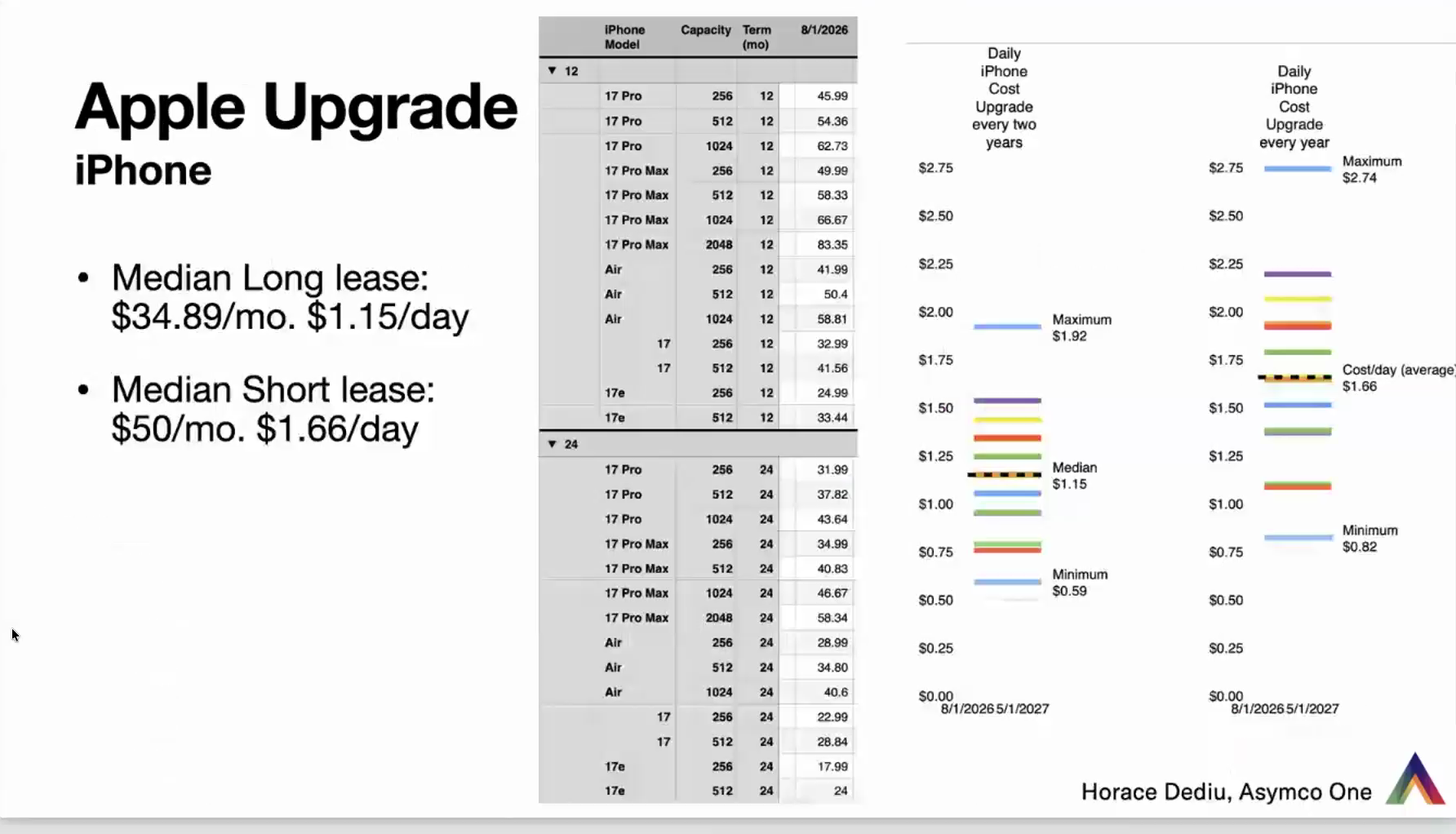
What I did is I went through the website and got every single configuration that has a price on it, and put it in a spreadsheet. This is just the iPhone, split into the 12-month lease and the 24-month — I call these the short and the long term. For each product, I took down the price, forwarded to August 1st. The thing to do is to track this and see whether it changes. We know that with the iPhone as it is, once they set that price in September, it doesn't change for the full year — they've never moved it. But here we're seeing the potential for Apple to tweak this on an ongoing basis.
Also notice that each price is down to the penny. This isn't $9.99, some feel-good price known to resonate. There are some in here that are essentially $18.01 per month — one cent. We see 67 cents, 35 cents, 56 cents, all over the place. These are very carefully chosen. These aren't chosen by a marketeer who says this is a feel-good price. These are chosen either because of the cost, or because of the knowledge of what the product can do.
To summarize: the median long lease for the iPhone is $34.89 per month, or $1.15 a day. The median short lease — only a year — is $50 a month, $1.66 a day. A very simple proposition: 34 or 50. On top of that comes the carrier plan, which is probably another similar amount. It makes a lot of sense to me, and I would love to do this, because if I commit to two years, then I know I'm going to get a new one after it's over. Nothing new, nothing special — it's just packaging and convenience.
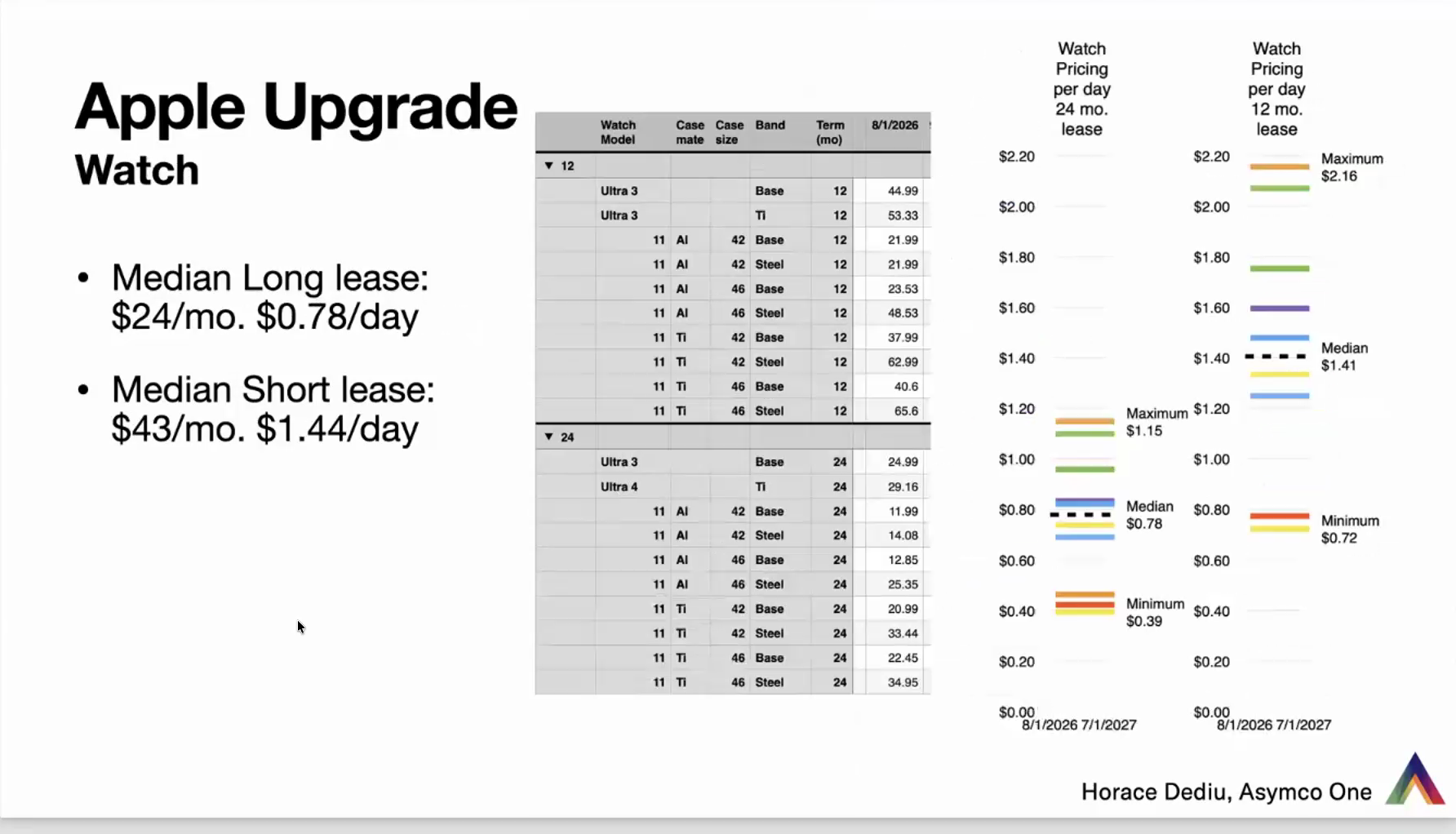
Jumping through the others quickly: the Watch is $24 a month, or 78 cents a day, on the long lease ($43 a month, $1.44 a day, on the short).
The iPad, it turns out, has a lot more configurations than the iPhone — it's the most complex, having to do with different displays, not just memory. The median for the iPad is $32 a month on the long lease, or $1.05 a day, and $36 a month, $1.18 a day, on the short. (By median I mean the price band halfway between the top and the bottom — half the prices above, half below. It's not the average; it shows where the midpoint is.) It comes out to about a dollar a day. The lease terms are slightly different for the iPad: 24 months is the short and 36 is the long, and the same with the Mac.
Mac prices surprised me — this is the first time I've done this exercise — but it's $44 a month median on a long lease ($1.45 a day) and $61 a month on the short. You could present this and say: if you want to get into a Mac, you can go as low as 82 cents a day. Or if you want to max out your system — some options cannot be put on a lease; they're purchase-only — a more or less fully loaded Mac Studio goes up to $5 a day.
I find these numbers extremely exciting, and most people, when they see them, cannot believe it. When I presented some of this on X, on Threads, and on Mastodon, people said: how do I sign up? How is it possible I can get a Mac for this little money? This is how people are going to react. Nobody believes it — they think it's a $5,000 product at the top end of the Mac scale.
I think this is very compelling. I think it's innovative because it makes it easy and convenient. Many critics said: if you do a lot of mental arithmetic, you'll probably realize you'd maybe save $15 going a different way; if you just want convenience, this is convenient. To which I'd respond: who's ever known anybody who cares about convenience? Obviously this is going to fail. Convenience is so important. People pay huge amounts of money for it — probably 20% of the economy is trying to deliver convenience to people. It's what credit cards do, it's what Apple Pay does. And it just is phenomenally resonant with consumers. It's not hiding anything. It's all transparent. You don't pay that much more — it's actually 0% financing in effect. You don't own the product, but who cares?
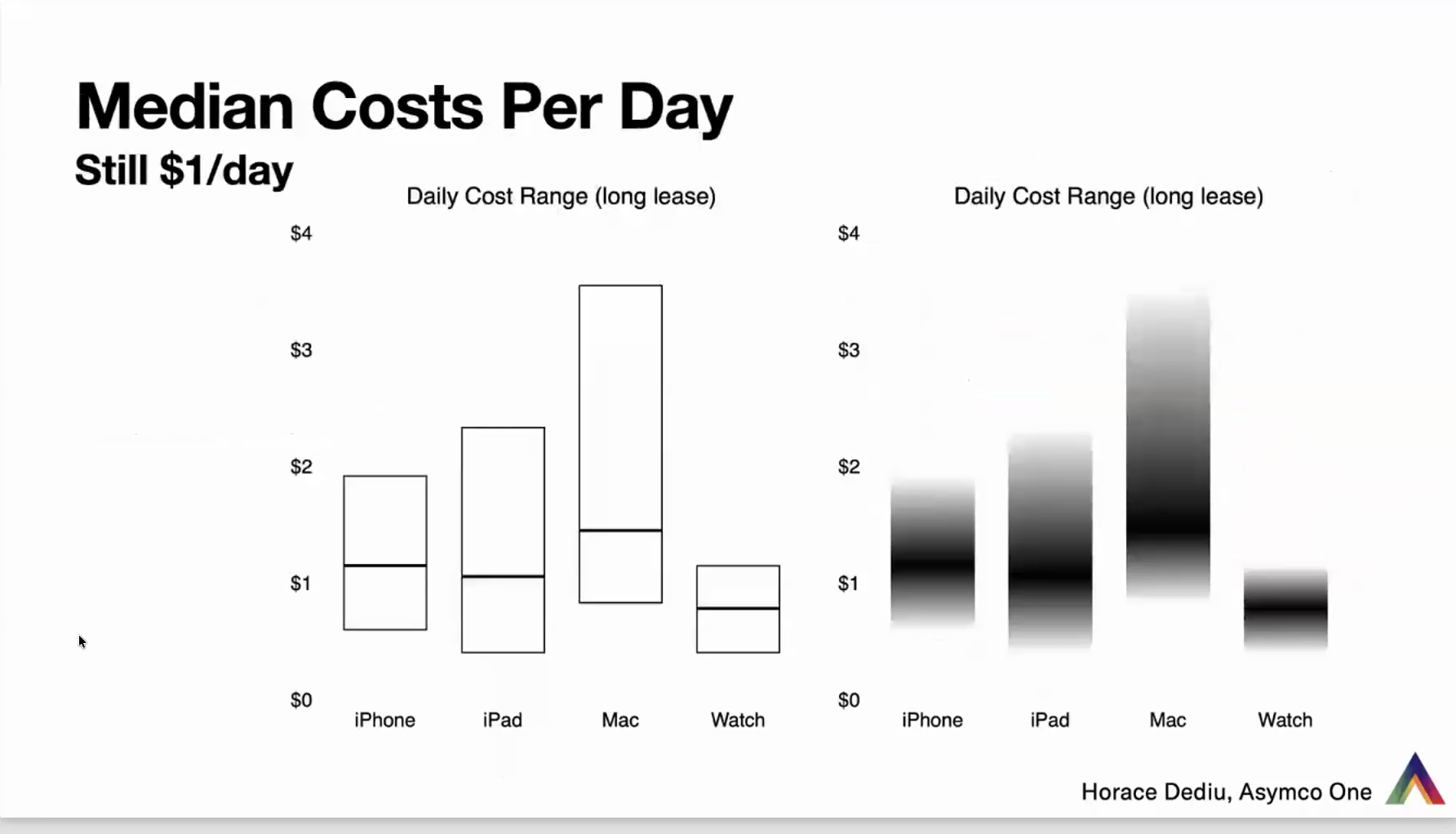
One summary slide on this. Across all these products — iPhone, iPad, Mac, and Watch — the median daily cost sits right around the $1 line. A little higher here ($1.10), $1.05 there, 78 cents for the Watch. Remarkably consistent. When I wrote this story about a dollar a day, maybe 15 years ago — prompted by Jean-Louis Gassée, by the way, who asked me one day over dinner: why don't you take the value of a Mac and divide it over its lifespan? — I did it for the iPhone, and lo and behold, it was a dollar a day. That would have been 2010, '11, '12. And it's still a dollar a day.
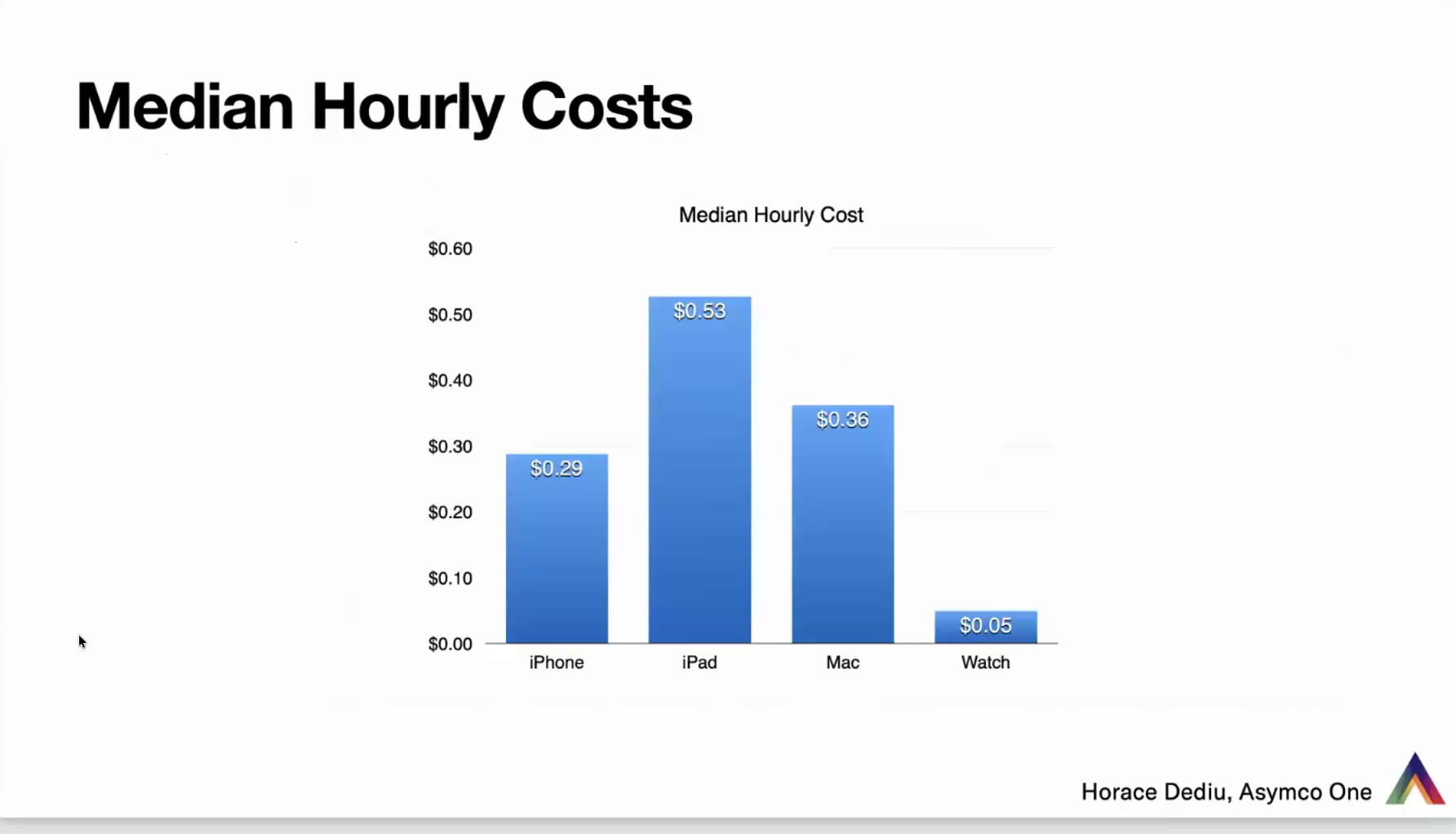
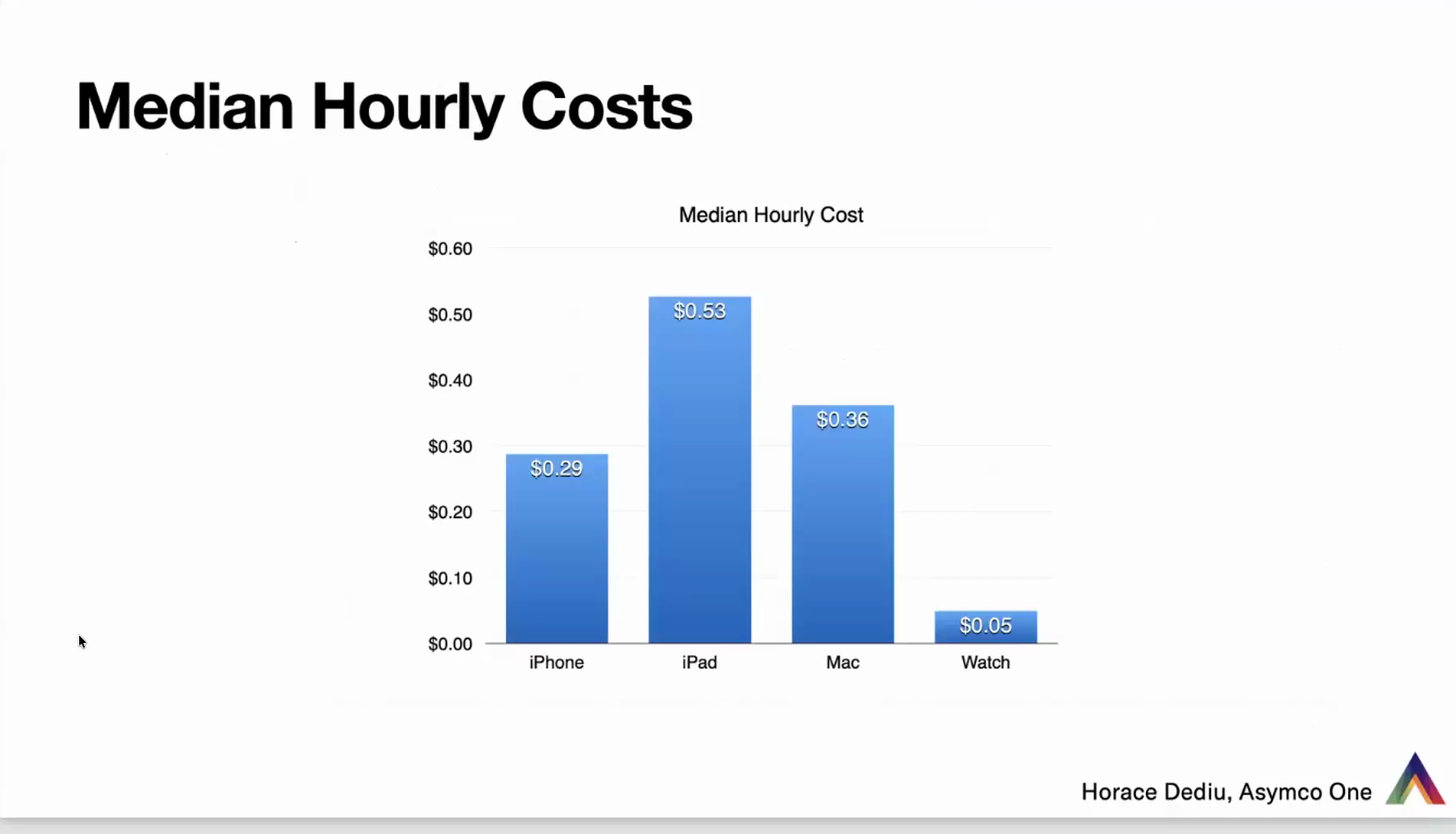
On top of that, you could ask: how many hours do you use this? That's one more graph — the cost per hour. The iPhone is used four hours a day; take that as an estimate. The average usage of an iPad is lower per day, therefore it's more expensive per hour. The Mac has a higher number of hours, but the product is more expensive. So we're looking at about $0.30 per hour, on average.
We could go a step further and ask: what about the number of times I use the product? It's hard to know how to measure the Mac, but in the case of the iPhone it's easy, because you can get it through your iPhone itself in Screen Time — it's called pickups: how many times you picked up the phone and turned it on. That number is about 100 on average. (It used to be 80; it's going up.) You can find out your own, take the amount you spend on a daily basis, and divide it yet again by the number of uses. The iPhone comes out to, if it's a dollar a day, about a penny per use. A penny each time it's unlocked.
And not only is this important from the consumer's point of view, it's a way to define the proposition of value for the whole company. Take every instance of use, multiply it by the number of people using it, multiply it by the number of days in a year, and you start to see how many transactions, how many interactions, and how many pennies add up to the value Apple creates. It's an absolutely phenomenal way of doing unit economics for the iPhone.
-- End of Presentation --
Editor's Note: This presentation is made available to non-subscribers for a limited time. Subscribe to Asymco Onefor full access to this and other content.
It was an honor to collaborate with Dr. Bobby Korn of USCD, Dr. Tommy Korn of Sharp Healthcare, and Nahia Jalbout, Rolika Bansal, Marissa Shoji, Sarah Cheng, Alessia D’Urso, Hetal Hosalkar, Catherine Liu, Don O. Kikkawa, and Ryan Broderick on our new paper published in AJO International (American Journal of Ophthalmology), exploring the use of Apple Vision Pro as a wearable spatial computing display for endoscopic lacrimal surgery.
Conducted at the UC San Diego Shiley Eye Institute, the study, titled "Apple Vision Pro as a Wearable Display for Endoscopic Dacryocystorhinostomy: Surgical Experience, Efficiency, and Cost," is among the first studies evaluating Apple Vision Pro as the primary intraoperative display for endoscopic lacrimal surgery. We compared it with the traditional monitor-based approach, focusing on surgical efficiency, surgeon workload, ergonomics, and cost.
Key findings include: • 19% shorter operative times • 100% functional success with no intraoperative or postoperative complications • Significantly lower surgeon-reported workload, with every participating surgeon preferring the Apple Vision Pro experience • Improved ergonomics, allowing surgeons to maintain a natural, forward-facing posture while requiring only a fraction of the space and cost of conventional operating room visualization systems.
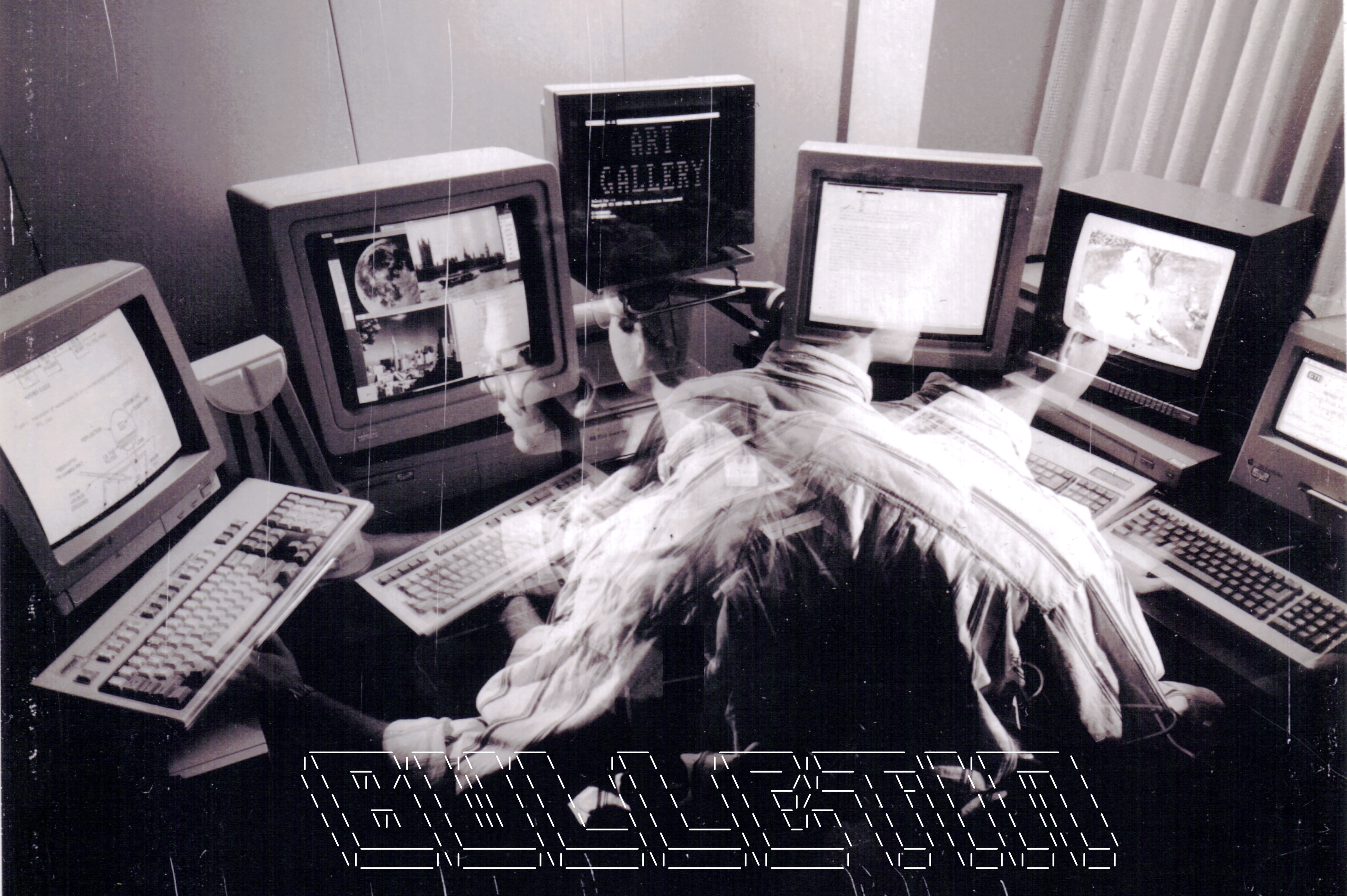
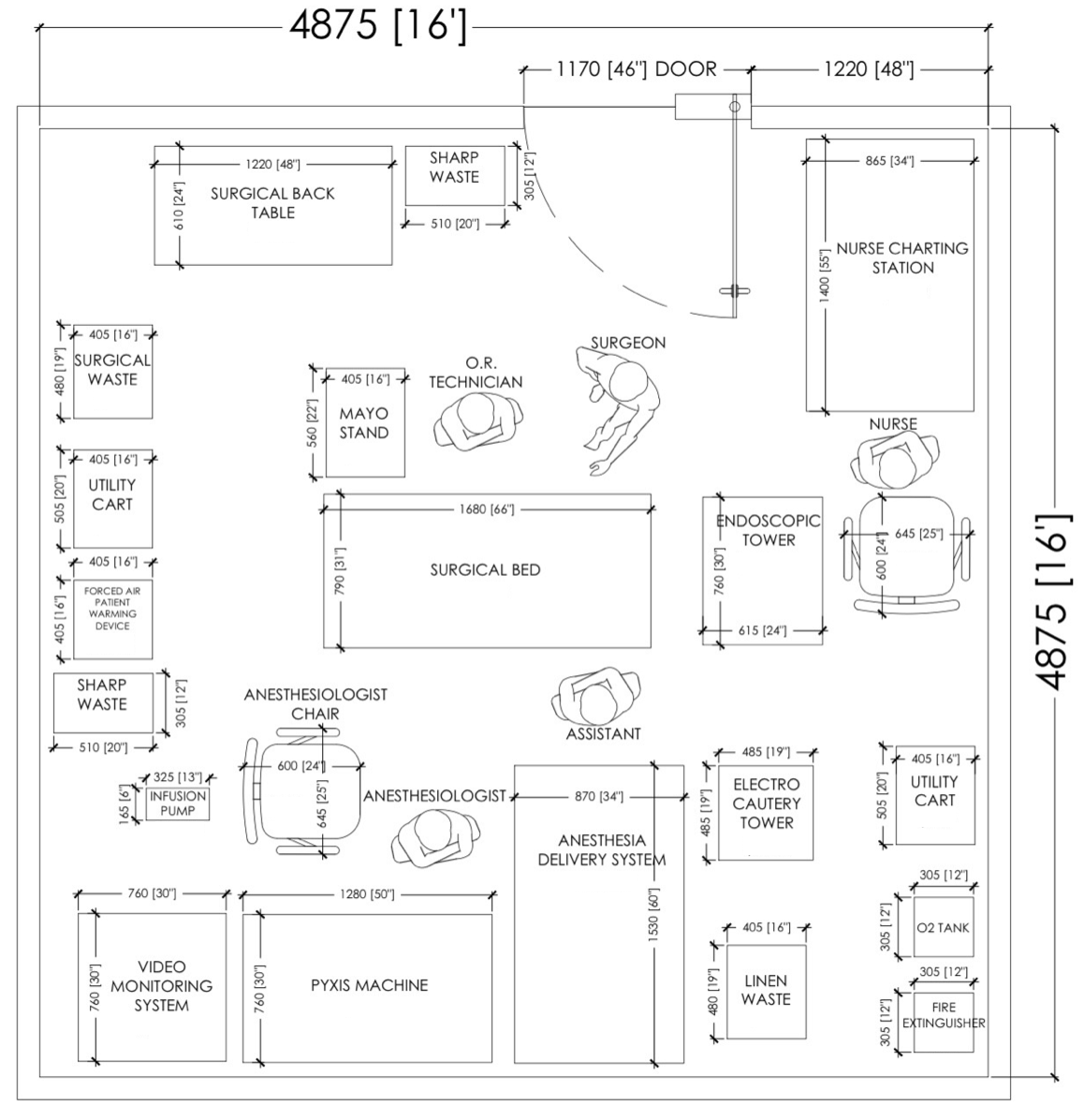
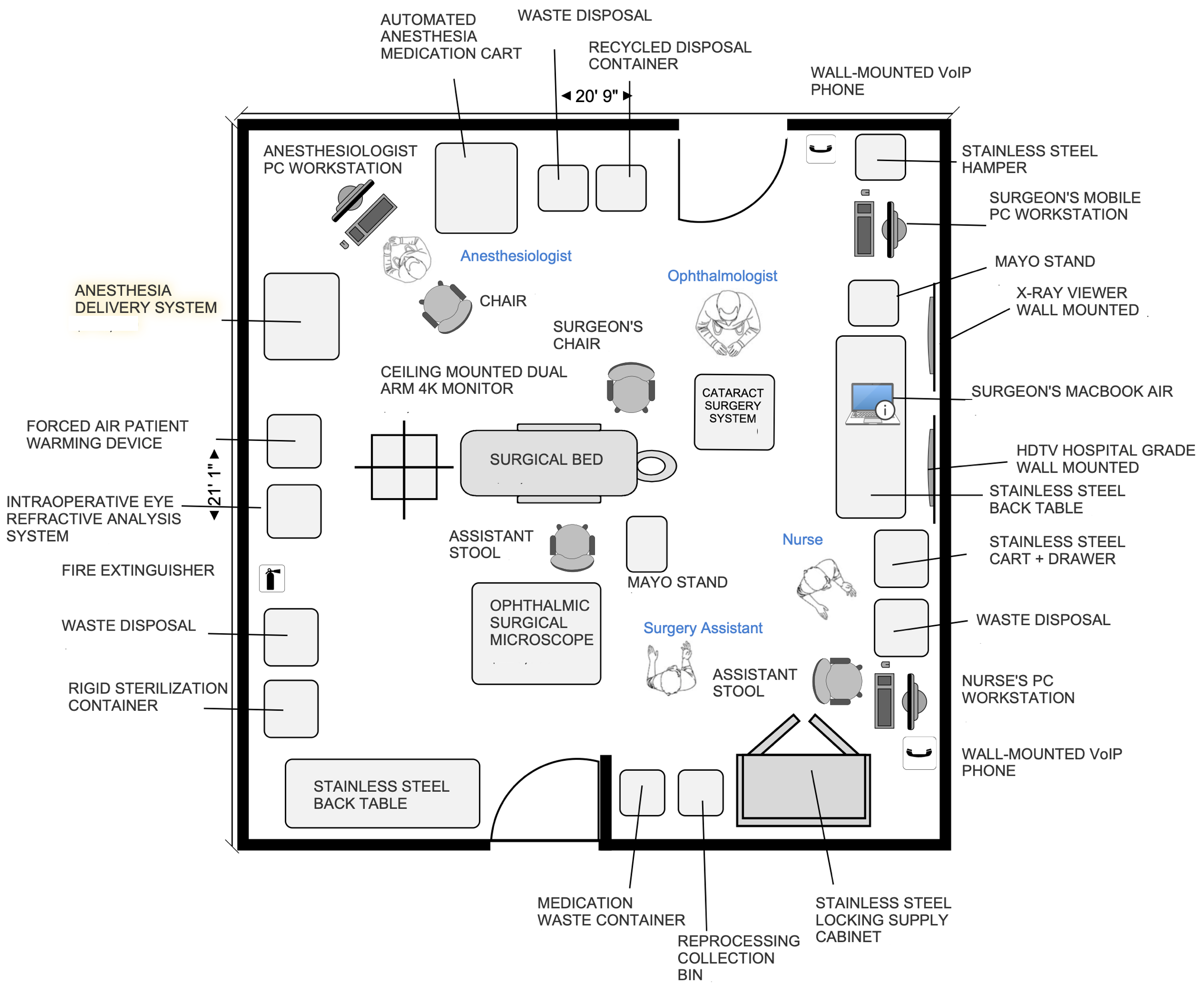
My contribution was to assess the cost and space impacts of the Apple Vision Pro in the constrained environments of ophthalmology operating rooms. The data are shown in the images below. First, the layouts of the rooms.
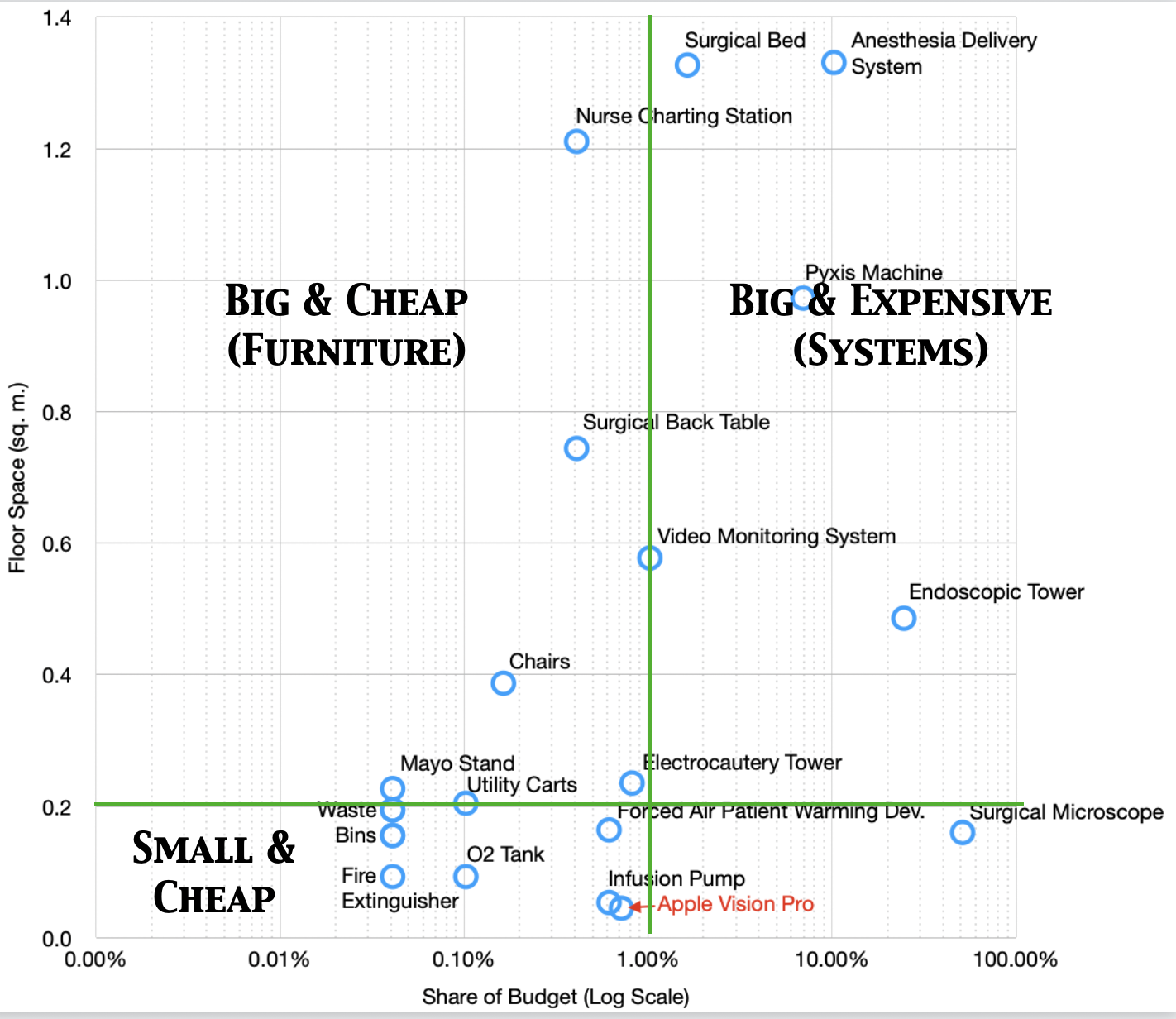
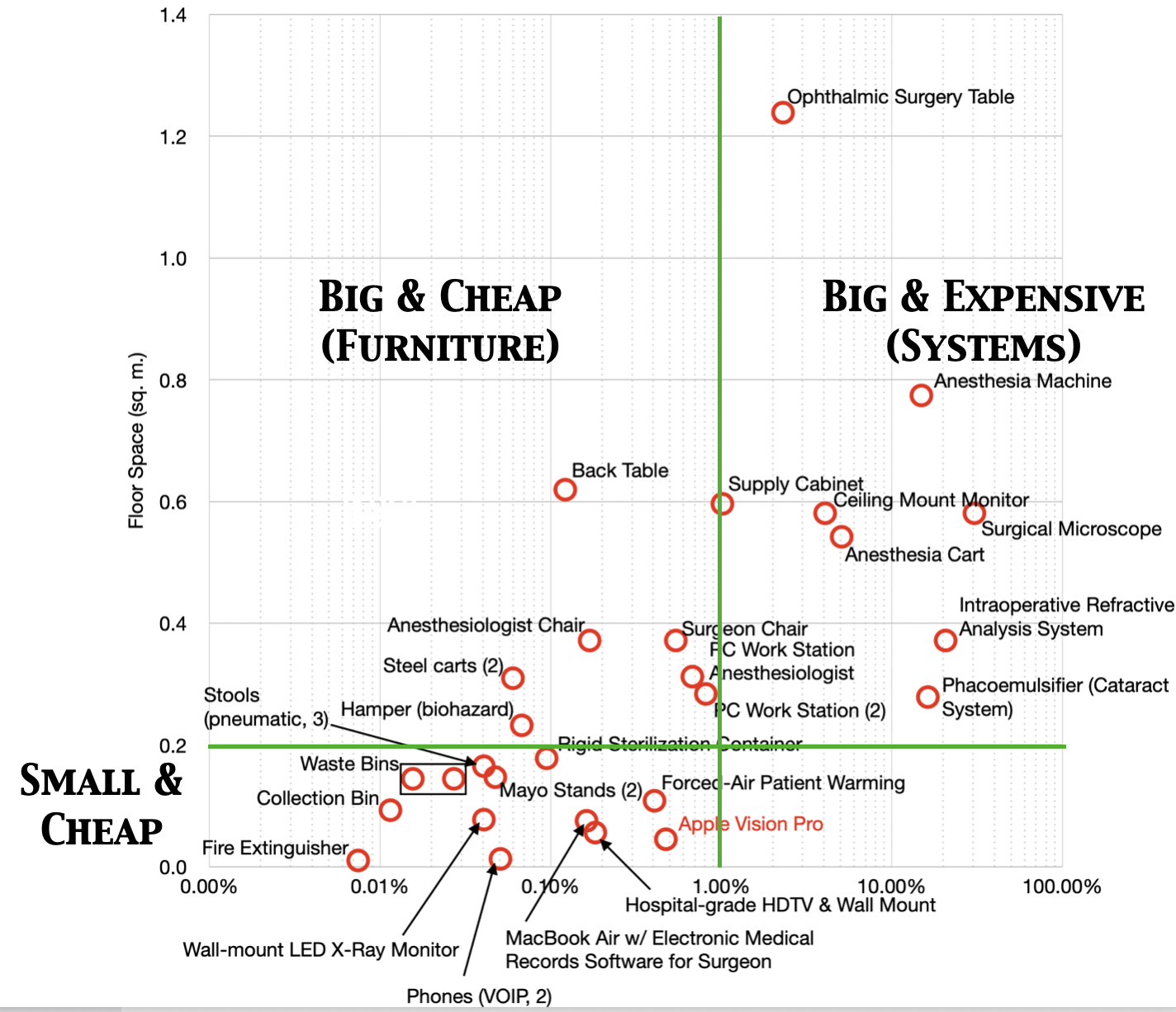
Second, the space required vs the cost of acquiring it.
In my experience, the Apple Vision is criticized for two things: being too big/heavy and being too expensive.
The data above shows that within the context of the operating room, the Apple Vision Pro is notable for being very small and very cheap. It is less than 1% of the cost and smaller than almost any piece of equipment.
When the iPhone was new it was considered a very expensive phone. At $500 most people, including, famously, Steve Ballmer, considered it too premium for the mass market. It turned out to be the most popular phone in most markets even when twice the price. It all depends on what it does and how easy it is to use.
For a hospital the cost of the Vision Pro is not insignificant. The paper considered what it can do, and, for that, it's a bargain.
Asymco Bulletin is a digest of all the work we have published for the week ending Aug 2, 2026.
July Office Hours
Apple Earnings Special: Office Hours Live Q&A→ The Apple Earnings Special took place on Friday, July 31, the day after Apple’s fiscal Q3 2026 earnings call, Tim Cook’s last as CEO. Horace reviewed the results and their implications and took questions from the live audience. Asymco One subscribers will have access to the live recording. →
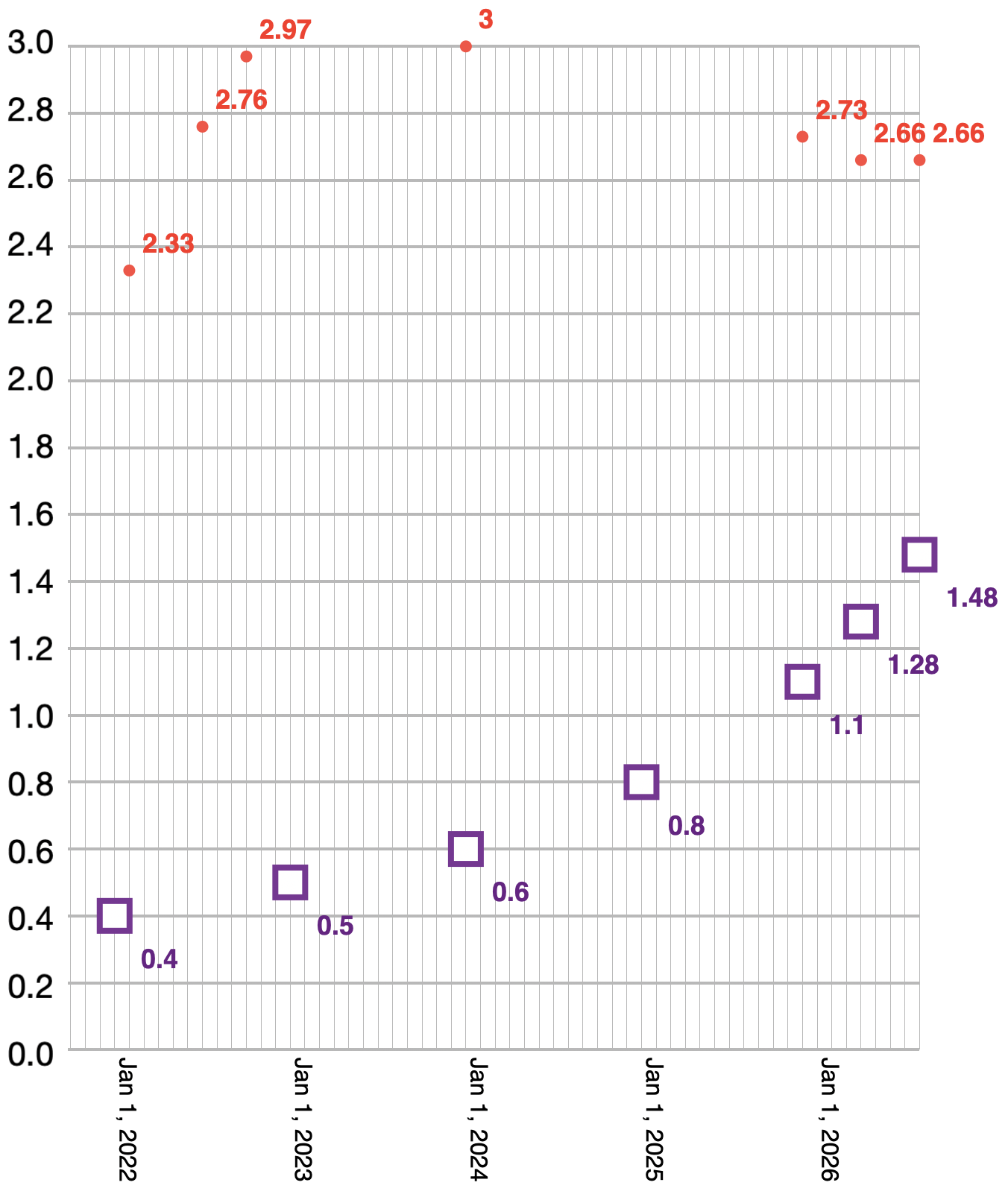
Tesla grew deliveries 25% and still managed only a 1.4% operating margin, 0.7% excluding regulatory credits. The bull case rests on FSD subscriptions, now 1.48 million, but Peloton peaked at 3 million on the same accelerating curve. Cars cannot be consolidated, made uniform, or iterated fast enough; even BMW’s base is only 50 million users and Tesla’s is barely 10 million after 23 years. There is no critical mass for an ecosystem in automobility, and that is why there is no Apple Car. →
A summary of revenue and EPS estimates from Yahoo, TipRanks and my own, alongside the March quarter’s estimates and actuals. Results land half an hour after close on July 30th, with Office Hours the following day. Both aggregators narrowed their EPS ranges significantly during the quarter, with a smaller squeeze on the revenue maximum. I don’t yet have a hypothesis for why. →
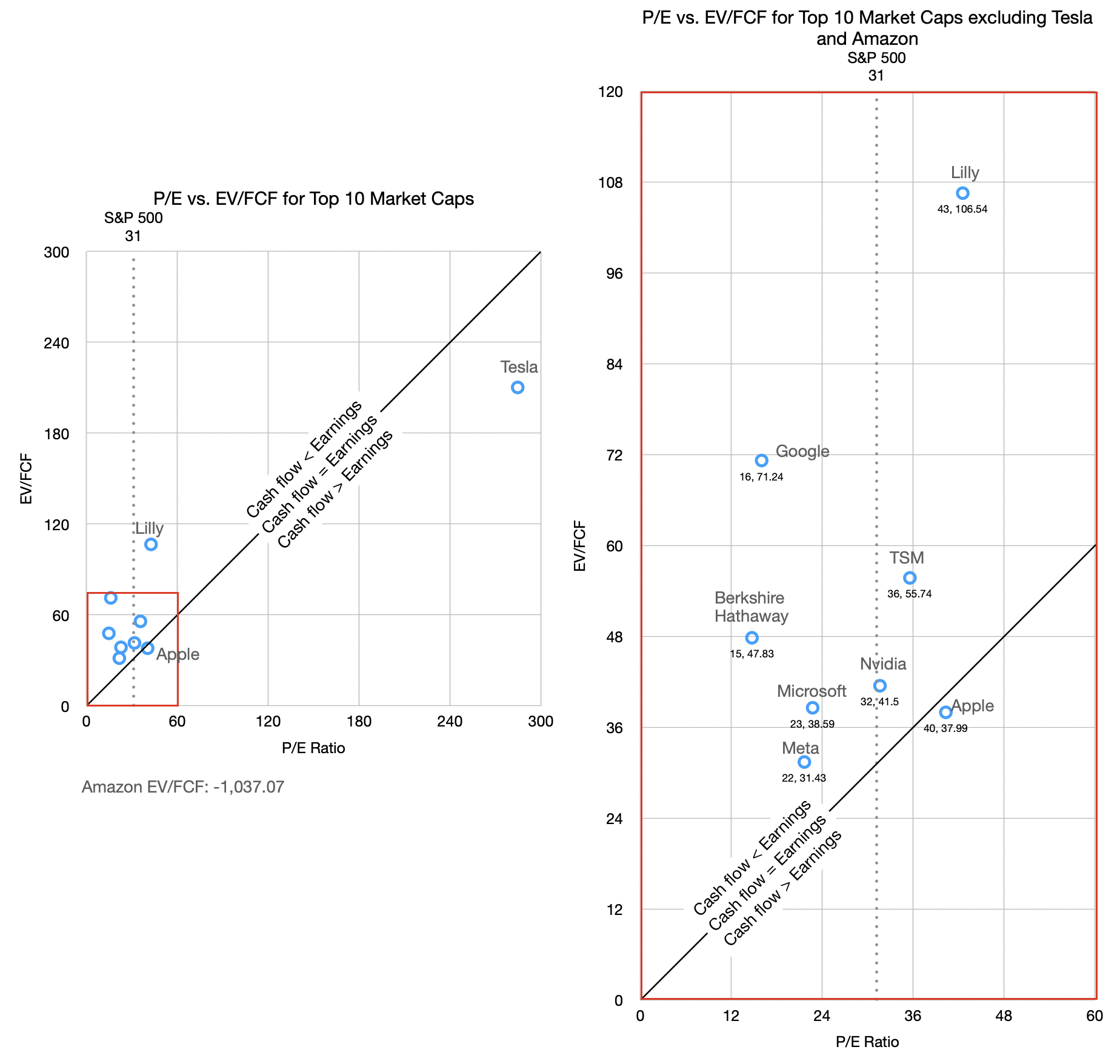
Four ways to look at valuation: P/E, EV/FCF, each against growth, and the two against each other. On P/E the market looks reasonable, but free cash flows are turning negative; Alphabet just recorded its first since 2004. When P/E and EV/FCF match, a company is in balance, and Apple is nearly alone there. Recessions are built on bad debt, and if data centers become debt financed against absent cash flow, contagion follows. Earnings are an opinion, cash flow is a fact. →
Nota Bene
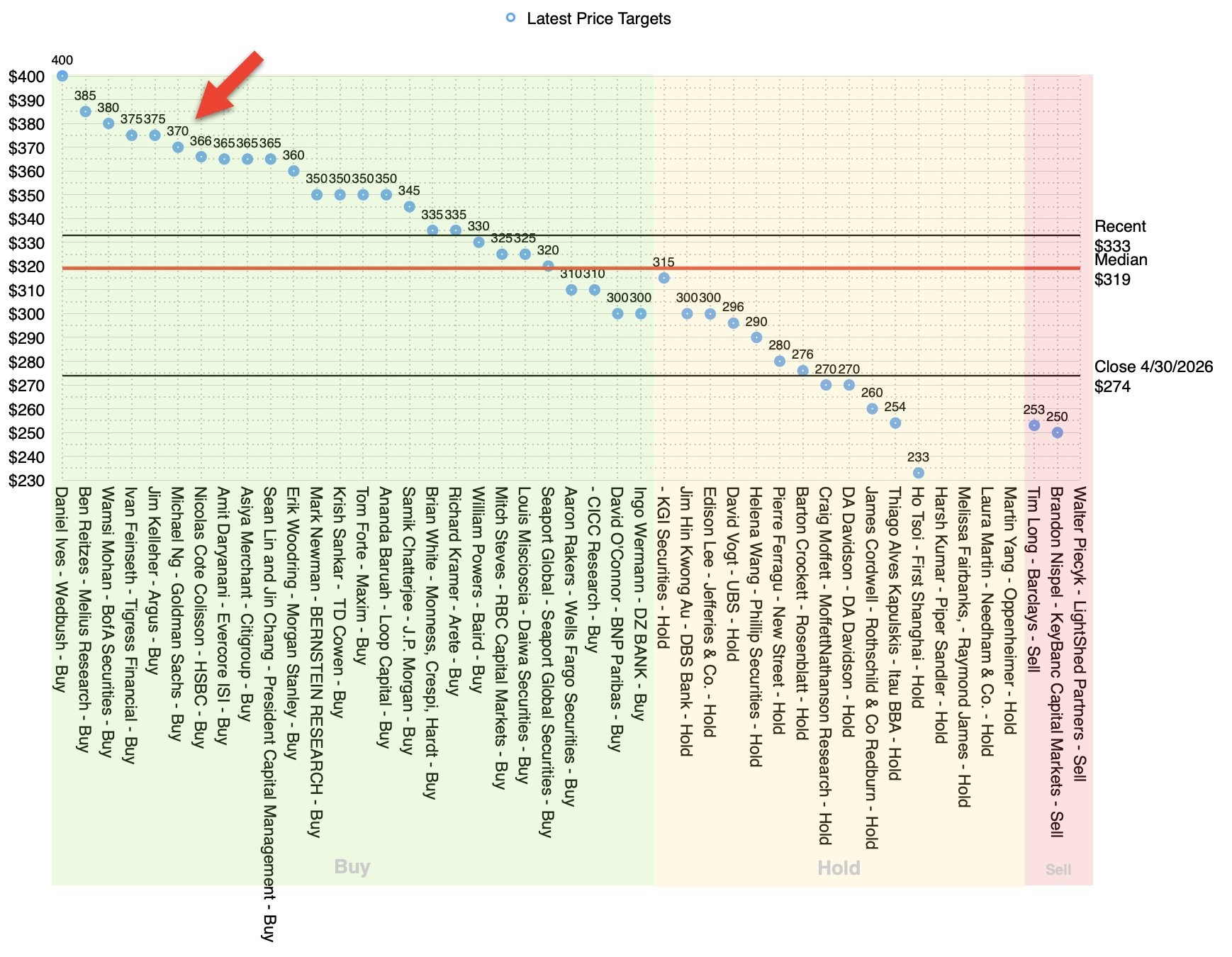
Goldman Raises Price Target Ahead of Q3 Earnings→ Goldman raised its target to $370 from $330, expecting 17% revenue growth and $54.8 billion in iPhone revenue from a price-inelastic base. Ng sits near the high end on both target and estimates. My iPhone estimate has higher unit growth but lower ASP growth; we end up $1 billion apart on revenues, almost all of it iPhone ASP. →
Apple reaches $5 trillion market cap for first time→ Apple briefly touched $5 trillion, a day after passing Nvidia as the most valuable public company. Eight years ago, on the eve of $1 trillion, analysts called it a clean beat on the path to a trillion while warning that 80% of sales were secularly challenged. Strip out the price points and the 2018 quotes read like the present. The company quintupled by doing nothing different. It has always been doing the right thing. →
Wall Street Predicts Third Quarter Numbers For Apple→ Consensus sits at $108.9 billion in revenue and $1.89 in EPS against guidance of 14 to 17 percent growth, on Tim Cook’s final earnings call as CEO. The quarter had no major hardware launches yet iPhone share increased. The thing to watch is guidance: September hangs on exact launch dates, given a split launch period and potential new ASPs. →
Apple Will ‘Watch Everything Burn’ When AI Bubble Bursts→ Ed Zitron told MacRumors that Apple is insulated from an AI collapse and will sit on the sidelines and watch everything burn. I would say they will simply collect all the available profits. He is right to put the Vision Pro at the heart of the discussion; it is the most important innovation of the age. But his comments on how it works show he has not studied it deeply enough to understand why Apple’s culture made it what it is. →
I would say they will simply collect all the available profits
MacRumors interviewed AI critic Ed Zitron, author of the Where's Your Ed At newsletter and host of the Better Offline podcast, about what could happen to Apple if the costly AI infrastructure boom collapses. Zitron argued that Apple is relatively well insulated because it has spent far less on data centers than rivals such as Microsoft, Google, and Amazon. He said the company could use the downturn to make selective acquisitions, though it might simply continue operating largely as before. "I think they will sit on the sidelines and watch everything burn," Zitron said. Here's an excerpt from the report:
If the bubble deflates the way you expect (write-downs, too much compute supply, possibly OpenAI cratering), can you walk us through what that would actually look like for Apple? Does anything break for iPhone users, or does Apple mostly watch it happen from the sidelines? Could it even benefit Apple?
I think things would look much the same for Apple. I think they will sit on the sidelines and watch everything burn. I could see them doing some choice acquisitions as things begin to collapse, but I could also see them do nothing.
I think Apple is in a very weird place at the moment. The Vision Pro was a dud, but it was also the most interesting and future-forward thing I've seen anyone put out in a while. If they were smart, they'd tread water and sink as much money into making that as small as humanely possible -- no matter how long it takes -- because the entire AI bubble is a result of everybody running out of hypergrowth ideas, mostly because we're flat out of new interfaces.
NB: Those who do not study history are doomed to repeat it. The history of computing is one of the easiest to study since it's so recent and well documented. We don't have to conduct archeology or infer from scraps of written works. The people who lived and worked through that period are mostly still alive and we can ask them questions. Still, Zirton misses a few points…
…What I appreciate about Zirton's analysis is that he places the Vision Pro at the heart of the discussion. It is indeed the most important innovation of the age. However he does not understand Apple's culture well enough to know why it is the way it is. His comments about how the Vision Pro works belie a failure to study it and understand it deeply.
There is a lot in the interview on MacRumors so it's worth reading.
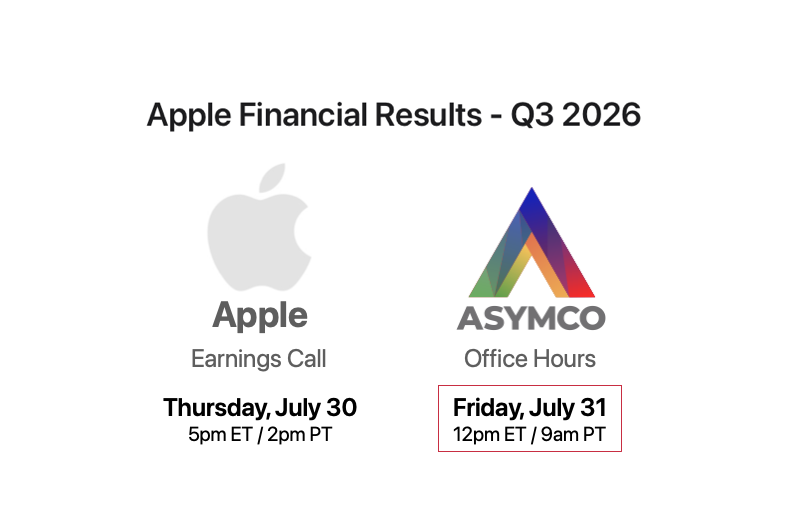
Asymco Office Hours Live Q&A with Horace Dediu takes place today at 12pm ET / 9am PT, the day after Apple’s fiscal Q3 2026 earnings call, Tim Cook’s last as CEO. Horace will review the results and their implications, and we will take Q&A from our live audience.
Topics:
Results vs. expectations: how consensus and Asymco estimates fared against the actuals
Segment performance: iPhone, Mac, iPad, Services, and Wearables growth
Record gross margins and the memory-price question
September quarter guidance, and why to beware December quarter guidance
Capital return: buyback pace, share count, and the net cash position
Tim Cook’s final earnings call and the Ternus transition
$5 trillion market cap, valuation, and the latest price targets
Capping off a historic last week of a historic quarter for Apple:
Today (Thursday, 30 July) 4:00p ET - Market closes. Skim Quarter in Review. 4:15p ET - Watch Horace live on The Close on Bloomberg TV. 4:30p ET - Apple Reports FQ3 Earnings 5:00p ET - Analyst Earnings Call (Tim Cook's Last)
final earnings call for Tim Cook as chief executive officer
Financial experts expect the brand to post very strong numbers for the quarter. Data from Yahoo Finance shows an average revenue estimate of 108.9 billion dollars across 27 different analysts. The earnings per share estimate sits at 1.89 dollars. TipRanks shows a very similar outlook, with a consensus revenue of 108.85 billion dollars. The company previously guided for a revenue growth of 14 to 17 percent compared to the same time last year. It also expects its gross margin to land between 47.5 and 48.5 percent.
This quarter represents the first full period to benefit from devices launched earlier in the spring. Aside from the new AirPods Max 2, there were no major hardware launches during these specific months. UBS noted that the market share for the iPhone actually increased during the quarter.
Mac computer revenue also went up thanks to the arrival of new models, even though the average selling price dropped slightly. The services division should see 13 percent growth, despite some struggles with App Store revenue.
The upcoming conference call will give the market a clear picture of how well the hardware maker handled a quiet summer. Investors will listen closely for any hints about future pricing strategies and how the company plans to handle rising production costs under its new leadership team.
Apple reached $1 trillion market capitalization on August 2nd, 2018, almost exactly eight years ago. Let's recall what the consensus looked like.
The jockeying between Apple and Nvidia reflects a debate about the future of AI that has preoccupied investors this summer. Apple on Tuesday briefly hit a market capitalization of $5 trillion for the first time, a day after passing Nvidia to become the most valuable publicly traded company.
Apple trailed its trillion-dollar peers on the market last year as investors worried that the company was missing out on the AI boom by keeping investments in check and delaying the long-awaited rollout of an upgraded Siri, which will be released this fall alongside new iPhone hardware. But the narrative has flipped of late due to concerns that the aggressive tech spenders are raising mounds of debt and going cash flow negative without a clear path to hefty returns.
NB: Apple reached $1 trillion market capitalization on August 2nd, 2018, almost exactly eight years ago. Let's look back on what analysts recorded as their opinions following the company's June quarter, 2018 results. These quotes were published on August 1st, 2018, one day before the $1 Trillion print.
“The combination of a strong macro environment and an increasingly engaged customer base led to double digit growth in all regions on a sell-in basis during the June quarter,” Morgan Stanley said in a note. “A clean beat on the path to $1 trillion.”
RBC was even more blunt, “Hit snooze for 90 Days. Path to trillion intact.”
Others, like Deutsche Bank, were more measured in their commentary.
“With 80 percent of the company’s sales exposed to secularly challenged businesses, we believe the long-term growth outlook remains limited,” the brokerage said. “With positives and negatives largely balanced at current levels, we view valuation as fair and maintain our Hold.”
Here’s a wrap of all the major analyst opinions.
Morgan Stanley (Overweight):
“Third-quarter revenue beat expectations largely on iPhone average selling prices and Services with wearables maintaining momentum from previous quarters. September-quarter guidance also topped expectations and reflects a similar mid teens revenue growth rate for the overall company despite the more difficult compare from a year ago. The combination of a strong macro environment and an increasingly engaged customer base led to double digit growth in all regions on a sell-in basis during the June quarter.”
“A clean beat on the path to $1 trillion.”
RBC (Outperform):
“Apple reported a modest June-quarter beat and guided Sept-quarter ahead of expectations. Given heightened concerns around large-cap tech and ongoing U.S./China tariff issues, this was a positive print vs. expectations. While we expect investors to wait for pricing clarity on next gen iPhones before deciding on Apple stock, near-term upward bias on the name remains given multiple tailwinds stacking up.”
“While investors looking for a ‘super cycle’ will remain disappointed, Apple’s narrative is shifting towards their ability to sustain mid-single digit sales growth despite flat iPhone units and low-to-mid teens EPS growth via buybacks. Maintain OP and adjusting our target to $225.”
“Hit Snooze for 90 Days. Path to Trillion Intact”
Deutsche Bank (Hold):
“Apple reported better-than-expected third-fiscal-quarter 2018 results with sales upside driven by iPhone, Services, and Wearables. While sales beat, iPhone unit growth of just 1 percent year over year remained lackluster, as iPhone sales upside continues to come from the reset higher in average selling price. Earnings per share beat expectations by $0.18, but we estimate that just $0.04 of the beat came from revenue upside, while the remaining $0.14 was helped by below-the-line items like higher other income, a lower tax rate, and buybacks. Given its revenue base and size, Apple’s recent growth has been impressive. However, with 80 percent of the company’s sales exposed to secularly challenged businesses, we believe the long-term growth outlook remains limited. We continue to see support for the shares from the company’s substantial share buyback, however, with positives and negatives largely balanced at current levels, we view valuation as fair and maintain our Hold.”
Citigroup (Buy):
“We believe the negativity on Apple stock is overdone and the majority of our thesis remains unchanged regarding ‘Applewood & 5 Reasons the Stock Should Trade Higher’ as detailed in this report. Specifically we highlight our view of Applewood which is Apple’s growth in service 31 percent year over year or 28 percent excluding one-time items which now represent 18 percent of Apple’s total revenues coupled with early innings growth of iPhone units in emerging markets and less than 2 percent share in India, thereby driving a growing sticky user base, which we have dubbed Applewood.”
Goldman Sachs (Neutral):
“Apple demonstrated better demand resiliency than we had expected in the summer as evidenced by an iPhone average selling price of $724 which was 5 percent ahead of our forecast. Guidance was just a touch ahead of our numbers but is consistent with our above Street average selling price estimates that are based on a detailed stock keeping unit level model. We believe Street forecasts are likely to move up but that average selling price expectations probably will remain too low for the December quarter as Apple continues to see support from ongoing mix toward higher average prices. Services growth adjusted for one offs dipped slightly but not that materially to 28 percent year over year from 31 percent last quarter.”
Bank of America Merrill Lynch (Buy):
“Five reasons why we believe Apple stock should outperform include: underlying iPhone demand remains strong and average selling prices are moving higher, gross margin has upside in fiscal 2019 given tailwinds from component cost reductions and potential tailwinds from foreign exchange, continued strong capital returns with $90 billion of buyback authorization remaining, continued strong growth in Services revenue across geographies (broad-based strength with contribution from licensing, App Store and Apple Care in the quarter), and strong demand for wearables (Apple watch grew mid 40 percent year over year and AirPods remain in high demand) drove 60 percent year over year growth.”
UBS (Buy):
“Yes, inventory is the highest in memory for a second calendar quarter (primarily component related, should burn completely off in CQ3) but implied iPhone units of 47 million to 48 million for CQ3 was spot in-line + services seem to be hitting an inflection. Apple is also effectively managing through some challenges on the cost side that should abate, though continued devaluation of key currencies like Chinese Yuan are an overall negative that bears watching. Given ecosystem switching which has become nearly non-existent, we think of iPhone as a recurring model in much the same way as services – albeit without much growth until there is a major form-factor change. Fortunately, this is on the horizon with foldable. In the meantime, Apple should at least hold serve with iPhone bias more to the upside based on procurement, average selling price still strong in the $720 to $725 range for the third calendar quarter, and services set to do about $3 per share in calendar 2020.”
Raymond James (Market Perform):
“We reiterate our Market Perform rating on Apple. June quarter results were slightly ahead of expectations; the variance vs. expectations was small enough that we expect neither bears nor bulls to change their view following this report. Apple’s rubber meets the road once the new phones come on sale, and we don’t expect the fall lineup to be different enough to improve the trajectory of iPhone sales. The Services business now represents the bull case for the stock, but our view is that it will be difficult for Apple to sustain the current rate of services growth due to a large portion tied to device sales coupled with a law of large numbers issue from App Store contribution.”
Piper Jaffray (Overweight):
“Apple reported June quarter revenue and EPS above the Street, with September-quarter revenue guidance also ahead of consensus. For the June quarter, iPhone was strong, as Apple shipped a total of 41.3 million units vs. consensus at 41.79 million and iPhone ASP was $724, compared to the Street at $694. Services revenue was $9.55 billion and gross margin was 38.3 percent. Revenue guidance for the September quarter is 3 percent above consensus, with the gross margin outlook in-line at 38.3 percent. With the potential launch of a wider array of ‘X-gen’ iPhones on the horizon, we recommend owning Apple on the potential for a ‘super-long’ cycle involving an ongoing multi-year move to the ‘X-gen’ form factor. Maintain overweight, price target to $218.”
If you did not know these quotes were from 2018, apart perhaps from the price points it would be difficult to guess they were not from the present. Cynics would say nothing has changed and they'd be mostly right. The company has quintupled in value by doing nothing different. It has always been doing the right thing.
In a memo to Apple's more than 120,000 employees on the day $1 Trillion was reached Tim Cook said the $1 trillion valuation was "a significant milestone" that gave Apple employees "much to be proud of." But he said it was "not the most important measure" of the company's success.
"Financial returns are simply the result of Apple’s innovation, putting our products and customers first, and always staying true to our values," Cook said in the memo.