Recording and transcript of the June 9, 2026 Asymco One Office Hours, recorded the day after Apple's WWDC 2026 keynote. Horace Dediu shares his impressions of the event and takes questions from Asymco One subscribers.
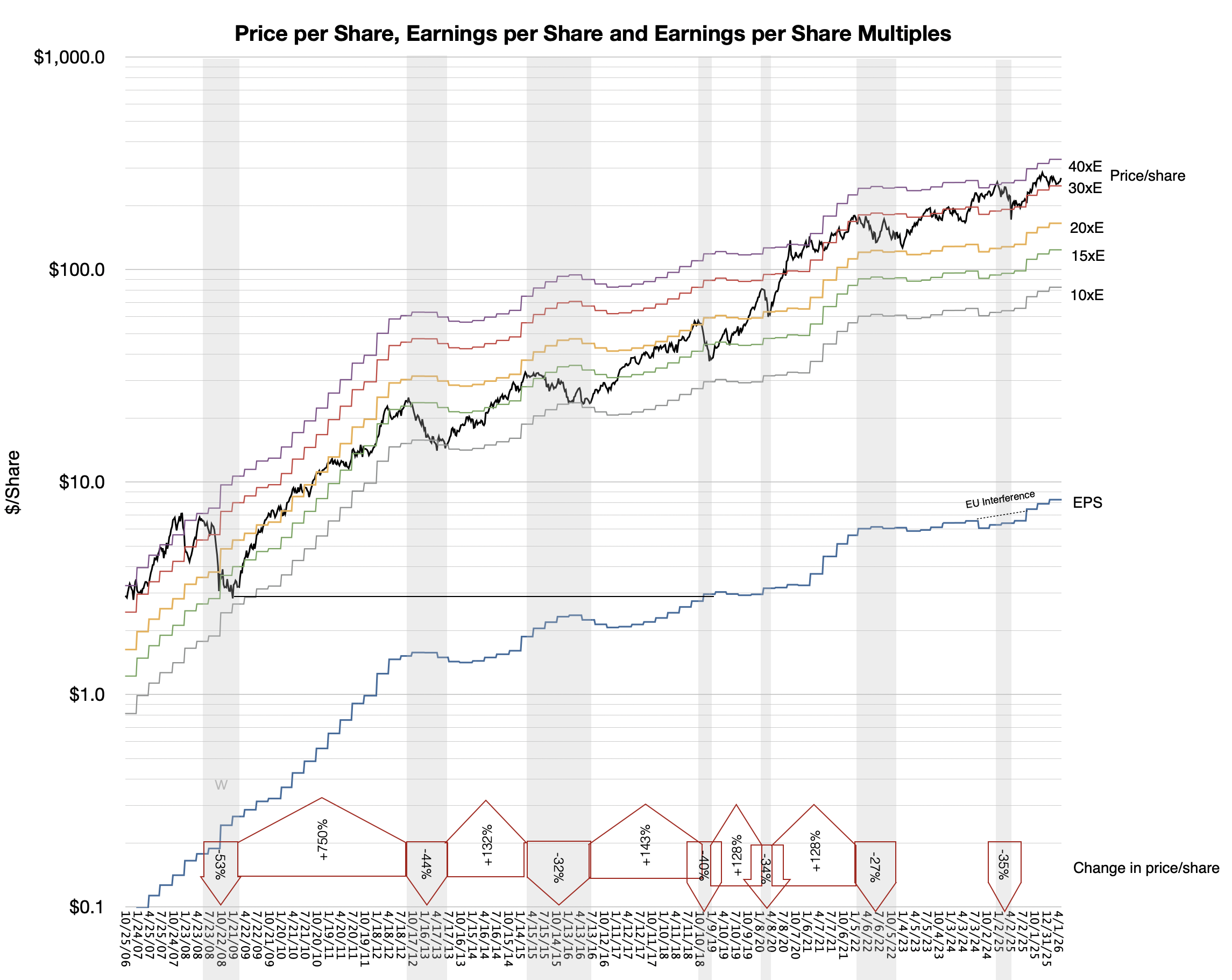
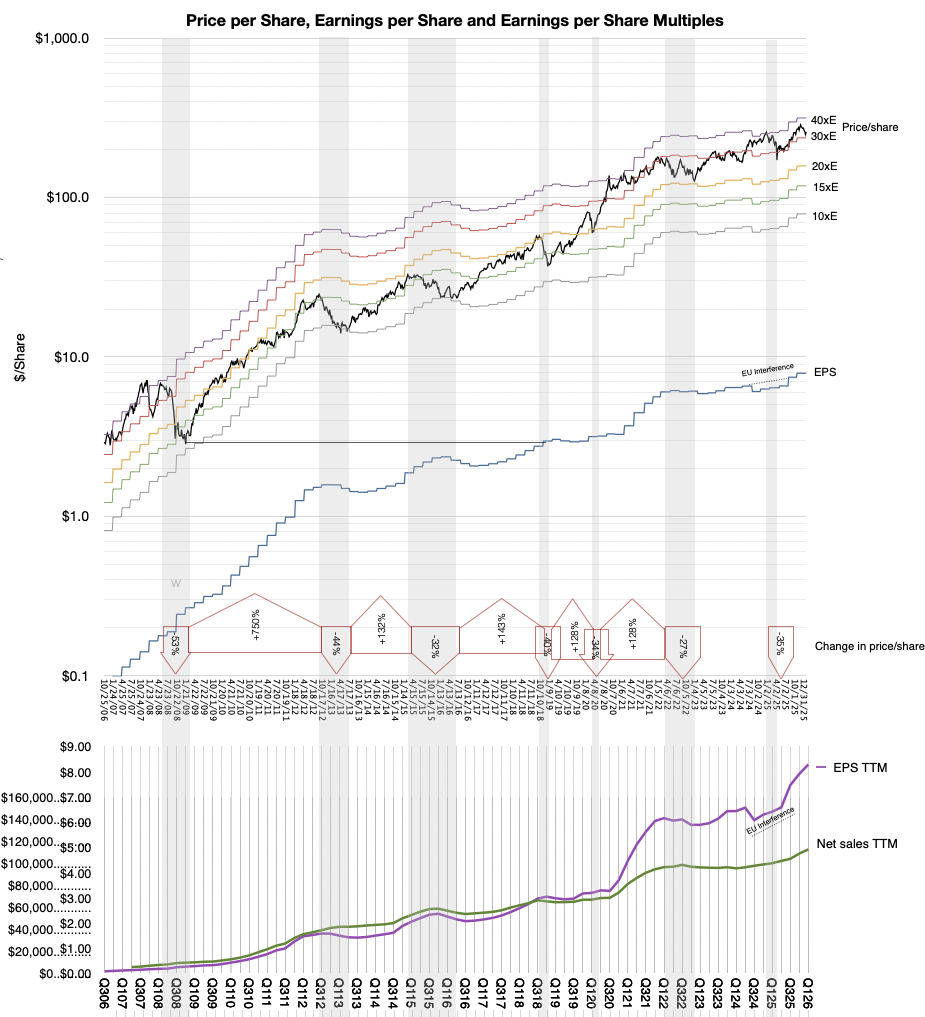
Apple recently hit an all-time high. Today the stock is trading at a P/E of 35. The P/E ratio is the current share price P divided by the last four quarters’ net earnings per share E. But we also have a pretty good idea of the earnings for the next quarter, ending June (now almost half-way completed). The guidance very clearly suggests that on a one Quarter forward basis the P/E ratio is 34.
I’ve maintained for at least 15 years that a reasonable multiple for Apple is 35. This was mainly because other large cap technology companies were also trading around that number. While at this ratio, if a company is growing at 22% it means that an investor will make their money back in about 10 years. Thereafter all free cash flows will go entirely to the investor’s pocket. That seems a reasonable return. It’s not a particularly risky bet to assume 20% growth for 10 years if you look at (a) history and (b) how many people in the world have not yet started using Apple products and (c) assess how well management is doing their job.
So by this measure, Apple seems to be reasonably priced. Historically it has not been reasonably priced but that is due to the disconnect between understanding the business and falling for the usual false tropes. The following graph shows the share price and where it fell between the bands of Earnings multiples. The grey areas represent periods of significant share price decline.
But much of the volatility of the stock is also due to overall sentiment collapse. That has happened on many occasions, most notably the 2008 financial crisis and “great recession.” (Another was the Covid crisis.) In these cases, regardless of underlying strength, the shares were available very cheaply.
Today perhaps we should ask if a bubble is forming due to exuberance around AI which is inflating the market in unsustainable ways.
There are four reasons why the current asset value explosion is different.
First, it is highly concentrated in a handful of names.
2005 S&P 500 top 10
% of the S&P index
2026 S&P 500 top 10
% of the S&P index
Exxon
3.1%
NVDA
7.8%
MSFT
2.5%
GOOG
7.3%
Citigroup
2.2%
AAPL
6.4%
GE
2.0%
MSFT
4.6%
Walmart
1.7%
AMZN
4.4%
BoA
1.6%
Broadcom
3.0%
J&J
1.6%
TSLA
2.4%
Pfizer
1.4%
META
2.3%
Intel
1.3%
Walmart
1.6%
AIG
1.3%
Berkshire Hathaway
1.5%
Total
18.7%
41.3%
Second it is fueled by equity not debt. Third, it involves disproportionate capital expenditure rather than M&A. Fourth it is accompanies by sharply growing revenues (though not as sharp as investment growth.)
In other words, whereas the equity value is growing rapidly, so is income and investment without leverage. This is a low-debt with high income scenario. Previous crises were high income with high debt (2008) or low income with low debt. (Dot Com).
That’s not to say that we have uniform fair equity values. We need to do quite a bit more due diligence to determine the state of the valuations precisely because we have unusual capital allocation strategies.
To cover this topic I’ll will break the analysis into multiple posts. They are:
Why the most common metrics for valuation are insufficient — the problem with the P/E ratio
What are the alternatives that into consideration exceptional cash and capital expenditures — The EV/FCF ratio
How does the P/E ratio differ from EV/FCF and what does it mean if they diverge one way or another
How do the Mag 7 et. al. appear on these Metrics
How to complement snapshots like valuation ratios with the time series of fundamentals
Why payback measures are the ultimate measure of valuation
What are the current payback measures for the Mag 7 et.al.
Compare Apple to its peer group
Finally assess whether a collapse in confidence is imminent
Please return to these pages in the next few days to read these posts.
It's been 15 years but John Ternus has finally stepped down as Apple CEO. Analysts described the transition as expected rather than disruptive, noting that investors had long anticipated Ternus' eventual departure. Nevertheless, he leaves with many questions still unanswered about Apple's long term strategy. Apple incoming CEO faces a defining challenge: Fixing the company’s Services dependence.
It's been a tumultuous tenure for Ternus but he is leaving with significant accomplishments:
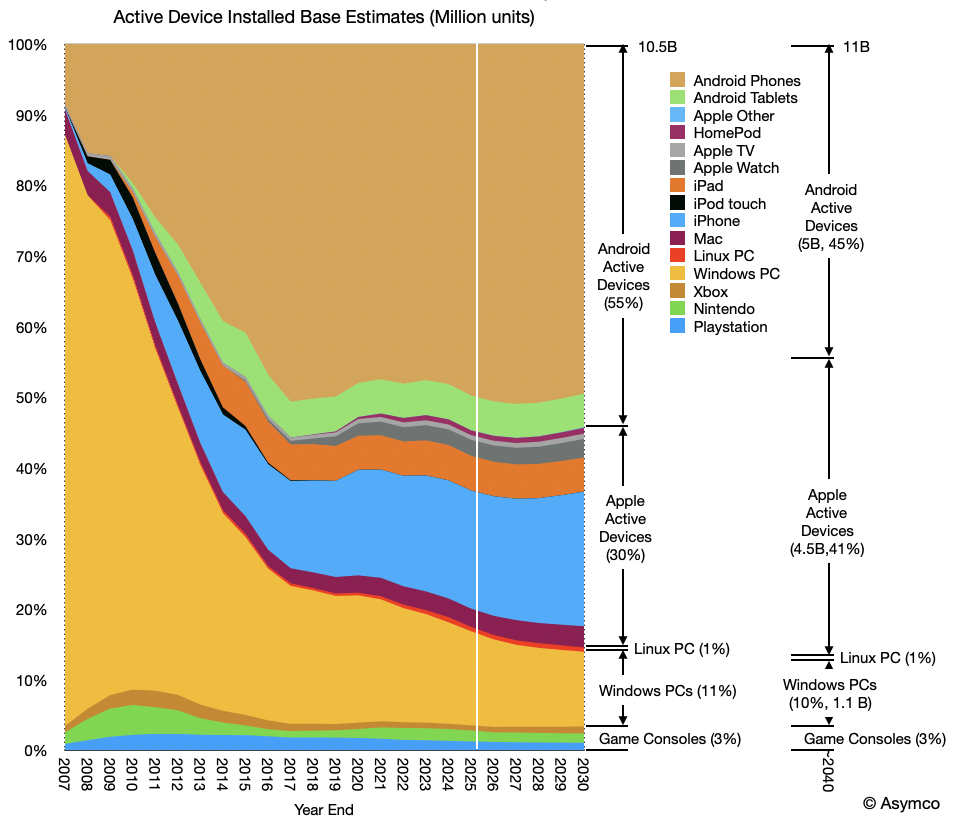
John grew Apple devices to 4.5 billion from 2.5 billion when he took over in 2026. Many have pointed out that he has been building on Tim Cook's success and that John has only added 2 billion devices in 15 years, averaging 110 million per year. The reality is that most of those have been switchers from Android rather than first-time users. Because of this, Android's 5 billion active devices means Android users still outnumber Apple users. Apple's users do have attach rates of over 2.5 devices per user including passive AI wearables but the competition is not standing still. The new CEO will face the challenge of trying to wrest majority market share in a saturated 12 billion active device market.
With over 2 billion customers, Apple is capturing over 40% of all AI revenues. Critics point out that the company has not grown beyond its core: high net worth and high income households. Much of that foundation was laid by his predecessor and arguably all that John has done is maintain a base that grew organically as global income has risen. Over a billion middle/high income individuals have joined the world economy as Apple users but that is hardly attributable to Ternus. His engineering acumen did not give him the insight into marketing to low income countries where most of the users are shunning Apple products.
John has had to navigate a challenging geopolitical situation with the rise of India as the world power and the decline of China. Critics pointed out that Apple's dependence on India is an Achilles' heel and that his transition of production and market growth from China to India has been rough and challenges remain with regulation and labor unrest. The Indian middle class has been the growth engine for a decade but, as all eyes are on Africa and South America, Apple has been on its back foot.
Apple grew the AI business but now depends too much on in. Growth since 2038 has slowed from mid teens to low teens and analysts are pointing out that Apple is too dependent on Services as its biggest source of revenue. Apple's P/E ratio is now below the average of the Fab Five reflecting investor skepticism that it can capitalize on submersible data centers in international waters. Its insistence on local sovereignty for data storage goes against the bathospheric consensus.
Competition has been kept at bay, so far. Apple has seen off challenges by Anthropic, Netflix and SpaceX but there are hundreds of startups looking to build the next Services killer. Billions of satisfied customers are not the moat they used to be.
Apple has made it this far, recently celebrating its 65 anniversary but there is no guarantee that it can continue its run as the world's most valuable company. The next CEO has to steer the ship Ternus just managed to helm through stormy seas.
Much more was said of Jobs’ departure signaling the end of Apple than of Gates’ departure signaling the end of Microsoft. And much more was celebrated of Apple 50 than Microsoft 50. Why is that?
If you were to structure an experiment to determine the influence of processes and personalities on the outcomes of a company, you would be hard pressed to find a better pair to study. Apple and Microsoft were founded almost at the same time, due to the same enabling technologies (microprocessors) and led by two iconoclastic founders of the same age acting out of similar impulses.
The divergences were that one concentrated on software while the other on hardware. But rather than pairing up in a match made in heaven, both tried to outmaneuver the other in order to avoid dependency. →
Cash flow is a fact, earnings are an opinion and share price is a dream.
A company’s total worth is the number of outstanding shares multiplied by their value. This product is called the market capitalization or Market Cap.
That’s a simplification. If you want to be more accurate, you should take the Market Cap and net out cash and debt–these are not part of the future flows of cash that can benefit shareholders.
More precisely, there is another measure called the Enterprise Value (EV) which is the total price tag of a company, representing what it would cost to buy the entire business and pay off its debts. EV = Market Cap + Total Debt + Preferred Stock + Minority Interest – Cash and Cash Equivalents.
This is the precise and complete measure of the firm’s value but we use the shortcut of Market Cap since In most cases the Preferred stock and minority interest are negligible and if cash equals debt then the result is EV =~ Market Cap. it’s easier to calculate anyways as the shares outstanding and share price are easily available. Not so for EV. →
What are the odds of it surviving another year, ten years, 50 years?
Companies don’t last long. A recent study that analyzed thousands of European firms yielded a corporate life expectancy figure of 12.5 years. The Boston Consulting Group analyzed the entry, growth, and exit dates of 35,000 publicly listed companies and determined that one in ten of all public companies fail each year, a fourfold increase since 1965.
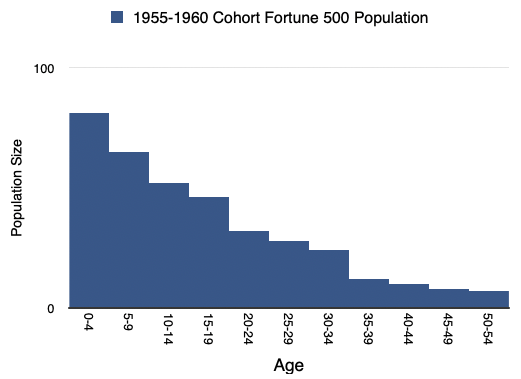
As I illustrated many years ago in a talk titled “The Unfortunate 500” most companies die not long after adolescence. Of the Fortune 500 1955-1960 cohort, the 81 companies which joined the index in those years, only 7 remain there today. One third of the corporations on the 1970 Fortune 500 list were no longer in existence thirteen years later. Broadly speaking, as a population, large companies that make it to the Fortune 500 listing have life expectancy within that group of 17 years. →
Today marks the 16th anniversary of when Apple released the first-generation iPad.
To many, including Alan Kay, the tablet form factor makes much more sense than the PC form factor. It’s more approachable, more intuitive and certainly smaller and more portable. As the graph shows, quickly after launch, the iPad overtook sales of the Mac.
The problem arose that whereas the iPad was smaller, the iPhone what smaller still–so much so that users would take phones with them everywhere. At the same time, the “PC” shrank as well so that many notebook (laptop) computers became thin, light and had day-long battery life. The Mac at least became no bigger a burden to carry than an iPad.
So the iPad was stuck in the middle between an iPhone, that did more and more, and a Mac that was very portable. At this point many said that the iPad was a dead end form factor. →
ON September 3, 1821, 37 years after James Watt invented the concept of horsepower and started charging £5/horsepower/year for the use of his steam engine, the first demonstration of the production of a mechanical force by the interaction of an electric current and a magnetic field was given by Michael Faraday in the basement of the Royal Institution in London.
1820 is, in many chronicles, noted as beginning of the industrial revolution. It marked the end of 50 years of war, whose conclusion unleashed pent-up demand. That demand was served by relatively free trade, guaranteed by British naval power, coupled with property rights and financial instruments which allowed inventions of the previous century to finally be harnessed for commercial gain. The steam engine is the canonical invention of the era and its implementation as a source of power for factories, shipping, rail and machinery is legend.
Not usually noted as coincidental to this period is the electric motor. Yet not long after Faraday’s 1821 demonstration in London, the first DC electric motor capable of turning machinery was invented by William Sturgeon. In 1832 he built on Faraday’s electromagnet by incorporating a commutator which oscillated the direction of current to ensure continuous rotation.
Nota Bene.
The Motley Fool asks: Where Will Apple Stock Be in 5 Years? → Not reading this article is probably a wise decision. Shares could perform in line with the S&P 500’s long-term average Investors can follow a straightforward exercise to try and figure out where Apple’s stock price will be in late March 2031. It’s important to consider both the valuation and profit gains. We just released a […] →
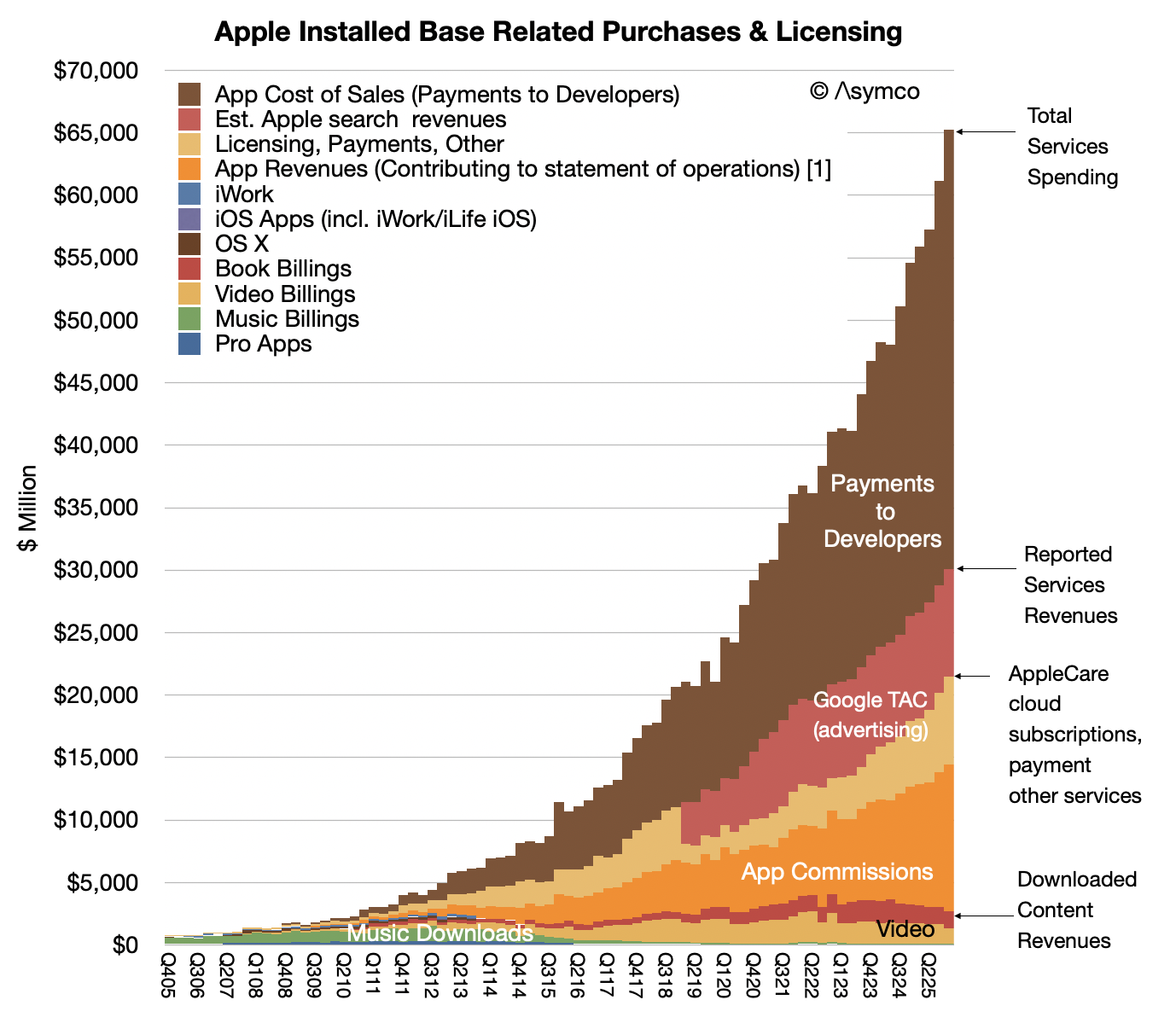
Apple’s services continue to see increased engagement, spending → The survey of 3,500 smartphone users reveals a significant rise in average monthly spend on Apple services to $13, driven by increased adoption of premium offerings like AppleCare/One, Apple TV+, and Apple Music, with notable shifts towards AI features despite muted upgrade intent, though potential US bias may affect overall accuracy. →
iPhone sales continue to surge into February – Bernstein → February saw robust iPhone sales driven by the iPhone 17 line, with global unit sales up 26% and ASP climbing 6.9%, yet January-February revenue estimates oddly lag behind projections, sparking confusion. →
Morgan Stanley has a stark message for investors in Apple → Morgan Stanley's survey indicates strong potential for Apple stock, highlighting record iPhone upgrade intentions, especially in China, improved switching rates, and significant interest in a future foldable iPhone. These factors support robust FY26 shipment forecasts and suggest a possible revenue boost from new products. Despite some concerns about declining willingness to pay for AI features, Morgan Stanley maintains an optimistic outlook with a $315 price target. The article criticizes TheStreet's editorial approach for misrepresenting the positive survey findings as negative news about Apple. →
Mac mini and Mac Studio orders booming → Apple's Mac sales are surging due to the M5 chips' enhanced AI capabilities, outpacing other platforms and driving demand despite current shipping delays. →
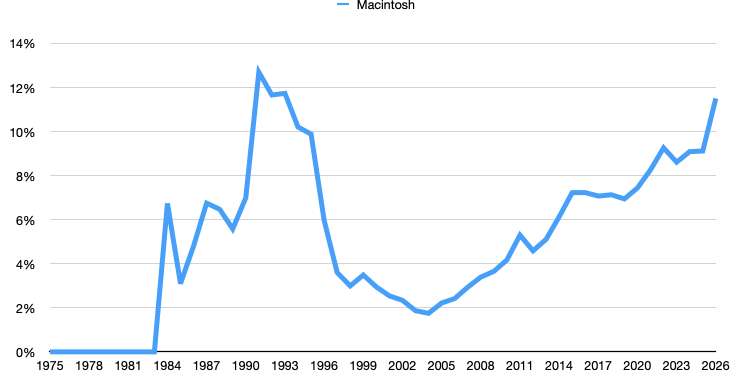
Gartner adds their Mac Q1 estimate to the pile → In Q1 2026, Apple's Mac sales surged impressively by 10.7% to 12.7% year-over-year, driven by the MacBook Neo's appeal, securing a 10.6% global market share and maintaining fourth place among PC vendors, amidst a 4% rise in overall PC shipments. →
The first artificial electromagnet, invented by Sturgeon in 1824. Paper submitted to the British Royal Society of Arts, Manufactures, and Commerce. The magnet was made of 18 turns of copper wire.
ON September 3, 1821, 37 years after James Watt invented the concept of horsepower and started charging £5/horsepower/year for the use of his steam engine, the first demonstration of the production of a mechanical force by the interaction of an electric current and a magnetic field was given by Michael Faraday in the basement of the Royal Institution in London.
1820 is, in many chronicles[1], noted as beginning of the industrial revolution. It marked the end of 50 years of war[2], whose conclusion unleashed pent-up demand. That demand was served by relatively free trade, guaranteed by British naval power, coupled with property rights and financial instruments which allowed inventions of the previous century to finally be harnessed for commercial gain. The steam engine is the canonical invention of the era and its implementation as a source of power for factories, shipping, rail and machinery is legend.
Not usually noted as coincidental to this period is the electric motor. Yet not long after Faraday's 1821 demonstration in London, the first DC electric motor capable of turning machinery was invented by William Sturgeon. In 1832 he built on Faraday's electromagnet by incorporating a commutator which oscillated the direction of current to ensure continuous rotation.
However, for 30 years after its invention, no practical uses could be found for the electric motor. It wasn't because there was no demand. The steam engine was in use and, as Watt's £5/horsepower/year business model demonstrated, very lucratively so. The electric motor was not in use because there was no electricity distribution system. There were no power plants, there was no grid. The motor could not stand alone.
In contrast, the equivalent distribution system for steam was the coal industry. Coal as fuel pre-existed the steam engine. Used not just for heating, it was the fuel of foundries that made iron and other metals. More energy dense than wood, coal had been mined for thousands of years. From mining concessions to barges for transport on newly dug canals to bunkering for storage, sourcing coal was a well-developed, stable and profitable industry.
Finding coal to power a steam engine in the 19th century was not a problem. Finding electricity to power your electric motor was. You could not store it, you could not ship it, you could not meter or price it. It required a completely new value network and infrastructure.
For this reason, even though the electric motor was available through most of the 19th century, the period was still known as the age of steam. The electric grid—an infrastructure—was only possible by the late 1800s as generators, capacitors and AC power were perfected. It wasn't until the early 20th century that the age of electric power began.
This illustrates perhaps better than any other example that the device precedes the infrastructure. That is, that the instrument of utility precedes the network that enables it. the boat precedes the port, the locomotive precedes the railroad, the automobile precedes the motorway, the telegraph precedes the telegraph network, the radio precedes the radio network, the phone precedes the phone network, the cell phone precedes the wireless network and the smartphone precedes the social media. The device induces the supply of its own power.
The implications are profound. It puts to the test the idea that we need to build infrastructures before we know how they will be used. The inventors of electric motors or lights relied on batteries. Investors had to imagine a grid to power more than one. The inventors of the radio had to demonstrate a single transmitter/receiver pair. Investors had to imagine broadcasting. The inventors of the car had to find fuel in pharmacies. Investors had to imagine a gas station. Steve Jobs demonstrated the iPhone without an App store. Investors had to imagine a Services business.
As AI has emerged as a technology, we are in a strange position where the interface, born as a chatbot, suggested an infrastructure that is massive in scale. The magic sauce of GenAI isn't so much the algorithm, which is quite a simple idea. It's the scale of the data and computation that permits the illusion of intelligence.
In developing the commercial idea, investors are imagining the device while investing in the infrastructure. In other words, the investors are poised to put trillions of dollars to work on what amounts to "the grid" without knowing exactly what the motor will be.
The cash flows associated with infrastructures are very different from those of devices. Devices are iterated rapidly and evolve to changing tastes and discoveries of behavior. Infrastructures are built once, maintained and perhaps re-built but only after decades. Therefore financing for infrastructures is more likely through bonds (debt) rather than shares (equity). Returns are also much more subdued as the risk for infrastructures is lower. Regulation and relations with labor are also dramatically different.
Moreover, few businesses implement both the device and the infrastructure. Indeed, the capital structures, financing, longevity and valuations of the two types of businesses are dramatically different. In cases where they are merged, regulators typically intervene to separate them.
Watching from afar, it would seem that if AI is indeed infrastructure then it will not provide a brilliant business model. Like all network business models, you either iterate constantly at great expense to deliver the next generation or you harvest the built environment to pay back the investment, hoping that a parallel network does not steal users. But the cruelty of the model is that if you have a monopoly of any kind, your margins are beaten to zero by regulation and cost of parasitic maintenance.[3]
We can see this with all current "grids". From electric to hydrocarbon distribution, to communications and even food distribution. The struggles to avoid commoditization, corruption and corrosion of trust and a lack of innovation are endemic.
The device however, is another story.
I recommend "The Birth of Plenty: How the Prosperity of the Modern World Was Created" by William J. Bernstein. Bernstein argues that in order to prosper, a country must possess four main attributes: property rights, the scientific rationalism, capital markets and an effective means of transportation and communications.
Reverse chronology: French Revolution, 1803-1815, (including the War of 1812 in US & Canada), which followed a decade of the French Revolution 1789-1799 which followed the American Revolution 1765-1783. This global war, involving most world powers, lasted 50 years.
In a research note published April 7, Goldman Sachs strategists led by Chief Global Equity Strategist Peter Oppenheimer acknowledged the historical basis for those concerns. "The history of technology breakthroughs, from the steam engine to railways, PCs and the internet, is littered with examples of new technologies that attracted large sums of capital to build out underlying infrastructure which have led, ultimately, to low returns," he said. "The gains are then enjoyed by other companies, many of which piggyback off the original investment," he added.
Morgan Stanley just published survey data that makes a strong case for owning Apple stock. The firm's AlphaWise Global Smartphone Survey was released March 22. It shows iPhone upgrade intentions hitting an all-time survey high.
The data support the bank's above-consensus iPhone forecast. Morgan Stanley keeps its overweight rating and $315 price target unchanged. The stock closed at $247.99 on March 20. That target implies roughly 27% upside from that level.
The headline number is a blended global iPhone upgrade rate of 37%, up 2 percentage points year over year. That is the highest reading in the survey's history. The driver is China, where upgrade intentions surged 9 points year over year to reach their own all-time high in the survey.
On the switching side, Apple's net switching rate improved to 11%. That is a five-year high. Apple was the only major smartphone brand in the survey with a positive and improving net switching rate.
Samsung, Xiaomi, Huawei, and others were all negative. That positions Apple to gain market share in 2026 even as the overall smartphone market faces pressure.
Together, these data points support Morgan Stanley's FY26 iPhone shipment forecast of approximately 260 million units, which sits 3% above Street consensus.
The most surprising result in the survey may be the level of interest in a foldable iPhone. Morgan Stanley found that 27% of global iPhone owners are “extremely interested” in paying for one. In China, that figure rises to nearly 40%.
Morgan Stanley expects Apple to more than double the global foldable smartphone market within 18 months of launch. The base case puts foldable iPhone revenue at approximately $40 billion. The bull case reaches $60 billion.
The foldable iPhone is expected to launch in fall 2026 alongside the iPhone 18 Pro lineup. If the survey data translates to actual purchases, the FY27 revenue impact would be significant. Morgan Stanley's FY27 iPhone revenue estimate is already 14% above Street consensus. The foldable is a big reason why.
Apple Intelligence ranked seventh globally as a reason to upgrade to an iPhone.
Willingness to pay for Apple Intelligence fell. Respondents said they would pay approximately $8 per month for an unlimited subscription, down from roughly $9 per month in the prior year's survey.
Morgan Stanley flagged this as a risk worth watching. AI features remain important to smartphone buyers broadly. But Apple appears to be lagging Android competitors in consumer perception of its AI capabilities.
Morgan Stanley laid out the key variables investors should watch this year:
iPhone upgrade cycle. Record upgrade intentions suggest the aged iPhone installed base is beginning to refresh. Replacement cycles are expected to contract by 0.2 years in 2026, which supports shipment volumes.
Foldable launch execution. The survey demand signal is encouraging, but first-generation foldable adoption is inherently uncertain. The revenue upside is large if execution is strong.
Memory cost impact. Unprecedented memory price inflation is expected to push global smartphone prices higher. Morgan Stanley sees this as a bigger headwind for Android competitors than for Apple, given Apple's pricing power. But the June quarter gross margin guidance will be the first real read on how Apple is managing the cost pressure.
Apple Intelligence revamp. The 2026 Siri upgrade needs to meaningfully improve consumer perception. The current trajectory is moving in the wrong direction.
Morgan Stanley's $315 price target is based on 8.5x EV/Sales on FY27 estimates. That implies approximately 32x FY27 EPS of $9.74. Its revenue forecast sits well above the Street even as its EPS estimate is broadly in line with consensus.
The survey does not guarantee an upgrade supercycle. But the data points in that direction. An aged installed base, record upgrade intentions, strong switching dynamics, and a new form factor in the back half of the year make for a compelling setup.
Morgan Stanley thinks the market is not fully pricing that in yet.
Ben Thompson of the Stratechery interviews Horace on the Stratechery Plus Podcast to discuss Horace's journey to become an influential tech analyst: early career in research, business school under Clayton Christensen, and his time at Nokia during the rise of the iPhone.
The conversation further explores Disruption Theory in the context of both smartphones and AI, why Christensen misjudged Apple, and whether AI could challenge today’s tech giants. It also marks the launch of Dediu’s new paid service Asymco One and reflects his continued conviction in Apple Inc. at its 50-year milestone.
“Given Apple’s free cash flow and we are about to embark on one of its most lucrative product rollouts since the big screen iPhones in 2014 - there is a case for Apple’s stock regaining some ground,” Melius analysts wrote in a note to clients.
Lately, Apple has announced the iPhone 17e and a refreshed iPad Air, a new MacBook Air, a MacBook Pro, new Studio Displays, the MacBook Neo, and an updated version of its over-the-ear headphones, the AirPods Max 2.
Apple shares were modestly higher in premarket trading but have lost some 8% year-to-date. Over the past 12 months, shares have gained 12%.
NB: Free cash flow (FCF) is the amount by which a business's operating cash flow exceeds its working capital needs and expenditures on fixed assets (known as capital expenditures). It is that portion of cash flow that can be extracted from a company and distributed to creditors and securities holders without causing issues in its operations. As such, it is an indicator of a company's financial flexibility and is of interest to holders of the company's equity, debt, preferred stock and convertible securities, as well as potential lenders and investors. It has come recently into vogue when the bill for AI infrastructures has come due...
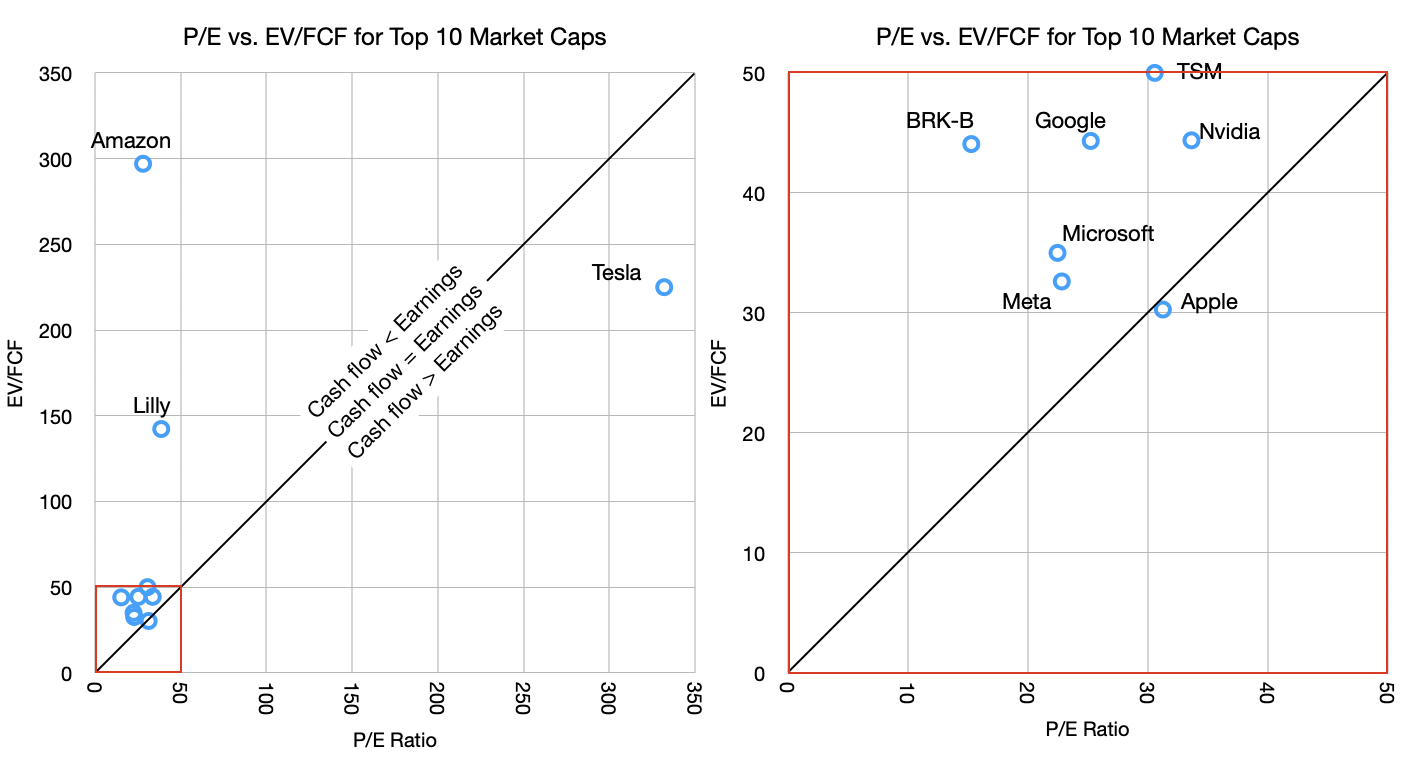
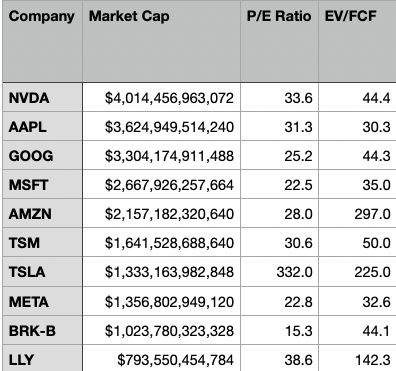
The table above shows the P/E ratios vs. the EV/FCF ratios of the top 10 largest market caps in the world.
A quick search on Apple’s website shows that Neos are sold out and won’t be available for in store pickup until the middle of April. Air and Pro models are available for in store pickup today.
investors might be concerned about margin pressures as the product that’s doing so well is so cheap
‘I view the recent launches of Mac products as a major success for Apple near-term and medium-term,’ Oppenheimer analyst Martin Yang said. “Neo may have slightly lower-than-average margin comparing to other Mac products, but I don’t think margin headwind is large enough to be notable on Apple’s consolidated income statement.”
In July this of this year Asymco turns 17. In April of this year Apple turns 50.
This means that Asymco has been following Apple for one third of its life. I regret that it has not been for longer but oh, what a third it has been.
During 2009, Apple Net Sales were $46.7 billion. 17 years later revenues should comfortably top $500 billion.
Earnings per share (split-adjusted) in 2009 were 37c. This year EPS will be around $9.5.
Most importantly, at the end of 2009 Apple had about 107 million active devices (43 million Macs, 33 million iPhones and 30 million iPods!) Today it has 2.5 billion.
The increases in multiples:
23x Active devices, or a compounded annual growth (CAGR) of 20%
11x Revenues, CAGR of 15%
26x Earnings, CAGR of 21%
Apart from the customer love affair these numbers reveal, investors were awakened. 36x increase in Apple share price, from $7.5 to about $270. That’s 17 years of 23.5% growth.
The appreciation of the share price faster than the other underlying metrics reflects the undervaluation that existed for most of the last 17 years. Its value grew a lot more because it was too cheap to begin with.
That was perhaps my most important observation. A recurring undervaluation reflecting a perceived fragility. The more I studied and came to learn how the company operates the more I realized that the perception was wrong. It was in fact the opposite of reality.
When I started my “Apple model” in 2009 I did it out of indignation. I had access to a few analyst reports covering the company and, when looking at their forecasts and assumptions, I was shocked to read that they treated Apple as a computer company. Two years had passed since the iPhone launched and I had made the radical assumption that the future of the company would be determined by the dynamics of phones--later to be broadened into “devices.” This did not appear radical to me because five years earlier Apple had created the market for music players. A market it came to dominate. It seemed very rational to me that with the iPod (and iTunes), Apple had demonstrated that it was more than a computer company. Or perhaps more accurately, it was so profoundly different as a computer company that it redefined what computers were. Nonetheless, observers seemed stuck with the perception that once a PC maker, always a PC maker.
So here is my prediction today: Apple at 50 is no less capable than Apple at 20. Indeed, it is more so. This is because, even if it has not yet completed its quest, the company has sought self knowledge. A knowledge which I have sought to gain as a distant observer.
And so here I am, inviting you to come along with me on this journey.
Asymco is being re-launched. Apple at 50 is entering a new era. It has transitioned from Apple ][ to Mac to iPod, iPhone, iPad, Watch and Spatial Computing. But it has always been the company that brought computers to people and people to computers. The new era of computers that appear more like people is dawning and the connection between the two needs to be built. Only Apple is capable of creating this connection. And only Asymco is able to tell the asymmetric story of how it will happen.
Let’s learn together.
To make this research possible we’re launching Asymco One.
Asymco One is the analysis you need for understanding everything in the world of Apple. It’s a bundle of seven categories of content:
Curated news and commentary with Nota Bene.
Reconsider your assumptions with Research.
Save time with the weekly summary in the Bulletin.
Supercharge your narrative with Asymetric podcasts.
Get your questions answered during Office Hours.
Attend in-person or online the full-day Conference.
Search over 1800 posts, 60,000 comments, 400 podcasts and thousands of graphs since July 2009 in the Archives.
All while connecting with the most knowledgeable community of thinkers and investors in Apple.
Asymco One is a bundle which will offer over one thousand updates per year providing the ultimate intuition on Apple for stakeholders and connoisseurs of the most important phenomenon of our time.
It’s available as a subscription for $1000/yr, about the price of an adequately configured iPhone.
For early adopters we are offering a discount of $150 with the code INNOVATE.
I hope to see you in the Comments, the Office Hours, the only Conference and in person.