Asymco

Asymmetric Intelligence

Samsung

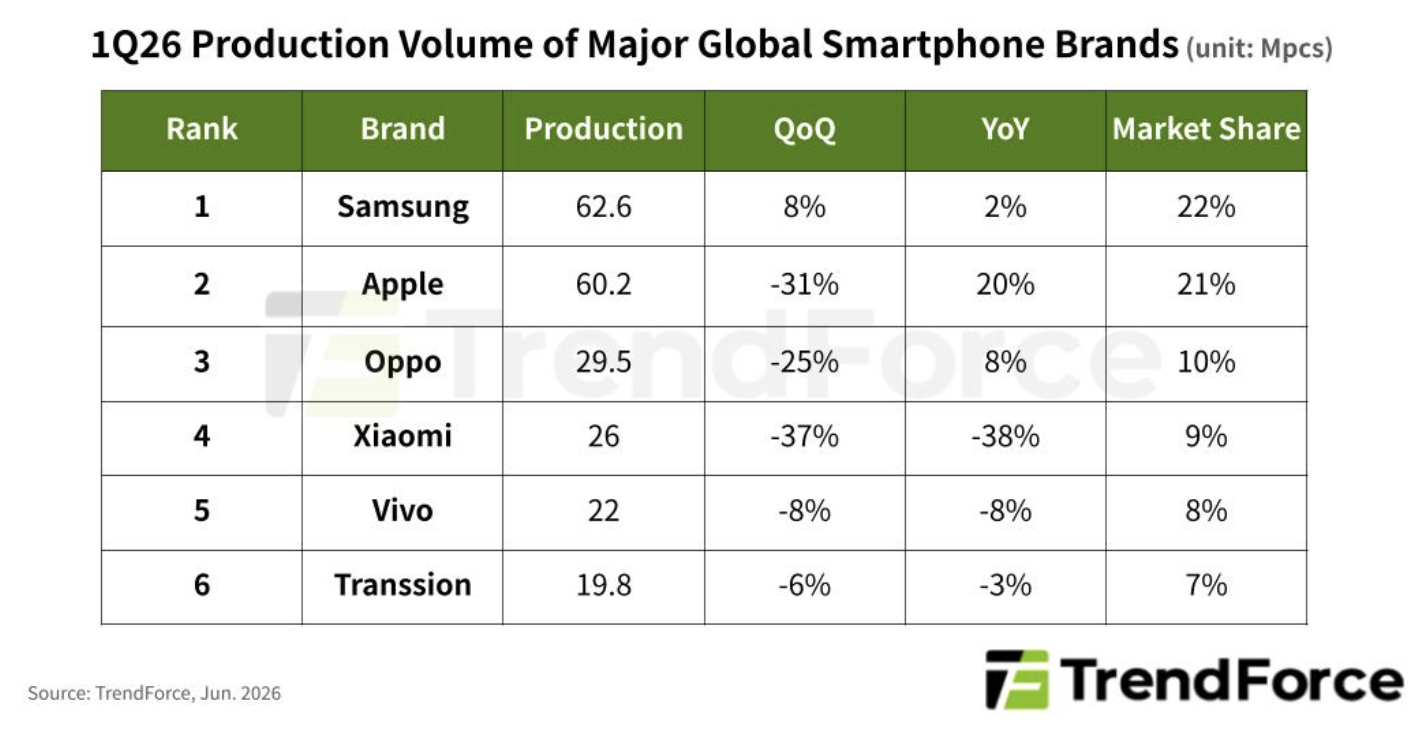
  1. Trendforce: Global Smartphone Production Fell 1.7% YoY in 1Q26; Sharper Decline expected in 2Q26

    Nota Bene · 2 comments

    Apple increases production by 21%

    TrendForce’s latest figures reveal that global smartphone production reached around 284 million units in the first quarter of 2026, marking a 1.7% YoY decline. Despite a sharp rise in memory prices since the second half of 2025, the effect on production was minimal because brands still held inventories of cheaper memory components. Additionally, consumer expectations of higher prices in the future have helped sustain short-term demand, cushioning the impact of rising memory costs on production during the quarter.

    However, as low-cost memory supplies are gradually exhausted and significant ongoing increases in memory prices reduce profits, most smartphone brands have begun adjusting production in the second quarter.

    Looking ahead, TrendForce forecasts global smartphone production to decline approximately 16.2% YoY to 1.051 billion units in 2026. Under a more severe scenario, the annual decline could become even more pronounced if memory price increases remain elevated and brands are forced to raise retail prices repeatedly.

    TrendForce notes that Samsung is relatively well-positioned to withstand the current cost inflation cycle thanks to strong financial backing from the broader Samsung Group and a sizable premium product portfolio. Nevertheless, its significant exposure to lower-end models remains a concern—particularly amid weakening consumer sentiment—making end-market demand a key factor to monitor.

    Apple ranked second with its production of approximately 60.2 million units during the quarter. In addition to ongoing production ramp-up for new iPhone models, output was supported by the launch of the iPhone 17e, resulting in 19.7% YoY growth.

    Compared with competitors that have already entered a margin-protection phase, Apple remains better positioned to absorb higher memory costs while maintaining profitability. TrendForce believes Apple is more likely to prioritize market share expansion during the current downturn as it lays the groundwork for future growth in recurring software and services revenue.

    Xiaomi, Oppo, and Vivo focus on preserving profitability as production plans face greater uncertainty

    First quarter production declined seasonally among the major Chinese smartphone brands, including Oppo (29.5 million units), Xiaomi (26 million units), and Vivo (22 million units). These three brands ranked third through fifth globally by production volume.

    While all three delivered strong market share gains in previous years, surging memory costs are now weighing heavily on profitability, creating significant uncertainty around their 2026 production plans. As a result, production targets may be revised downward if cost pressures persist.

    Transsion produced approximately 19.8 million units in 1Q26, roughly flat compared with the same period last year, placing sixth among global smartphone brands.

    The brand has been particularly vulnerable during the current memory price supercycle given its smartphone portfolio is heavily concentrated in entry-level and budget segments—where profit margins are already thin. Limited access to low-cost component inventories has further amplified the impact.

    Source: TrendForce

    NB: Counterpoint tracks sales, Trendforce tracks production. The production data may include inventory build-up not shown in sales while sales may include drawdowns not shown in production. The two analyses however agree on a market under significant supply-side stress. Profitability is a big concern and availability of components is critical. As noted previously in response to Counterpoint reports, the 2026 full year volumes will probably show the worst decline in decades.
  2. IDC Forecast: The smartphone market is on track for its worst year ever

    Nota Bene · 2 comments

    AI-driven memory shortage continues to hammer sales; Android sales to drop 20%

    According to analysis firm IDC, smartphone shipments are headed for a 13.9% decline in 2026, a downward revision from the 12.9% decline IDC had anticipated for the year in February. It would also mark the steepest drop in smartphone history, the company said.

    “these pressures are compelling vendors to reduce shipments, raise prices and concentrate on higher price tiers — elevating smartphone [average selling price] to a record $550, up $100 from last year,” IDC senior research director Nabila Popal said in a statement.

    “2026 will be a defining year for the industry as [a] new reality of structurally higher costs take hold,” she added. “For consumers, it means the era of ultra-cheap smartphones is over. For vendors, it means only those that can adapt their strategies to this new cost environment and sustain demand at elevated price points will survive.

    The broader Android smartphone market is set to take the biggest hit, with IDC projecting a 20% year-over-year drop in shipments. Despite that, Samsung is expected to increase its market share in the space at the expense of smaller smartphone companies thanks to its midrange and premium device lineups.

    Apple, the research firm said, is also expected to perform relatively well, with shipments forecast to fall 5.2% on the year, an improvement from a previously anticipated decline of 8.1%.

    In its most recent earnings report, Apple announced iPhone revenue growth of 20% for the second consecutive quarter, thanks to its strong iPhone 17 lineup and improved sales out of China.

    But CEO Tim Cook also warned of supply constraints due to both the memory shortage and the dearth of iPhone processors.

    See also: The Smartphone Market is Cracking.

    Source: Yahoo Finance

    NB: I would add that Apple also announced that revenues for June quarter would increase at the same rate as they did for March quarter, thus for at least half the year the company will achieve 20% growth in iPhone sales. This is in sharp contrast to both what IDC and Omdia have been reporting.

  3. Omdia: Apple grows 9% as European Smartphone Market Grows 2%

    Research · 4 comments

    Market contraction expected for second half of year.

    Omdia reports that Europe (ex. Russia) smartphone market grew 2% to 33 million units in 1Q26.

    Key vendor highlights from 1Q26 include

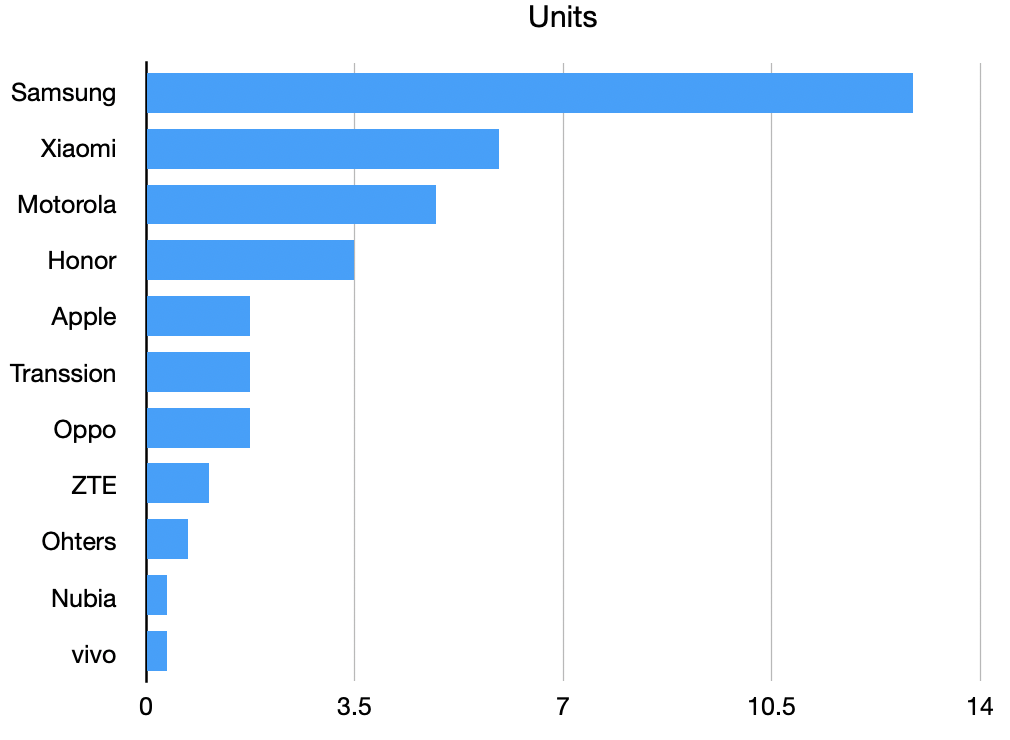
    Samsung was Europe’s largest vendor as it grew 3% to 12.6 million units. Effective discounting of the Galaxy A16 4G helped Samsung boost volume, offsetting declines related to the delayed launch of the Galaxy S26, A57 and A37.

    Apple grew 9% to 8.8 million iPhones, driven by robust iPhone 17 series demand in addition to benefiting from a wider mid-range coverage from the iPhone 15 and iPhone 16e. Noticeably, Apple’s strong results came despite lower and fewer discounts than in previous years.

    Xiaomi retained third place despite declining 15% to 4.5 million units, as it was more immediately impacted by supply-side difficulties. However, Xiaomi’s ASP grew 21% compared with 1Q25, boosted by a record-strong Xiaomi 17 and 15T series performance, which drove year-on-year value growth despite the shipment decline. Premium sales were particularly strong in France, Germany, and Spain.

    Motorola grew 17% to 1.9 million units, driven by rapid expansion in Spain and Portugal, alongside continued progress in France and Italy.

    OPPO grew 9% to 1.3 million units, largely driven by its comeback in France alongside growth in Romania and Poland. With both realme and OnePlus now under its umbrella, OPPO is restructuring to optimize its portfolio and strategy with ambitions to strengthen its European position.

    HONOR, ranking sixth, was the fastest-growing vendor among the largest players, with shipments increasing more than 60% compared to 1Q25. HONOR’s growth is underpinned by its portfolio being expanded further down the price-tiers.

    Source: Yahoo Finance

    "The average-selling-price (ASP) of smartphones in Europe surged to a record-high level of €580 in 1Q26," added Bjorhovde. "This was largely caused by lower availability of devices costing less than €200, which made up an all-time low of just 25% of shipments. Additionally, the high-end remained resilient thanks to Apple’s growth. The focus from both vendors and channel partners has shifted from volume to value to deliver results and operational sustainability. Many vendors who normally focus on the mass market segments are increasingly concentrating on the mid-to-high-end, hoping to benefit from less price-sensitive and upgrade-willing buyers."

    [My emphasis]

    "The first quarter of 2026 delivered beyond expectations, but the outlook remains bearish as the rapidly escalating memory bottleneck worsens," commented Bjorhovde. "Omdia forecasts shipments into Europe to decline 12% in 2026, but the majority of this will come in the second half of the year.

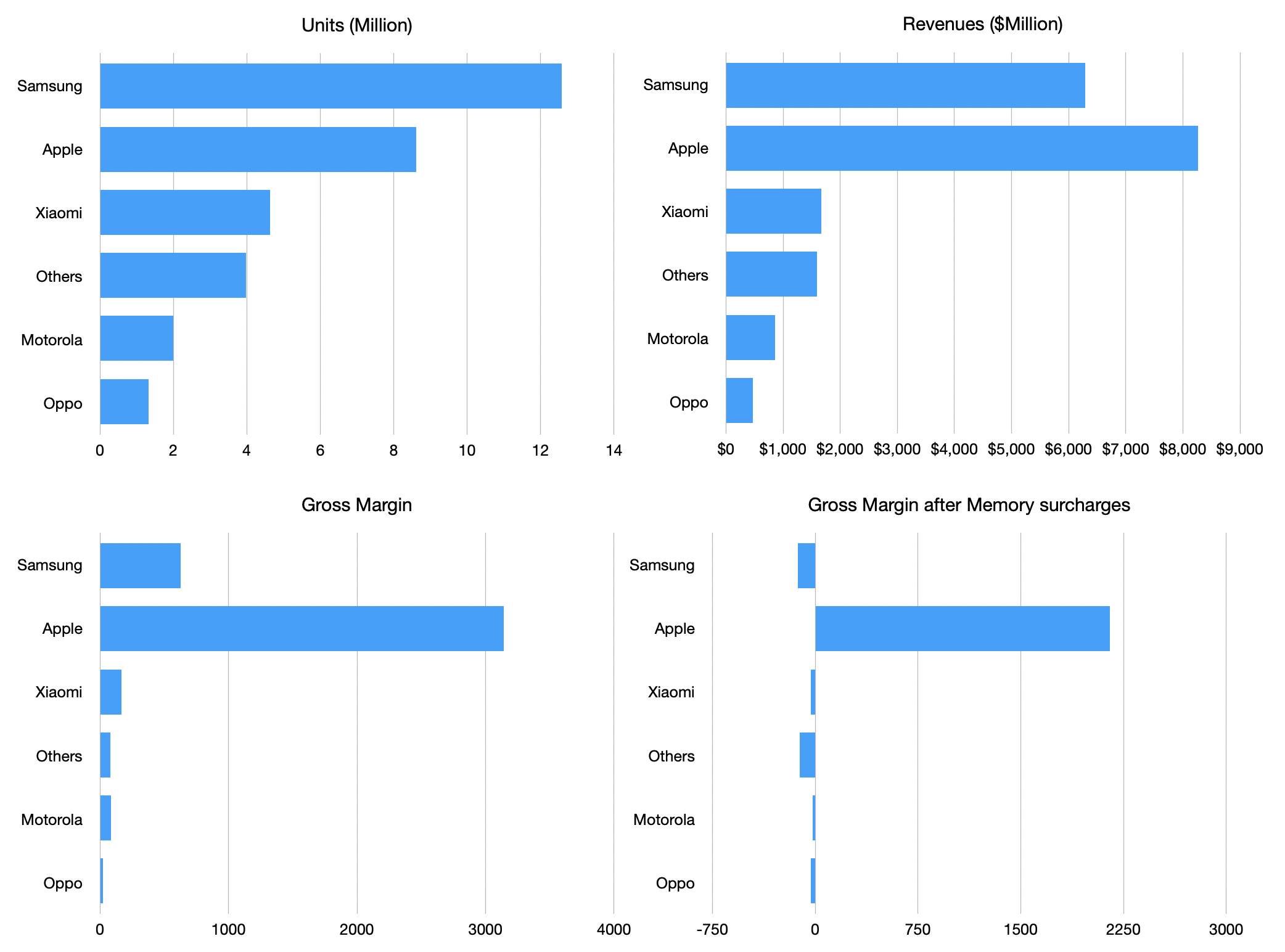
    Applying average pricing per vendor and average gross margins gives the following picture of the market:

    Apple currently captures 26% of unit volume, 43% of ...

  4. Apple was fastest growing Latin American smartphone vendor in Q1

    Research · 3 comments

    31% growth in a flat market

    The Latin American smartphone market grew 3% year over year in 1Q 2026 to 34.8 million units, supported by proactive inventory accumulation and the delayed pass-through of rising memory costs. Omdia analyzes the market’s uneven vendor performance, as Samsung and Xiaomi strengthened their leading positions, while HONOR and Apple saw sharp growth supported by entry-level and premium demand, respectively.

    Samsung led the region, shipping 12.9 million units (+9% YoY) and lifting share to 37%, its highest quarterly level since 1Q 2023, supported by strong performance of A‑series models across low‑end and mid‑high segments. Xiaomi held second, marking a sixth consecutive quarter of growth with 6.0 million units and 17% share, driven by double‑digit gains in Central America and Peru and solid traction of the Redmi Note 15 series in the mid‑high range. Motorola ranked third, contracting 5% YoY to 4.9 million units and 14% share, largely reflecting a 37% drop in shipments of US$100–US$200 devices, where G06 and G17 are key models. HONOR consolidated in fourth with 30% YoY growth to 3.4 million units and a 10% share, propelled by its Play 10 in the entry segment (below US$100), which approached half a million units sold for the first time.

    Apple completed the top five with a 31% YoY increase, supported by an exceptional performance in Mexico (+80% YoY) and robust reception of the iPhone 17 series.

    Source: Omdia

    NB: Apart from Nubia(?) with 1% share, Apple was the fastest growing vendor in a flat market. Note the price points…

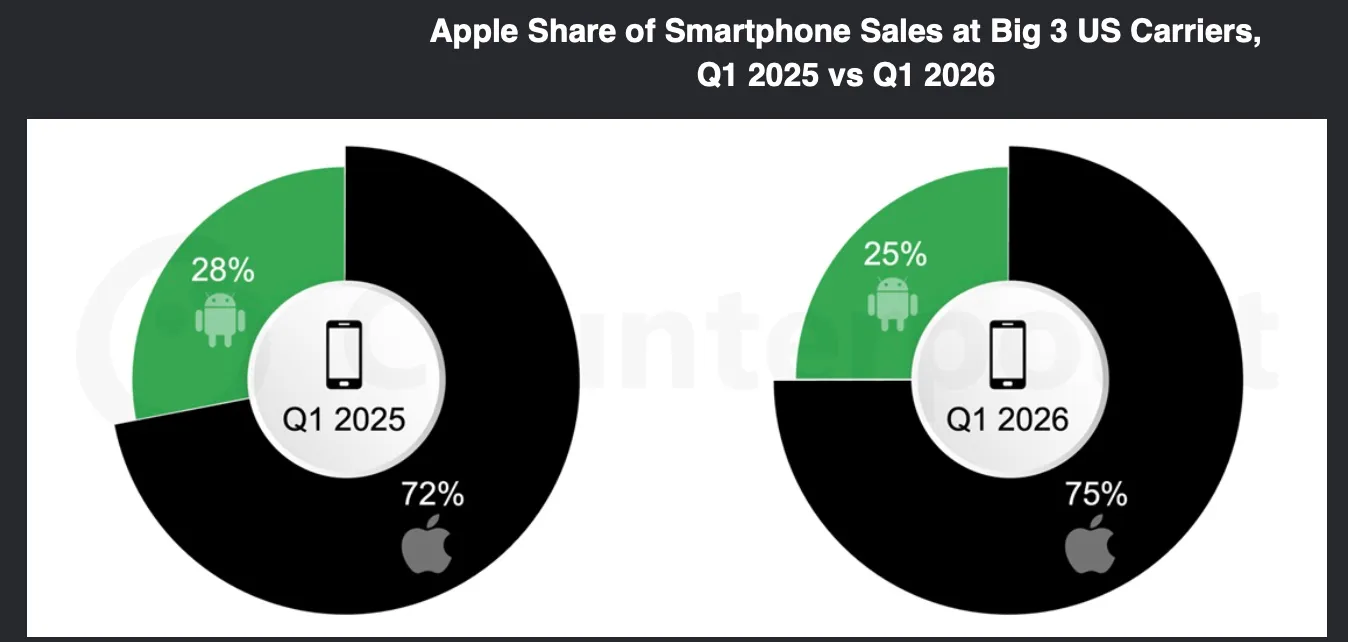
  5. iPhone Share of US Big 3 Carriers reaches 75%, 77% with Verizon

    Nota Bene · 2 comments

    Android down 14.4%. Small players getting crushed.

    Apple’s quarter one (Q1) 2026 iPhone sales volume in the US was up 1.3% year-over-year (YoY), outperforming the country’s overall smartphone market.

    That market declined 5.7% YoY, according to Counterpoint’s US Monthly Smartphone Channel Share Tracker. Apple’s share of volume grew by 4% YoY, as Android device sales declined 14.4% YoY.

    On the impact of the delayed launch,Graham said, “The premium smartphone space in the US is highly consolidated compared to some other markets, with Apple, Google, Samsung and, to some extent, Motorola comprising the vast majority of sales here. When one brand delays a flagship launch, it opens a window of opportunity to fill that vacuum. Apple did just that.”

    Apple grew its market share in each of the Big 3 US carriers. Its share grew the most at Verizon to 77% in Q1 2026.

    “If Apple can avoid significant price increases and continue to outpace its peers in promotional dollars, it will be tough for Android manufacturers to keep up in the year ahead, said Klaehne.

    Source: Counterpoint Research

    NB: What are the dynamics of the US market? The split between Apple and the rest of the market seems to be starker than ever. It's ask if there is a K shaped market emerging…

  6. The Smartphone Market is Cracking

    Nota Bene · 6 comments

    Fundamentals are breaking; Profits evaporate; Competitors flee; Android logic questioned

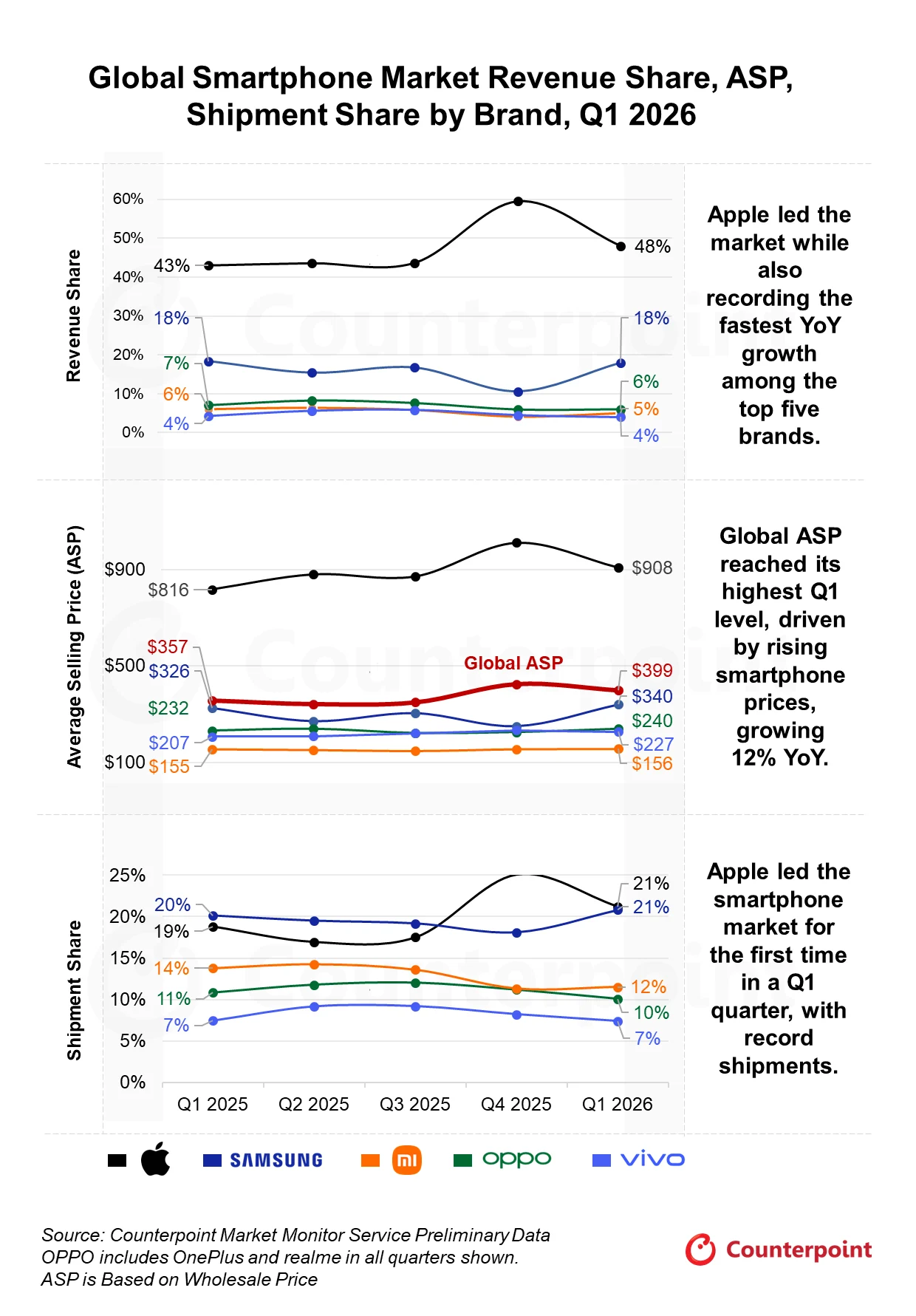
    Apple’s revenue climbed 22% YoY in Q1 2026, registering the fastest growth among the top five smartphone brands while also hitting a first-quarter record high. Furthermore, the brand led the global smartphone market in terms of shipments for the first time in a first quarter, capturing a 21% share.

    Commenting on Apple’s performance, Research Director Jeff Fieldhack said, “Apple’s growth was driven by sustained demand for the base iPhone 17 and iPhone 17 Pro Max, with a stronger mix of these models lifting Apple’s overall ASP by 11% YoY.

    Unlike its peers, Apple mostly maintained stable pricing despite rising BOM costs, reflecting its ability to absorb cost pressures and remain insulated from the memory crisis, which helped strengthen its competitive position during the quarter. Regionally, Apple saw broad-based strength, especially across the Asia-Pacific region, driven by subsidies, promotions, and trade-in offers.”

    The global smartphone market’s revenue grew 8% YoY in Q1 2026, driven by strong premium demand and pricing adjustments across major OEM portfolios amid rising Bill of Materials.

    The average selling price (ASP) climbed 12% YoY to reach $399, supported by contraction in entry-level segments and price hikes across regions.

    Apple led the global smartphone market in terms of value, recording its highest-ever first quarter revenue. Apple was the fastest growing brand with revenue up 22% YoY supported by relatively stable pricing compared to peers, despite broad-based price increases across the industry.

    Samsung held an 18% revenue share in Q1 2026, with shipments reaching 21% of the total market, supported by portfolio optimization and strong response for the Galaxy S26 series.

    The global smartphone market is expected to remain under pressure through 2026, and a substantial recovery is expected only in late 2027.

    Source: Counterpoint Research

    NB: The average sales price is up to $399 but Apple, with the largest share and fastest growth, reached $908? There's a lot more that does not make sense.

  7. The great memory panic of 2026

    Research · 2 comments

    Office Hours question asked by by Ian H. on May 1, 2026

    Q: Memory prices could move from 15% to 40% of the BOM of a device. This seems incredible. So how can Apple deal with this?

    This has been on people's minds now for what, three, four months? I think since January. I call it the Great Panic of 2026. The great memory panic.

    First of all, you have to understand the scale that Apple operates at. The number of devices in the hundreds of millions. It's not just iPhones, obviously. All of the Apple products consume some memory. And there's a lead time. When you're dealing with scale, there's a lead time. There's usually a couple years of lead time. And every supplier who works with Apple is doing it because they love volumes.

    Now, volumes are good for suppliers because they can also predict things in their own operations. They can plan, they can raise capital. Usually they need loans to do that, and they get good terms on loans if it's a long-term payback. And there's a lot of moving parts there that benefit scale.

    The difference with memory pricing that we're seeing a lot of anxiety around is at the margin. That is to say, there's a base production, and then there's a variable production. That variable production comes when somebody orders, "Hey, can I have something next month?" And the smaller suppliers tend to not have that long-term planning or the volumes that can fill the pipe. And so the marginal pricing on memory has gone through the roof. It spiked, and that's what we're seeing. But that's on the variable bit.

    So Apple negotiates on the base load. Now, of course, that marginal cost is going to eventually infect, if it continues long enough, base price. In fact, suppliers are going to say, well, even if it's two years out, we're going to have to ask for more, because there's so many other players that also we anticipate will be two years out. But then Apple can negotiate on another basis and say, well, if you don't do us a favor here and give us a better rate, then maybe we won't work with you when all this settles down. You know things are going to settle down. These things are always cyclical. There's never been a semiconductor boom that's not followed by a semiconductor bust. Never. And they know it.

    So they're happy to make mint on this volatility right now. So much so that I heard Samsung's making more money now with memory than Nvidia's making with their processors. So memory suddenly is the new gold. A year ago, two years ago, it was about compute. Now it's memory. Who knows what's next?

    But if you're in this business for the long term, and you want to play games, Apple's going to be there a lot longer. You could believe that AI is going to be going at this rate forever. We'll see if the profit model can sustain it. But I just speak from experience. There's a lot of these things that happen in the phone space with all kinds of components. There were always some shortages.

    There was storage. The iPod killed a hard drive supply chain. Apple monopolized the CNC machines that made the aluminum Macs. And these things happen. By the way, that monopoly is no longer in effect. Eventually, somebody built enough of the tooling and sold them to Apple's competitors. And if they want to make an aluminum enclosure, they can do so now. But that's how it is in this game, and nobody plays it as well as Apple does.

    If you read the book on China — Apple in China — there's a lot of anecdotes about this. So I can't get excited about any of these stories about supply crunches, other than there being a windfall for somebody and an anxiety, a panic for somebody else.

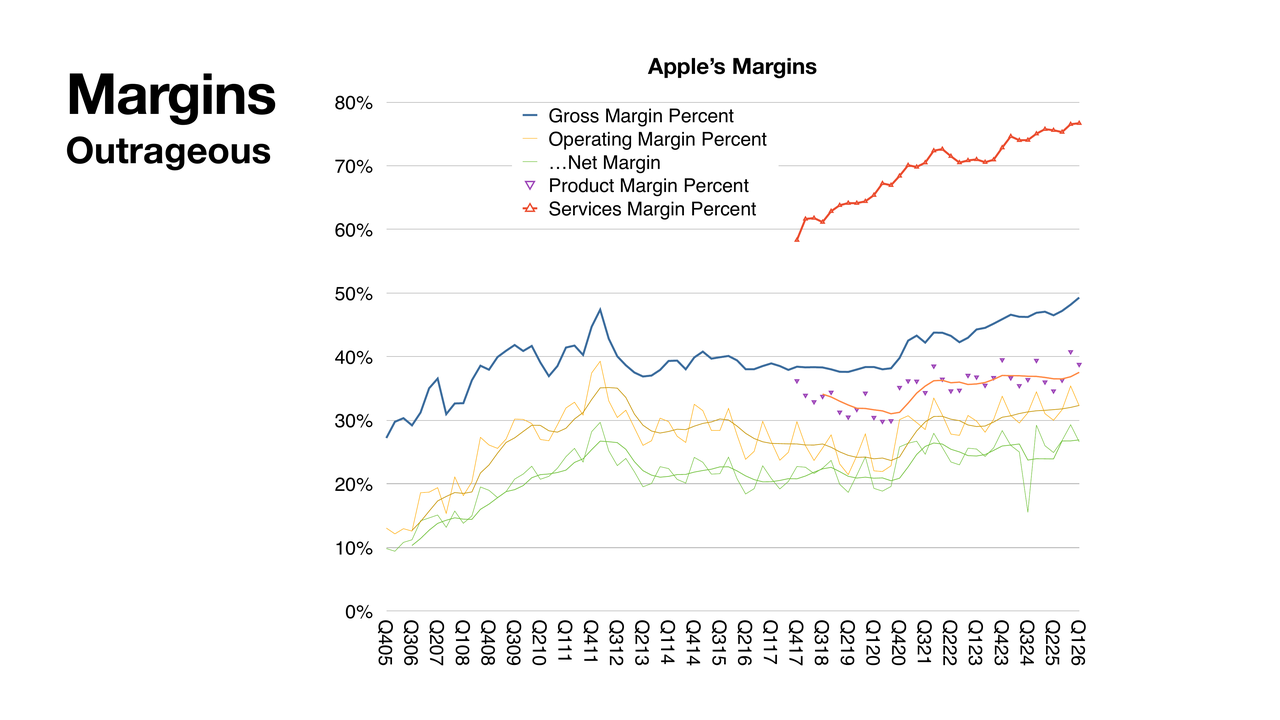
    And again, other analysts are starting to come around to notice that maybe this all settles into Apple gaining a whole lot of share, because all the other competitors won't be able to get any memory. So Apple could also just lock up everything and say, alright, we've got the biggest checkbook in the business, we'll take a hit on margins. As if we care, as if that matters. We go from 49% to 45%. Which is where we were two years ago. And then in doing so, we're going to take out everybody but Samsung. So we get in a situation where a lot of marginal players just disappear. And Apple locks up even more.

    And when you go for the jugular, you do all this, and then you launch a low-end product that's even cheaper, which is what the Neo looks like to me. I mean, Neo might be a prototype. The Neo might be John's trial balloon out there. Maybe he has a theory — I'm just speculating now — that Apple is going to go for the jugular on the iPhone in a couple of years. The iPhone's going to be $499. It'll be as good as the best iPhone today. And they're going to launch that against a landscape where everybody else is losing money at $800 a phone. And so they'll just quit.

    Now, it's uncharacteristic, but it's a low-end disruption coming from Apple. It's completely possible. It's well within their ability. And if they want to, they could. There's a lot going on here with what strategic intent is from John, and I think he comes with a fresh thinking on this. Not that Tim was unwilling, but I think he knew what works, and he was not willing to stray too far from what was reliable. And John may just think that, I know we can pull this off. And we'll go for a different way. Who knows?

    —

    This was one of the questions asked by the participants in Asymco's May 2026 Office Hours live Q&A session, open to Asymco One subscribers.

  8. Asymco Bulletin 011 - May 3, 2026

    Bulletin

    Asymco Bulletin is a digest of all the work we have published for the week ending May 3, 2026.

    Editor's Note: Starting next week, we will be sending Asymco Bulletin to Asymco One subscribers only. You will still receive Updates when new posts are published per your notification settings.

    Office Hours

    Asymco Office Hours — Apple Fiscal Second Quarter 2026 Review: The Presentation

    Apple FQ2 2026 Earnings Review

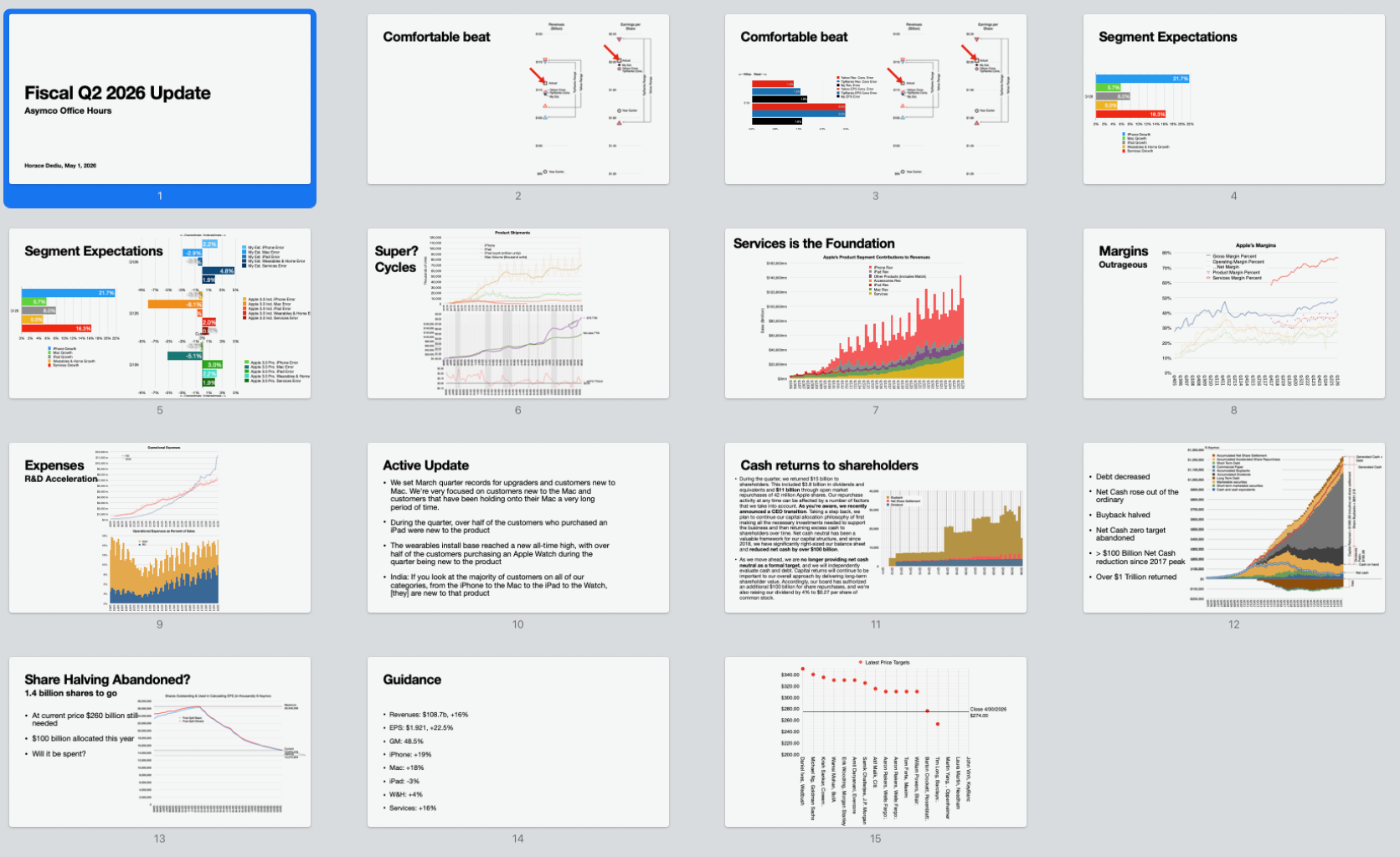
    In Asymco One's May 1, 2026 Office Hours session, review of Apple's Q2 2026 earnings, segment growth: iPhone at 22%, Services at 16%, iPad at 8%, Mac at 5.7%, and wearables at 5%. Steady, foundational growth of Services, Gross margins reached nearly 50%, R&D spending surged, a shift in Apple's capital return strategy showing perhaps the hand of John Ternus. Guidance suggests 16% revenue growth, 22% EPS growth. Analyst sentiment turned positive post-earnings, with most price targets rising above $310. Apple's evolving identity as an engineering-centric company was the focus of many questions. →

    Research

    Expectations for the Quarter

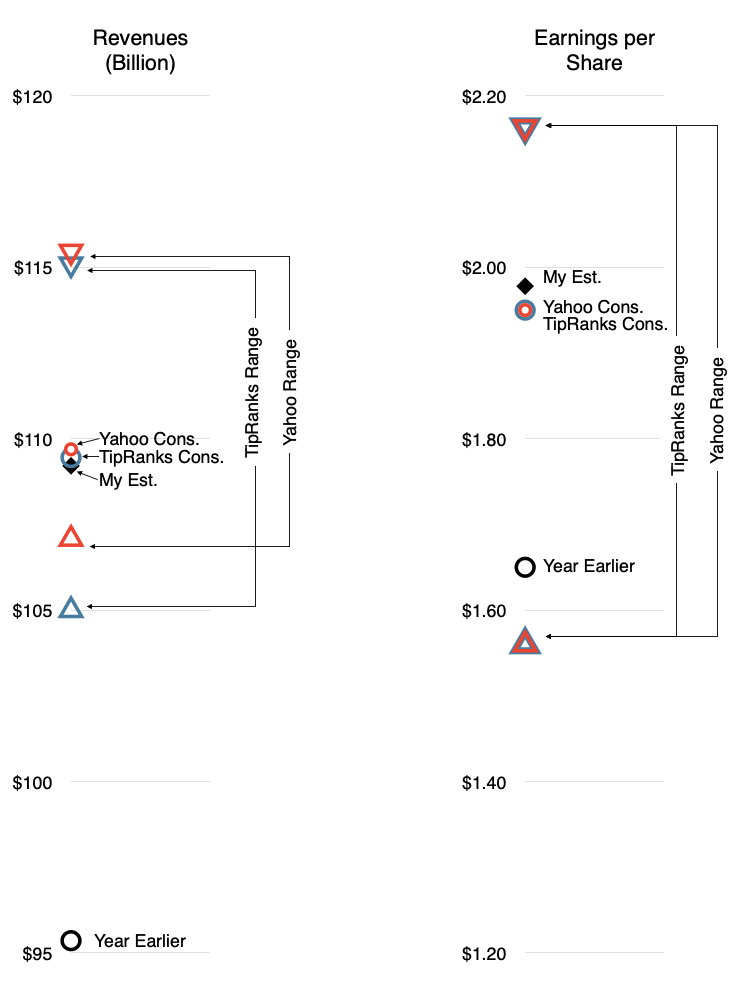
    Revenue and EPS consensus, year-ago results and my expectations Yahoo Finance Yahoo Finance’s revenue estimate for Apple in Q2 stems from 31 analysts. As of April 25, the average estimate is $109.69 billion, with a low of $107.08 billion and a high of $115.37 billion. For the earnings per share estimate, 32 analysts put it at an average of $1.95. The low is $1.56 and the high is $2.16. TipRanks TipRanks also does its own analyst polling on Apple’s quarter. In its forecast as of April 19, its consensus is for a revenue of $109.45 billion, with a high of →

    UBS Raises Price Target from $280 to $287 but Maintains Neutral Rating

    Nota Bene

    The Economist Interview: Hints at the future direction of the company → As is often the case, a 45 minute discussion turns into two sentences. The article sadly does not provide hints at the future direction of the company. But we can…

    TD Cowen: 15% revenue growth, 10% growth guidance → Apple is projected to gain market share in both smartphones and PCs, driven by strong iPhone 17 demand and the new MacBook Neo, with anticipated revenue growth of over 15% in Q3 and positive sentiment ahead of earnings.

    UBS Raises Price Target from $280 to $287 but Maintains Neutral Rating → Apple's fiscal Q2 shows promise with iPhone strength and solid Mac demand, especially for the budget-friendly Neo and AI-capable Mac mini, potentially boosting earnings beyond expectations.

    Morgan Stanley forecasts fiscal second-quarter EPS of $1.74 → Despite memory pricing pressures, Apple's strong iPhone sales, potential AI and foldable iPhone announcements, solid free cash flow, and favorable market conditions position it for better-than-expected earnings and a possible stock rise to $300 by September.

    Is Apple borrowing Samsung’s Market Expansion Strategy? → Bernstein SocGen maintains optimism on Apple's strategic pricing and ecosystem strength, forecasting EPS growth and potential market share gains, while Samsung faces smartphone profit challenges but thrives in memory.

    Separately, it’s been reported that Samsung might see its first operation loss from its phone division, resulting in Apple capturing 100% (or more) of global smartphone profits. Simultaneously, Samsung is seeing huge profit gains from memory, even overtaking Nvidia’s profitability. This is remarkable…

    Apple share of the smartphone SoC market grew from 15% to 19% in Q1 → In Q1 2026, global smartphone SoC shipments fell 8%, but Apple thrived in the premium market by leveraging its efficient supply chain and passing costs to consumers, boosting its market share from 15% to 19%.

    Google to sell TPU chips as Gemini shows returns → Why pour cash into Nvidia when you can craft your own cutting-edge chips like Google, and then turn that innovation into a lucrative side hustle by selling them to tech giants like Meta and Anthropic?

    The Vision Products Group Expanding → Gurman's 2025 dissolution claim clashes with 2026's active Vision Products Group hiring spree. The Vision Products Group posted 14 new senior roles last week.


    Asymco One gives you full access to our research, analysis, and commentary. Subscribe with code BULLETIN for a discount.

    Feedback: Have questions or comments? Reach out to us at contact@asymco.com. We’d love to hear from you.

  9. Apple share of the smartphone SoC market grew from 15% to 19% in Q1

    Nota Bene

    Supply disruptions strengthen the strongest

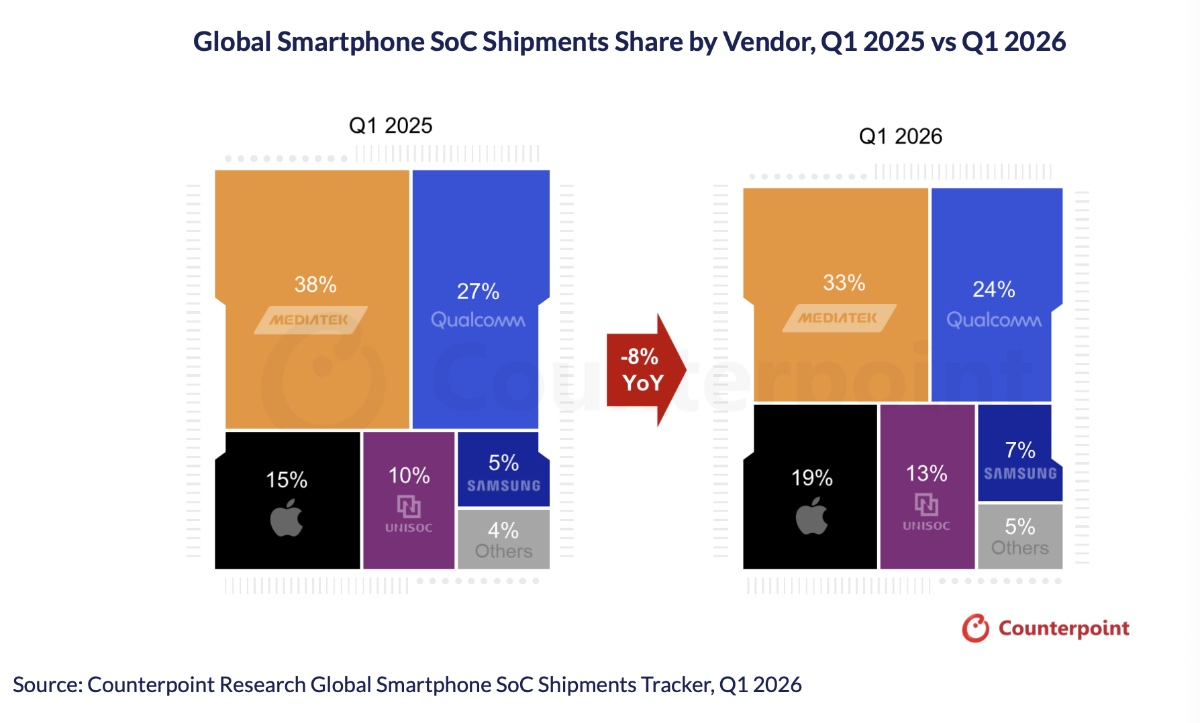
    Global smartphone system-on-a-chip (SoC) shipments declined 8% year-over-year (YoY) in quarter one (Q1) of 2026, according to Counterpoint Research’s latest Global Smartphone SoC Shipments Preliminary View report. However, it’s good news for Apple.

    Counterpoint says the premium segment has remained relatively resilient, with higher costs largely passed on to end consumers. Meanwhile, the entry-level manufacturers are increasingly adopting lower-cost chipsets to keep smartphone prices competitive.

    Qualcomm and MediaTek recorded double-digit declines in shipments. In contrast, Apple, Samsung, Google and UNISOC posted positive growth.

    Apple saw its share of the global smartphone SoC market grow from 15% in the first quarter of 2025 to 19% in the first quarter of 2026. Some explanation: A smartphone SoC (System-on-a-Chip) is a single, integrated chip that combines all essential computing components—CPU, GPU, memory, and connectivity modems (5G/Wi-Fi)—into one unit.

    Apple silicon is a series of proprietary, ARM-based systems-on-a-chip (SoCs) designed by Apple for its ecosystem, providing high-performance computing through a unified memory architecture and specialized components. They power iPhones (A-series), Macs (M-series), iPads, and wearables (S-series), focusing on superior power efficiency and security.

    Source: Apple World Today

    NB: Counterpoint Senior Analyst Shivani Parashar says that their integrated supply chains helped …

  10. Is Apple borrowing Samsung's Market Expansion Strategy?

    Nota Bene · 1 comment

    On March 18, 2026, Bernstein SocGen Group reaffirmed its “Outperform” rating and $340 price target for Apple Inc.

    Comparing it to Samsung’s 2009–2013 strategy, which saw Samsung increase its global smartphone share from 4% to 32% in Q3 2013, Bernstein emphasized Apple Inc.’s recent product launches as a strategy to widen portfolio price bands, driving share gains at the low end while raising prices at the high end to maintain margins. Although Samsung eventually lost market share to Chinese manufacturers, the firm said the stickiness of Apple’s iOS ecosystem will help it sustain long-term market share.

    Bernstein projected a 12% increase in fiscal 2027 EPS from share gains, split equally between hardware and services, assuming Apple Inc. captures 10% of Chinese manufacturers’ smartphone market share amid their supply issues. Some noteworthy product developments include the introduction of the $549 AirPods Max 2, the App Store cost reduction in China from 30% to 25%, and plans for a foldable iPhone.

    Source: Yahoo Finance

    NB: Separately, it's been reported that Samsung might see its first operation loss from its phone division, resulting in Apple capturing 100% (or more) of global smartphone profits. Simultaneously, Samsung is seeing huge profit gains from memory, even overtaking Nvidia's profitability. This is remarkable…

  11. iPhone vs Android Switching Rates

    Nota Bene · 3 comments

    Bitchin' ain't Switching

    SellCell’s Smartphone Loyalty Survey 2026 shows iPhone and Android loyalty at record highs, but Android users still switch more.

    Key findings

    iPhone loyalty stands at 96.4%, up from 91.9% in 2021

    iPhone switching stands at 3.6%

    Android loyalty stands at 86.4%, with switching at 13.6%

    Android users are nearly four times more likely to switch than iPhone users

    Samsung loyalty stands at 90.1%, up from 74% in 2021

    Samsung switching stands at 9.9%

    Google loyalty stands at 86.8%, up from 65.2% in 2021

    Google switching stands at 13.2%

    The loyalty gap between iPhone and Android now stands at 10 percentage points

    Price and value are the biggest drivers of switching

    Technology is the second biggest driver

    Overall, loyalty has increased across all major brands since 2021

    Source: SellCell.com Blog

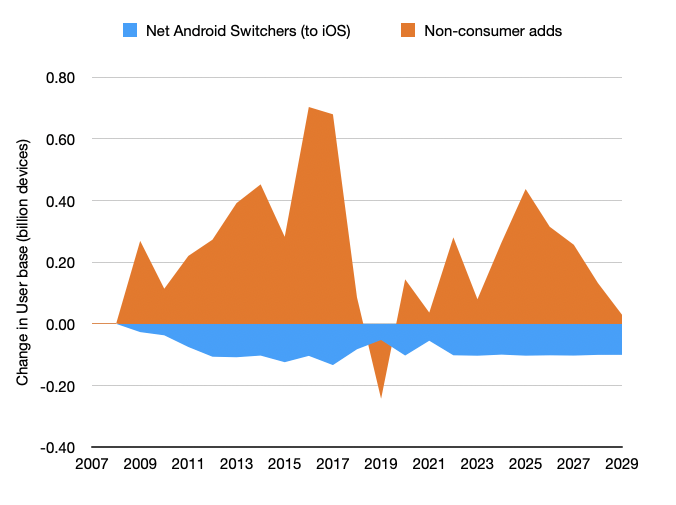
    NB: I did a deep dive into the data and came up with graph above. The original report shows intention numbers which seem quite high. For instance, the net switching rate between iOS and Android is 10% in favor of Apple. This would imply that the entire user base would flip in 10 years. It would also imply...

    As time goes on and saturation is reached (near 5 billion active smartphones) then the churn will imply that Android will eventually become a net user loser.

    That probably won't happen before 2030. When saturation does happen however, I will be watching to see if Apple chooses a different strategy to accelerate switching similar to what it is doing with the MacBook Neo at a time of PC market saturation.

    The lesson here is that switching intention surveys showing a net 10% churn rate don't mean that the actual switching rate is net 10%. The intention to switch is a sentiment but actual switching is often more difficult than a wish to do so.

    I think actual net churn is 1.7% of the base each year. That's still 100 million a year. For now it seems Apple is happy to maintain that rate.