Asymco

Asymmetric Intelligence

Horace Dediu

  1. Apple's guidance: in six months there will be a new set of worries

    Office Hours Research · 4 comments

    An Office Hours question asked by Joseph B., July 31, 2026.

    Q: What's up with the guidance? And why does this seem to be news to Mr. Market?

    Start by not getting emotional about this, because I've seen so many times mispricing of Apple. But the market, as they say, is always right. It is simply the voting of a lot of people, and what it determines is the market price. It doesn't determine right or wrong, it just says that's what the market thinks.

    The thing about the last few weeks, or even months, has been that Apple's been caught in a debate about whether AI is going to pay off or not. It was used by a lot of people who wanted to rotate out of AI names into something safe, and Apple seemed to be that choice. Apple never wanted to be chosen as a safe harbor. Management doesn't have that as their KPI, or in their plans, or in the product pipeline.

    So strange things happen. It was unexplainable to me why the stock went up as it did in many days over the last few weeks. It was good and I felt it was fair. If it had been trading at 50 P/E, I would have been getting a little bit nervous, thinking it's maybe not justifiable. But there are many companies trading at hundreds of P/E, and who's to say that's wrong?

    It seemed to have run ahead of itself a little bit. But on the other hand, the reaction is completely unwarranted if it's based on what Apple reported. Apple reported a very strong quarter. It reported some circumstances that are unusual. Foreign exchange is one. The struggle with getting supply is another. By the way, nobody seems to talk about memory anymore. Nobody seems to talk about the fact that we've seen price increases, which was just a month ago. It's all now that Apple is constrained, for other reasons. In six months we'll totally forget about this, and there'll be a new set of worries.

    Fundamentally, the company is doing very well. I think it is entering a cyclical period of above-average growth. It might be because products are getting a little bit old in people's hands. It might be that demand will truly pull forward a lot of new consumption, but it's constrained by being able to deliver. Again, not the first time.

    It's surprising to me how volatile, though — to see a 10% drop in one day, including after hours. I don't recall there being that much movement even in the times of Steve Jobs, when we did have huge volatility. But perhaps my memory's weak. On fundamentals alone: the next quarter, which isn't even a holiday quarter, growing 10% — as a disappointment? It'll re-accelerate.


    Editor's Note: This was one of the questions asked by participants in Asymco's July 2026 Office Hours live Q&A session, held the day after Apple's FQ3 2026 earnings and open to Asymco One subscribers.

    Subscribe to Asymco One for full access to this and other content.

  2. Apple Will 'Watch Everything Burn' When AI Bubble Bursts

    Nota Bene

    I would say they will simply collect all the available profits

    MacRumors interviewed AI critic Ed Zitron, author of the Where's Your Ed At newsletter and host of the Better Offline podcast, about what could happen to Apple if the costly AI infrastructure boom collapses. Zitron argued that Apple is relatively well insulated because it has spent far less on data centers than rivals such as Microsoft, Google, and Amazon. He said the company could use the downturn to make selective acquisitions, though it might simply continue operating largely as before. "I think they will sit on the sidelines and watch everything burn," Zitron said. Here's an excerpt from the report: 

    If the bubble deflates the way you expect (write-downs, too much compute supply, possibly OpenAI cratering), can you walk us through what that would actually look like for Apple? Does anything break for iPhone users, or does Apple mostly watch it happen from the sidelines? Could it even benefit Apple?

    I think things would look much the same for Apple. I think they will sit on the sidelines and watch everything burn. I could see them doing some choice acquisitions as things begin to collapse, but I could also see them do nothing.

    I think Apple is in a very weird place at the moment. The Vision Pro was a dud, but it was also the most interesting and future-forward thing I've seen anyone put out in a while. If they were smart, they'd tread water and sink as much money into making that as small as humanely possible -- no matter how long it takes -- because the entire AI bubble is a result of everybody running out of hypergrowth ideas, mostly because we're flat out of new interfaces.

    Source: Ed Zitron via MacRumors

    NB: Those who do not study history are doomed to repeat it. The history of computing is one of the easiest to study since it's so recent and well documented. We don't have to conduct archeology or infer from scraps of written works. The people who lived and worked through that period are mostly still alive and we can ask them questions. Still, Zirton misses a few points…

     …What I appreciate about Zirton's analysis is that he places the Vision Pro at the heart of the discussion. It is indeed the most important innovation of the age. However he does not understand Apple's culture well enough to know why it is the way it is. His comments about how the Vision Pro works belie a failure to study it and understand it deeply.

    There is a lot in the interview on MacRumors so it's worth reading.


  3. Wall Street Predicts Third Quarter Numbers For Apple

    Nota Bene

    final earnings call for Tim Cook as chief executive officer

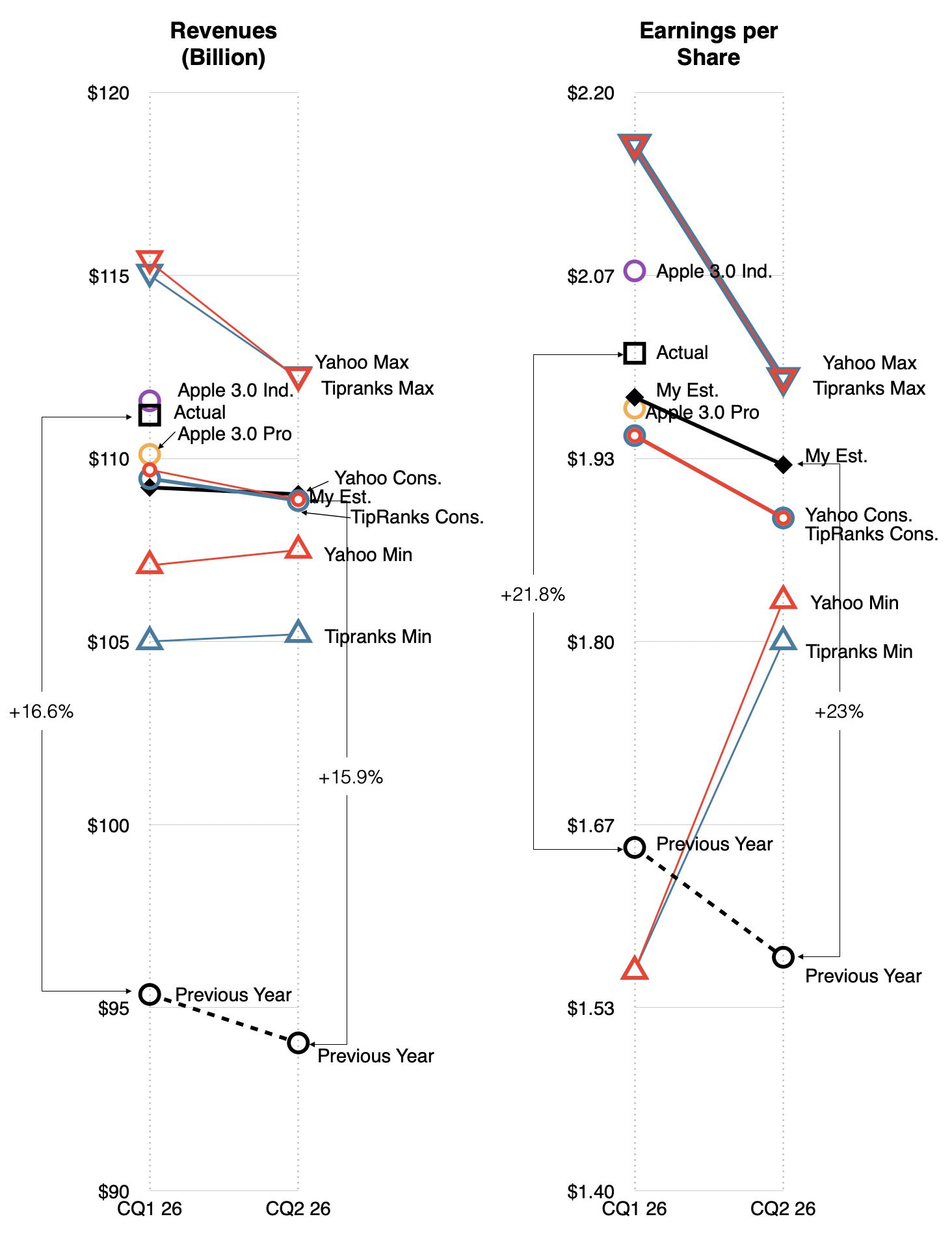
    Financial experts expect the brand to post very strong numbers for the quarter. Data from Yahoo Finance shows an average revenue estimate of 108.9 billion dollars across 27 different analysts. The earnings per share estimate sits at 1.89 dollars. TipRanks shows a very similar outlook, with a consensus revenue of 108.85 billion dollars. The company previously guided for a revenue growth of 14 to 17 percent compared to the same time last year. It also expects its gross margin to land between 47.5 and 48.5 percent.

    This quarter represents the first full period to benefit from devices launched earlier in the spring. Aside from the new AirPods Max 2, there were no major hardware launches during these specific months. UBS noted that the market share for the iPhone actually increased during the quarter.

    Mac computer revenue also went up thanks to the arrival of new models, even though the average selling price dropped slightly. The services division should see 13 percent growth, despite some struggles with App Store revenue.

    The upcoming conference call will give the market a clear picture of how well the hardware maker handled a quiet summer. Investors will listen closely for any hints about future pricing strategies and how the company plans to handle rising production costs under its new leadership team.

    Source: The Mac Observer

    NB: Watching the guidance for hints of how the iPhone will be performing given a split launch period and potential new ASPs.

    September will be the critical question. It all depends on the exact launch dates. If launch event is mid month when will product ship?


  4. Apple reaches $5 trillion market cap for first time

    Nota Bene

    Apple reached $1 trillion market capitalization on August 2nd, 2018, almost exactly eight years ago. Let's recall what the consensus looked like.

    The jockeying between Apple and Nvidia reflects a debate about the future of AI that has preoccupied investors this summer. Apple on Tuesday briefly hit a market capitalization of $5 trillion for the first time, a day after passing Nvidia to become the most valuable publicly traded company.

    Apple trailed its trillion-dollar peers on the market last year as investors worried that the company was missing out on the AI boom by keeping investments in check and delaying the long-awaited rollout of an upgraded Siri, which will be released this fall alongside new iPhone hardware. But the narrative has flipped of late due to concerns that the aggressive tech spenders are raising mounds of debt and going cash flow negative without a clear path to hefty returns.

    Source: CNBC

    NB: Apple reached $1 trillion market capitalization on August 2nd, 2018, almost exactly eight years ago. Let's look back on what analysts recorded as their opinions following the company's June quarter, 2018 results. These quotes were published on August 1st, 2018, one day before the $1 Trillion print.

    “The combination of a strong macro environment and an increasingly engaged customer base led to double digit growth in all regions on a sell-in basis during the June quarter,” Morgan Stanley said in a note. “A clean beat on the path to $1 trillion.”

    RBC was even more blunt, “Hit snooze for 90 Days. Path to trillion intact.”

    Others, like Deutsche Bank, were more measured in their commentary.

    “With 80 percent of the company’s sales exposed to secularly challenged businesses, we believe the long-term growth outlook remains limited,” the brokerage said. “With positives and negatives largely balanced at current levels, we view valuation as fair and maintain our Hold.”

    Here’s a wrap of all the major analyst opinions.

    Morgan Stanley (Overweight):

    “Third-quarter revenue beat expectations largely on iPhone average selling prices and Services with wearables maintaining momentum from previous quarters. September-quarter guidance also topped expectations and reflects a similar mid teens revenue growth rate for the overall company despite the more difficult compare from a year ago. The combination of a strong macro environment and an increasingly engaged customer base led to double digit growth in all regions on a sell-in basis during the June quarter.”

    “A clean beat on the path to $1 trillion.”

    RBC (Outperform):

    “Apple reported a modest June-quarter beat and guided Sept-quarter ahead of expectations. Given heightened concerns around large-cap tech and ongoing U.S./China tariff issues, this was a positive print vs. expectations. While we expect investors to wait for pricing clarity on next gen iPhones before deciding on Apple stock, near-term upward bias on the name remains given multiple tailwinds stacking up.”

    “While investors looking for a ‘super cycle’ will remain disappointed, Apple’s narrative is shifting towards their ability to sustain mid-single digit sales growth despite flat iPhone units and low-to-mid teens EPS growth via buybacks. Maintain OP and adjusting our target to $225.”

    “Hit Snooze for 90 Days. Path to Trillion Intact”

    Deutsche Bank (Hold):

    “Apple reported better-than-expected third-fiscal-quarter 2018 results with sales upside driven by iPhone, Services, and Wearables. While sales beat, iPhone unit growth of just 1 percent year over year remained lackluster, as iPhone sales upside continues to come from the reset higher in average selling price. Earnings per share beat expectations by $0.18, but we estimate that just $0.04 of the beat came from revenue upside, while the remaining $0.14 was helped by below-the-line items like higher other income, a lower tax rate, and buybacks. Given its revenue base and size, Apple’s recent growth has been impressive. However, with 80 percent of the company’s sales exposed to secularly challenged businesses, we believe the long-term growth outlook remains limited. We continue to see support for the shares from the company’s substantial share buyback, however, with positives and negatives largely balanced at current levels, we view valuation as fair and maintain our Hold.”

    Citigroup (Buy):

    “We believe the negativity on Apple stock is overdone and the majority of our thesis remains unchanged regarding ‘Applewood & 5 Reasons the Stock Should Trade Higher’ as detailed in this report. Specifically we highlight our view of Applewood which is Apple’s growth in service 31 percent year over year or 28 percent excluding one-time items which now represent 18 percent of Apple’s total revenues coupled with early innings growth of iPhone units in emerging markets and less than 2 percent share in India, thereby driving a growing sticky user base, which we have dubbed Applewood.”

    Goldman Sachs (Neutral):

    “Apple demonstrated better demand resiliency than we had expected in the summer as evidenced by an iPhone average selling price of $724 which was 5 percent ahead of our forecast. Guidance was just a touch ahead of our numbers but is consistent with our above Street average selling price estimates that are based on a detailed stock keeping unit level model. We believe Street forecasts are likely to move up but that average selling price expectations probably will remain too low for the December quarter as Apple continues to see support from ongoing mix toward higher average prices. Services growth adjusted for one offs dipped slightly but not that materially to 28 percent year over year from 31 percent last quarter.”

    Bank of America Merrill Lynch (Buy):

    “Five reasons why we believe Apple stock should outperform include: underlying iPhone demand remains strong and average selling prices are moving higher, gross margin has upside in fiscal 2019 given tailwinds from component cost reductions and potential tailwinds from foreign exchange, continued strong capital returns with $90 billion of buyback authorization remaining, continued strong growth in Services revenue across geographies (broad-based strength with contribution from licensing, App Store and Apple Care in the quarter), and strong demand for wearables (Apple watch grew mid 40 percent year over year and AirPods remain in high demand) drove 60 percent year over year growth.”

    UBS (Buy):

    “Yes, inventory is the highest in memory for a second calendar quarter (primarily component related, should burn completely off in CQ3) but implied iPhone units of 47 million to 48 million for CQ3 was spot in-line + services seem to be hitting an inflection. Apple is also effectively managing through some challenges on the cost side that should abate, though continued devaluation of key currencies like Chinese Yuan are an overall negative that bears watching. Given ecosystem switching which has become nearly non-existent, we think of iPhone as a recurring model in much the same way as services – albeit without much growth until there is a major form-factor change. Fortunately, this is on the horizon with foldable. In the meantime, Apple should at least hold serve with iPhone bias more to the upside based on procurement, average selling price still strong in the $720 to $725 range for the third calendar quarter, and services set to do about $3 per share in calendar 2020.”

    Raymond James (Market Perform):

    “We reiterate our Market Perform rating on Apple. June quarter results were slightly ahead of expectations; the variance vs. expectations was small enough that we expect neither bears nor bulls to change their view following this report. Apple’s rubber meets the road once the new phones come on sale, and we don’t expect the fall lineup to be different enough to improve the trajectory of iPhone sales. The Services business now represents the bull case for the stock, but our view is that it will be difficult for Apple to sustain the current rate of services growth due to a large portion tied to device sales coupled with a law of large numbers issue from App Store contribution.”

    Piper Jaffray (Overweight):

    “Apple reported June quarter revenue and EPS above the Street, with September-quarter revenue guidance also ahead of consensus. For the June quarter, iPhone was strong, as Apple shipped a total of 41.3 million units vs. consensus at 41.79 million and iPhone ASP was $724, compared to the Street at $694. Services revenue was $9.55 billion and gross margin was 38.3 percent. Revenue guidance for the September quarter is 3 percent above consensus, with the gross margin outlook in-line at 38.3 percent. With the potential launch of a wider array of ‘X-gen’ iPhones on the horizon, we recommend owning Apple on the potential for a ‘super-long’ cycle involving an ongoing multi-year move to the ‘X-gen’ form factor. Maintain overweight, price target to $218.”

    If you did not know these quotes were from 2018, apart perhaps from the price points it would be difficult to guess they were not from the present. Cynics would say nothing has changed and they'd be mostly right. The company has quintupled in value by doing nothing different. It has always been doing the right thing.

    In a memo to Apple's more than 120,000 employees on the day $1 Trillion was reached Tim Cook said the $1 trillion valuation was "a significant milestone" that gave Apple employees "much to be proud of." But he said it was "not the most important measure" of the company's success.

    "Financial returns are simply the result of Apple’s innovation, putting our products and customers first, and always staying true to our values," Cook said in the memo.


  5. Goldman Raises Price Target Ahead of Q3 Earnings

    Nota Bene · 1 comment

    Goldman Sachs reiterated a Buy rating on AAPL stock and raised its price target ahead of Q3 FY26 earnings.

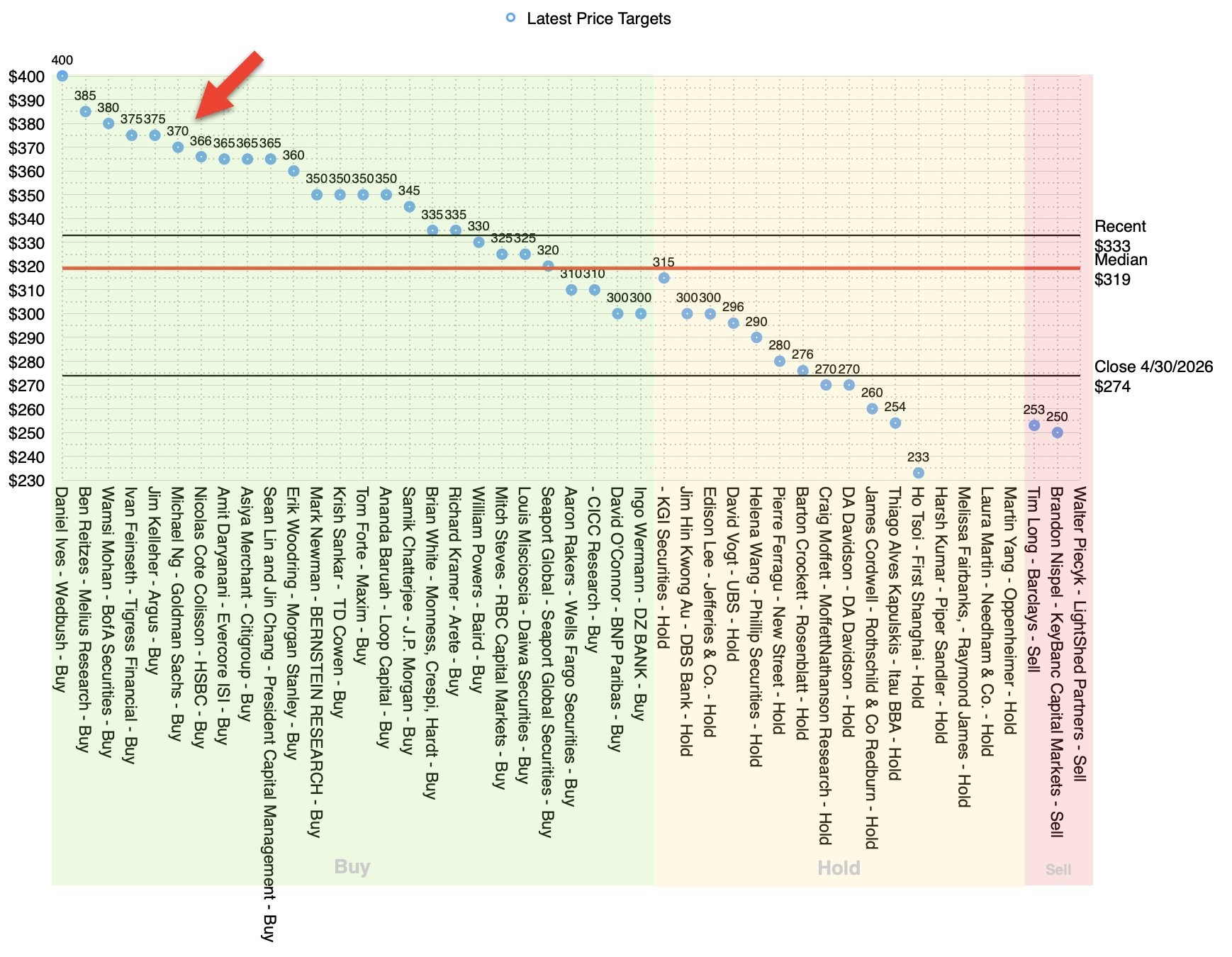
    The analyst raised his price target for AAPL stock to $370 from $330, increasing his valuation multiple to reflect his growing optimism in the company’s iPhone replacement cycle and AI efforts.

    Ng expects Apple to report better-than-expected Q3 FY26 earnings, driven by 17% revenue growth to $110.1 billion, which is at the high end of AAPL’s revenue growth guidance range of 14%-17%. He also expects iPhone revenue of $54.8 billion (23% growth), above the consensus estimate of $53.7 billion. Ng expects iPhone revenue growth to be driven by a 15% unit growth and a 7% rise in ASP (average selling price) on a premium mix shift.

    Additionally, Ng projects 15% growth in Apple’s Services revenue, in line with the Street’s expectations. Within Apple’s Services business, Ng noted continued slowdown in App Store growth due to lower commission rates across markets such as China and Japan. Nonetheless, the analyst expects double-digit growth in the Services business, driven by strength in the services tied to Apple’s products (such as iCloud+ and AppleCare+).

    Ng noted that Apple stock is outperforming the broader market since the beginning of the second quarter, as investors rotated away from traditional AI infrastructure stocks. He added that investor sentiment also improved as Apple gained market share despite industry-wide price hikes due to elevated memory costs. Furthermore, the progress in Apple Intelligence following the WWDC event also helped address AI disruption concerns.

    Meanwhile, Ng expects Apple’s recently announced price hikes for Mac and iPad to support earnings growth over the next few quarters, as he believes that the company’s user base is “relatively price inelastic given brand stickiness, U.S. carrier subsidies, and availability of recent low-cost product launches (iPhone 17e, MacBook Neo).”

    Source: TipRanks

    NB: Ng is near the high range for both his price target and quarterly estimates.

    My estimate is higher on the iPhone unit growth but lower on the ASP growth. Regarding iPhone revenue growth, my estimate is 21% vs. his 23%. We are $1 billion apart on net revenues, almost all attributed to the iPhone ASP difference.


  6. Time to Buy, Time to Sell.

    Nota Bene

    One flipped to Buy, one flipped to Sell. By my count 28 say Buy and 20 say Hold or Sell.

    Apple stock inched lower in pre-market trading on Friday even after HSBC analyst Nicolas Cote Colisson upgraded the iPhone maker to Buy from Hold and raised its price target by about 41% to $366 from $260. The firm said Apple is nearing an “operational turning point,” helped by its AI plans and what it called “one of its most innovative product pipelines.”

    Colisson said Apple is now better placed to benefit from AI than before. He believes the company can stay away from the “too high capex debate” while using its installed base of 2.5 billion devices to expand Apple Intelligence.

    The analyst expects Apple’s revamped AI platform to play a key role. He said the new agentic Siri AI will add visual intelligence and richer interactions. It will also access information across apps to deliver better responses. According to HSBC, the AI upgrade comes at the right time as Apple prepares to launch new devices.

    HSBC also highlighted Apple’s strong hardware roadmap. The analyst expects the iPhone 18 Pro and Pro Max later this year, followed by an iPhone Air, a book-style foldable iPhone, a 20th-anniversary iPhone, and smart glasses over the next two years. He believes these products, along with better AI features, could trigger a “strong renewal cycle” among iPhone users.

    Reflecting this outlook, HSBC raised its 2027 and 2028 revenue forecasts by 7% to 9%. It also increased its 2027 iPhone sales forecast by 11% to 13% and lifted its 2027 EPS estimate by about 8%.

    Source: TipRanks

    NB: 41%! From $260 to $366 is quite a jump. Meanwhile, KeyBanc Capital Markets downgraded the iPhone maker to Underweight from Sector Weight…

    … slapping a $250 price target on a stock that closed at $317.31 on Monday ($333 at time of writing).

    KeyBanc sees iPhone revenue up 23.2% in FY26, ahead of consensus at 19.7%, but growth slowing sharply to 4.9% in FY27 versus Street at 8.3%.

    As hardware unit growth cools, the firm also cuts back its Services view, modeling FY27 Services growth decelerating to 7% versus consensus near 12%.

    With Apple trading at about 24.5x FY27 EV/EBITDA and roughly 35x forward earnings — more than two standard deviations above the S&P 500 and Nasdaq — KeyBanc argues the multiple no longer fits a maturing, slower‑growth hardware and services story.

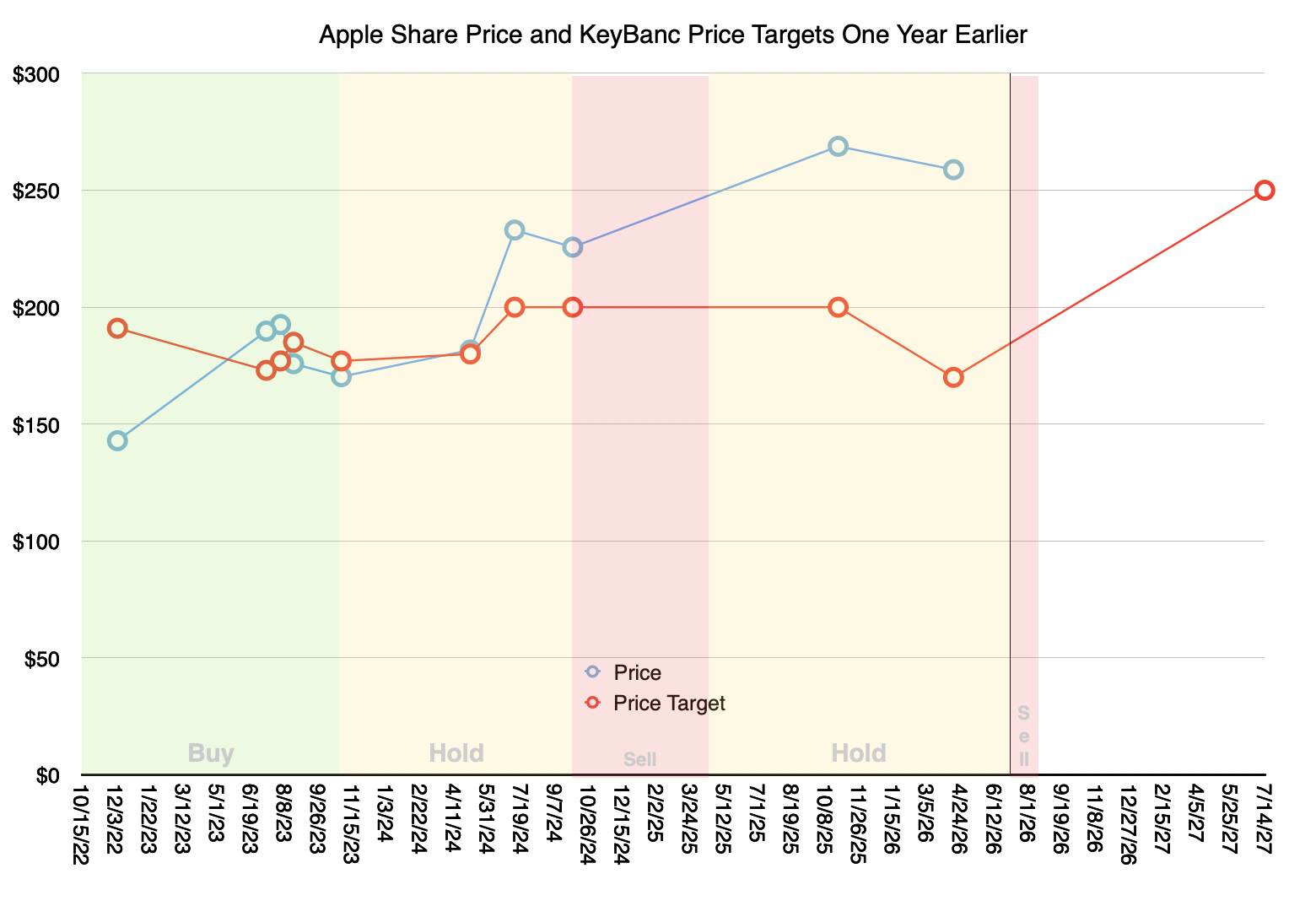
    Here is Keybanc's performance on Apple targets. The red line shows the year-ago targets and the blue line shows the performance of the share price. Note that during the time when the rating was "Buy" the targets and results aligned very well, surprisingly so. As the rating switched to Hold and later to Sell, the targets diverged from results dramatically.

    That happened already in 2024 and got worse since. The latest target set for $250 happened the day before the share price rallied and it now sits at $333. The implication is that shares will drop $83 or 25%.


  7. Why Huawei and Apple Grew While China's Smartphone Market Fell Again in Q2 2026

    Nota Bene

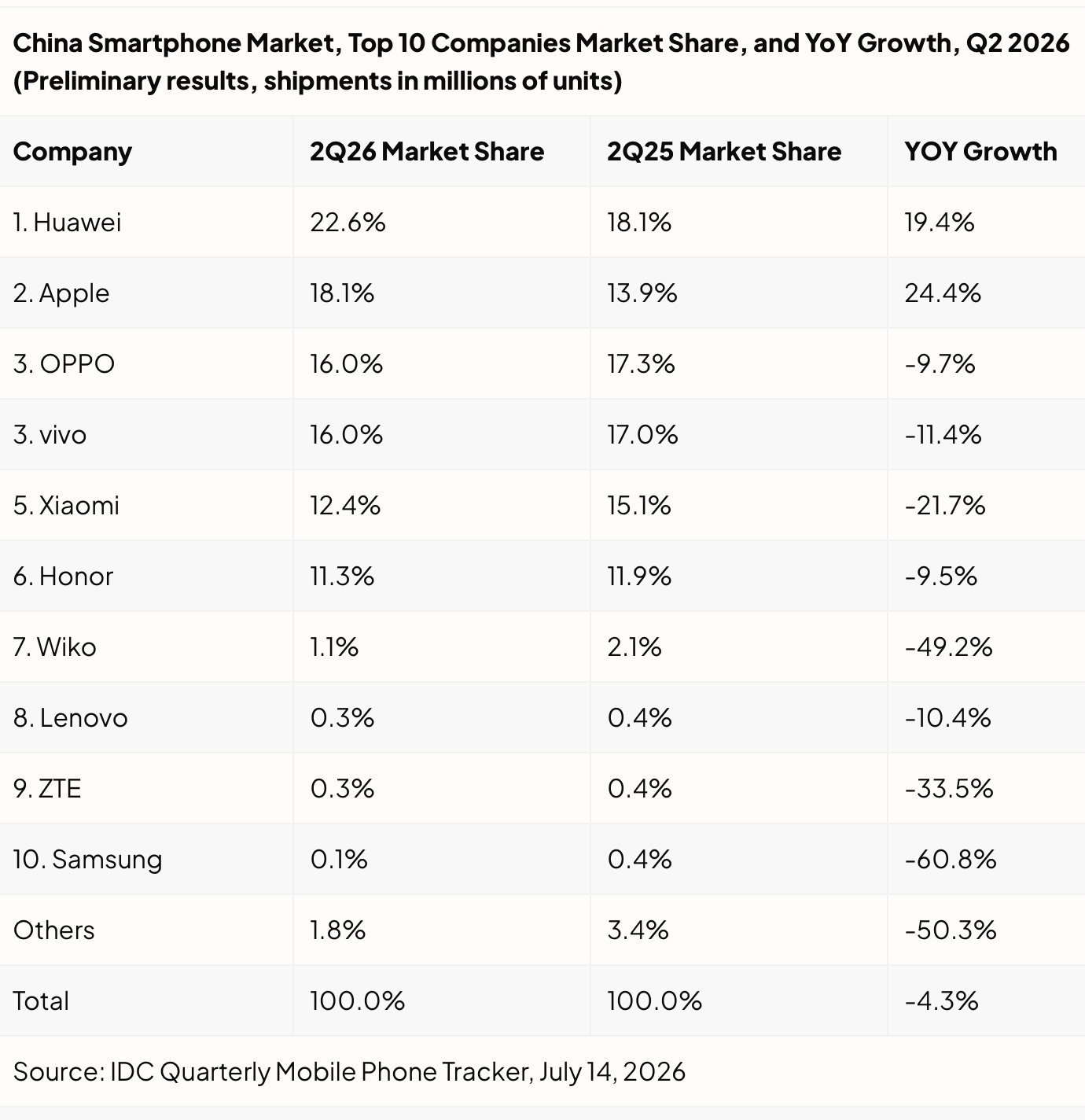
    Apple gaining share in China

    China’s smartphone shipments came in at roughly 66 million units in the second quarter of 2026, down 4.3% year over year and the fifth straight quarter of decline. Rising memory and component costs pushed most Android vendors to raise prices, which cooled upgrade demand. Huawei and Apple were the exceptions, growing close to 20% and 25% respectively.

    Huawei and Apple moved in the opposite direction for reasons that were just as concrete. Both held prices steady while the rest of the Android field raised them, and both layered on targeted promotions. Huawei kept widening its lineup to cover more of the market, while Apple’s early signaling of price increases on its second-half products pulled some buyers forward into the iPhone 17 series sooner than they might have bought otherwise. Strong brand pull helped as well.

    The top six vendors now hold about 96% of the market, which keeps squeezing smaller and mid-sized brands and pushes concentration higher.

    China Smartphone Market at a Glance, Q2 2026

    Total shipments: about 66 million units, down 4.3% year over year

    Fifth consecutive quarter of year-over-year decline

    First-half 2026 shipments: about 134 million units, down 4.2% year over year

    Huawei and Apple: each up roughly 20% year over year

    “618” festival smartphone sales: down close to 15% year over year

    Vendor tiers: Huawei and Apple lead, followed by OPPO and vivo, then Xiaomi and Honor close behind

    Top six vendors: about 96% of total market share

    Source: IDC

    NB: Other analysts are reporting similar story globally but with Samsung instead of Huawei as growing (apart from Apple.)

    The data sounds repetitive but it should be considered in light of the discontinuities we are experiencing in supply chain pricing. The challenge will be pull-forward demand into the next quarter and the price increases on the iPhone line into the holiday quarter. Note well however that the line-up will probably be split into two launch quarters, with China probably being targeted with the later (spring) quarter.


  8. Omdia: Global smartphone market down 4% in 2Q26 while Apple and Samsung soared

    Nota Bene

    Counterpoint estimating total market sales fell 11%

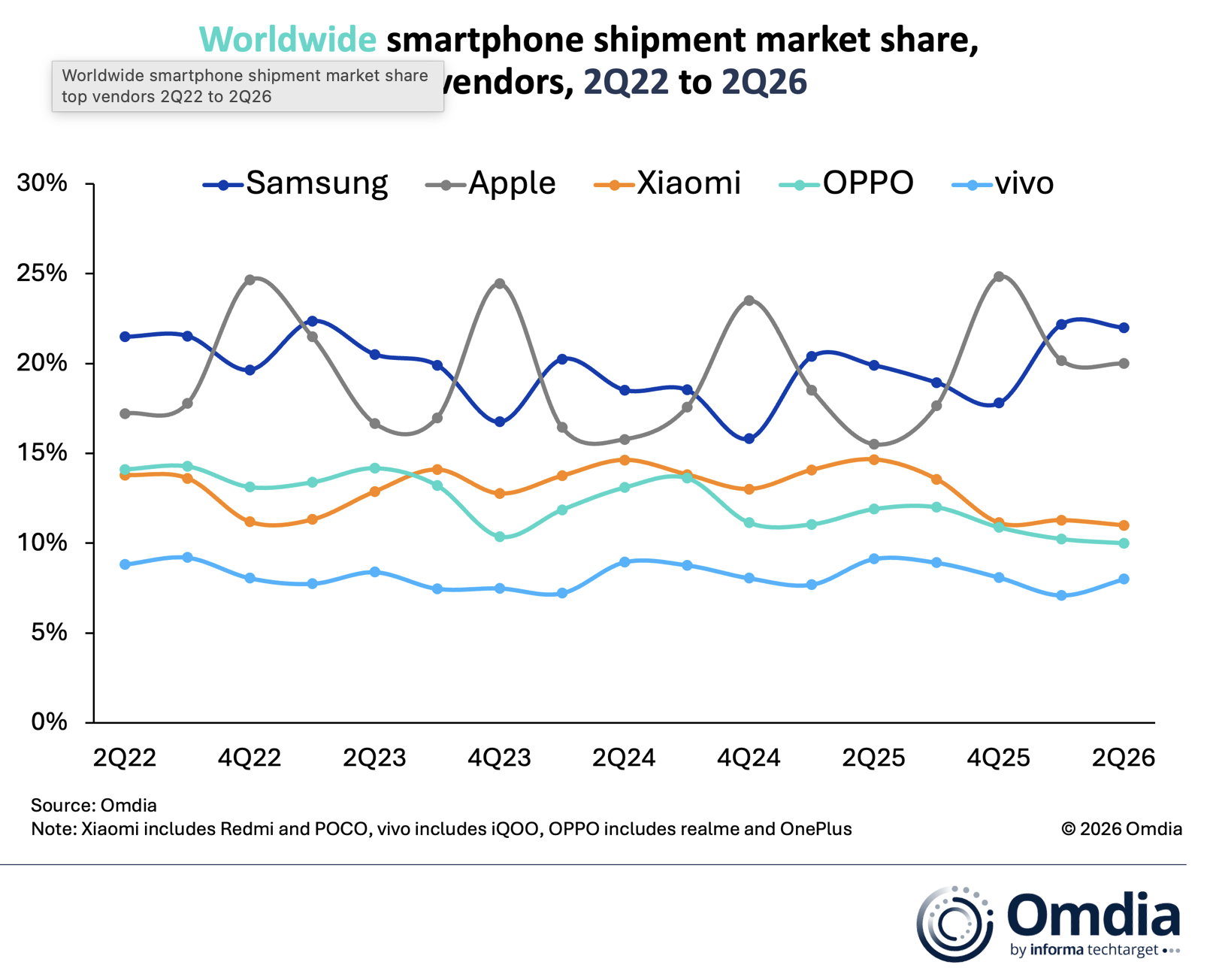
    Apple delivered its best second-quarter performance ever, capturing a record-high 20% market share during what traditionally is its slowest quarter of the year. The iPhone 17 series delivered one of the strongest iPhone refresh and upgrade cycles in Apple’s history. Apple also benefited from stable pricing while most competitors were forced to raise their pricing. However, as Apple raised pricing across other products towards the end of 2Q, a key question remains to what extent iPhones might be impacted by similar hikes later this year.

    “The steepest volume drops hit the sub-$400 mass market segment, where supply constraints are tightest, profit margins are slimmest, and price sensitivity is highest,” said Runar Bjorhovde, Principal Analyst at Omdia. “To adapt, vendors are shifting their strategies from volume to value by reoptimizing portfolios and adjusting retail pricing. Managing the surging component costs is incredibly complex and unpredictable, with some vendors facing memory costing more than four to five times what they did a year ago. Memory and storage alone now account for more than 60% of the bill-of-material for budget devices and more than 30% for high-end models. Although memory and storage costs are the biggest challenges for vendors, they are far from the only challenge. New semiconductor bottlenecks, such as within foundries, are adding further cost pressures.”

    “We anticipate the sharpest volume declines to hit in the upcoming two quarters, where normal seasonal demand peaks – driven by new launches, holidays and shopping festivals — collide with constrained memory chip supply,” added Bjorhovde. “Consequently, vendors are expected to lean further into the higher price segments to capitalize on customers seeking device upgrades in 2026’s sales season. However, while moving upmarket protects margins and revenue, vendors offer fewer options to budget-constrained consumers. Many mass-market buyers will be forced to delay purchases, downgrade expectations, utilize financing, or opt for refurbished devices.”

    Source: Omdia

    NB: Counterpoint came out with a report the same day estimating that the smartphone market in the second quarter overall sales fell 11% year-over-year while Apple saw a 3% year-over-year rise in shipments and ended the quarter with 20% of the market. I note that …

    … Chinese brands Xiaomi, OPPO, and vivo, all saw steep year-over-year declines, due largely to rising memory prices. Overall, during a highly stressful market condition, where the market is contracting and margins are contracting Apple seems to be moving in the opposite direction.

    I recall crises such as AI, Covid, supply chain shortages and China demand collapses in the last 6 years leading to sell-offs and loss of confidence in the company. In all cases, the business emerged stronger.


  9. Why all-in and why all are in

    Research · 5 comments

    Take all my money, please.

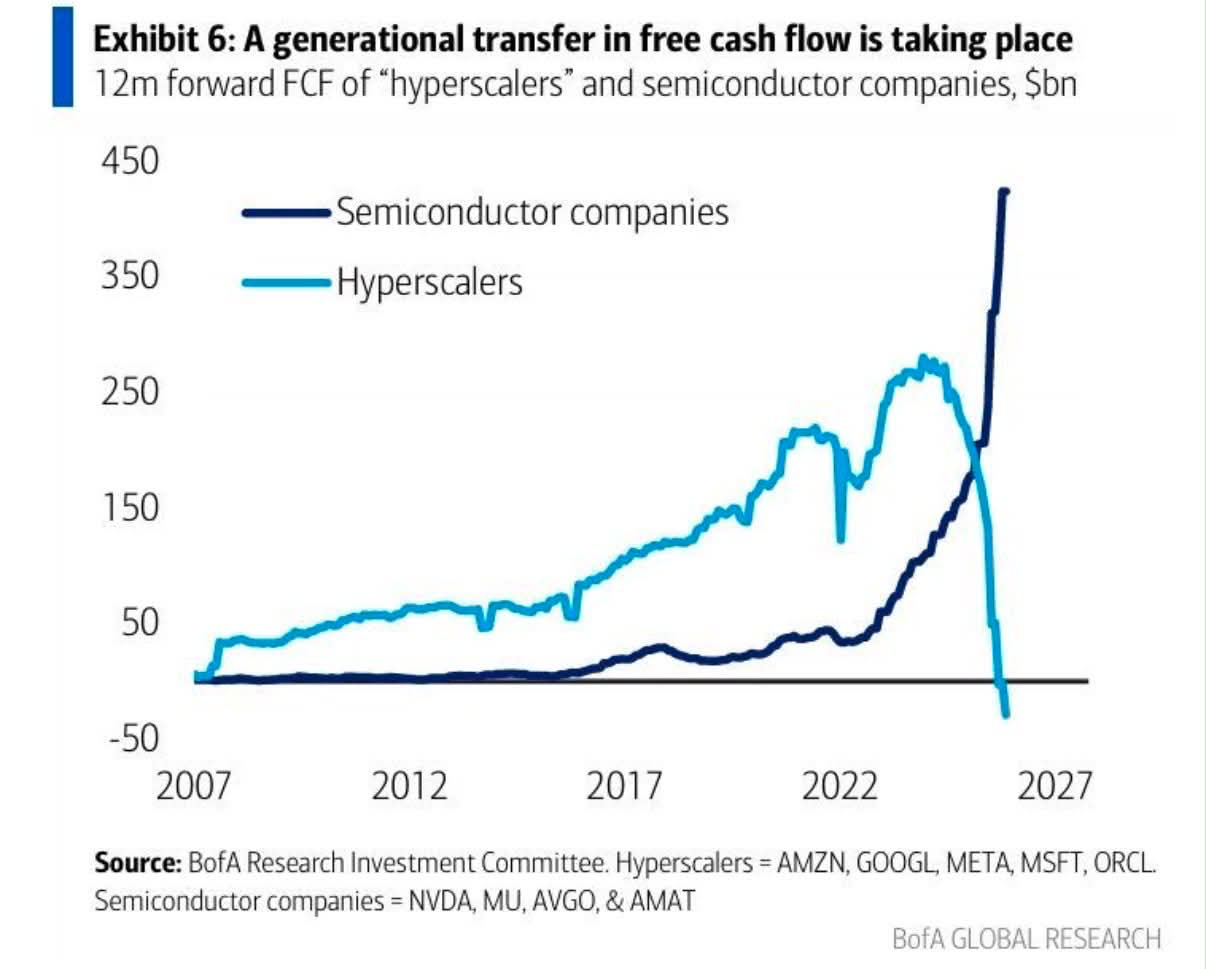
    The graph above shows that Amazon, Alphabet, Meta, Microsoft and Oracle decided to transfer their shareholders' wealth to the shareholders of Nvidia, Micron, Broadcom and Applied materials1. This is not an exaggeration. Free cash flow is wealth and it belongs to shareholders. The transfer is real since the capital expenditures undertaken with this cash flow by these "hyperscalers" have gone directly to create unprecedented windfall profits for semiconductor companies. So much so that the companies receiving these windfalls are scrambling to give it to their shareholders (and employees.) And the scale is astonishing! These companies alone are moving hundreds of billion, more than the profits gained in the semiconductor businesses in decades.

    Prof. Clayton Christensen had a theory he called "the dumb manager theory" to describe what most people use to explain why companies fail. According to this theory when a company is successful it's because its managers are smart. Conversely, when a company is failing it's because its managers are dumb. The problem with the theory is that it's usually the same managers who are there when a company succeeds as when it fails. Believing in the theory implies that you also believe that smart people can turn dumb. But you can't tell when and why this happens so determining success depends on your skill at psychoanalyzing managers.

    The second problem with the theory is that when one company fails, many other companies in the same industry fail as well. Yes, Kodak failed to grasp digital photography and its management has been skewered for it. But so did Fujifilm in Japan and Agfa in Germany. Did all these managers get together at a dumb management conference and agree to do the same dumb things at the same time? Clay Christensen asked if it's possible that they colluded to fail. He noted that he's often heard of collusion in order to succeed but never of collusion to fail.

    So the dumb manager theory of success and failure of businesses is problematic. When successful companies fail, it's not likely due to managers losing their competencies. Indeed, it may be because they are too competent.

    Disruption theory holds that companies fail precisely because managers pay too close attention to targets that are no longer relevant. And the "collusion" aspect is that all managers become fixated on the same target at the same time because they are all trained in the same way. There is group-think but also group-obsession on metrics and best practices and theories of the market that no longer apply.

    In the current wealth-transfer spectacle, managers at companies which are at the "top of the stack" offering complex, multi-faceted, multi-sided marketplaces of services to billions of consumers and businesses and advertiser customers through multiple channels of global distribution chose to give all they have2 to the "bottom of the stack" commodity semiconductor designers and manufacturers. The very businesses that they chose not to participate in and which a multitude of advisors, analysts and academics told them for decades are worthless metal benders.

    This new logic is that by directing all their capital to the bottom of the stack they will ensure continuing success of their complex top-of-the-stack business.

    The irony should not be lost on the reader.

    It's not just a question of "what if they're wrong?" The paradox is why is the plunge so headlong, so reckless. I.e. why is it not calibrated to an abundance of evidence of returns on the risk taken and, moreover, why is the belief so universally held.

    In other words, why all-in and why all are in.

    Of course, there is one anomaly: Not "all" are in. Apple is not all-in and it's the only one of the Magnificent 7 that is conspicuously hedging on this wealth transfer.

    Apple may be the anomaly that answers the paradox. The reason Apple stayed out will not be found in the "wise manager theory" of avoiding failure.

    Apple preserved its shareholders' wealth because they focused on their customers. (Yes, quite an anticlimax.)

    They did not have data centers to serve ads and sell capacity to businesses. They did not assume that customers' data is a commodity to be traded. They worried about privacy and quality of experience. They had to convince each buyer to decide to buy individually. In other words, they had a very simple business model: sell things to people who decide to buy because it works for them.

    But it required a complex execution. They had an integrated business: from retail to distribution to manufacturing and all the way to silicon. They did not sit only at the top of the stack. They sat at the bottom of the stack too. And in the middle. They were aware of the power of silicon and of hardware and of operating systems, APIs, design and everything in between.

    Having this perspective on their own business and customers, making all-in bets on a single technology that may be vulnerable to rapid commoditization3 seemed unwise. When everyone was throwing everything at "infrastructure" they looked at their own infrastructure and asked what the big deal was. When all the "compute" spending went to Nvidia, Apple asked why can't we just build our own, 1000x more processors? When projections of infinite revenues were made Apple asked where it would come from and how will it be segmented and justified and how exactly will consumers benefit and pay for it.

    The head scratching was seen as foolishness or foot dragging or fatal delays but it was genuine prudence. The more alone Apple was the more it was accused of stupidity. Au contraire! The suspicion should have been on the "group" making wild bets not on the skeptic sitting on his hands. Always be suspicious of beliefs in miracles and especially of any consensus in them. But that is how markets work. Overreaction is axiomatic; disillusionment guaranteed.

    1. Not included are the capital flows from investors in OpenAI, Anthropic and SpaceX and recipients such as Samsung and LG and a multitude of data center suppliers.
    2. All the current cash flow is gone, next comes the process of going into debt and thus giving up what they might get in the form of future cash flows.
    3. Open source/Chinese models will clearly be good enough.
  10. Game Over. Remember Consoles?

    Nota Bene · 1 comment

    Many PlayStation users are considering a switch to PC after Sony announced the end of physical games on its platforms.

    A reader poll by Push Square, which specializes in PlayStation coverage, has shed light on how fans are feeling about Sony’s next generation console and it should raise alarm bells for the company. Nearly half of the 6,545 respondents shared that they’re seriously considering switching from PlayStation to PC. Meanwhile, only a mere 23% were intent on staying in the PlayStation ecosystem.

    Far and away the biggest reason this group of players was looking at the PC was Sony’s recent decision to not support physical games beyond 2028, with 41% of respondents pointing to this as the reason for a potential move away from PlayStation. This was followed by being more confident in long-term game ownership on PC, which likely stems from the company having recently removed purchased shows and movies from users’ libraries.

    It’s not just concerns about the future of game ownership on Sony’s platform that’s giving these users pause, though. Higher prices are a sticking point, too. When asked what they would do if the PS6 cost $1,000, only 14% of respondents affirmed that they would pick it up at launch. Most respondents say they will opt to either get a PC instead or just skip out on the next generation entirely.

    Source: HotHardware

    NB: There are big problems with reader polls. There is selection bias and the chance of dissatisfaction generating a response is higher than satisfaction. However, the bigger problem is that consoles are under persistent disruption pressure. Microsoft is laying off thousands in its XBox division. This problem was evident more than a decade ago.

    The phone was a "good enough" gaming system and created its own demand and hence its own market. New genres and new generations of users grew up with phone gaming. The PC on the other hand was getting powerful enough to challenge the type of immersive games for high-end gaming (online massive multiplayer especially).

    The upshot of it is that the App Store has overwhelmed the console business. The old platforms carry on but are increasingly appearing to be exhausted. User dissatisfaction and defection are inevitable.


  11. Citi hikes Apple price target by $50 to $365

    Nota Bene

    Cites market share gains and pricing power

    On Monday, Citi raised its price target on Apple to $365 from $315 while maintaining its Buy rating. The move reflects stronger margin expectations and rolled-forward financial estimates amid what the bank sees as Apple’s continued resilience in a tough environment for devices.

    Citi remains constructive on the stock, highlighting Apple’s ability to gain market share even as broader smartphone and PC markets face headwinds.

    Outperforming a Declining Market

    Citi notes that smartphone and PC markets are likely to decline by mid-to-high teens percent. Despite this, Apple is positioned to outperform. According to the note:“continues to outperform the broader smartphone market through share gains, design-driven demand, and strong positioning in the mid-range price segment via promotions and subsidies.”

    The firm also stated that Apple “should continue gaining market share despite a slowing devices market.”

    Pricing Power and Margin Protection

    A key driver behind the higher price target is Apple’s demonstrated ability to implement selective price increases. Citi observed that Apple raised prices on several products mid-quarter amid rising component costs and is evaluating additional memory suppliers to diversify its supply chain.

    While iPhone prices remain unchanged for now, Citi expects price increases in the upcoming September launch cycle: “with more focus likely on the higher end models where demand is more resilient.”

    The bank also flagged an expected foldable iPhone launch in the fourth calendar quarter. These factors support higher margin expectations following recent price increases.

    Source: MacDailyNews

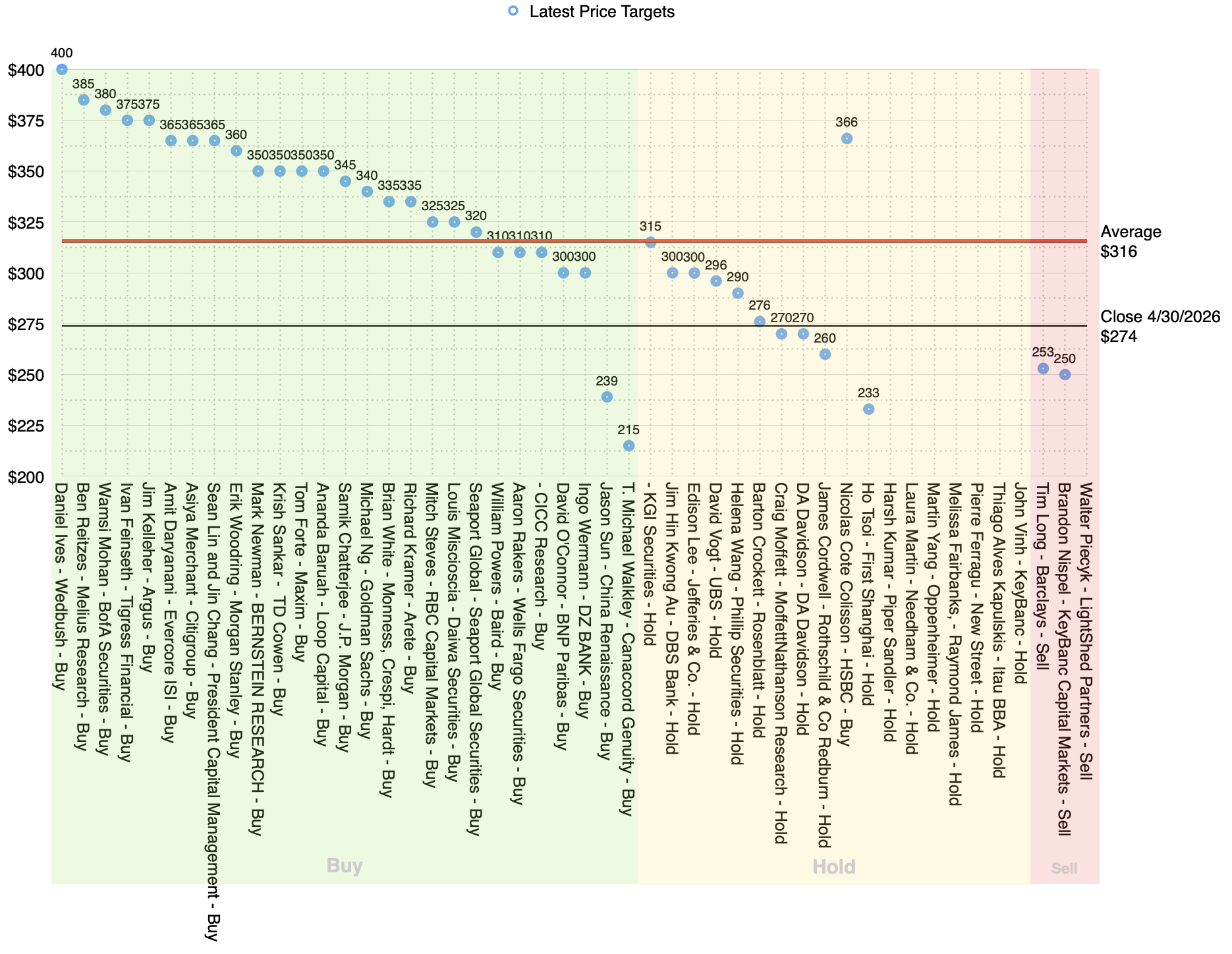
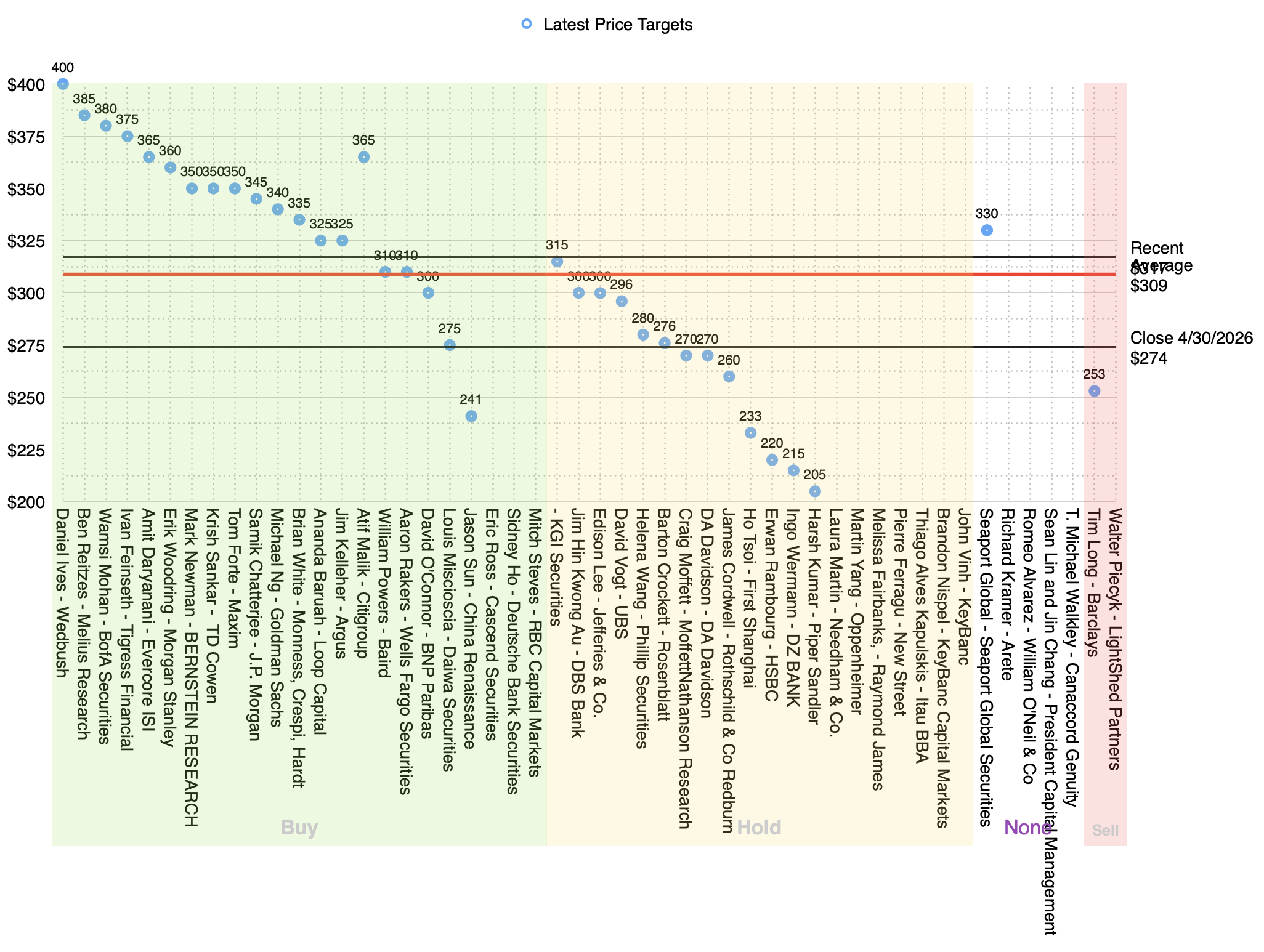
    NB: The new price target is shown in the updated analyst target graph. The average target has now risen to $309 while the shares are trading around $317 and set a new all-time intra-day high above $323.

    Targets are increasing among the "Buy" rating analysts but the majority of analysts maintain a hold or sell or no rating on the company. There is a possibility that Apple may resume the position of highest market capitalization.

    The news of price increases caused a dramatic fall in the share price but a few weeks later the analysts are noting that the company might prosper regardless. This should not come as a surprise to readers of this web site.