Asymco

Asymmetric Intelligence

artificial intelligence

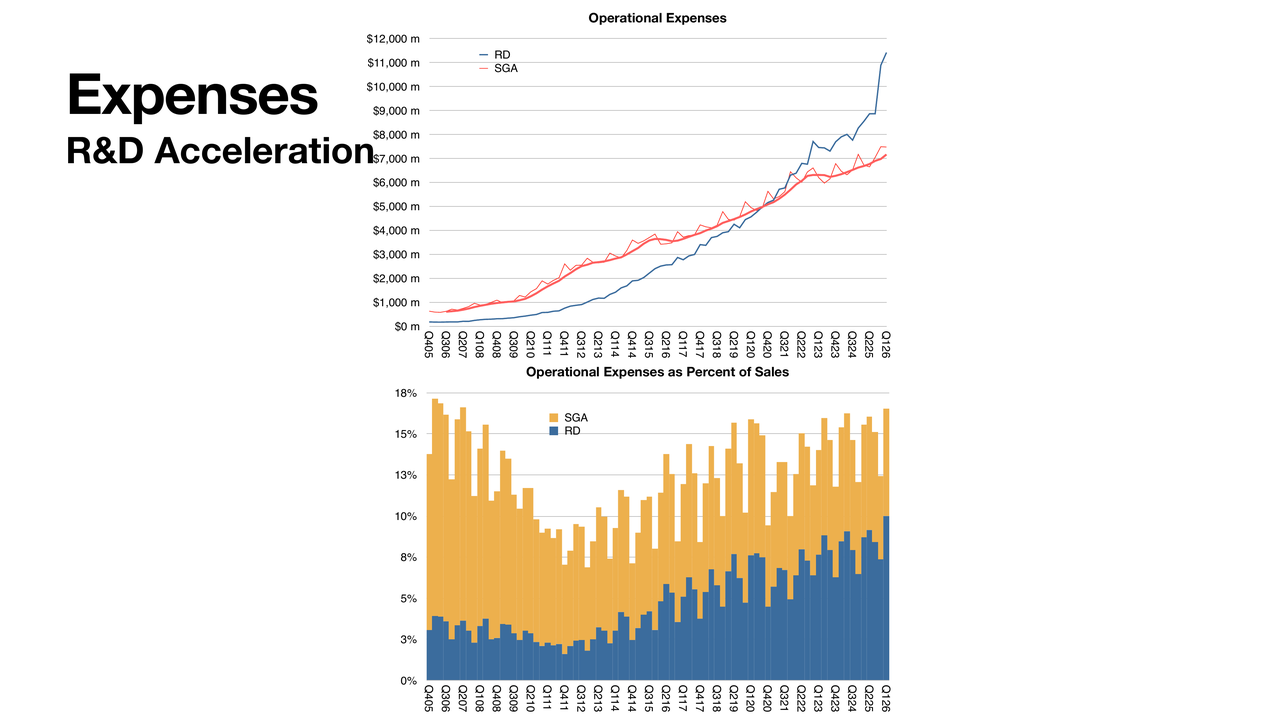
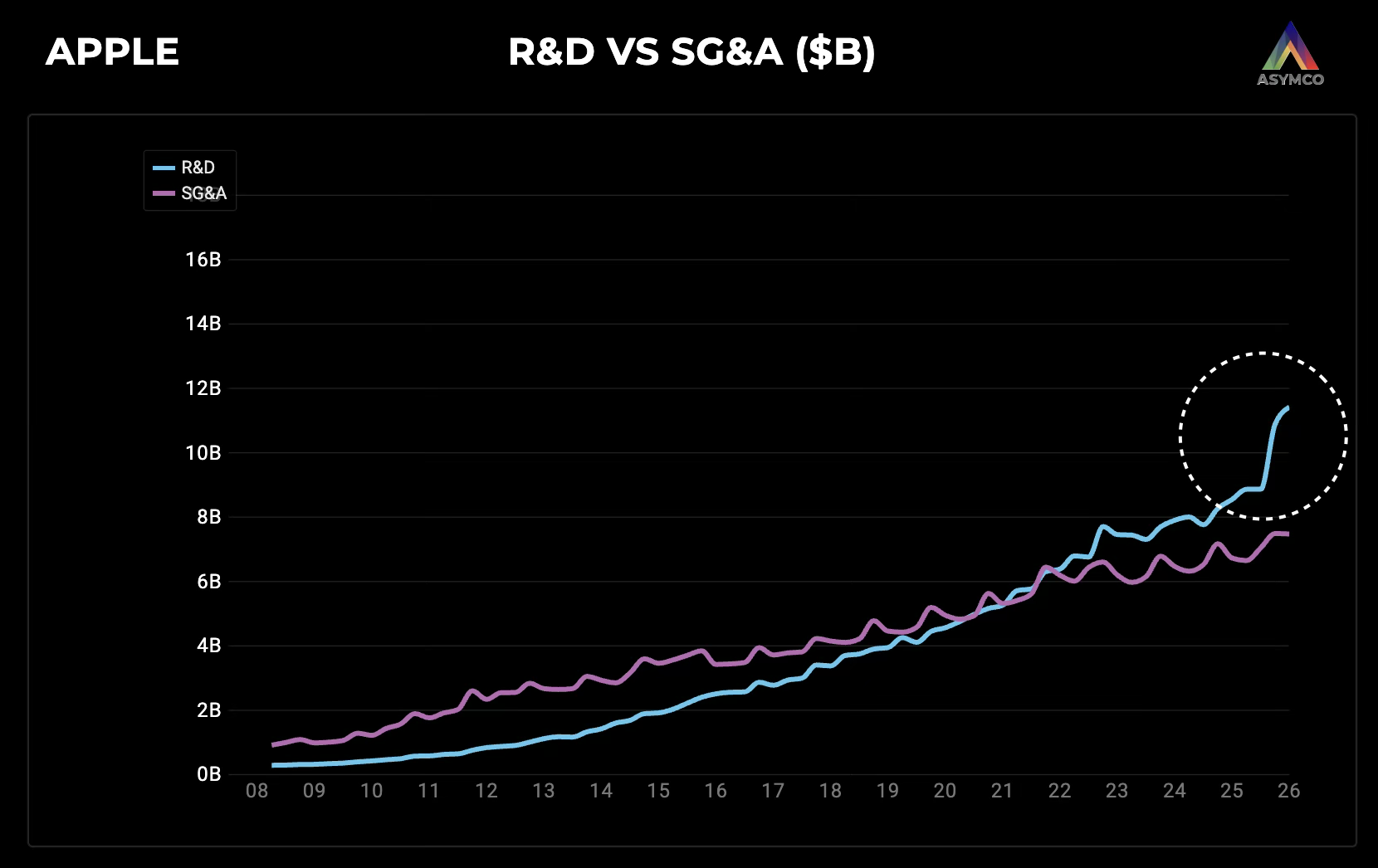
  1. Why is Apple's R&D run rate suddenly $40 billion/yr.?

    Research · 1 comment

    Office Hours question asked by Frederich H. on May 1, 2026.

    Q: Any thoughts on the breakdown of R&D, with that big jump?

    It's hard to tell. I do think they're buying — that does include some hardware. A lot of hardware. I think they're building quite a bit of capacity in order to implement their versions of AI. They're not for deployment, but they're for testing and experimenting. They're hiring people as well, obviously that's included. But I do think it used to be they bought equipment for testing — I don't know, radio frequencies, and testing the iPhones, and semiconductors, and testing a lot of things like that. But I do think probably there's a lot more spending now on the stuff that feeds AI. It's not on the level that a hyperscaler's doing, because they're building it for scale, and Apple's maybe building it for testing.

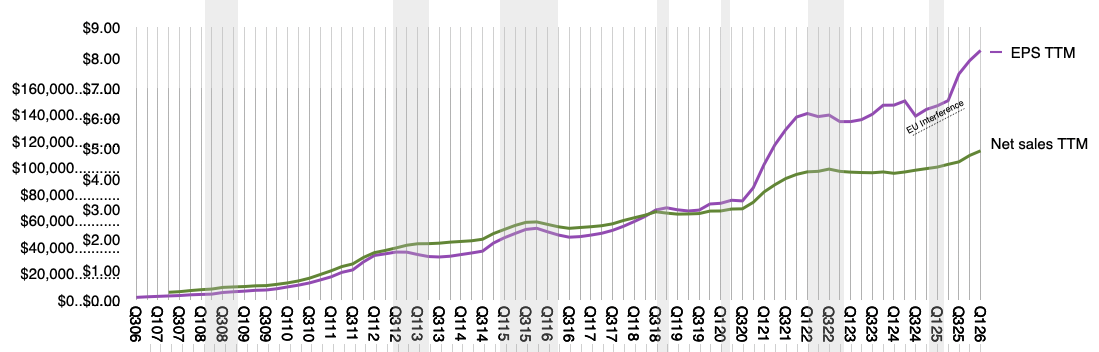
    We're talking about here, look, $11 billion in R&D, that's in one quarter. So that goes out to about $40 billion a year.

    Mostly, I think this is people, but there is some equipment involved. It's just maybe different ways of capitalizing it, because capital equipment is a complex story.

    It seems like a big jump, but it's only $2 billion more compared to the prior period. It's recurring though. And the reason that this stays steady and keeps growing is because people are on the payroll. And so if there's more and more people, that's paid every period — the reason, by the way, you see SG&A being seasonal is because there's temporary people in the stores. That involves people who are hired for the holidays in the Apple stores. So that's where you see some less than steady. But engineering people are more steady. But if there's a spike, there might be something going on where there was some equipment involved.

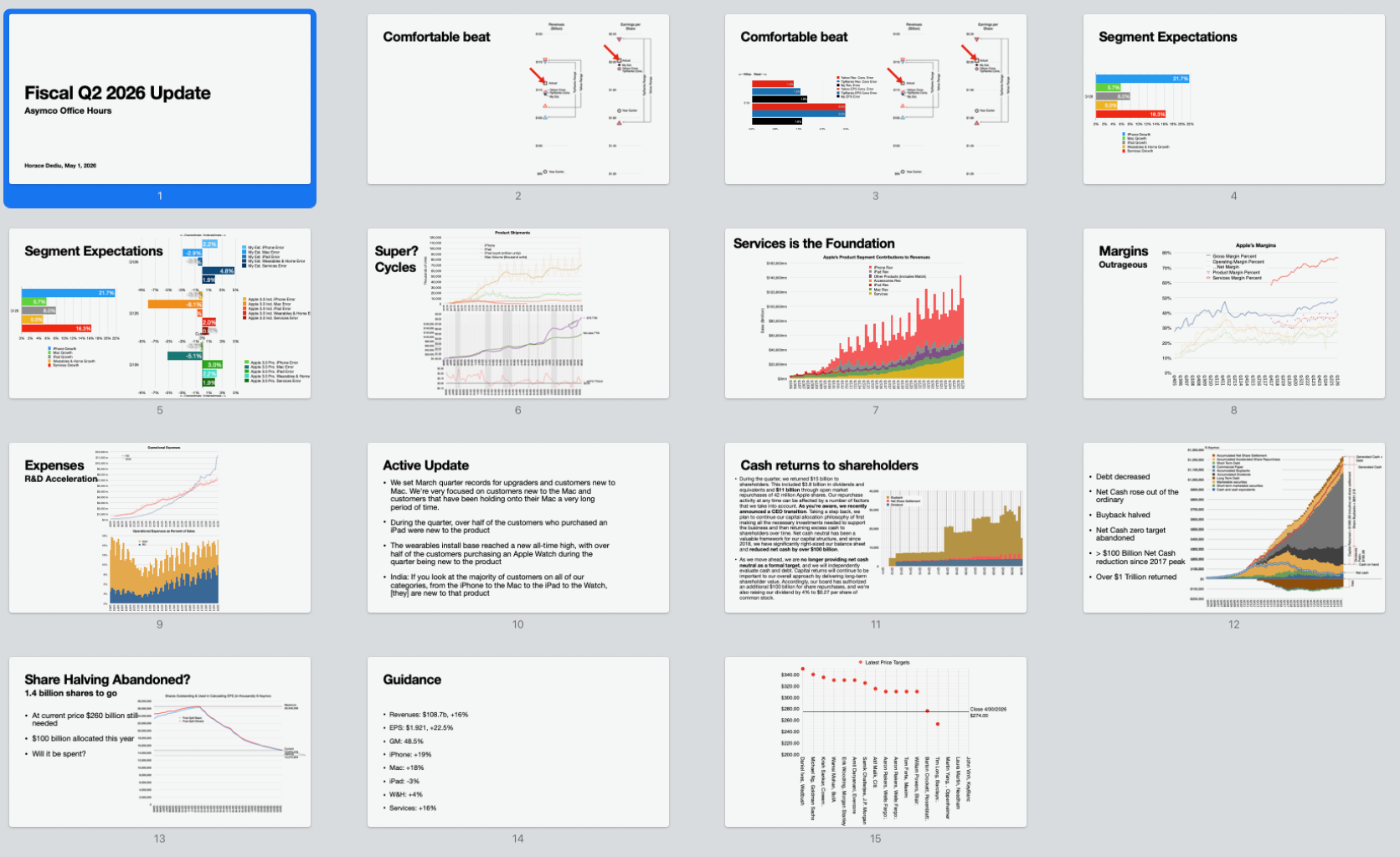
    See also R&D Acceleration section of Apple 2026 FQ2 Presentation.

    —
    Editor's Note: This is a lightly-edited revision of a question asked by participants in Asymco's May 2026 Office Hours live Q&A sessions, open to Asymco One subscribers.

  2. Why won't Apple become a cloud company?

    Research · 2 comments

    An Office Hours question asked by Fred S., May 1, 2026

    Q: Ever since Johny Srouji started talking about Apple Silicon and the power consumption for the performance and the unified memory, and now we've seen the Mac mini surge, I just wonder about high-end computing. The whole area of where that Mac architecture may go beyond its success as an individual consumer computing product. From all the high-end workloads that might be coming their way.

    The story of Apple is one of personal computing. It's not a story of servers, it's not a story of clouds, it's not a story of centralized computing. They've tried once or twice to make a server product, and they abandoned it. They've even abandoned the high-end Pro product, and created the almost-as-fast Studio product.

    Now, that does not mean they're shying away from high-power computing. They're just saying, we're going to put that high-power computing in a desktop, or in the laptop, or even in the phone. Everyone who's grown up throughout the personal computer era can remember Moore's Law, and how exponential growth has driven computation to levels that seemed impossible just a few years earlier. We've hit some slowdowns, but fundamentally, the potential exists.

    And by the way, it's not even a classic computational CPU problem. We're dealing with AI. We're mostly dealing with high bandwidth, large data, and we're dealing with simple calculations on it in parallel, which means the architecture is much more around large matrix computations. This is why Nvidia came from graphics. Graphics was the same problem — a graphics accelerator is a matrix problem. And so is machine learning. So different variations of these have come in as a sort of a parallel to the CPU, the general computation problem.

    The idea Apple has is that they're going to catch up with whatever is done on the server, they're going to do it on the device. You can call it Edge, you can call it personal — the old term was personal computing.

    I may be naive, but I think we'll get very powerful desktop computers that can do what is essentially AI, but for the individual. The other aspect here is that Apple is a consumer company, not a B2B company — it's a B2C. They want to bring that power to as many people as possible. And they're certainly delivering hundreds of millions of computers a year. Nvidia's making tens of millions of computers a year. Apple is capable of doing orders of magnitude more.

    So I think they're going to affect the disruption in AI. It's not going to be that there's no profit in AI, it'll be that it'll be done with Edge more, especially as it doesn't have to be a world model — it can be a personal model. If you want to look up something globally, you can use the cloud, but if you want to deal with tasks in your world, you're going to work with Apple computers.

    It may take years to get there. But in the meantime, I don't think a centralized service — these OpenAI, or Anthropic, or Microsoft, who are trying to make us a singular superintelligence — is necessary for everyone. It'll be a good reference, but it's not how you want to handle your personal information. So I think that's what the future is, and I think Apple's very much planning for it.

    It sounds cliche, but when Apple started, it was IBM that dominated computing. And IBM was about centralized computing, and their thesis was everything we now call "the cloud" — but it was all in one big computer that served the entire organization, whether that organization is a government or a big company. And then we went to mini computers, then we went to desktop computers, then we went to portable computers.

    Then, fast forward 25 years and we had Google. Well, now central computing is the internet. In the internet, everything needs to be indexed to be able to be found. So they created an index in the cloud. And then a lot of companies moved that computing they used to have locally into the cloud, as a shared resource from Amazon, AWS, and others, and that became cloud compute. Even now, those are the drivers for growth for Microsoft and Amazon and Google.

    The AI part of that is tiny — there's revenue from AI, but there's a lot of revenue from cloud. That still is valuable. But that's not a job for consumers. You do some things in the cloud — you store things, you search, you communicate in messages and so on. But most of the data that matters to you will get also indexed locally, so you can pull up your photos, pull up these things, and it'll be a blend of the two.

    So that's where Apple lives, and I don't see anything fundamentally changing about this, because computation tends to commoditize. Software tends to be replicated. Algorithms tend to be replicated. In fact, even the AIs we have today were all because people publish papers, and one company invents it, another implements it, as was the case with the transformer. As far as I understand, it was Google who actually wrote the paper on it.


    Editor's Note: This was one of the questions asked by the participants in Asymco's May 2026 Office Hours live Q&A sessions, open to Asymco One subscribers.

  3. Asymco Bulletin 011 - May 3, 2026

    Bulletin

    Asymco Bulletin is a digest of all the work we have published for the week ending May 3, 2026.

    Editor's Note: Starting next week, we will be sending Asymco Bulletin to Asymco One subscribers only. You will still receive Updates when new posts are published per your notification settings.

    Office Hours

    Asymco Office Hours — Apple Fiscal Second Quarter 2026 Review: The Presentation

    Apple FQ2 2026 Earnings Review

    In Asymco One's May 1, 2026 Office Hours session, review of Apple's Q2 2026 earnings, segment growth: iPhone at 22%, Services at 16%, iPad at 8%, Mac at 5.7%, and wearables at 5%. Steady, foundational growth of Services, Gross margins reached nearly 50%, R&D spending surged, a shift in Apple's capital return strategy showing perhaps the hand of John Ternus. Guidance suggests 16% revenue growth, 22% EPS growth. Analyst sentiment turned positive post-earnings, with most price targets rising above $310. Apple's evolving identity as an engineering-centric company was the focus of many questions. →

    Research

    Expectations for the Quarter

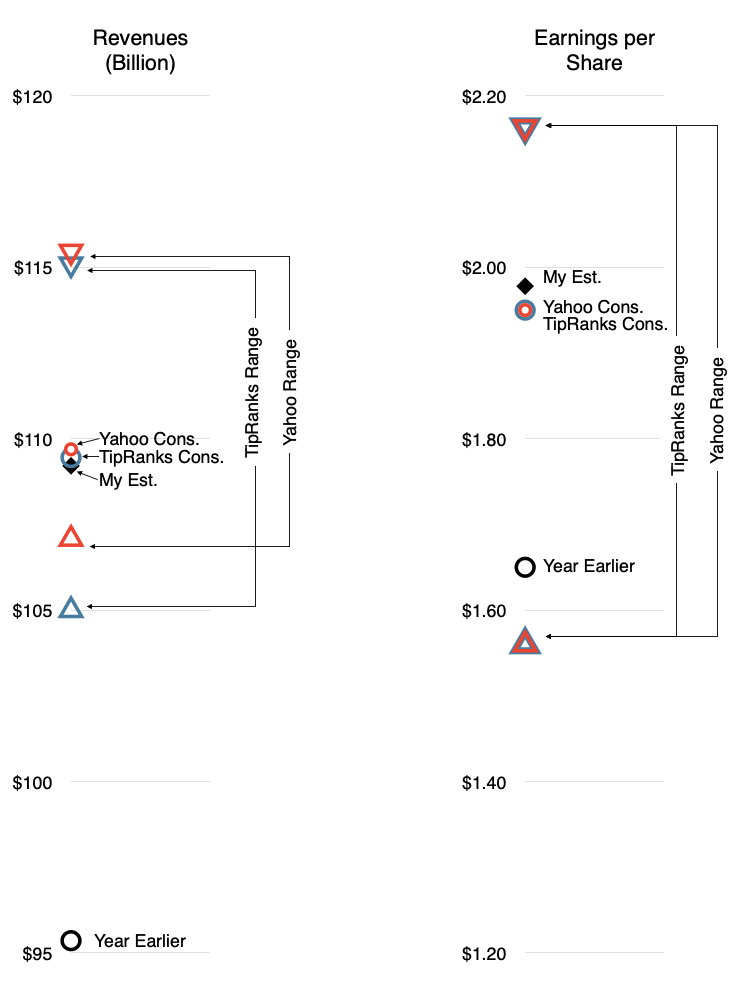
    Revenue and EPS consensus, year-ago results and my expectations Yahoo Finance Yahoo Finance’s revenue estimate for Apple in Q2 stems from 31 analysts. As of April 25, the average estimate is $109.69 billion, with a low of $107.08 billion and a high of $115.37 billion. For the earnings per share estimate, 32 analysts put it at an average of $1.95. The low is $1.56 and the high is $2.16. TipRanks TipRanks also does its own analyst polling on Apple’s quarter. In its forecast as of April 19, its consensus is for a revenue of $109.45 billion, with a high of →

    UBS Raises Price Target from $280 to $287 but Maintains Neutral Rating

    Nota Bene

    The Economist Interview: Hints at the future direction of the company → As is often the case, a 45 minute discussion turns into two sentences. The article sadly does not provide hints at the future direction of the company. But we can…

    TD Cowen: 15% revenue growth, 10% growth guidance → Apple is projected to gain market share in both smartphones and PCs, driven by strong iPhone 17 demand and the new MacBook Neo, with anticipated revenue growth of over 15% in Q3 and positive sentiment ahead of earnings.

    UBS Raises Price Target from $280 to $287 but Maintains Neutral Rating → Apple's fiscal Q2 shows promise with iPhone strength and solid Mac demand, especially for the budget-friendly Neo and AI-capable Mac mini, potentially boosting earnings beyond expectations.

    Morgan Stanley forecasts fiscal second-quarter EPS of $1.74 → Despite memory pricing pressures, Apple's strong iPhone sales, potential AI and foldable iPhone announcements, solid free cash flow, and favorable market conditions position it for better-than-expected earnings and a possible stock rise to $300 by September.

    Is Apple borrowing Samsung’s Market Expansion Strategy? → Bernstein SocGen maintains optimism on Apple's strategic pricing and ecosystem strength, forecasting EPS growth and potential market share gains, while Samsung faces smartphone profit challenges but thrives in memory.

    Separately, it’s been reported that Samsung might see its first operation loss from its phone division, resulting in Apple capturing 100% (or more) of global smartphone profits. Simultaneously, Samsung is seeing huge profit gains from memory, even overtaking Nvidia’s profitability. This is remarkable…

    Apple share of the smartphone SoC market grew from 15% to 19% in Q1 → In Q1 2026, global smartphone SoC shipments fell 8%, but Apple thrived in the premium market by leveraging its efficient supply chain and passing costs to consumers, boosting its market share from 15% to 19%.

    Google to sell TPU chips as Gemini shows returns → Why pour cash into Nvidia when you can craft your own cutting-edge chips like Google, and then turn that innovation into a lucrative side hustle by selling them to tech giants like Meta and Anthropic?

    The Vision Products Group Expanding → Gurman's 2025 dissolution claim clashes with 2026's active Vision Products Group hiring spree. The Vision Products Group posted 14 new senior roles last week.


    Asymco One gives you full access to our research, analysis, and commentary. Subscribe with code BULLETIN for a discount.

    Feedback: Have questions or comments? Reach out to us at contact@asymco.com. We’d love to hear from you.

  4. Apple FQ2 2026 Earnings Review

    Office Hours

    Join us live for a comprehensive review of Apple's FQ2 2026 Earnings Report by Horace Dediu during our May 2026 Asymco Office Hours.

    What we’ll cover:

    📅 Friday, May 1, 2026 · 12:00pm ET / 9:00am PT

    Asymco One subscribers can participate live:

    Not an Asymco One subscriber: Subscribe today & attend live.
    Still not sure? Watch asymco.com/live for a livecast link.


    The series so far:

    • Mar 4, 2026 with Ben Bajarin: implications of Apple’s March 4 rollout.
    • Apr 8, 2026: with Gene Munster: China concentration, AI narrative shift, hardware → services → Personal AI.
    • May 1, 2026: fiscal Q2 results & succession.

    Office Hours is a benefit of Asymco One. Recordings and transcripts are archived for Asymco One subscribers only.

  5. Google to sell TPU chips as Gemini shows returns

    Nota Bene · 2 comments

    Why give all your cash to Nvidia? Why not make your own chips? Then why not sell them?

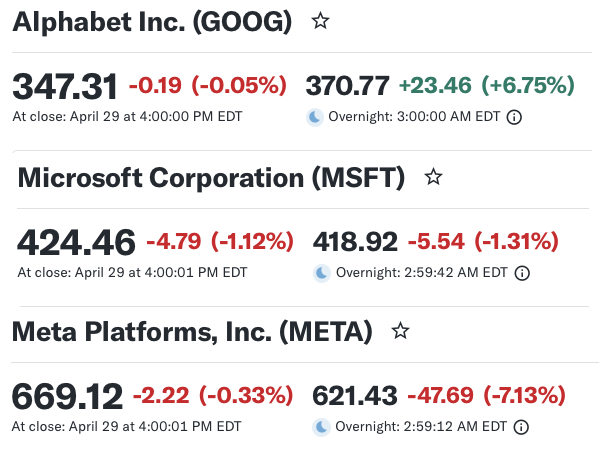
    Google said that it plans to sell its custom Tensor Processing Units (TPUs) to select customers who will install the chips in their own data centers.

    The move is a change from Google’s prior strategy, which saw it rent out TPU capacity to customers from its own data centers — and is yet another strike at AI chip king Nvidia.

    The announcement, during the company’s Q1 earnings call, comes a week after Alphabet announced two new TPUs: its TPU 8t for AI training and TPU 8i for inferencing.

    Alphabet didn’t disclose potential customers, but it signed a multiple-gigawatt agreement for next-generation TPUs with Anthropic earlier this month, with chips expected to begin coming online in 2027.

    And according to The Information, Alphabet has also entered into a multibillion-dollar chip deal with Meta (META).

    Source: Yahoo Finance

    NB: Alphabet Q1 sales grew 22% to $110 billion, with Cloud up 63% to $20 billion. Operating margins grew by 220 basis points, with services and cloud operating margins both increasing y/y.

    The search business continues to benefit from AI. AI overviews and AI mode are sustaining as search sales grew 19%.

  6. Is Apple borrowing Samsung's Market Expansion Strategy?

    Nota Bene · 1 comment

    On March 18, 2026, Bernstein SocGen Group reaffirmed its “Outperform” rating and $340 price target for Apple Inc.

    Comparing it to Samsung’s 2009–2013 strategy, which saw Samsung increase its global smartphone share from 4% to 32% in Q3 2013, Bernstein emphasized Apple Inc.’s recent product launches as a strategy to widen portfolio price bands, driving share gains at the low end while raising prices at the high end to maintain margins. Although Samsung eventually lost market share to Chinese manufacturers, the firm said the stickiness of Apple’s iOS ecosystem will help it sustain long-term market share.

    Bernstein projected a 12% increase in fiscal 2027 EPS from share gains, split equally between hardware and services, assuming Apple Inc. captures 10% of Chinese manufacturers’ smartphone market share amid their supply issues. Some noteworthy product developments include the introduction of the $549 AirPods Max 2, the App Store cost reduction in China from 30% to 25%, and plans for a foldable iPhone.

    Source: Yahoo Finance

    NB: Separately, it's been reported that Samsung might see its first operation loss from its phone division, resulting in Apple capturing 100% (or more) of global smartphone profits. Simultaneously, Samsung is seeing huge profit gains from memory, even overtaking Nvidia's profitability. This is remarkable…

  7. Morgan Stanley forecasts fiscal second-quarter EPS of $1.74

    Nota Bene · 1 comment

    Expectations are low due to memory pricing, apparently.

    Apple has multiple catalysts for strong revenue growth, so investors shouldn’t be spooked by any margin pressure from rising memory…

    “Memory inflation will pressure margins, but this is well-known, and iPhone revenue upside sets up for a better than feared June quarter guide,” Woodring wrote.

    He added that any announcements regarding an AI powered Siri at the company’s Worldwide Developers Conference in June, and the expected release of a foldable iPhone, would be positive tailwinds that can help push the stock higher after earnings.

    Woodring, who rates the stock as Overweight with a $315 price target, also thinks Apple stands out against large tech peers as the company continues to report strong free cash flow while competitors continue to spend massive amounts of capex on building out AI infrastructure.

    We expect gross margin downside to be more than offset by revenue upside in the June quarter guide, making for a better than feared earnings and a clearing event into WWDC this June, and the iPhone launch in September.

    While our gross margin forecast remains below Consensus given rising memory cost pressure, continued strength in iPhone, Mac, and Services revenue should more than offset this pressure and result in a June quarter implied EPS guide in-line with Street estimates (~$1.74) – a better-than-feared outcome against relatively low expectations.

    At 28x next year GAAP EPS – roughly the midpoint of Apple's historical 24-34x valuation range – valuation is neither cheap nor taxing, but with our ~$10 of FY27 EPS 5% above Consensus, we see a path to $300 for Apple shares by this September, driven by modest multiple expansion and more robust positive EPS revisions.

    Source: MacDailyNews

    NB: Multiple catalysts, revenue upside, positive tailwinds, sentiment tailwind, favorable seasonal window, modest multiple expansion, thematically favorable backdrop, robust positive EPS revisions.

  8. The Economist Interview: Hints at the future direction of the company

    Nota Bene · 2 comments

    "Apple’s new boss needs to restore its magic for the AI era"

    If Mr Ternus does “nothing but keep the ship on course”, Apple could almost double its number of devices from 2.5bn globally to 4.5bn over the next 15 years, reckons Horace Dediu, a veteran Apple analyst. That would be a huge platform on which to run—and monetise—AI apps. As users subscribe to ChatGPT or other AI apps, “Apple will just take a cut,” Mr Dediu adds. By one estimate, Apple is close to generating $1bn in ai revenues so far this year via the App Store, despite having no flagship ai product.

    Azeem Azhar, author of Exponential View, another newsletter, adds that to overcome bottlenecks in cloud-based AI, routine queries may be shifted to “edge” devices, creating a big opportunity for Apple. In Mr Azhar’s telling, the future will involve “a combination of the highly portable phone with the persistent desktop or server. Both play to Apple’s strengths.”

    There is, however, a more radical path available to Mr Ternus, which is to develop a new “form factor” beyond the iPhone that is more suitable for the interactive nature of ai than doomscrolling on a touchscreen. Competitors are already trying to turn the smartphone into yesterday’s technology. Meta, the social-media giant run by Mark Zuckerberg, is selling millions of AI-powered smartglasses. Sir Jony Ive, the design guru who helped Jobs create the iPhone, has teamed up with OpenAI to develop a brand new gadget of unknown form. To keep up, Mr Ternus may have to reinvigorate Apple’s product line-up with a determination that eluded Mr Cook.

    Apple’s Vision Pro virtual-reality headset, though an over-priced flop, may help the new boss develop Apple smartglasses. The company is also reportedly working on a wearable AI pin. Mr Dediu says that one of Mr Ternus’s main strengths may be his devoted following among Apple’s engineers, who have been pivotal to the firm’s success. “Ternus will come out as an engineer’s engineer,” he says. “He is hard-core. That might energise the teams.”

    Source: The Economist

    NB: As is often the case, a 45 minute discussion turns into two sentences. The article sadly does not provide hints at the future direction of the company. But we can…

  9. The iPhone is ‘not getting disrupted’ by AI: Perplexity CEO

    Nota Bene

    AI makes the strong stronger. That is the opposite of disruption.

    The iPhone appears stronger than ever despite Apple’s AI struggles, and that’s not a coincidence, says Perplexity CEO Aravind Srinivas.

    Speaking on the latest episode of the This Week in AI podcast, Srinivas indicated that the iPhone only stands to benefit from continual AI improvement.

    "Here’s my opinion. I haven’t said this before. The phone, the iPhone is actually not getting disrupted by AI at all. In fact, the more AI works better, the iPhone essentially becomes your digital passport."

    Perplexity’s CEO touts Apple’s ecosystem and silicon advantages as some of the reasons why the iPhone is positioned for continued success. It’s also, in his view, why Apple can afford to move slow with its long-delayed Siri overhaul.

    "My sense is that even though a lot of people have opinions on how bad Siri is or good Siri is, [Apple has] the ability to take time and do things they want to do, because they have advantages as a brand that people truly trust. The ecosystem lock-in is underrated. Auxiliary hardware devices, the chip advantage, all of this is really underrated right now.
    Srinivas also mentions how the iPhone is central to people’s lives for many reasons that have nothing to do with AI."

    He says, “It has your wallet, it has all your cards, it has your passes, it has your health records, you connect with other human beings through it, you do FaceTimes, you do calls, you have photos of precious moments in your life.” All of these are extremely personal, and as a result, users won’t easily switch away from iPhone.

    Source: 9to5Mac

    NB: Knowing the theory of disruption provides a three year lead in decision making. The observation...

  10. The Composition of Active Devices

    Research · 8 comments

    Measuring the future

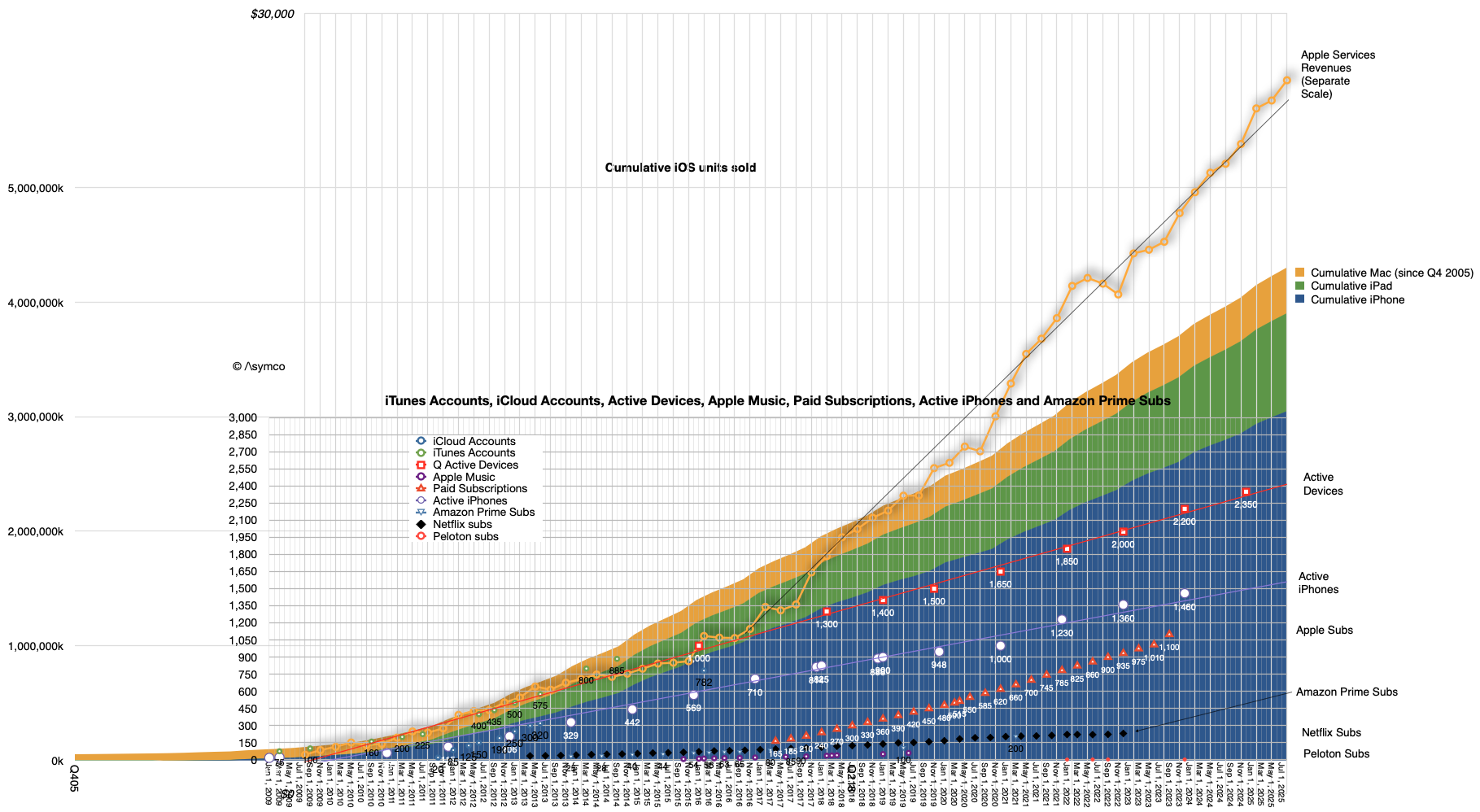
    In January this year Apple reported that there were 2.5 billion active Apple devices in use. This figure has been getting updated for years and I've been reporting its trajectory and other measures that are correlated to it. For instance the number of Apple subscriptions, Apple Services revenues and other historical indicators such as iCloud accounts and Apple Music.

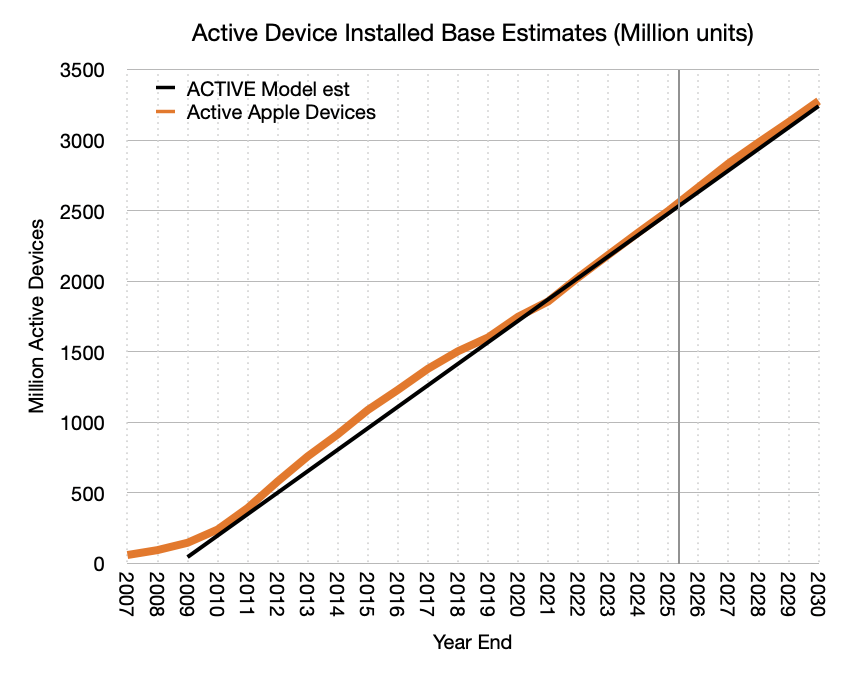
    Simplifying, I published the "ACTIVE" model which makes some basic projections of this total device count and it's shown below"

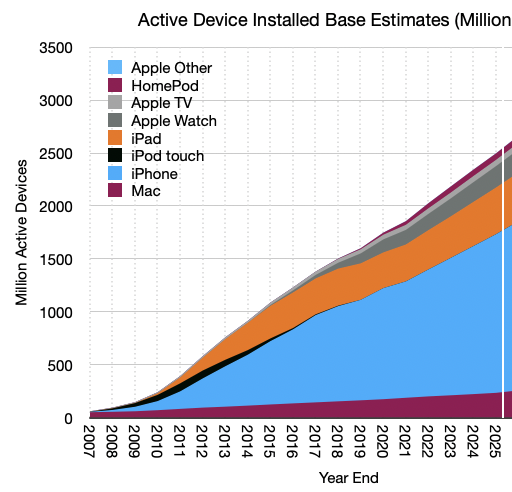
    One element of the analysis that has eluded me was the more precise composition of this total "devices". In other words, which devices and what is their mix. We have seen numbers for iPhones but not for other types of devices. I should note that this is not easily derived because we have neither the units sold (only revenues) and we don't know how long they stay in use. The measure of active population implies that the products are bought, used and eventually retired.

    The only clue we have, beside quarterly revenues--and even there wearables and home are not separated by product--is that management occasionally mentions that "more than half" of buyers of a specific product are "new to the product". It's not much to go on.

    But there are other data sets we can tap. StatCounter provides a share of platforms in use by aggregating browser identifying data for a moderately large set of web sites. That may help with share of base but not with how much the total base is. Various other analysts do try to summarize some of the installed base for particular dates.

    Combining all the available data and some interpolation, I set out to do is to provide a yearly count of the population of Apple devices for each year since 2007. Then to try to forecast this population to 2030. The result is shown below:

    The following is a summary for the components for the end of 2025 in millions:

    Year-endMaciPhoneiPadWatchApple TVHomePodOther
    2025233150044220358.561.750.5

    This history looks like this:

    What about the future? Let's dig in.


    This is a future five years away. Is this growth rate and consistency in mix a reasonable assumption?

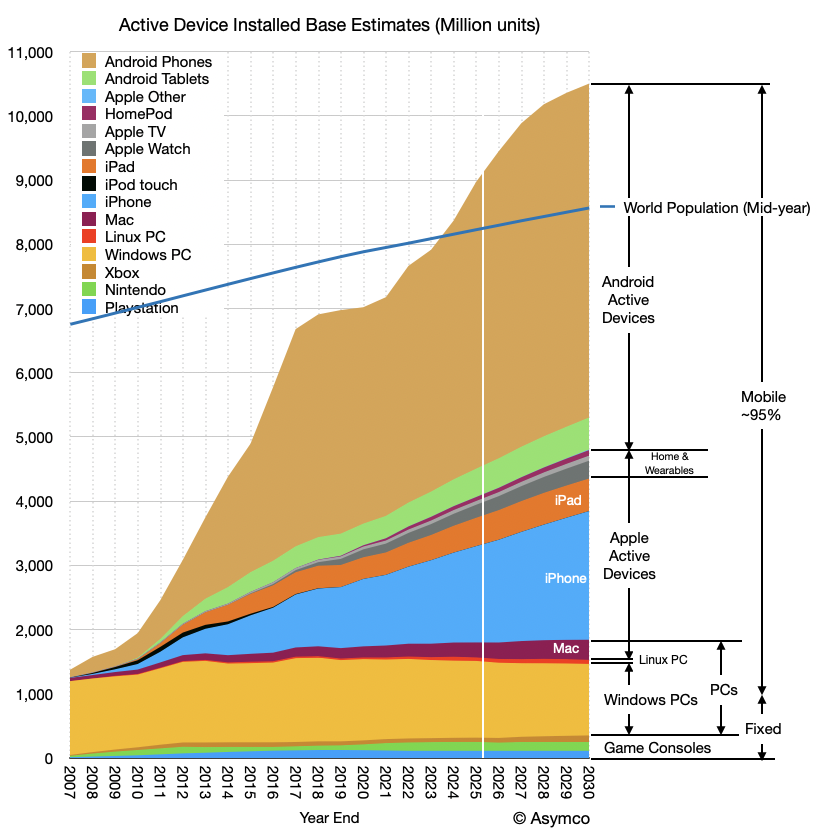
    To answer, we should zoom out and look at not just Apple's device base. The following graph shows also Android phones and tablets, Windows, Linux (PC) and Game Consoles.[1] It contrasts mobile and "non-mobile" computing and shows the total global population (blue line).

    I have several observations:

    • The total device population now exceeds the total human population. The total number of phone lines was already higher for some time[2] but what are shown here are "computers" insofar as they have CPUs and operating systems that can run third-party apps.
    • Given the device count exceeds human count, how much higher can this total go? The forecast shows a slowing of growth within the next five years but this is not a certainty. The attach rate of devices/person could well exceed 1.2 to 1.3 and go to levels seen in wealthy countries (above 2.) If that is the case then the device total may exceed 16 billion at saturation. This has implications for how far current strategies and business models can run.
    • The composition of device types is fairly constant and form factor substitution is rare. New categories beyond phones and current wearables are hard to anticipate but even if they emerge, the evidence suggests they are additive. Evidently the phone did not so much displace the PC but build on top of it. The potential for wearables and home devices to explode is there but it's hard to image these stealing "share of pocket" any more than phones stole "share of desk or share of backpack". If they do explode, they will add to the total via higher attach rates. 3x human population (24 billion) is possible with new wearables and home[3].
    • AI holds many promises but how AI is accessed is not necessarily requiring of or benefiting from new device types. The smartphone is still the best AI device imaginable[4]. Ambient or passive computing can be provided by existing wearables but, as the graph shows, these are augmentative to phones. If AI introduces a completely new form factor, the impact will take decades to diffuse. As the graph shows, the mobile era is now approaching 20 years with the next five years foreseeable with some confidence. The next 15 years will be discussed in a future post.
    • Android typically captures non-consumers who eventually churn into Apple devices. This means that as long as non-consumption exists, Android grows and as long as Android exists Apple grows. If and when Android growth stops then the dynamics will change and Apple might change strategy to accelerate churn.[5]
    • Google and Apple will be the primary distributors for all software and services into the foreseeable future. Try as they might, challengers face over 9 billion in installed base. Note well how entrenched Windows has been on the desktop even as (free) Linux and (better) macOS alternatives have harvested usage. This rigidity has held over the 1.5 billion addressable market for 30 years now. For additional evidence consider the dynamics, or lack thereof, of the game console business.
    1. It excludes servers and early phone platforms such as Symbian, Blackberry and Linux phones.
    2. According to ITU Facts and Figures 2024, there were 112 mobile-cellular subscriptions per 100 inhabitants globally in 2024
    3. Households are 1/3 human population and vehicles are only about 1/7 so Home and Automotive don't move the needle much.
    4. AI is, if anything, putting the "smart" back in "smartphone".
    5. This might be what is happening with the Mac Neo, decades after the PC market saturated. Perhaps pieces have finally fallen into place but apart from Chromebooks, it's been very difficult to challenge the Windows PC head-on. (Though the iPad was possibly designed to displace some of the PC usage, it hit mainly with non-consuming very young or very old and PC use was unaffected.)

    —

    Join me for a live discussion of this research and more at Asymco Office Hours Live Q&A on Friday, May 1, 2026.

  11. Apple FQ2 2026 Earnings Review

    Office Hours · 4 comments

    Join us live for a comprehensive review of Apple's FQ2 2026 Earnings Report by Horace Dediu during our May 2026 Asymco Office Hours.

    What we’ll cover:

    📅 Friday, May 1, 2026 · 12:00pm ET / 9:00am PT

    Asymco One subscribers can participate live:

    Have a question? Drop it in the comments below — we’ll prioritize subscriber questions submitted in advance, or email events@asymco.com.

    Not an Asymco One subscriber: Subscribe today & attend live.

    Still not sure? Watch a livecast on asymco.com/live .


    The series so far:

    • Mar 4, 2026 with Ben Bajarin: implications of Apple’s March 4 rollout.
    • Apr 8, 2026: with Gene Munster: China concentration, AI narrative shift, hardware → services → Personal AI.
    • May 1, 2026: fiscal Q2 results & succession.

    Office Hours is a benefit of Asymco One. Recordings and transcripts are archived for Asymco One subscribers only.